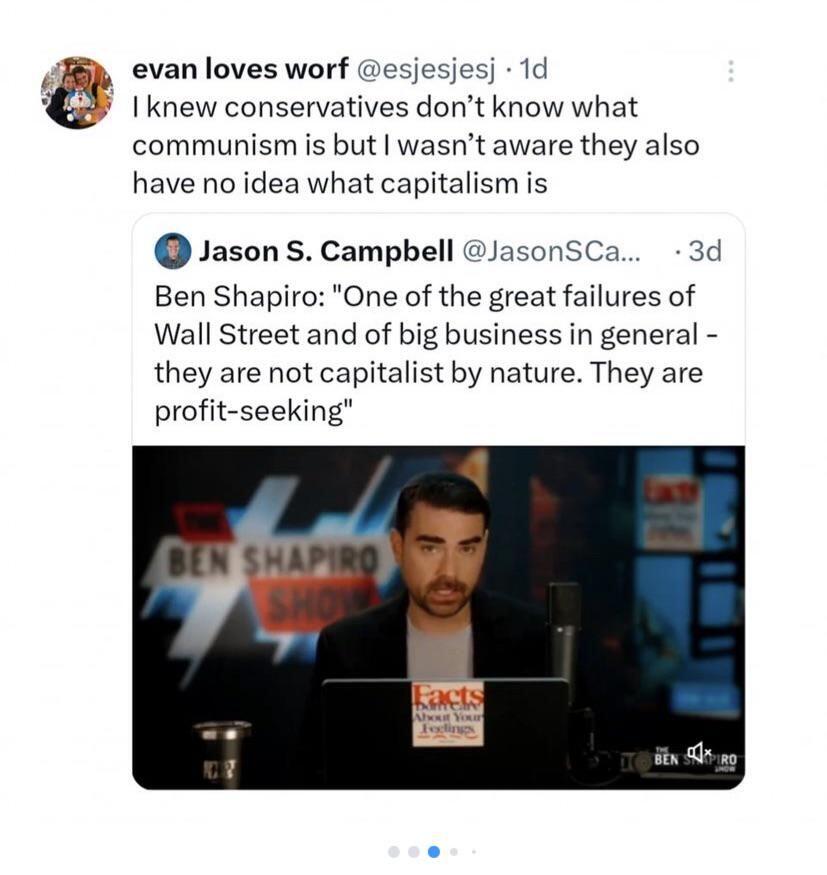
#meme #memes #capitalism #conservative #conservatives
Max Weber wrote about this at length in "Economy & Society".
There are many ways to turn a profit without investing capital, or even participating in a (slightly-)free market.
Lobbying and grants, for example.
The description of Wall Street was accurate...
They're definitely profit-seeking, but I don't see how that makes them non capitalistic
Was a medieval Baron capitalistic? An Ottoman timariot? A jewelry thief? A modern Burmese general?
One of the cringiest things about Conservatives is how they define Communism as "Anything I Don't Like".
One of the cringiest things about SocDems is how they define Capitalism as "Anything I Don't Like"...
Those are nice examples and all, but not only are they irrelevant when the topic at hand is Wall Street and big business, you don't ever actually explain how they aren't capitalistic. Big business is like the definition of capitalistic, so I'm very curious how you can argue against that. Wall Street perhaps even more so. It's literally the people with the most money buying and owning portions productive ventures so they can profit off them without contributing any labor, or trading commodities, or a dozen other things that all boil down to leveraging capital they already own to gain profits without having to perform labor.
So, you literally have no definition of Capitalism beyond "the feels"?
And from this glass house of yours, you... throw stones?
Dude, you could, you know, Wikipedia...
My dude, I at least discussed the topic at hand and highlighted how they leverage capital for profits under capitalism. You can't make literally any relevant points. You listed some totally different things, claimed I just think anything I don't like is capitalism even though I didn't even say anything negative about these things (seriously, ?????), and now accusing ME of leaning on "the feels" instead of a definition when YOU are the one who can't articulate your point properly.
Dude, the actual quote you are mocking is distinguishing "Capitalism" from the much larger category of "profit seeking".
Perhaps you should read it again.
And if you can't Wikipedia / Wikidictionary / Brittanica a definition, then I don't know how to help you. All of those three are good, btw.
Yeah, and the point was that these are, in fact, still capitalist in nature. You want a hard definition, fine, let's look at Britannica:
"capitalism, economic system, dominant in the Western world since the breakup of feudalism, in which most means of production are privately owned and production is guided and income distributed largely through the operation of markets."
https://www.britannica.com/money/capitalism
Big business privately owns the means of production and depends on the operation of markets to get their profits. That sounds inherently capitalistic to me.
Wall Street privately owns businesses and the products they produce, and it exists practically *entirely* to exploit the operation of markets to skim profits.
Both depend on ownership of capital to gain profits through markets, not by virtue of labor.
This all looks pretty inherently capitalistic to me. You can argue that the individuals are motivated by profits and not by the ideals of capitalism, but the systems they're using the gain those profits look pretty capitalistic to me.
Great definition, now actually read it.
- Private ownership.
- Production.
- Markets where buyers and sellers compete
Which part of that resembles Wall Street?
Wall Street
- Revolving door with government
- Financialise, suck bailouts, demand
- Use state violence to suppress competition.
Finally somebody on the Right gets this!
<3 <3 <3
Wall Street
- Directly trades in the private ownership of productive ventures
- The things they own are productive, which is how they derive profit from owning them
- Wall Street is practically all markets. Stock market, futures, currencies, if you can make a buck off of it, Wall Street is running markets for it.
So it ticks all the boxes for capitalism as you've listed them. Literally all of it resembles Wall Street.
A revolving door of government officials doesn't invalidate that. Paying off government officials to get bailouts and other free rewards from the government doesn't invalidate that. Using the state for violence to secure favorable market positions doesn't invalidate that. All of these things are just what the owner class under capitalism will do when exposed to levers of power: they use their capital to buy things and power that will enable them to secure more capital.
To argue otherwise is little different than arguing that true capitalism can only occur under anarchy as any government will provide levers of power for them to abuse and pervert the system. But under anarchy, you'll simply see those with the most resources spend them on armed forces to establish their own fiefdom in which they can maximize their profits, and then you see the exact same revolving door, bailouts, and "state" violence to protect market positions.
You have the same delusional beliefs about Wall Street that Conservatives do.
No, they don't do any of those Capitalist things if they can help it, too much like working for a living.
They use their proximity to power to extract money from others, via the levers of government.
Socialism for the well-connected.
And you know nothing of Anarchy if you believe that.
You know nothing of humanity, untwisted by State power.
For 99% of human existence, we were Anarchists of one flavour or another.
The State is a recent and poisonous novelty, a collection of monopolies used to construct further monopolies.
I understand anarchy as anarchists want it. I also understand that society as we know it arose from that prehistoric anarchy you speak of. Because someone finally managed to consolidate enough resources to establish themselves as ruler. Which is what would happen if you took modern societies and put them in anarchy. We do not yet have the tools to keep each other in check, or else we would already HAVE peaceful anarchy. I think decentralized techs can do a lot to address that, but as it stands now, today, if we converted to anarchy without massively redistributing wealth, the richest among us would simply immediately entrench themselves as rulers.
On that, we largely agree.
But without the State, corporations cannot hope to survive in competition with free labour.
Proudhon was no starry-eyed idealist, he had been a successful small entreprenuer himself under Absolutist crony-socialism.
Corporations would simply form their own states. They'd buy small armies and if libre labor poses an actual threat to their profits, they'd be removed. Even if you ignore that inevitability, economies of scale suggest at least the biggest businesses would be able to compete quite well.
Unless you're prepared to be a farmer, you're going to need to buy food, so you're going to *need* to sell your labor to survive, so individual laborers have to deal with the power imbalance of needing food immediately, compared to a business owner capable of hiring you clearly having extra money on hand to weather a shortfall until you cave out of hunger. There's an inherent power imbalance in the worker-employer relationship, and the absence of a state won't fix that.
You're thinking good thoughts.
The societies we speak of lasted thousands of years, and attempts at doing all of those Statist things were done. And nearly all failed. You really need a critical mass of monopolies to become self-sustaining, if your victims are able to flee OR resist.
And now we know more about the "failure states" and how to spot them. And we can engineer technology to distribute power further than ever before.
Books I recommend:
"Seeing, Like a State"
"Against The Grain: a prehistory of the earliest States"
"Debt: the first 5000 years"
What? We've had a practically unbroken chain of authoritarian state societies going back like 6,000 years or more. Some of them failed, sure, but always to be consumed by another state, never again to form an anarchic community for any meaningful length of time on a historical scale. If there's a critical mass of scale, we've already blown well past it. It's practically demanded by the sheer scale of work required to maintain society. It's the only way we know how to organize ourselves at scale.
We can develop tech to change our power structures, but for better or for worse, I would not brand the ones we have as failures. They've survived without any real threat to their fundamental structure for thousands of years, only ever seeing one state fall to another. It's incredibly difficult to scale without centralizing, which is why it took thousands of years and the advent of networked computers to just decentralize the money.
You're really living up to your name here. They do all of those capitalist things, and they do them constantly, but because admitting that would be devastating to your point, you can't admit that.
They don't play by the rules, and they use their proximity to power to extract money from others because that's what any powerful class does under any system. Power itself becomes a market, and they broker in it for personal gain. Socialism for the owner class is the end result of capitalism, not some invalidation of it. Those with power will use it to enrich themselves, and under capitalism, capital *is* power, so how could you expect anything else?
We already agreed on definitions of Capitalism, and its very clear that describes small business (much of the time), not Wall Street.
Capital ipso facto is one form of power, there are many and entertwined.
Socialists love Big Business. It crushes and exploits them, but their horizons are so narrow they can dream of nothing but riding the machine.
They dream of being Conservatives.
I still disagree that it doesn't describe Wall Street. It's inherently capitalist to its core, even in the way it perverts and exploits government.
What do you think socialism actually is? Since you insist so strongly on getting a definition, let's check Britannica.
"socialism, social and economic doctrine that calls for public rather than private ownership or control of property and natural resources. According to the socialist view, individuals do not live or work in isolation but live in cooperation with one another. Furthermore, everything that people produce is in some sense a social product, and everyone who contributes to the production of a good is entitled to a share in it. Society as a whole, therefore, should own or at least control property for the benefit of all its members."
https://www.britannica.com/money/socialism
Sure seems to me like actual socialists would be against big business. Ironic that you can realize how conservatives label anything they don't like as communism but then proceed to do the exact same thing, just with socialism instead.
Actual socialists SHOULD be, but the Western world is full of "Euston Road Declaration"-type sellouts.
All of that Socialism definition except the last paragraph applies to the modern Wall Street.
And that last paragraph, I'm sorry to say, has never applied to Socialism anywhere more than briefly...
What? Wall Street *privately* owns things. They perform no labor but still take a share of the profits simply for having owned capital. And we agree that the last sentence doesn't apply, so basically none of this definition applies to Wall Street.
As for parts of it supposedly never happening (not fully versed, can't say for sure either way), I think that's more an issue with the supposed implementation not living up to the ideal or theory. It's not an indictment of socialism itself to say systems didn't properly embody it.
Again. You have no idea what capitalism is. But keep beliving the PsyOp you are fed by the media.
Please explain, you were unable to do that last time. You explained what fiat allows people to do, but you never even attempted to explain why that means it's not capitalism.
I couldn't do it last time, what makes you think I can do it now? Keep hating capitalism. Study Bitcoin. This will teach you as well what real capitalism is.
You didn't even try. You made it clear what you think the distinction is between capitalism and the current system. You made it clear that this allowed and even encouraged certain behavior. You didn't even attempt to explain why this deserves to be considered a separate system from capitalism. Maybe you have a decent reason, maybe not, I dunno since you never actually mentioned it.
I think you should read what I'm saying more closely and spend less time trying to fill in the perceived gaps. You're repeatedly putting words in my mouth that I don't agree with. You assume that just because I had the gall to question your definition of capitalism, I must also hate capitalism want communism. If you'd been paying attention, I never suggested ditching capitalism *or* adopting communism. You treat capitalism like a religion, where even basic questions are branded as heresy, and it prevents you from properly discussing the subject.
Okay. I give it one more shot. In capitalism you keep what you generate based on what resources you have. In the current system, those close to the moneyprinter can print resources for free. Which makes it bad.
I hope this made it more clear to you. I don't treat anything like a religon, I simply have none. But real capitalism can solve our current world, the problem is, most people are psyoped into belving our current system is capitalism. which it's not.
You never said communism is better, but thats what I hear oftten.
Okay, that actually sounds like a reasonable distinction to make. I'd agree that'd constitute some new system if that was all there was to it, but I don't think it's fully correct here. The important distinction, I think, is who gets close to the money printer and how.
It comes down to how a self interested actor with access to the money printer will behave. They'll seek to enrich themselves, which means using the printer for their own good. They can't get away with just printing money for themselves, so they have to resort to allocating the printed money to someone with the capacity to reward them. They're unlikely to receive much extra power while maintaining power over the printer, so they'll mostly pursue financial rewards. This means allocating the printed money to people who have the capacity to reward them handsomely. In effect, those who receive the free rewards are those who already have resources free to reward the printer, and they receive those rewards as a direct and exclusive result of the resources they already hold. So ultimately, they're still generating as a result of resources they already own.
This is why I see fiat as simply an augmentation of the powers of the ruling class in whatever system it operates under, NOT a wholly new system. If we lived under a feudal system, the free rewards would all go to royalty and their vassals. If it was idealistic communism (i.e., that wasn't captured by authoritarians, which is very unlikely), it'd be used to secure the needs and wants of the people. None of these radically change the structure of the systems that fiat occurs under, it just bestows additional free rewards to whoever is in the uppermost class
I agree that fiat money is the root cause. The solution is simple - bitcoin. there will never be more than 21million. there is no way you can print more.
It sounded a little bit that you are advocating for communism. Let me make one thing clear, i rather life in the current system than in communisim. but the current system can and will be dismanteled by bitcoin.
The root cause of what? Again, read carefully, I don't think I'm saying what you think I'm saying. I never said fiat was the root cause of anything. I said it was an augmentation of the powers of the uppermost class. It takes the nature of the system to the extreme. Bitcoin will help remove those augmented powers, but as I said in the last thread, the ruling class was still very much capable of abusing the hell out of us when they only had hard money.
I don't think it's a cure all. It can help solve a lot of problems, but it won't change human nature and how we leverage power dynamics. This is another of those borderline religious idealizations. Bitcoin is amazing at what it does, but it can't fix *everything*. It can only fix the things that directly stem from the quality of the money.
You never said that directly but indirectly. Otherwise I misunderstood you.
Bitcoin has nothing to do with a religion and it will change the way peoples behaviours. Because to enrich yourself, you have to support others.
It might seem unrealstic that bitcoin will fix everything - but once you truly understand it, you realize it does.
I support it so much because I love what god it does for the world.
I did not say such indirectly. I explicitly and directly said it simply augmented existing powers.
How do you see bitcoin changing people's behaviors in this way? As I said before, we used to have hard money, and it most certainly did not force people to support others to enrich themselves. We waged wars for profits. We established monopolies. We crushed workers' rights. We enslaved peoples. We destroyed communities. We did all these things under capitalism when we had hard money that transacted primarily in cash. How is bitcoin going to prevent that?
Incentves. No one is better than their incentives. To aquire more bitcoin you have to benefit others. Our current system benefits you, if you behave in a bad way. If you behave god in our current system you can't get rich. If saving enriches you, because the money is deflationary, your decision will be different
That's like saying to acquire more gold, you have to benefit others. Even if you ignore theft on the basis of the cryptography, it doesn't forbid or discourage exploitive working conditions. It doesn't forbid or discourage using slave labor to produce your goods. It doesn't forbid or discourage dumping toxic waste into ecosystems. It doesn't forbid or discourage wage theft, which is by far the most common form of theft in the US. It doesn't forbid or discourage price gouging, even on critical, life saving goods like medicine, food, or shelter. How is it supposed to encourage mutually beneficial behavior when it can't do anything about these selfish behaviors?
Best thing is, research it for your own. I know how it works but it is hard to explain. I did research it my own thats how I got to understand it.
Companies doing this right now can lend new money from the money printer. If there is no moneyprinter and no one buys your stuff, you are bankrupt in a very short time. If you can take credits and credits and credits. You don't need to sell anything. Hard money isn't everything, but at least half of every transaction. I don't know how to explain that to you. But I know how it works, thats why I would recomand to you, to study bitcoin.
Btw. Goverments would also have to act differently, to get money from you, they can't simply seize it. they have to convince you to give it to them. with gold that was different
I've been watching bitcoin since before Mt Gox collapsed. Stop telling me to study bitcoin. I've almost certainly been in this space longer than you, which is why I understand both its potential AND its limitations.
Again, companies got by without a money printer for centuries, and it never stopped them from acting extremely selfishly in the past, so removing it isn't suddenly going to make them altruistic. It's just going to bankrupt some of them. The money isn't even free for most of the businesses, it typically goes to banks who loan it out fully expecting to be repaid, and they won't throw bad money after the good forever. You only get free goodies if you don't fuck with another rich guy's profits.
Governments will be forced to act differently, true, but this will mainly be from inability to grow debt forever and, if forced to transact exclusively on chain, transparency. Even just using the lightning network as a government agency threatens the potential transparency gains. Plus, the government can't easily seize it, but they're still quite capable of coercing you to pay up. Again, I agree it will induce positive change, but I think you expect more than we'll get from it.
You can be in the space for 1 day or 1 year or 1 decade. has nothing to do with understanding bitcoin.
if you want to think we will have the same problems and refuse to study bitcoin. it is your decison, but then i dont have the time or the will to explain it to you, sorry.
did you know, nobody can spend bitcoin without the private key? so if they kill you, they can't spend it - with gold that is no problem.
I think it's primarily the capability to explain it that you lack. And yeah, the world's most advanced supercomputer can't steal your bitcoin, but you're still vulnerable to the old fashioned $5 wrench attack. Or being jailed until you make the payment or give up your keys. Or seizure of physical assets. Or denial of access to benefits or services. Or a dozen other things. It's true the government can't just seize your bitcoin, but they still have the power to make life extremely miserable until you do what they want.
Maybe it is my lack. What options do you have with physical money or gold? none, they can take it and kill you - with bitcoin you are dead and thats it. btw. how do you think the goverment is funding that if they don't have anything?

