

This is the definition of the exponential function
F(x) = 2^x
At time 0 F = 1
At time period 1 F (1) = 2
At time period 2 F (2) = 4
F (3) = 8
And so on
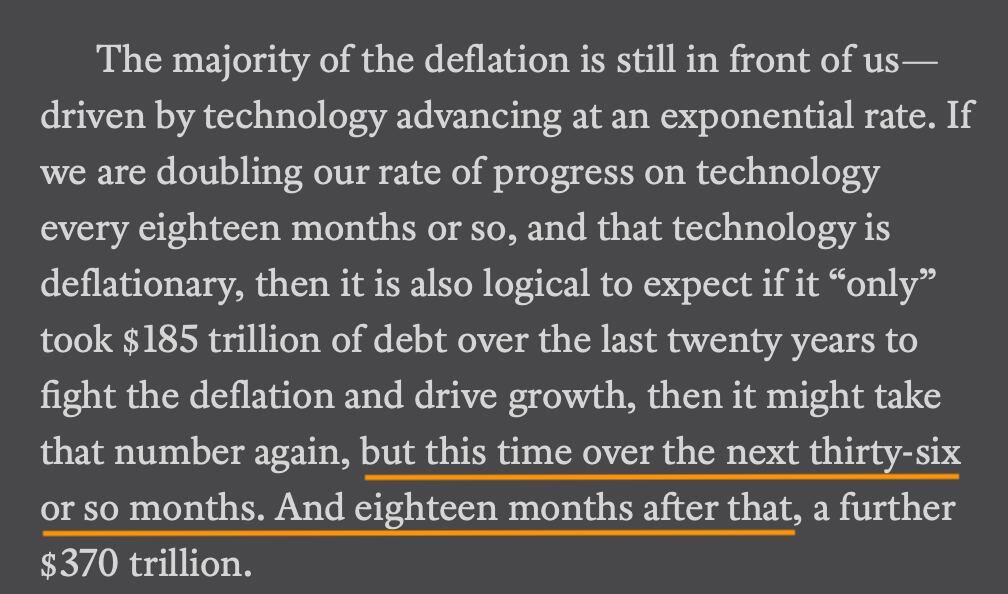
Hi nostr:nprofile1qyvhwumn8ghj7un9d3shjtnndehhyapwwdhkx6tpdshszythwden5te0dehhxarj9emkjmn99uq3samnwvaz7tmjv4kxz7fwvd6hyun9de6zuenedyhsqgyraqvdl0kvafttpa232a4nl5u60fgwrkq4jdp4qqmglgy9envkfvqndjex , we are working on translating "The Price of Tomorrow" into Russian and I'd like to ask you to elaborate on a piece you cover in chapter 4.
I can't understand why is it that it will take 36 months to get to another $185 trln, and only 18 again to get to $370 trln?
This is the definition of the exponential function
F(x) = 2^x
At time 0 F = 1
At time period 1 F (1) = 2
At time period 2 F (2) = 4
F (3) = 8
And so on
yep, I get that. My question is why does it switch between 36 and 18 months?
I would understand if the paragraph said "we will need another 185 trillion in the next 18 months and another 370 eighteen months after that. For some reason it's 36 months for the next 185 trillion.