
How Many More Ridiculous Green Energy Projects Will Fail?
How Many More Ridiculous Green Energy Projects Will Fail?
https://mishtalk.com/economics/how-many-more-ridiculous-green-energy-projects-will-fail/
The answer is all of them, in due time. Here are the latest spectacular failures.
 ?itok=TTuz9zvR
Birds Fry Every Two Minutes
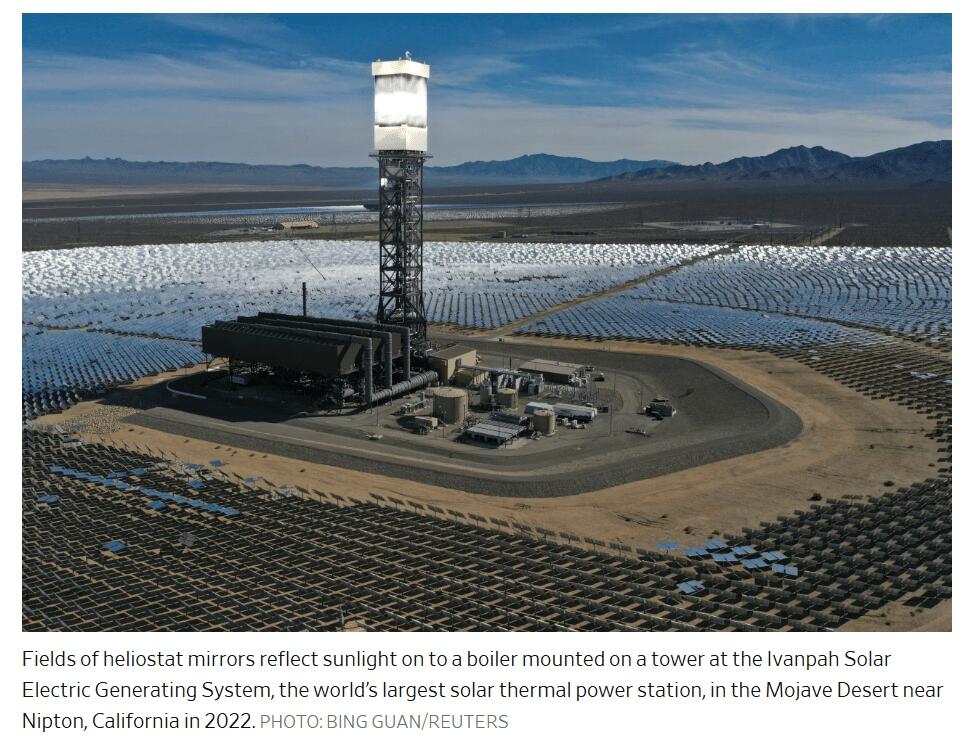
It took 10 years, and hundreds-of-thousands of dead birds, before the Ivanpah Solar Electric Generating System in California would meet its fate.
The Wall Street Journal explains in https://www.wsj.com/opinion/a-prolific-executioner-of-wildlife-e762353b?mod=hp_opin_pos_5#cxrecs_s
An Obama-era monument to green delusions finally faces extinction.
Longtime readers may recall a 2014 Journal https://www.wsj.com/articles/google-kills-birds-1411688771?mod=article_inline
about California’s “bird-fryer” solar plant, a taxpayer-backed venture that was hell on local animals. Turns out it was also hell on electricity ratepayers. But as with so many politically favored green ventures, waiting for official acknowledgment of failure can feel like an eternity.
Now finally here in 2025 it seems the reckoning has begun. The Las Vegas Review-Journal notes in an https://www.reviewjournal.com/opinion/editorials/editorial-taxpayers-may-lose-green-at-ballyhooed-solar-plant-3271837/
that “a major California utility — Pacific Gas & Electric — announced that it will no longer buy power from the Ivanpah solar plant off Interstate 15 near the Nevada-California border. As a result, two of the plant’s three towers will shut down next year — and the third will probably follow.”
The plant might have functioned merely as the world’s most expensive backyard bug zapper. But it was just too lethal. The Review-Journal’s Emerson Drewes https://www.reviewjournal.com/business/energy/ivanpah-solar-is-shutting-down-majority-of-its-plant-3268775/
last month:
Federal wildlife officials said Ivanpah might act as a “mega-trap” for wildlife, with the bright light of the plant attracting insects, which in turn attract insect-eating birds that fly to their deaths in the intensely focused light rays.
So many birds have been victims of the plant’s concentrated sun rays that workers referred to them as “streamers,” for the smoke plume that comes from birds that ignite in midair. When federal wildlife investigators visited the plant around 10 years ago, they reported an average of one “streamer” every two minutes.
Performance has proven so poor that PG&E has exercised its right to terminate the contract, about which https://www.pv-tech.org/project_focus_nrg_and_brightsource_celebrate_ivanpah_groundbreaking_an/
: “the utility is in ‘ongoing discussions’ with the project’s owners and the federal government over ending the utility’s contract.”
Calculating the Number of Dead Birds
There are 525,600 minutes in a year.
At one fried bird every two minutes, assuming sunshine 50 percent of the time (more in summer and less in winter), that’s 525,600 / 4 or roughly 131,400 dear birds per year.
Over 10 years that would be 1.31 million dead birds. Ouch!
That may be the high side, perhaps even low side. However, it’s clear that hundreds of thousands of birds were killed in this boondoggle that was never profitable even with subsidies.
New Jersey Reaps the Wind, Again
It’s not just solar. Also note that Shell just backed out of a wind-energy project despite huge subsidies.
Another offshore wind development stalled this week off the Jersey shore, making it the latest of three such projects to fail despite generous terms from the state. Energy giant Shell wrote off its 50% stake in Atlantic Shores, choosing to take a $1 billion impairment instead of complete the 2,800 megawatt wind farm. New Jersey’s Board of Public Utilities canceled its request for a wind-energy provider, leaving the unfinished project with no prospective customer.
Ratepayers can rejoice. Atlantic Shores would have charged about three times the market price for the power it generated, according to a review by Whitestrand Consulting. That would have raised electricity rates by 11% for residents and 13% to 15% for businesses, forcing them to overpay by $48 billion over the wind farm’s lifetime.
Gov. Murphy has treated renewable energy as a sacred cause no matter the costs since 2018. That includes a bill he signed to let Ørsted pocket federal credits it had promised to pass on to customers, though he clawed money back when the projects died.
Mr. Murphy says he approves of the utility bureau’s decision not to seek a new wind provider, but he still hasn’t given up his green dreams, calling offshore wind a “once-in-a-generation opportunity.” A once-in-a-generation failure is more accurate.
A Mountain of Unrecyclable Waste
The Institute for Energy Research notes https://www.instituteforenergyresearch.org/renewable/broken-windmill-blade-closes-nantucket-beaches/
This story is from July 2024, but it contains pertinent details.
A massive wind turbine blade shattered offshore Massachusetts causing extensive debris, which shut down beaches on Nantucket Island and caused serious concern to fishermen, who worried that the debris could damage their boats. The failure of the massive blade and the resulting debris caused the federal Bureau of Safety and Environmental Enforcement to https://apnews.com/article/nantucket-wind-turbine-damaged-4ae71edc04bd8b3a046364c56ed3623a
began sending electricity to the grid this past winter.
A GE Vernova https://doggerbank.com/project-news/incident-at-dogger-bank-wind-farm/
in Germany last fall, which brought the number of broken GE blades at the Alfstedt-Ebersdorf wind farm in Lower Saxony to three. The first blade had broken off the previous year at one of the wind farm’s eight GE 5.3-158 turbines.
On June 28, America Electric Power (AEP) filed https://www.renews.biz/94228/aep-sues-ge-over-defective-turbines/
in New York court over quality and warranty concerns, claiming widespread issues with the turbines it has deployed at three wind projects in Oklahoma. It is alleging that “within only two to three years of commercial operation, the GE wind turbine generators have exhibited numerous material defects on major components and experienced several complete failures, at least one turbine blade liberation event, and other deficiencies.”
GE Vernova is not the only wind turbine maker facing losses. Last year, Germany’s Siemens Energy, announced it would https://www.cnbc.com/2023/08/07/siemens-energy-books-2point4-billion-wind-turbine-hit-in-q3-2023-results.html?utm_source=substack&utm_medium=email
and dealing a blow to one of the world’s biggest suppliers of wind turbines.
Massive Wind Graveyards
Wind turbine blades are made from fiberglass, or fiber reinforced plastic, and https://mailchi.mp/cfact/shattered-wind-turbine-closes-nantucket-beaches?e=044a9c3d8a
, in stacks rising as high as basketball backboards.
How Many Birds are Killed by Wind Turbines?
The American Bird Conservancy estimates approximately 538,000 wind turbine-caused bird deaths occur in the U.S. each year.
Raptors like Golden Eagles and nighttime migratory songbirds are particularly vulnerable.
That estimate is from 2021. So double or triple it. But skeptics point out cats kill 2.4 billion birds a year. And 200 million birds are allegedly killed by automobiles each year.
Have cats killed any golden eagles?
Economic Reality
Let’s return to economic reality.
None of these projects are profitable, even with subsidies. That’s why they fail.
Meanwhile, consumers face monstrous hikes in energy bills to pay for these boondoggles as mounds of unrecyclable garbage piles up in massive wind graveyards.
Related Posts
August 19, 2020: https://mishtalk.com/economics/green-energy-failed-leaving-millions-in-california-blackout/
Electrical companies imposed rolling blackouts for the first time since 2001. Inability to meet the surge in demand is due to a shift from natural gas.
September 5, 2023: https://mishtalk.com/economics/bidens-green-energy-inflation-reduction-act-needs-a-big-bailout-already/
Surprise, surprise. Subsidies were not enough to make Biden’s energy projects profitable.
May 21, 2024: https://mishtalk.com/economics/hoot-of-the-day-no-one-wants-green-energy-if-its-too-cheap/
Treasury Secretary Janet Yellen wants the EU to hike tariffs on China just as the US did.
August 10, 2024: https://mishtalk.com/economics/another-green-energy-company-declares-bankruptcy-thank-bidens-tariffs/
Conflicting goals often leads to the worst of both outcomes. That’s what’s happening with solar panels and EVs.
Finally please consider https://mishtalk.com/economics/the-futility-of-wind-and-solar-power-in-one-easy-to-understand-picture/
How do we get green energy from here to there and at what cost?
Let’s return to the lead question.
Q: How Many More Ridiculous Green Energy Projects Will Fail?
A: All of them, unfortunately not fast enough. And none of them should have been approved in the first place.
Addendum
One reader commented, “Onshore wind is cheap and kills a tiny amount of birds. To me it is an important part of future energy mix.”
I replied … If wind was cheap, without subsidies, then we would have more of it.
That we don’t, even with subsidies, is telling.
And if government would stop investing in losers, with subsidies, and just stay out of it, we would likely be further along with solutions.
https://cms.zerohedge.com/users/tyler-durden
Wed, 02/12/2025 - 06:30
https://www.zerohedge.com/energy/how-many-more-ridiculous-green-energy-projects-will-fail