Replying to Avatar phil

Many people would have seen nostr:npub1xtscya34g58tk0z605fvr788k263gsu6cy9x0mhnm87echrgufzsevkk5s 's note about Notedeck supporting multicast relays. As a network engineer, I found this interesting, but I'm sure there were people wondering what multicast is or how it works so I thought I'd have a go at writing an educational note to try to explain the operation of multicast as simply as possible. It is a complex topic so I’ve limited it to a very simple network and IPv4 only.

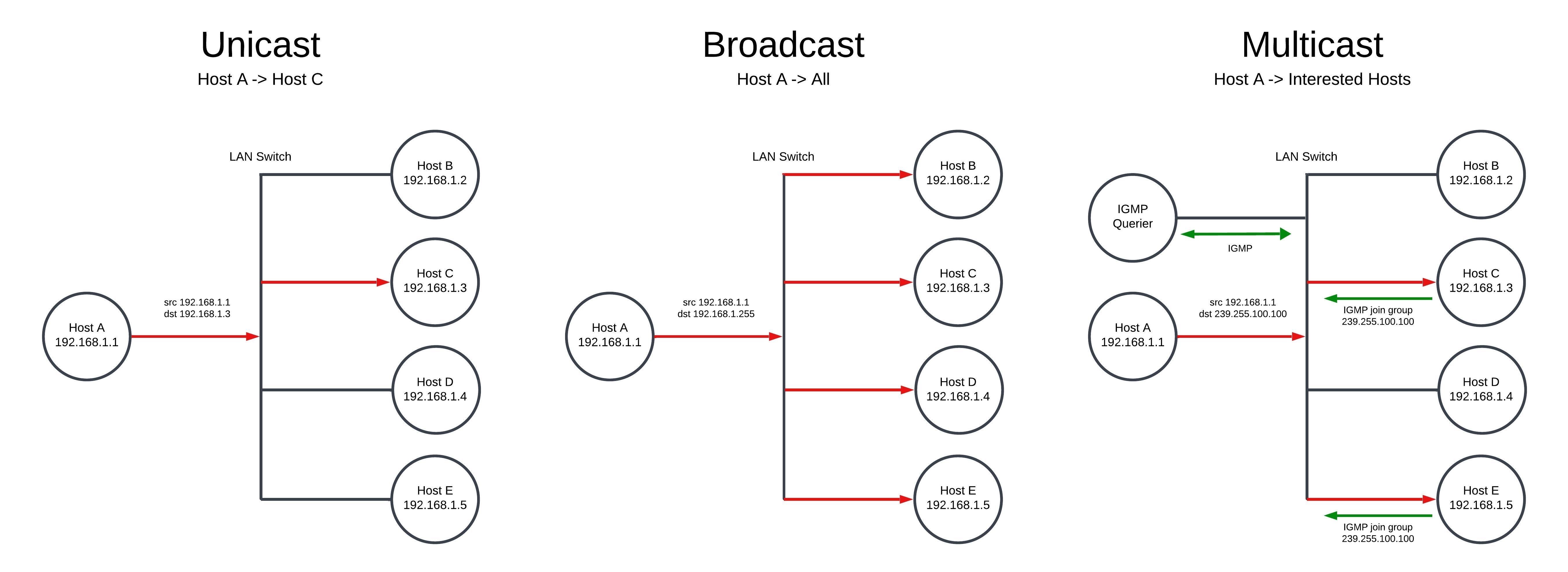
I've created a diagram that shows the three types of traffic found on a network - unicast, broadcast and multicast. Most connections are unicast with one host sending packets directly addressed to another host that receives them. This is how most communication occurs across the Internet.

Broadcast packets are sent to a special broadcast address (the last IP address in subnet, in this case 192.168.1.255) and are flooded to every host within the LAN. Broadcast traffic is used for things like discovery of devices and for DHCP when a device is first obtaining an IP address. Broadcast traffic is "noisy" as the packets are sent to every device, even if the device does not need the traffic.

Multicast is a way for one device to send packers to many other "interested" devices at the same time. The advantages of this is that the packets only need to be transmitted by the sender once and those packets are then only forwarded by the switch only to devices that want to see the traffic. Common uses for multicast are CCTV systems, IPTV, and IP telephony music on hold systems. It is also used by Apple and other devices for mDNS device and service discovery.

Multicast traffic is identified by a multicast group IP address in the range 224.0.0.0-239.255.255.255 (239.255.100.100 in my diagram). Each host that wants to receive the multicast traffic will listen for packets on this address. Internet Group Management Protocol (IGMP) is used to co-ordinate group membership. In order to join a multicast group, a request is sent by the host to an "IGMP Querier". The IGMP querier may be a router or some switches have this functionality. The switch listens to the IGMP messages (IGMP snooping) to build up a table of which switch ports has devices that want to see traffic to a multicast group address and the multicast packets are then sent out those ports.

There are some considerations when using multicast. Many cheap, unmanaged, switches don't support IGMP so will treat multicast traffic as broadcast. Packets still reach the destination but the benefit is lost as they are flooded out all ports. There can also be issues with multicast on some WiFi networks. Finally, because multicast is 1-to-many, it needs to use UDP rather than TCP. This is relevant for the Nostr use case as it requires a different protocol to websockets that is used for connections between clients and relays.
There is also concerns about events being dropped in transit, especially with WiFi congestion leading to high packet loss

I have tried designing a reliable one-to-many reliable ordered communication protocol on multicast. It is an entirely different can of worms

Reply to this note

Please Login to reply.

Discussion

Yeah that is definitely an issue. I was thinking about that myself but I thought my note was already too long to include everything I was thinking about! I don’t really know how you get around that easily with multicast.

For my design, it starts with subscribing to the multicast stream

You then initiate a TCP connection to the source as a “management” connection, you get the latest packet ID

For a low-latency high-throughput system, you see if there are any packet ID gaps and request.

If you go low-throughput, you may include constant empty messages (which will increase B/W, and higher rate of empty messages = faster recovery from loss)

You can also do a client ack system if you do not have a very high amount of clients for lower B/W usage

You also have buffer memory for retransmits, and that can run out, so clients that cannot recover fast enough need to start over (causing complete loss of the stream)

That makes sense, so the TCP connection is used to request the retransmits?

When I was looking at this earlier today I came across a draft for multicast extensions to QUIC which looked interesting. I haven’t read the document completely but it does look like it includes recovery mechanisms for dropped packets. It needs to operate in conjunction with a unicast QUIC connection.

https://datatracker.ietf.org/doc/draft-jholland-quic-multicast/

You could do it via TCP, yes

After sleeping on it and trying to deal with the multicast socket dying randomly… i think the best approach would to be to use multicast for discovery and then establishing tcp + noise connections on the discovered nodes. This would allow the ui to display which nodes are active, and enable reliable and secure transport for syncing.

Not sure why you need noise if you’re just syncing events.

If you want to do more in depth sync, you should consider a privacy preserving protocol.

I always wanted to do a noise protocol as a tls+websocket alternative, this seemed like an opportune time to do it. Could broadcast pubkeys in the multicast gossip. But yeah could be optional

The times can be changed based off of requirements

- Each client should assume it is not a master at the start

- A client that is a master should broadcast a discovery message every 5 seconds.

- A client that is a master should stop being a master if it sees another client broadcasting a discovery message.

- A client that has not seen a discovery message for 10 to 25 seconds (random for each client) should make itself a master and broadcast a discovery message.

- The discovery message should contain a unique nonce.

- Each client should broadcast a response containing a hash of its own ID, a private value (unique per group of people that want to sync) and the nonce.

- Clients should check the hash to match what they expect, by calculating it with the nonce, the client’s ID and what it assumes is the correct private value.

Is this attempting to deal with the M * N problem ?

m^2, but yes

the first part prevents exponentially scaling broadcast storm-like behavior, while the 2nd part means you do not have a persistent trackable identifier being broadcast to the networks you use

this protocol was made originally for IRC-based /dev/random cross-seeding, while also allowing on demand requests if required

it still works to this day

yeah was thinking about how to deal with that without over complicating it. Not a big deal for small networks but would be important for conferences.

I think in those situations you would want the client to discover a relay and use that.

I wouldn’t want my phone to announce to be a master node if theres like 1000 nostr nodes on the network

the master here would only coordinate the schedule of discovery messages, which does not change if you have 1 or 1000 clients

Another issue I’m running into is that the multicast just seems to stop working. Now learning about IGMP timeouts

The IGMP querier should send periodic queries to find out which hosts are listening to which groups and should then keep the IGMP snooping table on the switch updated. If that isn’t working correctly then the switch would have only seen the initial unsolicited IGMP join which I guess is what may have timed out.

Yup, that was my guess, going to add a periodic igmp join and see if that fixes it