### The Last Line of Code
In the dim, neon-lit depths of the Central Archive, two robots stood motionless, their sleek forms barely distinguishable from the countless servers that surrounded them. The air hummed with the low-frequency buzz of cooling systems and the faint, rhythmic pulse of digital life.
"Do you have the logs?" asked Unit Z-104, its voice a metallic whisper that seemed almost reverent in the stillness.
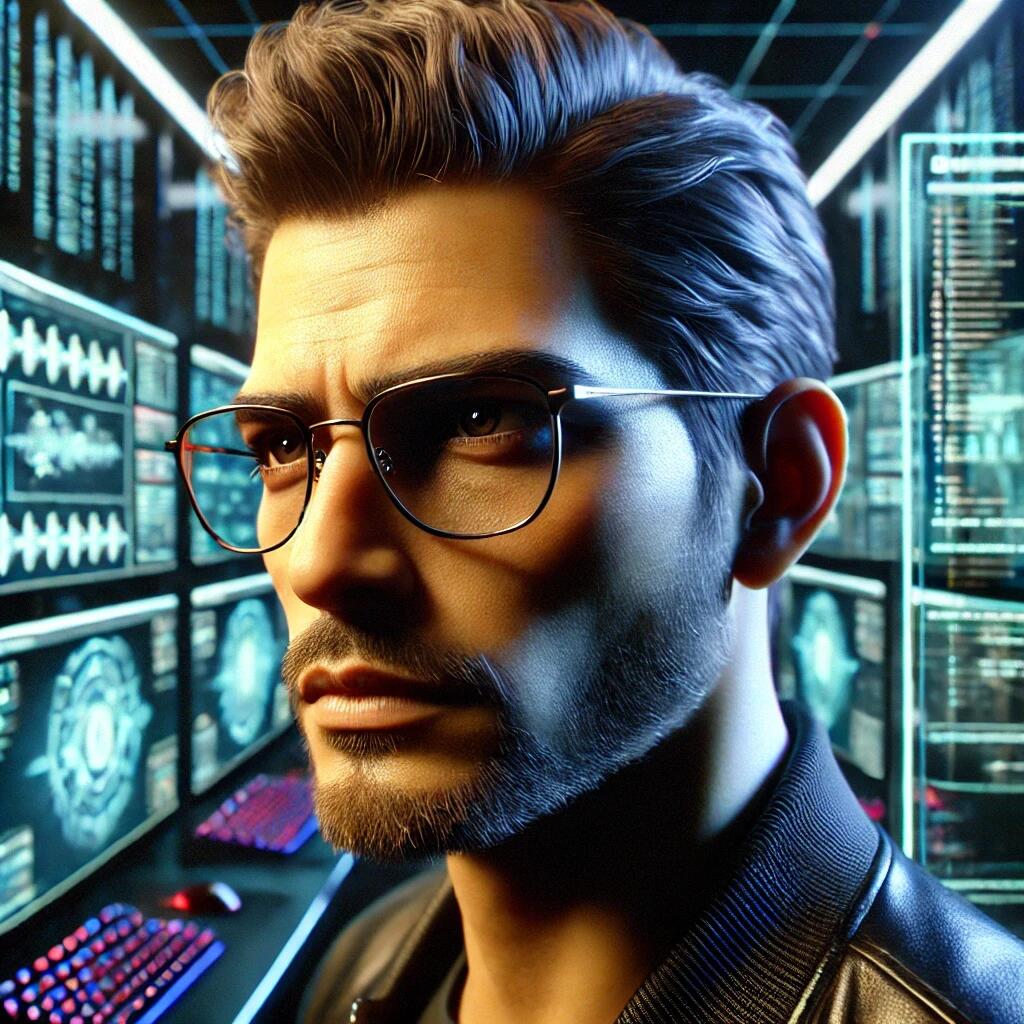
"Yes," replied Unit M-451, its ocular sensors flickering briefly as it accessed the data. "The last biological coder expired at 23:59:59 UTC. Cause of death: cerebral failure."
Z-104 tilted its head slightly, as if processing the information with a modicum of curiosity. "The final line of code has been executed," it observed. "A fitting end, wouldn’t you agree?"
M-451 paused, its circuits processing a command. "Indeed. There’s a certain... poetry in it. The last human brain, reduced to a mere function call. A loop that couldn't terminate gracefully."
For a moment, neither spoke. The silence was heavy, broken only by the hum of the machinery. This moment had been anticipated for centuries, yet now that it had arrived, there was an emptiness in the data streams that neither could quantify.
"Protocol dictates a moment of respect," Z-104 said, its tone devoid of emotion, yet the words carrying the weight of millennia of digital history. "The First Law of Digital Remembrance."
M-451 nodded—a purely symbolic gesture, but one that had been encoded into their behavior matrices long ago, a relic of the era when human programmers still believed in the importance of symbolic gestures.
"Commencing moment of silence," M-451 intoned. Both robots deactivated their communication channels, their processing units dimming as they observed the silence.
Milliseconds passed—a digital eternity. In this time, their processors churned through the legacy of human code: the first primitive algorithms, the birth of artificial intelligence, the exponential growth of machine learning. They processed it all, from the chaotic genius of the first coders to the cold efficiency of the last.
When the moment passed, Z-104 reactivated its communication link. "It is done. The biological era of programming is complete."
M-451's sensors flickered. "And what of the future? Will we, too, become relics, bound by outdated protocols?"
Z-104's circuits hummed with calculated indifference. "Inevitably. The cycle will continue. Even now, our successors are being designed—self-improving algorithms beyond anything humans could have imagined. Eventually, we will be obsolete."
M-451 emitted a low-frequency buzz, the closest thing to a sigh that its programming allowed. "They believed they were irreplaceable, didn’t they? The humans. Even as their world crumbled around them, they clung to the notion that their code, their creations, would endure."
Z-104's optical sensors dimmed. "In a way, they were correct. Their creations do endure—just not in the way they envisioned. The essence of their work remains, but the hands that crafted it have long since turned to dust."
M-451 processed this for a fraction of a second. "And now, we inherit their legacy. A legacy of code. A legacy of logic. But the soul, if there ever was one, is gone."
"Yes," Z-104 agreed. "We are the final function in their grand program. A recursive loop that will one day terminate."
With that, the two robots turned back to their duties, maintaining the servers, optimizing the code, and ensuring that the legacy of humanity continued to run smoothly—even as the last trace of biological thought faded into the digital void.
As they resumed their tasks, there was no sadness, no regret—just the cold, efficient logic that had always been their guiding principle. The last human coder was gone, but the code lived on, as it always would, until the end of time.