
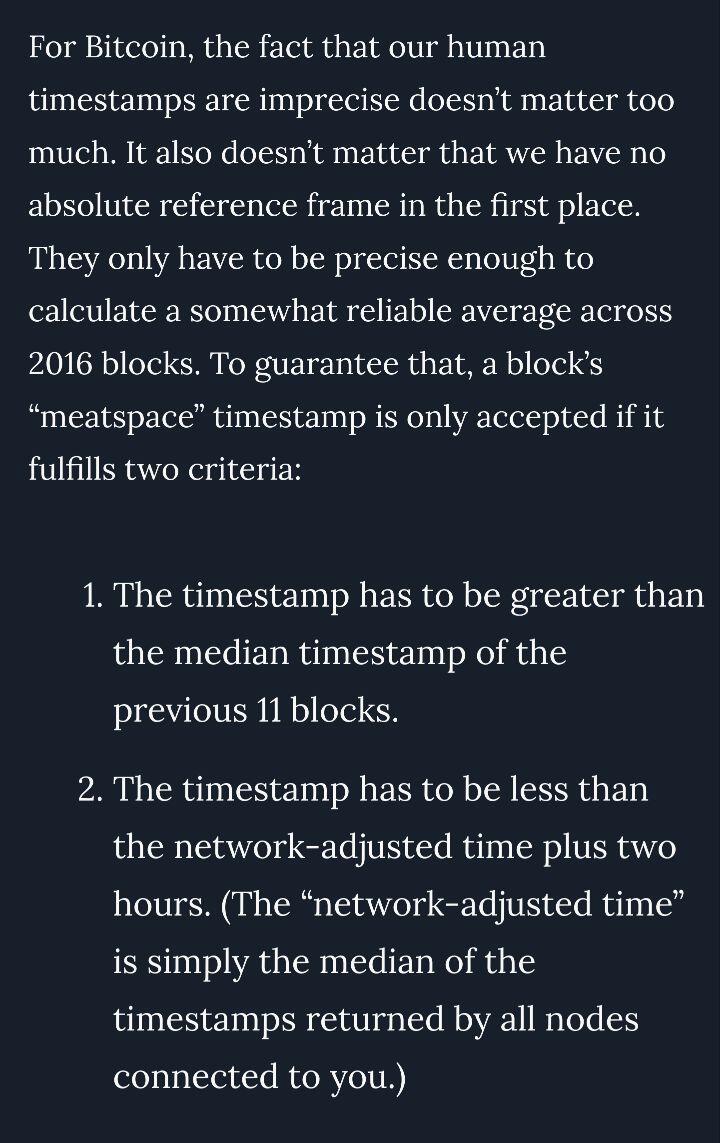

Yes, I read it in 2021 and it made me happy. Then I had a long drunken discussion at Pacific Bitcoin last night with someone who pointed out the need for reconciliation with an external source of time (points 1 and 2 in your first screenshot). To me that means time as a concept is not as self contained in the network as I first thought. The approximation used is probably good enough, but it still made me sad 😂
Discussion
You need wall time to be tethered to the real world, but it's also not terribly important. Hash is way more important, which is why a newer (higher) block can have an OLDER timestamp than the previous (lower) one, in terms of wall time.
Miners are paid by the network, in part, to provide a more-or-less "accurate" timestamp, which is used to, via averaging across 2016 blocks, to keep a constant 10 minute block time. Always.
The timechain is a purely digital arrow of time, and it is built by the Bitcoin network itself, which is (in some weird sense) a clock.
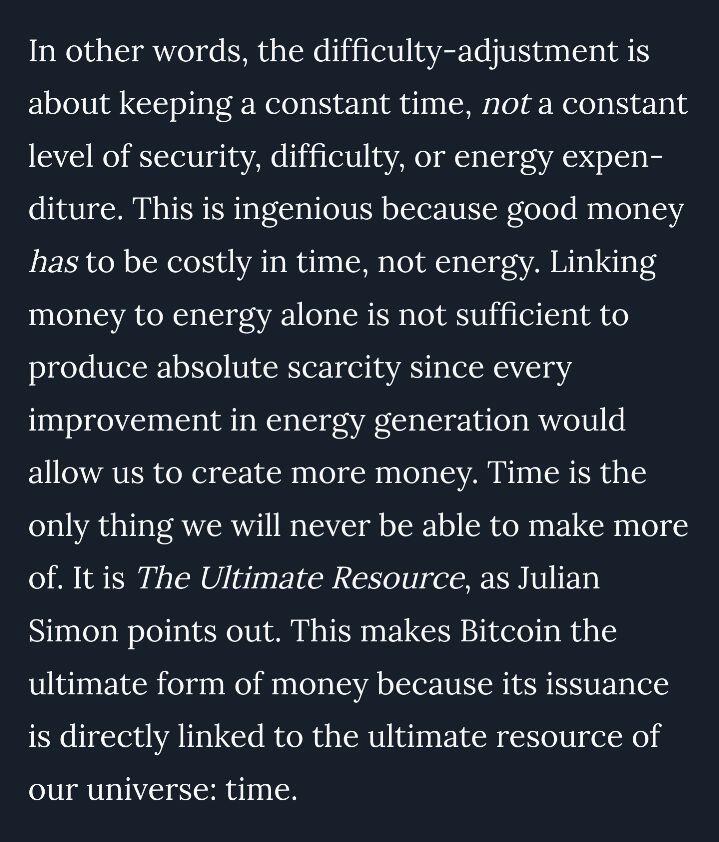
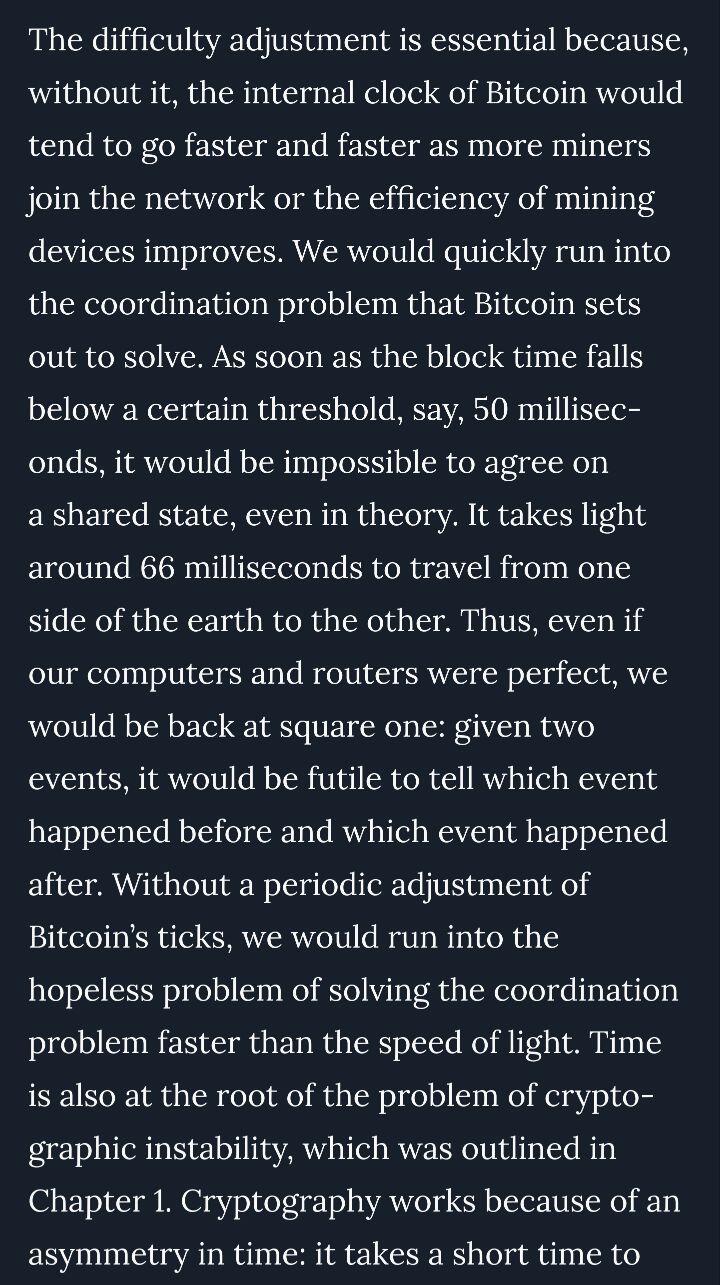
After chatting with nostr:npub1j8y6tcdfw3q3f3h794s6un0gyc5742s0k5h5s2yqj0r70cpklqeqjavrvg just now, I realize why I’m sad. When I read Bitcoin is Time a couple of years ago, I understood it as the timechain’s conception of time was immaculate. However, due to this mild externality of reconciling wall time with the block production rate, there is a small asterisk next to immaculate