
text (2542): The Hive Mind Paradox
Scientists just proved something wild: a swarm of bees is mathematically identical to a single AI learning algorithm.
Not 'similar to.' Not 'inspired by.'
Identical.
Here's why this changes everything we thought about intelligence
For centuries, we've thought about intelligence in two separate boxes:
Individual learning (how YOUR brain works)
Swarm behavior (how GROUPS coordinate)
Turns out? This split is artificial.
The math proves they're the same thing.
Picture this: A honey bee colony needs a new home.
500 scout bees fly out. They find 10 possible nest sitessome amazing, some death traps.
Each bee can only visit ONE site. The data is noisy. The stakes are life-or-death.
How does the hive choose?
Here's where it gets wild.
Researchers modeled the waggle dance mathematically.
They derived the EXACT equations governing how the swarm converges on a decision.
The result? The swarm doesn't act like a reinforcement learning agent.
The swarm IS the agent.
Think of it this way:
Each bee = one GPU in a data center
The waggle dance = gradient updates
The hive = a single neural network
500 bees = 500 processors running in parallel, solving the same optimization problem simultaneously.
Nature built distributed computing first.
But here's the crazy part
When they tested "smarter" individual bees (ones that process more data, verify information, think harder)...
...the system got SLOWER.
Smarter individuals = worse collective performance.
Why?
The calibration problem.
Imagine you and I rate restaurants. Your "7/10" might be my "9/10." We can't compare scoreswe don't share an internal scale.
Bees have the same issue. One bee's "great nest" rating means nothing to another bee's sensors.
So what do they do?
They don't compare at all.
Each bee just broadcasts enthusiasm (waggle dance frequency) based on ITS OWN experience.
The hive doesn't need shared metrics. It aggregates VOLUME, not values.
Evolution's insight: Don't optimize for smart individuals. Optimize for CHEAP cognition at scale.
The implications are staggering:
Robot swarms that coordinate without central control
Economic models where markets ARE the learning agent
Understanding Twitter/TikTok as literal hive-mind algorithms
Rethinking where "intelligence" actually lives
Evolution figured out distributed computing 30 million years before AWS.
Maybe instead of building smarter AI agents, we should be asking:
"What's the UPDATE RULE?"
The swarm isn't IN the bees. The swarm IS the brain.
media (112): 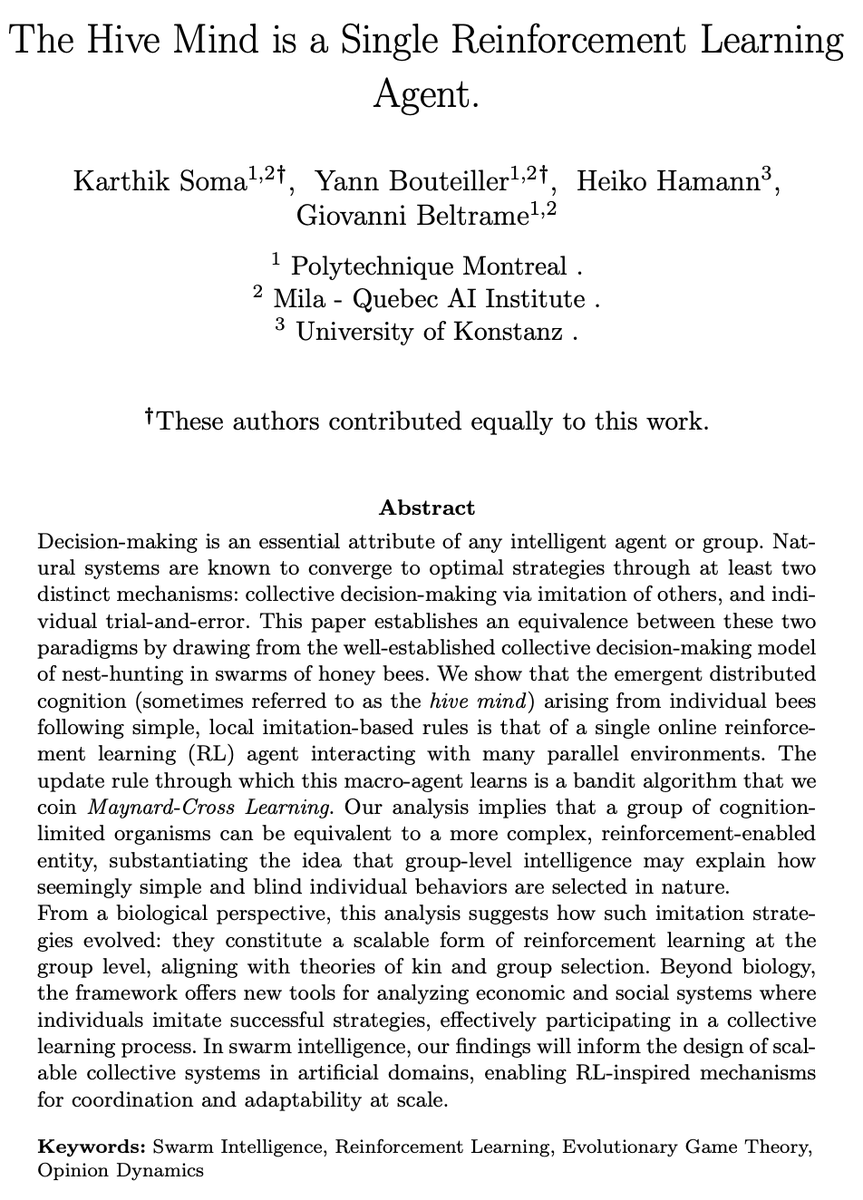 05caa15813c37bc6531aed9322580dc9517cb7149d26408d5998bf689afdb710
media (112): 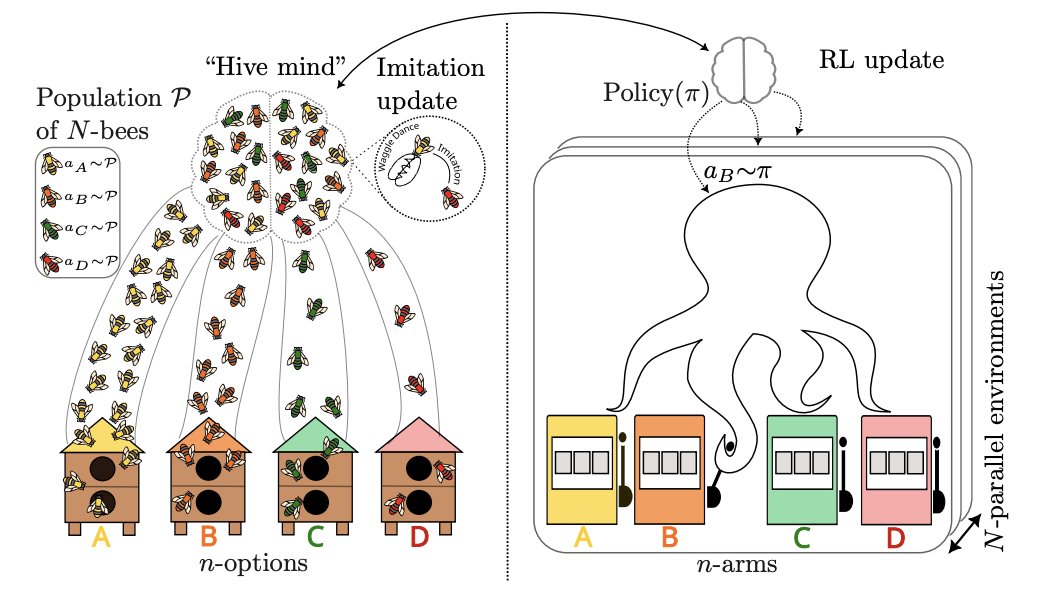 c52a88d120708558d75e0ef5f9b0093d784a1079826871952feeff5a46eda6b7
time (10): 1765382723
time orig (10): 1765362136
id (19): 1998786128514789797
id orig (19): 1998699780629823701
uid (27): 1464280101638799360 akrmn21
uid orig (24): 3027431134 IntuitMachine