
**Data-Centers & Small Nuclear Reactors - A Match Made In Heaven?**
Data-Centers & Small Nuclear Reactors - A Match Made In Heaven?
_Authored by Brian Gitt via RealClear Wire (https://www.realclearwire.com/articles/2023/04/12/onsite_nuclear_provides_247_clean_power_893420.html),_
**Most of us don’t think about the huge data centers that enable our constant internet usage.** But they’re essential to our civilization—and they consume enormous amounts of electricity 24/7.
 ?itok=nzqQWrT5 (
 ?itok=nzqQWrT5)
**Powering these data centers is fast becoming a problem**. Northern Virginia, for instance, hosts the largest concentration of data centers in the world. Tech giants like Amazon, Facebook, Microsoft, and Google have invested $126 billion (https://www.datacenterknowledge.com/colocation/report-data-centers-virginia-supported-17-billion-economic-output-2021) in Virginia data centers. And the region’s insatiable appetite for power continues to grow due to surging demand for cloud computing services.
**Without reliable power, cloud service providers can’t grow to match the pace of increasing demand. But the electrical grid can’t keep up.** Right now, power transmission bottlenecks in Northern Virginia could delay new data center development into 2026 (https://www.datacenterdynamics.com/en/news/dominion-energy-admits-it-cant-meet-data-center-power-demands-in-virginia/).
Data center developers across the pond are facing the same problem. Microsoft and Amazon halted plans to build new data centers in Dublin, Ireland, because of power shortages and threats of rolling blackouts. And British officials paused construction (https://www.datacenterdynamics.com/en/news/report-home-building-to-halt-in-west-london-due-to-data-center-power-demands/) on new houses in West London until 2035 because data centers had already maxed out the local grid’s capacity.
And it’s not just power consumption that is sparking opposition to data centers. Concerns about greenhouse gas emissions, water usage, noise pollution, and the overall sustainability of data centers are fueling local opposition that is constraining where—or even whether—data centers get built.
**Google, Amazon, Microsoft, and Facebook have responded to the demand for clean energy by investing heavily in wind and solar projects.** But wind and solar alone can’t solve the problem. Those energy sources simply can’t deliver the uptime that data centers need. Consider the European wind drought of 2021 that cut wind power in the UK by 32 percent for 6 months (https://www.cnbc.com/2021/09/29/sse-says-low-wind-dry-conditions-hit-renewable-energy-generation.html). The need for round-the-clock uptime presents a serious—perhaps insurmountable—obstacle to data centers relying solely on sources of power like wind and solar that don’t generate power at night, or on cloudy days, or when the wind doesn’t blow.
Some people hope we’ll eventually be able to store surplus wind and solar energy in batteries. But the reality is that batteries are too expensive to store enough energy to supply reliable power for weeks (let alone months) of uncooperative weather.
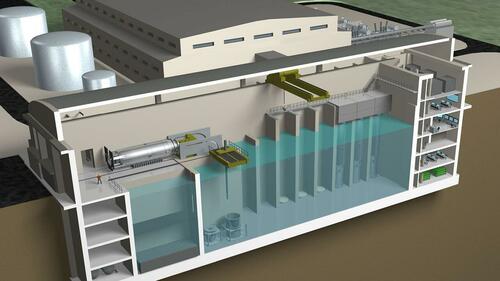
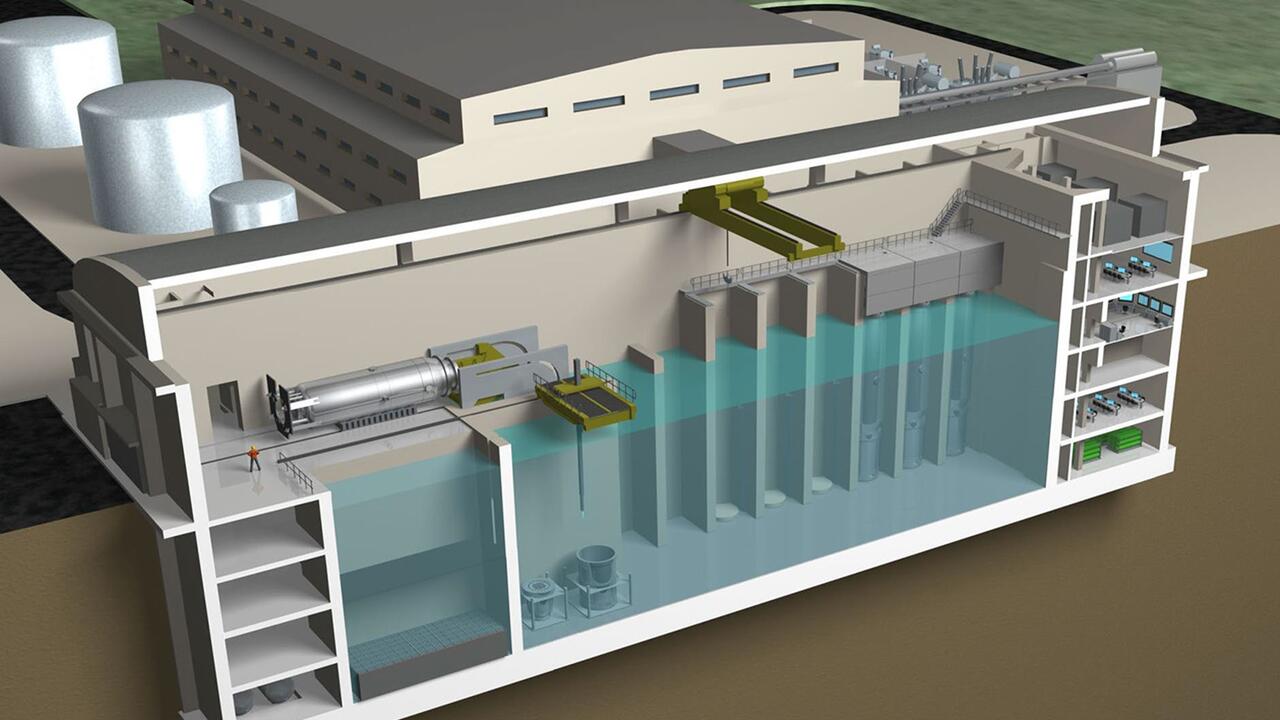
**The good news is that there’s a solution—a power source reliable enough to provide uptime round-the-clock at low cost and with zero emissions: a small onsite nuclear power plant dedicated to supplying power to a data center.**
Small modular reactors (SMRs) supply between 10 and 300 MW of power 24/7. A data center supplied by an SMR would face no more competition for power with local communities. No more waiting for new transmission lines or power plants to be built. And no more emissions. When we consider the full lifecycle of different power sources (including mining, manufacturing, and disposal), solar emits four times more carbon than SMRs.
SMRs differ from large conventional nuclear plants as much as modern smartphones differ from old rotary phones. Conventional plants are large and complicated, and cumbersome US and European regulations make them expensive to build. Two units (1,117 MWs each) currently being built in the US state of Georgia have cost upwards of $30 billion. Construction on them, moreover, is six years behind schedule, and when they finally come online in 2023, they will have taken 14 years to complete. These kinds of costs and delays present a capital risk factor for large conventional nuclear plants.
**Large nuclear reactors are also land-intensive.** They typically require over 800 acres and usually need to be sited near a lake, river, or the ocean to access water for cooling. Plus, they don’t recycle spent fuel.
SMRs are simpler and much less expensive to construct. **Off-the-shelf components and factory prefabrication bring construction costs as low as $60 million**…
https://www.zerohedge.com/energy/onsite-nuclear-provides-247-clean-power