
**Speak Your Truth: Don't Let The Government Criminalize Free Speech**
Speak Your Truth: Don't Let The Government Criminalize Free Speech
_Authored by John & Nisha Whitehead via The Rutherford Institute,_ (https://www.rutherford.org/publications_resources/john_whiteheads_commentary/speak_your_truth_dont_let_the_government_criminalize_free_speech)
> _“If freedom of speech is taken away, then dumb and silent we may be led, like sheep to the slaughter.”_
>
> _\- George Washington_
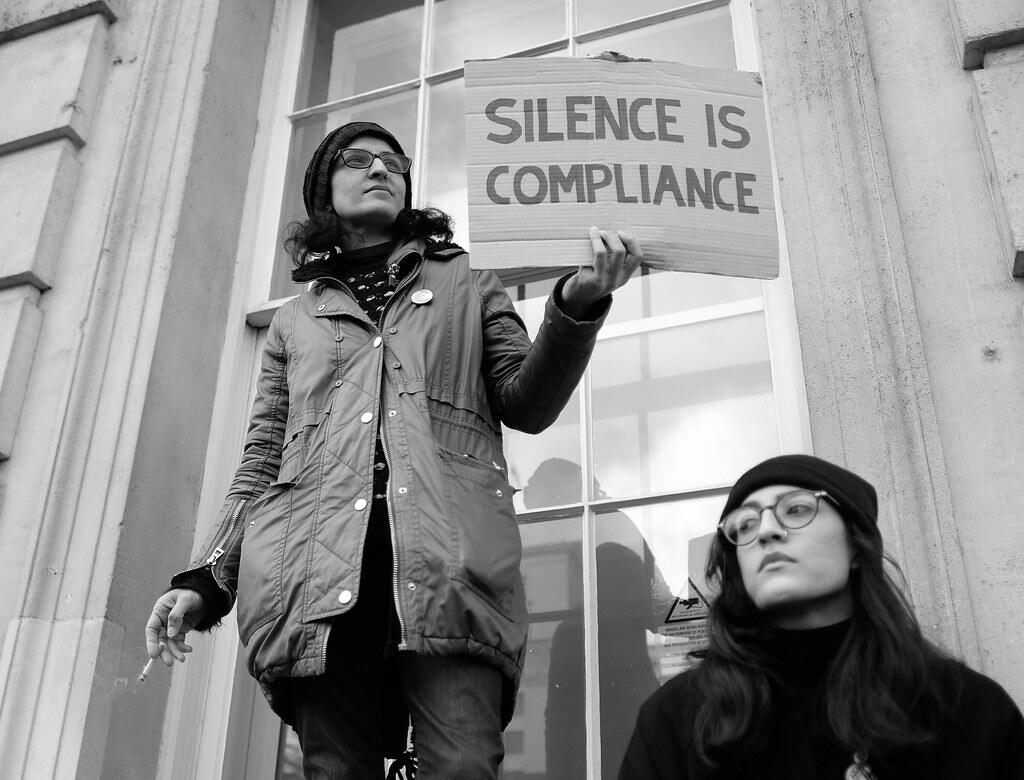
What the police state wants is a **silent, compliant, oblivious** citizenry.
 ?itok=XxYcxKm8 (
 ?itok=XxYcxKm8)
What the First Amendment affirms is an engaged citizenry that speaks truth to power using whatever peaceful means are available to us.
**Speaking one’s truth doesn’t have to be the same for each person, and that truth doesn’t have to be palatable or pleasant or even factual.**
We can be loud.
We can be obnoxious.
We can be politically incorrect.
We can be conspiratorial or mean or offensive.
**We can be all these things because the First Amendment takes a broad, classically liberal approach to the free speech rights of the citizenry: in a nutshell, the government may not encroach or limit the citizenry’s right to freedom of religion, speech, press, assembly and protest.**
This is why the First Amendment is so critical.
It gives the citizenry the right to speak freely, protest peacefully, expose government wrongdoing, and criticize the government without fear of retaliation, arrest or incarceration.
**Nowhere in the First Amendment does it permit the government to limit speech in order to avoid causing offense, hurting someone’s feelings, safeguarding government secrets, protecting government officials, discouraging bullying, penalizing hateful ideas and actions, eliminating terrorism, combatting prejudice and intolerance, and the like.**
When expressive activity crosses the line into violence, free speech protections end.
However, barring actual violence or true threats of violence, there is a vast difference between speech that is socially unpopular and speech that is illegal, and it’s an important distinction that depends on our commitment to safeguarding a robust First Amendment.
**Increasingly, however, the courts and the government are doing away with that critical distinction, adopting the mindset that speech is only permissible if it does not offend, irritate, annoy, threaten someone’s peace of mind, or challenge the government’s stranglehold on power.**
Take the case of _Counterman v. Colorado_ (https://www.rutherford.org/publications_resources/on_the_front_lines/rutherford_institute_warns_against_giving_the_government_a_green_light_to_chill_political_speech_on_social_media) which is before the U.S. Supreme Court.
Under the pretext of clamping down on online stalking, Colorado wants the power to be able to treat expressive activities on social media as threats (https://www.rutherford.org/publications_resources/on_the_front_lines/rutherford_institute_warns_against_giving_the_government_a_green_light_to_chill_political_speech_on_social_media) without having to prove that the messages are both reasonably understood as threatening an illegal act and intended by the speaker as a threat.
While protecting people from stalking is certainly a valid concern and may be warranted in this particular case, the law does not require speech to be a “true threat” in order to be criminally punished. The Supreme Court has defined a “true threat” as “statements where the speaker means to communicate a serious expression of an intent to commit an act of unlawful violence to a particular individual or group of individuals.”
Indeed, Colorado’s stalking law is so broad that a person can be charged with stalking for repeatedly contacting, surveilling or communicating with an individual in such a way that a reasonable person would feel serious emotional distress.
In the absence of any substantive guidelines on what constitutes a true threat on social media, such laws could empower the government to misinterpret any speaker’s intent and meaning in order to criminalize legitimate political speech that is critical of government officials and representatives.
Case in point: in Oklahoma, a street preacher who expressed his moral outrage over public drag queen performances that occur in front of children and churches that endorse same-sex marriage was given a five-year restraining order and threatened with arrest after citing Bible verses on social media (https://www.rutherford.org/publications_resources/on_the_front_lines/oklahoma_court_threatens_street_preacher_with_arrest_for_using_bible_verses_to_criticize_same_sex_marriage) about God’s judgment of sin.
The Rutherford Institute has taken…
https://www.zerohedge.com/political/speak-your-truth-dont-let-government-criminalize-free-speech
