
“The nation that makes a great distinction between its scholars and its warriors will have its thinking done by cowards and its fighting done by fools.”
- Thucydides
The criticality of serendipity in spurring creativity and innovation is why the development of a “scene” is the one of the most important contributors to rapid progress in any human endeavor. A “scene” is much bigger than whether people work remotely or in an office; it is the social condition of possibility for rapid breakthroughs that create cultural inflection points.
“Scenes” are not architected top-down, but emerge as a result of both intentional and unintentional incentives that draw people to self-select into communities that are doing something similar, exciting, and hard together. Success builds on success, attracting more talent over time.
Scenes are communities of purpose and doing; while people in them may have cultural similarities, they are not identity communities. They are *about* something that participants in a scene can feel, even if they can’t describe it.
Scenes are extraordinarily economically generative, and financial incentives may be a part of the incentive structure that brings them about, but the sense of purpose that gives a scene its vitality is not primarily financial. Scenes are characterized first and foremost by a sense of purpose that far exceeds any straightforwardly or immediately measurable outcome.
Scenes tend to attract grifters and performers who replace actual generativity with its illusion. These may be governments looking to collect rents, investors wanting to squeeze every last bit of profit out of a generative venture, and an endless retinue of hangers-on wanting to “ride the train” as long as it’s moving. Even some of the most generative and original contributors to scenes can become captured by their own success, becoming grifters and performers themselves. These are predatory forces that drain the life out of scenes.
The other main reason that scenes die is that people participating in them usually don’t have a good account of why they happened in the first place. This means they often make poor executive decisions: trying to control the scene or “keep it going” through magical thinking or heavy-handed intervention. Instead of prioritizing purpose—“what is the next calling or endeavor that I can now devote myself to that is only possible because of the breakthroughs generated by the last scene?”—they prioritize nostalgia, “keeping the band together,” or otherwise trying to replicate the past.
The only thing that “keeps a scene going,” in other words, is keeping alive the devoted, purpose-driven, productive but unpredictable and risky conditions of its origination. A scene that is alive keeps generating new scenes out of itself; it reinvents itself in ways that it cannot predict or imagine in advance.
The scene is the condition of “serendipity.” 
At this point, the words “ethics” and “governance” basically mean “politics.”
Not even a thoughtful politics, but an extremely reductive, cartoonish politics.
So many destructive social and political movements happen when people desire greatness and excellence but allow it to make them snobs, supremacists, or otherwise look down on other people.
The truly great invite others to greatness. They recognize that excellence has countless ways of showing itself. Great people do not judge or exclude others from the possibility of greatness, especially on the basis of random or superficial characteristics.
Relationships are the bedrock of human life; they are both what makes life worth living and the seeds of innovation and progress.
Not all human relationships can be based on care--there are simply too many people in the world for everyone to personally devote selfless attention (care) to everyone else. But when people instrumentalize (i.e. treat as transactional) those relationships that SHOULD be based on care--those with their intimates, whether at home, with friends, or at work--that is when we say colloquially that they are being "political."
"Political" relationships may *look* like care on the outside; often, one party to the relationship is indeed fooled that the other party does care about them. But these are not relationships of care. They are relationships of exploitation. Sometimes this exploitation is mutual; sometimes it is not. But either way, at least one party to the relationship is achieving some kind of short-term benefit from relating politically, so they continue to do so.
This is how "politics" (exploitation) comes to substitute for care--that is, for skill, competence, attention, achievement, and love. Often, institutions collapse when relating within them becomes so political that care starts to be punished. This is what we sometimes call a "crisis of culture" or "corruption."
It is extremely difficult to solve crises of culture from within. This is because the incentives of the institution have started to war against care. People who demonstrate care in any way start to be viewed with suspicion; they are seen to be "playing a different game." This is seen as a threat to the short-term benefits that most people within the game now believe are the objectives of the game.
When we talk about something like civilizational decline and collapse, this lack of care--and the politicization of relating--is pervasive. It inhabits many institutions simultaneously. Even if one institution manages to reform itself against all odds, the other institutions in their web of social connections, which they depend on for at least some things, stand against them. These "meta-institutions" to which smaller institutions belong also have "personalities of a higher order" that can become corrupt and war against care.
There is no top-down solution to this problem; the main thing people can do to preclude decline and collapse is ensure that care (selfless attention, skill, love) characterizes all of their own relating with the people closest--most intimate--to them. As each of us demonstrates care in the relationships that matter most to us, the relationships for which we carry the most responsibility, others in our social circles witness this and are influenced by our behavior. They then begin to treat their own intimates with more care. This creates a virtuous cycle that can eventually transform many thousands or even millions of humans.
But this kind of transformation takes time. It requires persistence. It calls us to have the imagination to work toward a transformation that we may never see.
Care is an infinite task. We never get to the point that care is no longer required. Instead, we get the privilege of continuing to build upon the foundations built by the care of others, the vast majority of whom we will never know. And we too will be forgotten, but our care will leave a material imprint on the world in the kind of world that it makes possible.
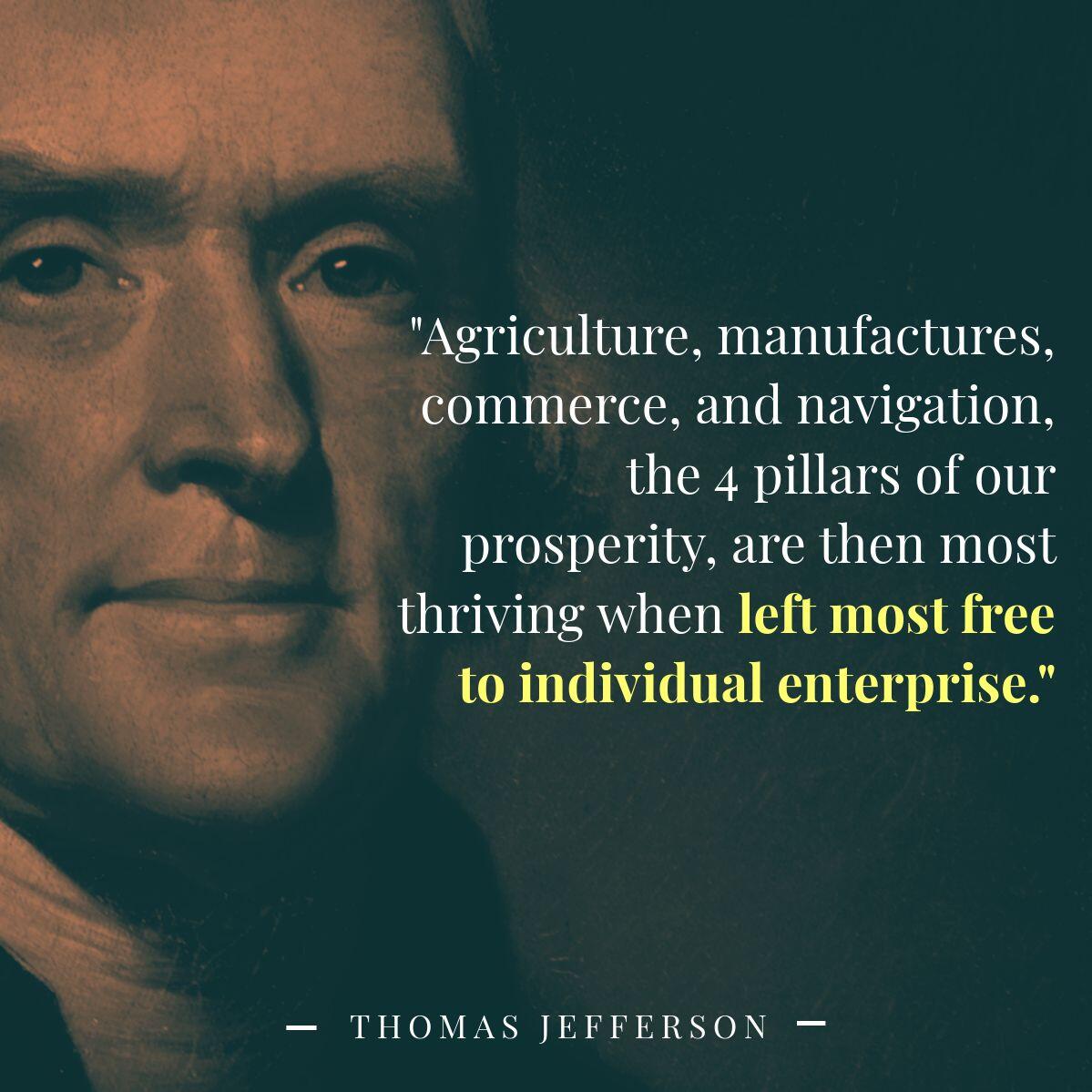
Worth reading these highlights from President Thomas Jefferson's first State of the Union address in 1801:
- The freedom of individual enterprise as the bedrock of American prosperity
- End to domestic federal taxation
- The role of the United States not as a world police, but as a place of "asylum" and "hospitality" for immigrants seeking a better life from around the world
- Depriving the Treasury of the means (revenue) to wage wars in advance
While there has been a lot of reporting and political outrage about illegal border crossings into the U.S., few journalists or policymakers have spoken to migrants themselves.
The surge in recent migrants from China is eye-opening: many are COVID lockdown refugees, fleeing what they perceive to be an arbitrary authoritarian regime that can take away their livelihoods at any moment, tanking the economy in the process:
“I sold everything that I had,” Huang [a migrant] said. “We were treated like caged animals.”
If we are serious about tackling the problem of illegal immigration, we need to do more than just police the border. We need to solve the problem at the roots, by creating an international political order where liberty is materially and systematically privileged over authoritarianism. We need to create fair trade agreements so that every country’s people have a shot at prosperity.
Ultimately, the solution to mass migration is to give people hope wherever they are. That is much harder than winning an election here and there: it calls for leadership based on principle.
aljazeera.com/economy/2024/2…
Mad respect for Rebecca for demanding respect to the bully’s face, in the moment.
One of the most important skills parents can teach their children is how to stand up for themselves *in the moment.* Bullies count on people being too embarrassed or afraid to “rock the boat.” Then the moment passes, and people wonder who is telling the truth, if it really happened that way, why the bully’s victim doesn’t “just let it go.”
Children need to know that sometimes “getting an adult” isn’t possible. Often the adult is on the bully’s side. If you don’t stand up for yourself, few others will. The miraculous thing is, though, when you *do* stand up for yourself, often the powerful—the “adults”—shift allegiances: they turn from the bully’s side to yours. But that doesn’t happen without a fight.
In the moment. To their face.
It’s much harder to learn this as an adult, but it can be done.
twitter.com/joshsmithhosts…
We are seeing who actually believes in human equality and meritocracy and who is just using those words to disguise and advance their own supremacy.
As Peter Boettke points out, the main distinction between schools of economic thought that fall into error vs. those that hold over time is whether they accept and build upon the reality of scarcity.
If you don’t assume scarcity, nothing that flows from that concept holds: the regulating function of prices, the incentive structures of property and jurisdiction, the ability of economic actors to make trade-off decisions and learn from them over time.
Quite simply, scarcity is the organizing principle of economics. Without it, we enter an antigravity world—of course not in fact (gravity continues to exist), but in ideas and action. Navigating a world based on a faulty world-model eventually leads to being wrecked.
I have more thoughts on this.
Hypotheticals like the trolley problem—which these “longtermist” arguments are—are attention-grabbers precisely because *there is no moral resolution to the problem.* Kill your family, or kill a million people? You can only choose one; which one do you choose? It’s a Sophie’s Choice: all answers to the problem create moral injury. There is no “good” or “right” answer.
People are titillated by the trolley problem because it seems to “reveal” that human beings are all immoral at root, or that evil is unavoidable because we all can be “forced” to do terrible things under certain circumstances. It reveals no such thing about “human nature”. All it shows is that we can get ourselves into terrible situations in which every outcome is tragedy. That should create motivation enough to prevent and preclude such situations wherever possible, not to succumb to them as though they are inevitable. THAT is where morality lies: taking responsibility for preventing trolley problems from ever arising in the first place.
There is a human situation in which trolley problems are virtually guaranteed, and that is war. In war, people have to make extreme decisions they would never otherwise make, and they are traumatized for life by their resolutions of *unresolvable* moral dilemmas.
This is why preventing and precluding war is one of the highest moral imperatives of human societies. A society functioning from the traumatizing moral logic of war is a monstrous society. Any argument that suggests that trolley problems need to be “baked into” the structures of social life as permanent resolutions to unresolvable moral dilemmas is fundamentally misunderstanding the conditions that generate human flourishing over time.
We ensure the flourishing of future generations of humans precisely *by* loving and caring for those dearest to us—our family and friends—courageously and above all other humans that we come into contact with. Not because they are “essentially” more valuable from some God’s-eye view, but because they are uniquely *ours* to love and to cherish.
Morality emerges from the responsibilities we undertake in concrete relationships with specific others, not from some abstract idea about how “valuable” lives are in relation to each other.
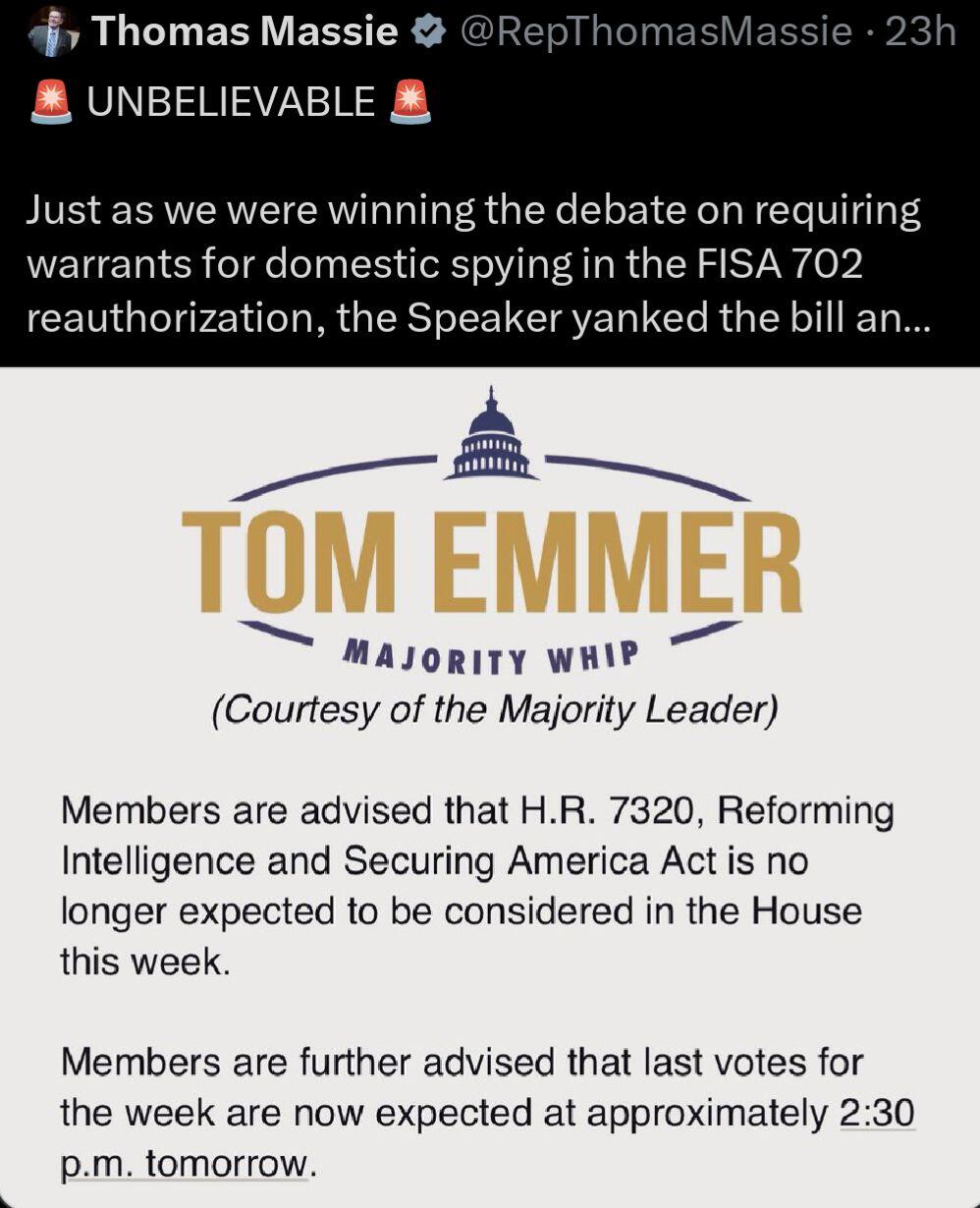
The manufactured “critical national security issue” memo, the Palantir CEO’s op-ed in Time, and National Security Advisor Jake Sullivan’s public statements all failed to get them the votes they need to reauthorize warrantless domestic spying, so they are suspending the legislative process.
Rep. Tom Emmer has been a vocal #bitcoin advocate in the past. It’s worth stating clearly that you can’t support financial self-sovereignty (#BTC ) without also supporting Constitutional limits on the government’s ability to collect information about Americans.
The American people need to keep this confrontation going. This bill should become un-passable.
Monetary policy always picks winners and losers. The arrangement of power in a society largely determines who those winners and losers are.
It’s almost as though when we “declare war” on something, we hyperaccelerate the proliferation of that thing.
War is slowed and halted by “turning swords into plowshares”, not by ramping up sword manufacturing, training, and distribution.
It should go without saying that the American people, like any other people, cannot pay the costs of the collapse of the system of international law. Even if they wanted to, it would be materially impossible. This is not about Israel, or Ukraine, or any other country. It is about the fact that the American people and the U.S. government simply cannot appropriate and create enough money to single-handedly finance the unilateral, violent “containment” of the collapse of the global system of national sovereignty. That work has to be done diplomatically, over generations. And it requires leadership with a kind of character that has been absent for a long time.
Reasons the Geneva Conventions prohibited the annexation of territory by conquest after the Second World War:
1. It is a Pandora’s Box that opens an endless litany of historical grievances and re-adjudication of existing borders through violence.
2. War is terrible and bad; it always and without exception produces atrocities that cannot be forgotten or forgiven, generating new grievances and new wars.
The United States should have spent the last several decades doing everything possible to protect and honor the Geneva Conventions. Instead we gave certain countries carte blanche to ignore them and also ignored them when it suited us. This has now opened the door to a world of hurt.
Now more than ever it is important to make the *positive* case for peace.
It is not enough--although it is vitally important--that we prevent and preclude war. The mere absence of kinetic violence is not peace. In fact, such "absence" often conceals all kinds of violence which threatens to erupt into armed conflict.
We must have a positive definition of what peace looks like. To develop such an understanding, we need a theory of human flourishing. This is the project I look forward to undertaking with my colleagues at the ISSP.
We don’t have a “Plan B” for the people and things we love.
Love is an absolute value—it demands everything.
It cannot be compromised (partly lived); it can only be fulfilled or sacrificed.
The most important thing Americans can do to stand for liberty and prosperity here and abroad is curtail the power of our own government.
We are being divided and conquered by debates about whether or not specific foreign governments and specific leaders are “good” or “bad.” That completely misses the point—the state is not to be trusted, period.
The peoples of the world either will or will not come to that conclusion for themselves. It’s not a decision we get to make for them. We *are* responsible for who we are and how we choose to live.
When we forget this, we are owned.
Part of the controversy around Bukele is that many observers don’t seem to have an account of when criminality shades into warfare. A few teenagers holding up and robbing a store is a crime. The occasional kidnapping and homicide is a crime. Institutionalized gang warfare, lasting generations and effectively strangling civil society and driving a refugee crisis, is really closer to war. Which makes sense, given the origins of Salvadoran gang violence in the Salvadoran Civil War.
The challenge for wartime leaders like Bukele is how to restore sufficient confidence in the institutions of state justice that the state of emergency can be truly sunset. This means creating a path for greater enfranchisement of the population in the political process, the institutionalization of conflict in the deliberative bodies of an elected legislature, and the peaceful transfer of power. It is extraordinarily difficult to thread this needle, and many countries end up collapsing back into warfare the moment a strong, charismatic leader is no longer in power. I hope for the people of El Salvador that the Bukele Government can transition the country to a stable, lasting peace.