
The rise of LLMs in education has made more apparent who is using the new technology as a prosthesis—to enhance their ability to learn—and who is using it to outsource responsibility for their own minds.
This outsourcing of responsibility is nothing new. People have been doing it since time immemorial: letting authorities, crowds, and received wisdom think for them. Technology only accelerates that. Technology shows us our character—and if we don’t like it, it gives us the opportunity to become better people.
There will always be alpha in thinking for yourself and being your own person. But it’s a much harder road than “going with the flow” and contenting oneself with the illusions of intelligence, virtue, insight, agency, and independence.
People who insist on learning and becoming in good faith will make mistakes; they will fail; they will look dumb; they will disagree with their past selves; they will repent; they will be humbled; they will forego opportunities for easy power and pleasure that others take advantage of.
But they will live truthfully, and it is the truth of their lives that will inevitably transform them—and, over time, the world.
Uncertainty increases transaction costs.
Graeber’s theory of money in “Debt” is basically MMT.
He doesn’t come out and say it—academics sometimes like to hide their views for various reasons—but that’s what it is.
For a thorough takedown, check out “Toward an Anthropological Theory of Money” in The Satoshi Papers.
Graeber is a fascinating storyteller, but a poor theorist of money.
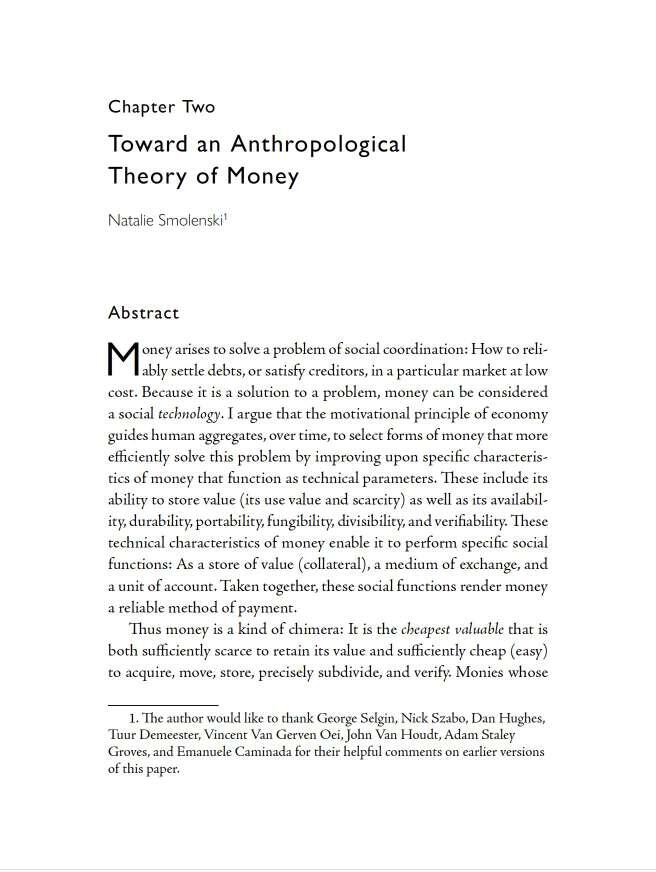
Order The Satoshi Papers here: https://www.amazon.com/dp/B0F1FNGYD9?ref=cm_sw_r_ffobk_cso_cp_apin_dp_PFNS3RGN8BBEVNCT190P&ref_=cm_sw_r_ffobk_cso_cp_apin_dp_PFNS3RGN8BBEVNCT190P&social_share=cm_sw_r_ffobk_cso_cp_apin_dp_PFNS3RGN8BBEVNCT190P&bestFormat=true&dplnkId=d05a9d4d-fc12-47ee-9975-30e00958d790
Do you think they know what the Triffin Dilemma is?
It’s wild to me that @LinkedIn still hasn’t implemented @Blockcerts.
Few know this, but every @MIT graduate gets a digital diploma anchored to #Bitcoin using the @Blockcerts open standard.
It’s the easiest way to verify claims on the internet.
https://registrar.mit.edu/transcripts-records/diplomas/digital-diplomas
The paper “Toward an Anthropological Theory of Money” contains a detailed response to #Graeber’s theory of money.
In a nutshell, my argument is that debt is a moral sentiment that precedes both law and money. In that sense, it is a social universal. However, methods of *reckoning debt* via units of account (which measure *price*, not “value”, as Graeber claims) had to await the invention of money, which emerged bottom-up as media of exchange in standardized commodity forms (what anthropologists have called “repeatable objects”). The state only got in the business of issuing (and in some cases monopolizing) money many millennia after this process had already been underway in human societies around the world.
Graeber, although sometimes identified as an anarchist, subscribed to the state theory of money as articulated by Alfred Knapp and in its current interpretation by the MMT school. His “anarchism” emerges in the implicit utopian political project he calls for in “Debt: The First 5,000 Years”: abolition of both money and state.
Peace emerges bottom-up.
This is why when the state is intent on war, it divides people and makes peaceful civic associations between them harder: harder to go to the same schools, to live in the same neighborhoods, to marry, to have children, to transact, to worship together.
If people aren’t talking, trading, and making babies, war is often on the horizon.
Wisdom involves making accurate and precise distinctions.
An enemy and an “existential threat” are not the same thing.
Danger and “existential threats” are not the same thing.
Anyone claiming there is an “existential threat” has a very high burden of proof.
Military conflict brings one of two outcomes: victory or defeat.
Neither of these are the same thing as peace, security, or prosperity.
The conditions of peace, security, and prosperity are created by the enduring character of a society. It’s shared *wisdom* in both thought and action.
“Tyrannus impius non habet spem
Et si quidem longae vitae erit
In nihilum computabitur.”
- The Book of Wisdom
We are being led by people trying to convince us to see the world in terms of enemies. This “politics of the enemy” leads to vast self-destruction and destruction of others. It routinizes hate. It makes us worse people.
The only way to counter a politics of hate is with a politics of love.
That does not require pretending that enemies don’t exist.
It requires meeting everyone—friends, strangers, and enemies—with love.
That’s the only way to actually win.
We win not when the enemy is destroyed but when calling them an enemy no longer makes any sense.
With government funding comes surveillance.
The more programs the government funds, the more everything is AML/KYC'ed, tracked, and controlled.
The problem is not so much that new technology is being used on the battlefield, but that there are no longer any laws or norms of war, and the battlefield is everywhere.
Promo pricing for The Satoshi Papers ENDS Feb 1st!
Library Edition: $174.95 → $199.95
Paperback: $33.95 → $39.95
Pre-order here
The redistribution Altman has in mind would certainly not enable the kind of rising standard of living enjoyed by a productive workforce—wealth would be “growing,” but only for the very few. Rather, it would bring about a neo-feudalism, or the transformation of the majority of human habitable spaces into permanent, fully-surveilled refugee camps.
Fortunately for humanity, I don’t think Altman’s vision for the future will come to pass. The advancement of technology does not hamper the ability of human beings to innovate. People will always invent new and productive things to do as technology advances. The fact that we can’t imagine the jobs our great grandchildren will have does not mean that those jobs won’t exist.
Follow-up: Those making predictions about AI “transforming society” need to make their claims a lot more precise. Every new technology “transforms society.” What exactly are you claiming is being or will be transformed in this case, and by what mechanism? Most of what passes as “commentary” on this topic is just wild speculation.
People invoking political solutions to problems have an especially high burden of proof to clear. You have to convince the American people that 1) there is a problem that 2) legislation, or another use of state power, can Constitutionally solve 3) in a way that preserves the values of liberty and opportunity that are central to the character of this Republic.
The fact that something is new and makes people uneasy is not, in itself, a justification for any action whatsoever, especially not by the state.
Anthropologist here:
Sam’s claim that “the whole structure of society will be up for debate and reconfiguration” because of AI is meaningless. It literally means nothing.
It *is*, however, part of Sam’s pattern of existentialist scaremongering. Scaremongering to which the solution always seems to be to give Sam more power.
Sam’s suggestion that “the whole social contract” is up for grabs is a *political* claim. The social contract that underpins the political institutions of the United States is crystallized in the U.S. Constitution.
Sam is implying that AI will soon be so powerful that this Constitutional political order will no longer hold. He can then position himself as a savior—as an author of the new, “post-AI” social contract. Which, like all the other contracts he negotiates, are structured principally to benefit Sam Altman. And these contracts tend to change whenever Sam decides they should.
While AI is certainly advancing at a rapid clip, it is human beings who continue to be in charge—and responsible for—our social and political destinies. We can absolutely choose to uphold the Constitutional social contract that the American Founders put in place. I would strongly suggest we do.
Of course, as a free people, we can also choose to alter that contract. But if we do, it should be for *positive* reasons, not reasons driven by weakness and fear.
Anyone selling you fear is selling you control. Don’t buy it.
Fascinating piece on the anthropology and economics of prison gangs. ⬇️
Gangs, like clans, are a form of governance that arises organically when populations reach a certain *scale.* Exploding prison populations in certain U.S. states (Texas, California, New York, Chicago) mean that prison officials can’t effectively govern them all. Gangs step in to fill the void.
Political economist David Skarbek: “So each of these is consistent with a causal claim that big, diverse communities that can’t rely on official governance tend to form gangs. If you look at clan-based societies, they’re socially organized in a very similar way. And I hadn’t discovered this clan literature until I finished writing my book. But clans form when there are not strong and effective state based institutions, and when groups are large enough that they can’t rely on these informal mechanisms. So there’s a similar phenomena arising in certain times and places like we might expect.”
I wrote about the Solidarity (Solidarność) movement that toppled communism in Poland, and its similarity to the #Bitcoin movement today.
I spotlight the song "Noah's Ark" (with a full English translation!) by "bards of the resistance" Jacek Kaczmarski, Przemysław Gintrowski, and Zbigniew Łapiński.
https://bitcoinmagazine.com/culture/arka-noego-noahs-ark-on-solidarity-and-bitcoin
In his response to Marc Andreessen, Yuval Levin of the @AEI and @tnajournal points out that what humanity needs to become the builders Andreessen calls for is a "fuller anthropology":
"an understanding of the nature of the human person and the character of human flourishing that could help [the builder] see that what we most need to build are families and communities, and that technological progress ultimately cannot be sustained without the kind of cultural confidence that makes itself evident first and foremost in a commitment to the next generation."
Levin repeats throughout his essay that many Americans today don't know how to be good ancestors: how to build for future generations who will enjoy the world after them. He calls this blindness characteristic of all "decadent" societies--and I think this is an astute observation.
There is an important extension of this thought: those who don't know how to be ancestors also often don't know how to be inheritors. I have witnessed this in many American universities: confusion over canon, a desire to reject or cancel thinkers who were instrumental in building the institutions we now inhabit, a desire to change things that have been working well just to put one's own "individual mark" on the institution. There is a kind of graceless lack of charity toward past generations which mirrors the difficulty of caring about future generations. The general result is that students suffer. They are not only robbed of their own inheritance, but they learn socially destructive attitudes, which they often go on to mimic later in life.
Kinship is one of the oldest concepts in anthropology--and one of the oldest social technologies on Earth. The anthropological discipline was born, during the 19th century, largely through the comparative studies of kinship around the world.
Kinship is the most fundamental way that human beings imagine their world and their place in it. Every human infant comes to know itself first in relation to its mother or father--the primary caregiver who is most closely in sync with the provision of its basic survival needs. As the child grows, it builds out its model of the world first in terms of kin, and that becomes a kind of "scaffolding" for everything else.
A crisis of kinship--defined in terms of Levin's essay as the incapacity to be good inheritors and good ancestors--is a crisis of humanity. Here it is important to remove some of the value judgments that often accompany crises. A structural crisis is no particular individual's "fault," although a cascade of irresponsibility is often both a cause and a result of human-generated crises. Rather, crisis points to the fact that something that was previously working (or seemed to work) no longer does. We must ask what about the previous arrangement was unsustainable and adapt our institutions for the future--in light of *who we want to be, as individuals and as a people.*
This means that learning to be good ancestors and good inheritors requires something of us beyond simply "returning" to past models of kinship that may have worked, provisionally, for other human societies. As L. P. Hartley said, "The past is a foreign country." The answer to any society's ills cannot simply be importing the cultural practices and values of another--including those of its own society in the past. Such importation simply cannot be done, because the past no longer exists.
Rather, we must be in integrity with who we are today--and that means admitting and accepting the particular challenges that afflict us as well as the particular opportunities we have that are ours to seize. Levin quotes Ecclesiastes:
"To every thing there is a season, and a time to every purpose under heaven. A time to be born, and a time to die; a time to plant, and a time to pluck up what was planted. A time to kill, and a time to heal; a time to tear down, and a time to build. (Ecclesiastes 3:1–3)"
Becoming a good inheritor and a good ancestor thus requires, first and foremost, recognizing what is *ours*--who and where *we* are in relation to our past and future kin.
The questions we must ask mirror this ancient text:
What is *our* season?
What is *our* purpose?
What is *our* time to live, and *our* time to die?
What shall *we* plant, and what shall *we* harvest?
What shall *we* kill, and what shall *we* heal?
What shall *we* tear down, and what shall *we* build?
Every individual person must answer these questions for his or her own life. And every community--that collective of shared will and action--gets to answer them for itself as well