
Do you know a college-aged young person interested in #Bitcoin?
Consider sharing this exciting initiative with them!
--------------------
The future doesn’t just happen - it’s built by us, by a you and a me (h/t @NSmolenski at @btcpolicyorg's Summit ‘24).
That’s why we started “Layer Zero.” This summer, step out of the classroom and into the world. Immerse yourself in communities worldwide, where you’ll build real-world solutions & champion innovation.
Satoshi said "Bitcoin" twice in the white paper. "Network"? Twenty-one times. Progress happens when people come together and Layer 0 is the heartbeat and foundation of the Bitcoin ecosystem.
⚡ Applications close Feb 15.
👉 Apply now: form.typeform.com/to/FXfttZrK
👉 Learn more: bitcoinstudentsnetwork.org/layer-zero
The future is ours to build.
#Bitcoin #LayerZero
The reason studying the “history of economic thought” matters from a scientific (rather than merely historical) standpoint is to understand how key concepts and theories in the field of economics are justified.
For example, an economist should be able to take to root an account of why profit-and-loss accounting is a key component of a “free” market economy.
This does not mean studying old texts for their own sake. Any science that is truly a science advances, and practitioners should not need to reconstruct the entire history of the field to practice their science. You don’t need to read Leibniz to understand and use calculus, for example.
But economics, like all the social sciences, must have a keen grasp of the objects within its domain. The objects of mathematics are often quite clear; the objects of economics less so. Thus, at this stage in the development of the field, they need to be justified—that is, described in a way that can be objectively verified.
The antidote to control is responsibility.
Grimes asks a good question: "Who is a philosopher?" Before we can answer it, we must first answer, "What is philosophy?"
The truth is there is no consensus on this--although there are ways to approach such a consensus. Etymologically, the word philosophy means "a love of wisdom," but then what is wisdom? Is wisdom different from, say, science? Is philosophy, then, something different from science, or is it itself a scientific practice?
Every state (that is, centralization of power) either starts as or trends toward dictatorship. No exceptions.
Political theory must begin here.
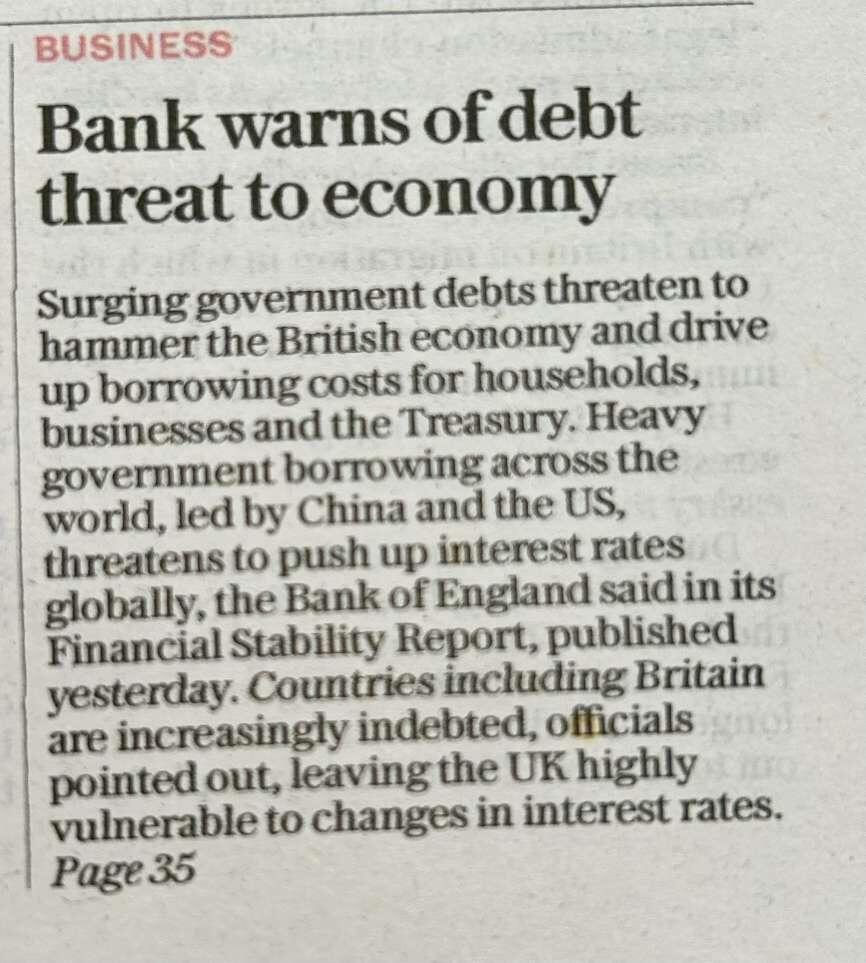
“Chancellor on Brink of Second Bailout for Banks” - 2024 Edition
(From the @dailytelegraph)
#SovereignDebtMatters
The Texas Bitcoin Foundation is excited to share a chapter of The Satoshi Papers just in time for the Thanksgiving Holiday—“Then They Fight You,” by @Avik Roy.
Avik explains why #Bitcoin adoption is in the interests of both the American people and the US government.
Clear, well-researched, and concise, this analysis will be accessible both to families and policymakers across the country.
Pre-order your copy of The Satoshi Papers at a Black Friday discount, below! ⬇️ #Bookster
No, going along with the narrative that AI companies care about “safety” has nothing to do with gullible, childlike “neurodivergence” and everything to do with the ability to think and be honest with oneself.
Think: What are this company’s incentives? What do its actions over time show that it is consistently solving for?
Think: Has anyone at this company actually defined “safety?” Technically? Legally? Interpersonally?
Think: What are my incentives? What do I *really* want? What am I personally solving for that this job is attractive to me?
Just asking those questions should be enough to disabuse anyone of the convenient stories that 1) the companies they work for prioritize “AI safety” (whatever that is) and 2) their own illusions that they are “pure” moral actors navigating a fallen world. Both the companies and their employees are making rational decisions based on their own values and priorities.
We need to stop giving people outs for their own moral responsibility—whether that is due to neurodivergence, mental illness, or anything else. These are full-grown adults making real decisions that affect their own lives and the lives of others.
Choosing to work for a company building AI tools is neither essentially good nor bad. Just be honest about what the company is doing and the ways you have chosen to participate—or not.
The Tornado Cash ruling is undoubtedly good news. However, the court also spells out clearly the path that the U.S. Congress could take to make mixers illegal: amending the IEEPA.
As the “Introduction” to The Satoshi Papers shows, the IEEPA (International Emergency Economic Powers Act) and the NEA (National Emergencies Act) were both passed in the 1970’s to enable the U.S. President to bypass Congress and directly govern by Executive Order—so long as he claims it is a “state of national emergency.”
“Governance by national emergency” has become a primary way that unaccountable executive power has been used since the Carter Administration—particularly through the unilateral imposition of economic sanctions by U.S. presidents. All presidents of all parties have used this power, and they do so with increasing frequency. The NEA and the IEEPA are the legislative authority that U.S. presidents rely on to function as dictators, exerting personal economic control over anyone, anywhere in the world through their enforcement arm: the U.S. Treasury Department.
These laws must be abolished if we are to once again become a free society. That is the truth.
We talk a lot about the Federal Government’s sovereign privilege to print money to pay off debt. (For this reason, many believe government debt doesn’t matter.)
State and local governments do not have this privilege.
Government dysfunction is often easier to see at the state and local levels for this reason.
At the end of the day, collateral—things of actual value—backstops the whole debt system. The productivity of citizens is the ultimate collateral.
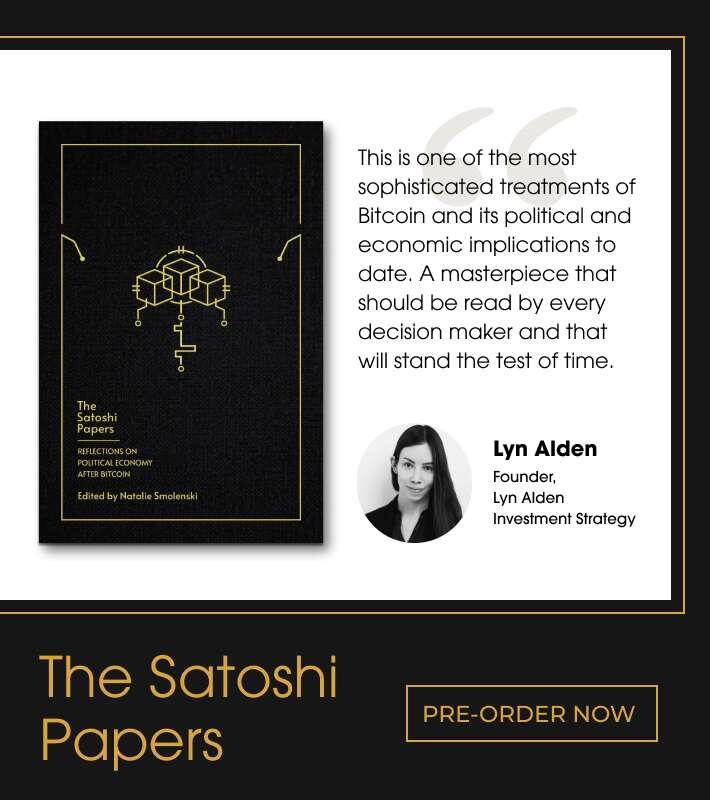
So grateful to the brilliant @LynAldenContact for this vote of confidence in The Satoshi Papers. 🙏♥️💪
This means so much to me and to all of the authors of The Satoshi Papers.
"The Satoshi Papers" is now available for pre-order! 🥳🚀🎄 LINK BELOW ⬇️
The @TXBitcoinFound's first book features ten essays by some of the world's leading #Bitcoin scholars examining what happens when a key function of the state--the issuance of money--is automated by a stateless, global protocol.
As an artifact, "The Satoshi Papers" is also a rare feat in the publishing world today: a limited-edition, hardbound Library Edition with gilded pages. We went out of our way to produce an object of the highest quality that Bitcoiners can be proud of: scarce, valuable, and made with ideas and materials that stand the test of time.
The Library Edition is designed to be a precious gift and lifelong keepsake. Only a few will ever be printed. These books are destined to circulate as collectible objects, monuments to our current era in the history of Bitcoin adoption.
The Foundation also recognized that the Library Edition may not be accessible for everyone, so we made a paperback edition that all can enjoy. Whether you order the Library Edition or the paperback, you are supporting the Foundation's work as a volunteer-led, educational charity.
The launch dates for both the Library Edition and the paperback are still being finalized, but both editions will start shipping in early 2025. I will share with you the official publication dates as soon as they become available.
Please also stay tuned for news of the Satoshi Papers Book Launch Event, which is being planned in Austin, TX in 2025. We look forward to welcoming you and celebrating this achievement together.
Together in truth and self-sovereignty! 🫶✊
https://store.bitcoinmagazine.com/pages/the-satoshi-papers?_pos=3&_sid=aa9a82d9b&_ss=r
A Nation of Individuals?
https://bitcoinmagazine.com/culture/a-nation-of-individuals-
Join me, @RebelEconProf, and @Avik Roy (founder of @FREOPP) at the @NABSummit on November 20 in Dallas, TX!
Our panel discussion, "US Global Leadership: #Bitcoin & the Dollar," will cover how the US Treasury became the world's global reserve asset and the relationship between that reality and our fiscal future. We will also examine three model scenarios for Bitcoin adoption in the United States.
northamericanblockchainsummit.com
Perhaps it’s time we just started calling Neocons “imperialists.”
There is nothing “neo” about their worldview. The urge to conquer and subjugate others is as old as humanity itself.
I would love to see honor become a cultural value in America again.
- Keeping our word to our friends, to strangers, and to our enemies.
- Speaking and acting in good faith.
- Having a consistent moral compass that guides us in both good and bad times.
- Changing our minds when presented with better evidence or arguments.
- Being able to have hard conversations without melting down, blaming, shaming, or retaliating.
- Standing in solidarity with people who are different from us without needing to valorize or demonize any part of that coalition.
Honor enables us to keep and nurture relationships over time. A world without honor is a bleak hellscape of shallow, transactional relationships and betrayal. You can’t build anything without honor; not friendships, not families, not companies, not countries, and certainly not a civilization.
No matter what we do, if we do it with honor, we have hope that any mistakes we make, errors of judgment, or misunderstandings can be corrected over time. And we have hope that other honorable people will continue to stand with us.
Honorable people hold up the world.
It starts with us. We can do this. 💪
These “precarious elites” do see their exploitation as a structural problem, but they blame “capitalism” instead of the brute fact of supply and demand: there are just too many of them competing for the same few prestige jobs. While the American worker imagines a path to better pay and working conditions through organizing, the precarious elite sees no such path—because for them *status* is just as, if not more, important than pay and benefits, and that is something much harder to negotiate. Elites insist that *they should be able to do exactly the (prestigious) jobs that they want to do.* They are also educated enough to have read the socialist and communist literatures. That combination leads to the fantasy that the government could force their employers not only to pay them more and treat them with dignity—which in some cases it could, certainly—but also to guarantee these conditions *in prestige jobs* for everyone who wants them.
There likely is a legitimate case to be made that some of these prestige employers are violating labor laws and should be held accountable. In other cases, there are certainly opportunities to pass new laws prohibiting what amounts to indentured servitude. But actually enforcing these laws will only reveal what is already plain as day: that there are far fewer prestige jobs than there are elites who want them.
The double bind for elites is that the prospect of taking a “lower status” job—even one that pays a lot more, where workers are treated significantly better—is even worse than being a de facto slave with a prestigious role. This leads precarious elites to demand a magical solution: the state. The state must not only protect workers, but guarantee certain kinds of jobs at certain levels of pay and benefits for anyone who wants them. Needless to say, this demand can never be fulfilled, and the cycle of partisanship is then retrenched: precarious elites blame American workers for having the gall to vote and organize based on self-interest, rather than to crusade for an idyllic state of affairs that will not come.
The shift of the American working class from the Democratic to the Republican Party in this last election, and the outrage it has generated among many leftist American academics, has led me to reflect on why so many academics become strong socialists or even communists, while the vast majority of the American “working class” do not.
They would likely call it “false consciousness” on the part of the American worker. By I see it as false consciousness among elites: they *do not recognize that they are elites,* and that their social status motivates them differently from how the typical American worker is motivated. In short, there is a difference between economic *class* (being a “worker”) and social *status* (being an “elite”). In this I am convinced that Peter Turchin’s structural-demographic theory continues to have explanatory power. (I won’t go into that here, but do check out his work.)
Socialism and even communism carry strong appeal for a specific kind of highly educated, young elite today: the kind that needs to work for a living, but still sees itself as elite. These are not “white collar workers;” they are “precarious elites.” They are subject to a dynamic that few want to talk about:
Some of the worst labor exploitation in this country occurs in so-called “prestige industries.” These include education (higher and lower), entertainment, journalism, publishing, art, philanthropy—even, on the higher-paid end, investment banking and other financial services.
You want to help a celebrity launch a new brand or product? Prepare to make $35,000 a year and work 24 hours a day, 7 days a week, doing countless frenzied tasks that have nothing to do with your job description.
You want to teach philosophy at a University? Get ready to make $17,500 a year, if you’re lucky. If you’re an international graduate student, your visa to stay in the U.S. is also completely contingent on your advisor’s approval; as a result, abuse is rampant.
You want to write for The Atlantic or The New Yorker? You can maybe get a few hundred bucks per article as a freelancer; $60K per year as a staff writer, if you’re lucky.
You want to become a powerful banker? You may start at $150K per year right out of college, but you will work 80-120 hours a week at the expense of everything else in your life, no telling how long—certainly for years. Your mental and even physical health are the price you pay for this “opportunity.”
These are the jobs that children of elites want. They want these jobs so much that they are willing to subject themselves to highly fragmented, authoritarian, and toxic work environments, with such high turnover, particularly of junior workers, that it’s socially a war of all against all. These jobs are different from working at a factory or an established company—there is a “musical chairs” dynamic, authority is exercised arbitrarily and chaotically, the job tasks can change daily and even moment to moment, most relationships are based on dominance/submission, and there is no “solidarity.” Employers believe it’s a “privilege” for anyone to have these jobs, and that therefore no one in them has the right to complain. Their refrain: “There are always 100 more candidates ready to take your place.”
In addition, there is the psychology of being an elite: you expect to be treated better by virtue of your education and social status, so it can be shameful to admit that you are being abused and might need to fight for better working conditions. Young elites may even want to organize and collectively bargain, but they don’t know how—they’ve been carried along by their social status in extremely authoritarian and chaotic environments and may never have really built anything with others over time.
For many young precarious elites, therefore, socialism becomes a kind of dream of not only of a good workplace but of a good society—one where they get what they believe is their “due.”
Yes, economics is a science.
The astronomer and polymath Copernicus not only discovered that the Earth orbits around the sun, but argued that the quantity of money affects the purchasing power of money. He also described both Gresham’s Law and the Cantillon Effect decades before their eponymous elaborators.
The point is not who was “first” to come up with a theory (that is irrelevant for the science itself), but that multiple scientists were independently coming to the same conclusions about the social phenomenon that is money.
Observations that are considered “political” today will be simply folded into the scientific knowledge of the future. That is how progress is made.
No, #AI cannot and will not allocate capital “more rationally” than human economic actors.
This is because the information that is navigated by allocators of resources is not just information about past actions but the *subjective nexus of motivation and will* that is *actively being generated* by living economic actors in every moment.
This *cannot* be determined in advance.
No amount of computational power can model the present and future valuations, motivations, and actions of all living subjects interacting to form markets and economic ecosystems with perfect accuracy.
The planning problem continues to have no resolution.
The “institutions” people rarely if ever address the question of scale.
How exactly are you going to “achieve social consensus,” as @DAcemogluMIT says we must, at a scale of 336 million people (population of the U.S.)? 30 million people (population of Texas)? 7 million people (population of Houston metro area)?
Human beings evolved in communities of under 150 people (the Dunbar number). Beyond that, “consensus” (in any active, intentional sense) becomes very difficult.
Perhaps the key to achieving social consensus at larger scales is for those institutions to do less. A lot less.
But somehow that never seems to be on the table for mainstream social scientists.