🌊 SURF 'N TURF 🏝️
-THE ISLAND LIFE-
SEVEN LESSONS FROM THIS PICTURE
✅ 1. Not all opportunities are to be taken.
Some are traps.
✅ 2. A person can become so determined to destroy another person that they become blind and end up destroying themselves.
✅ 3. You fight best in your natural element and environment.
Here the bird has advantage in his natural element.
✅ 4. Know your limits, we all have them.
✅ 5. Sometimes the best response to provocation is not to fight.
✅ 6. Sometimes to accomplish something you need team work, you will not always win alone.
✅ 7. Stick to what you do best and don't pursue what will kill you.

Credits goes to the respective
Author ✍️/ Photographer📸
🐇 🕳️
#Bitcoin #Satoshis #Freedom #Apocalypse #Music #Movies #Philosophy #Literature
#Grownostr #Stoicism #Nature
APOCALYPSE ANONYMOUS by
ATOSHI ANARKOMOTO
🌊 SURF 'N TURF 🏝️
-THE ISLAND LIFE-

Plato and Aristotle stand as pillars of Western thought, each representing foundational perspectives that have shaped centuries of philosophy, science, and spiritual traditions, including the esoteric frameworks of Hermeticism. To grasp their influence on Hermetic thought, it's essential to understand how each thinker framed reality itself and the path to knowledge—a dichotomy that touches on the core of the Hermetic quest for unity and understanding.
Plato’s Idealism and the Notion of Higher Realms
Plato’s philosophy, particularly his concept of "Forms," suggests that the material world is but a shadow of a higher, perfect realm. In his allegory of the cave, Plato describes humanity as chained prisoners, able only to see the shadows of real objects projected on the wall, mistaking these shadows for reality. True knowledge, Plato argues, comes not from observing these shadows but from contemplating the unchanging, eternal Forms—the abstract, perfect archetypes that transcend the material world.
This Platonic worldview resonates deeply with Hermetic principles, which similarly emphasize the existence of higher, spiritual realities that lie beyond ordinary perception. Hermeticism teaches that beneath the veil of the physical world lie realms of pure consciousness and divine intelligence.
This notion of transcendent truth aligns closely with the Platonic ideal that there is a reality beyond the senses, accessible through the mind, the spirit, and higher intuition. In this sense, Plato’s Forms mirror the Hermetic concepts of archetypal truths, accessible only through inner enlightenment, meditation, and spiritual awakening. Just as Plato’s philosopher is called to transcend the shadows of the cave, the Hermetic seeker is called to look beyond the illusions of the material world and to connect with the divine essence of all things.
Aristotle’s Empiricism and the Value of the Material World
In contrast, Aristotle took a different approach, grounding his philosophy in the empirical world. He saw knowledge as something that comes through observation and experience rather than purely abstract thought. Aristotle believed that form and substance are inseparable, that essence is not hidden away in another realm but embedded within the things themselves. According to him, we gain understanding by studying these physical forms and processes, dissecting them, and learning through direct engagement with the world around us.
This perspective finds its echo in the alchemical side of Hermeticism, which, unlike the strictly mystical paths, values physical transformation as a sacred mirror of spiritual evolution. Alchemists worked with the materials of the earth—lead, gold, mercury—believing that in transforming these elements, they were enacting a microcosmic version of the soul’s journey toward enlightenment.
Through the symbolic manipulation of earthly substances, the alchemist sought to understand the spiritual transformations that lead the soul back to its divine origin. In this way, Hermeticism does not dismiss the physical world as a mere illusion, as might be suggested in a purely Platonic view, but rather sees it as an essential aspect of spiritual growth. Like Aristotle, the Hermetic path acknowledges the value of direct experience and the lessons embedded in the material realm.
Bridging Idealism and Empiricism in Hermetic Thought
Hermeticism harmonizes these two seemingly opposing philosophies by teaching that the inner and outer worlds, the ideal and the material, are two expressions of a singular reality. Hermetic philosophy emphasizes the maxim "As above, so below; as within, so without," which beautifully encapsulates this union of Platonic idealism and Aristotelian empiricism.
This principle suggests that the spiritual realm (Plato’s Forms) and the material world (Aristotle’s observable reality) reflect one another and are interconnected. In other words, the soul's journey to enlightenment is not a rejection of the physical world but a deeper engagement with it. The seeker is called to see the divine in the earthly, the infinite within the finite.
Plato’s idealism brings us to recognize the unseen, higher truths, nudging us toward the esoteric wisdom that lies beyond sensory experience.
Aristotle’s empiricism, meanwhile, grounds us, reminding us that spiritual growth is not a path of escapism but one of profound integration with the here and now. True Hermetic practice demands an alchemical process that unites these principles, transforming the mundane into the divine. It is a path that does not merely seek to know but to become, through direct experience and inner realization.
The Inner Alchemy: Fusing Intuition and Reason for Spiritual Enlightenment
Hermeticism thus bridges the Platonic and Aristotelian paradigms, recognizing that spiritual enlightenment involves both the mind’s abstract vision and the heart’s lived experience. Just as an alchemist transforms lead into gold, the Hermetic seeker transforms ordinary awareness into divine insight by integrating thought, emotion, and experience into a unified spiritual understanding.
Plato’s Forms remind us that there are unchanging truths, archetypes, and spiritual realities that anchor the cosmos; Aristotle’s empiricism reminds us that our journey requires a full-hearted engagement with the world around us.
Hermetic wisdom teaches that both the Forms and the physical world are manifestations of the One, the Divine Source from which all things emanate. Plato’s vision of an unchanging realm of archetypes complements Aristotle’s insistence on the study of tangible reality, both pointing toward a unified truth that Hermeticism seeks to embody: that the cosmos is an interconnected whole, with spirit and matter intertwined. To experience this wholeness is the goal of Hermetic practice, where the ideal and the real meet, just as the soul meets the divine.
In this balanced perspective, the Hermetic seeker becomes both the philosopher contemplating the Forms and the alchemist engaging with physical transformation. This dual approach enables the seeker to bridge the divide between thought and action, spirit and matter, idealism and empiricism—a journey not only toward knowledge but toward wholeness and spiritual unity.
Credits goes to the respective
Author ✍️/ Photographer📸
🐇 🕳️
#Bitcoin #Satoshis #Freedom #Apocalypse #Music #Movies #Philosophy #Literature
#Grownostr #Stoicism #Nature
APOCALYPSE ANONYMOUS by
ATOSHI ANARKOMOTO
🌊 SURF 'N TURF 🏝️
-THE ISLAND LIFE-

Mark Twain's Pudd'nhead Wilson, a masterfully crafted social critique, delves into the heart of darkness of the antebellum South.
With his characteristic wit and biting irony, Twain exposes the grotesque absurdity of racial prejudice and the corrosive impact of slavery on society.
The novel centers on a startling premise: the accidental switch at birth of two infants, one white and one Black. As the boys grow up, their lives diverge dramatically due to the arbitrary construct of race. This audacious plot device serves as a powerful indictment of a society built on such a fundamental falsehood.
Twain introduces the enigmatic figure of Pudd'nhead Wilson, a man ahead of his time, who uses science to challenge the prevailing racial stereotypes. Through Wilson's eyes, the reader is invited to question the very foundations of identity and the destructive power of prejudice.
Beneath its satirical veneer, Pudd'nhead Wilson is a poignant exploration of the human condition. Twain's characters are complex and multifaceted, defying easy categorization. The novel is a stark reminder of the enduring power of storytelling to illuminate the darkest corners of the human heart.
With Pudd'nhead Wilson, Twain delivers a powerful and provocative work that continues to challenge and provoke thought long after the final page.
Credits goes to the respective
Author ✍️/ Photographer📸
🐇 🕳️
#Bitcoin #Satoshis #Freedom #Apocalypse #Music #Movies #Philosophy #Literature
#Grownostr #Stoicism #Nature
APOCALYPSE ANONYMOUS by
ATOSHI ANARKOMOTO
🌊 SURF 'N TURF 🏝️
-THE ISLAND LIFE-

Alexandre Cabanel was 24-years-old when he painted L’Ange Dechu (The Fallen Angel) in 1847 as an academic oil on canvas painting. It is currently stored at the Musée Fabre in France.
The Fallen Angel is perhaps one of the most popular works of art ever created. Behind flexed arms, a winged nude hides his face. His brows arch over red-rimmed eyes and a tear of rage as his mane of hair breaks in the wind. Of course, his physique is flawless. Although his posture seems relaxed, each muscle is tensed and ready to fire. This is the last moment before he is cast out of paradise. An angel who has fallen from grace and has been banished by God.
Cabanel’s inspiration for this work was John Milton’ epic poem, Paradise Lost (1667) and fallen angels: Moloch, Belial, Mulciber, Mammon and Beelzebub. The last of whom is Beelzebub, better known today as Lucifer.
Credits goes to the respective
Author ✍️/ Photographer📸
🐇 🕳️
#Bitcoin #Satoshis #Freedom #Apocalypse #Music #Movies #Philosophy #Literature
#Grownostr #Stoicism #Nature
APOCALYPSE ANONYMOUS by
ATOSHI ANARKOMOTO
🌊 SURF 'N TURF 🏝️
-THE ISLAND LIFE-

The Trevi Fountain (Italian: Fontana di Trevi) is an 18th-century fountain in the Trevi district in Rome, Italy, designed by Italian architect Nicola Salvi and completed by Giuseppe Pannini in 1762.
Credits goes to the respective
Author ✍️/ Photographer📸
🐇 🕳️
#Bitcoin #Satoshis #Freedom #Apocalypse #Music #Movies #Philosophy #Literature
#Grownostr #Stoicism #Nature
APOCALYPSE ANONYMOUS by
ATOSHI ANARKOMOTO
🌊 SURF 'N TURF 🏝️
-THE ISLAND LIFE-

Phryne, white marble, on a faux marbre, bronze and gilt bronze revolving base, 169 cm / base 82 cm.

Phryne was a famous hetaira, a prostitute that was invited in many symposia because of the vast knowledge she had about various matters of the state or of philosophy.
The statue is in a private collection.
By Francesco Barzaghi.
Credits goes to the respective
Author ✍️/ Photographer📸
🐇 🕳️
#Bitcoin #Satoshis #Freedom #Apocalypse #Music #Movies #Philosophy #Literature
#Grownostr #Stoicism #Nature
APOCALYPSE ANONYMOUS by
ATOSHI ANARKOMOTO
🌊 SURF 'N TURF 🏝️
-THE ISLAND LIFE-

In 480 B.C. a state of war exists between Persia, led by King Xerxes (Rodrigo Santoro), and Greece.

At the Battle of Thermopylae, Leonidas (Gerard Butler), king of the Greek city state of Sparta, leads his badly outnumbered warriors against the massive Persian army. Though certain death awaits the Spartans, their sacrifice inspires all of Greece to unite against their common enemy.

300: Rise of an Empire.
300 is a 2006 American epic historical action film[4][5] directed by Zack Snyder, who co-wrote the screenplay with Kurt Johnstad and Michael B. Gordon, based on the 1998 comic book limited series of the same name by Frank Miller and Lynn Varley.

The film, like its source material, is a fictionalized retelling of the Battle of Thermopylae in the Greco-Persian Wars. The plot revolves around King Leonidas (Gerard Butler), who leads 300 Spartans into battle against the Persian "God-King" Xerxes (Rodrigo Santoro) and his invading army of more than 300,000 soldiers. As the battle rages, Queen Gorgo (Lena Headey) attempts to rally support in Sparta for her husband. The film also features Michael Fassbender in his film debut
Credits goes to the respective
Author ✍️/ Photographer📸
🐇 🕳️
#Bitcoin #Satoshis #Freedom #Apocalypse #Music #Movies #Philosophy #Literature
#Grownostr #Stoicism #Nature
APOCALYPSE ANONYMOUS by
ATOSHI ANARKOMOTO
Absolutely 💯. Gods just make up their own rules. They don't give a damn. They are like honeybadgers 🧡
🌊 SURF 'N TURF 🏝️
-THE ISLAND LIFE-
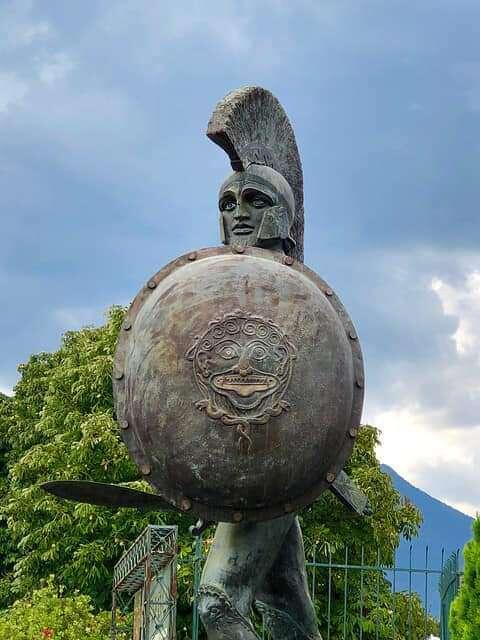
Details of the Spartan King Leonidas, exposed in a public area in present day city of Sparta.
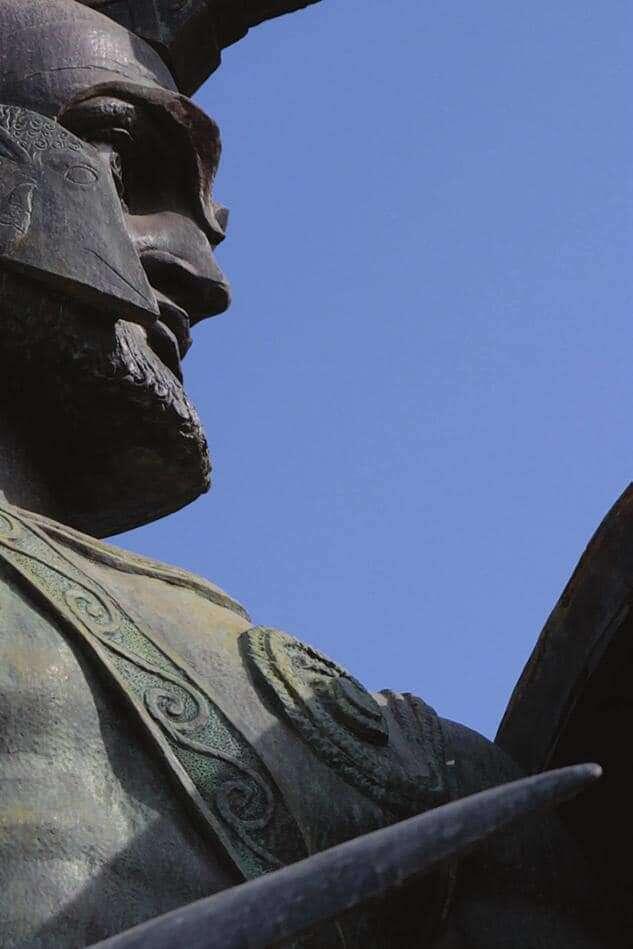
Leonidas was the Spartan King in the battle of the 300 at Thermopylae, at 480 bC.
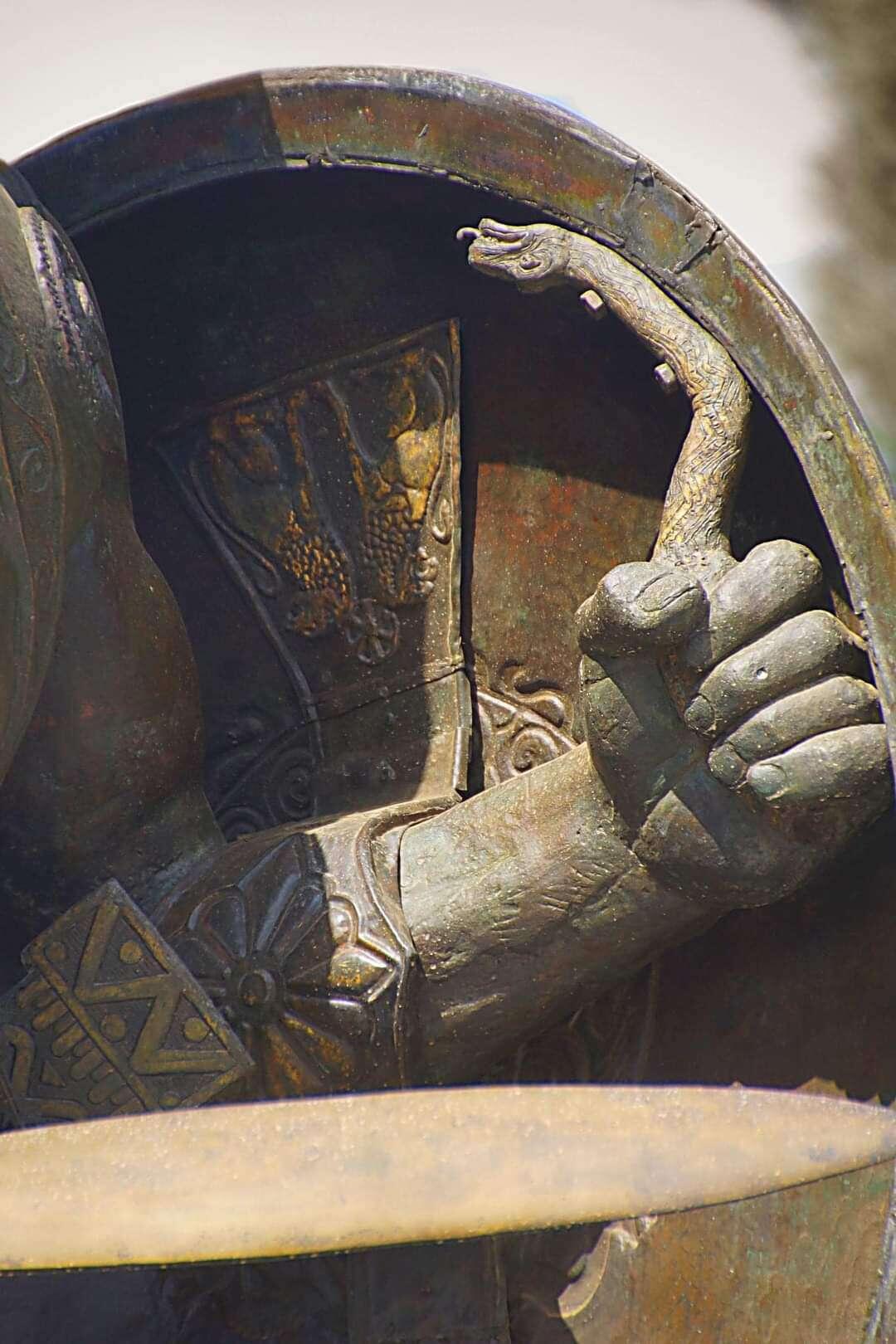
Leonidas I (/liəˈnaɪdəs, -dæs/; Greek: Λεωνίδας, Leōnídas; born c. 540 BC; died 11 August 480 BC) was king of the Ancient Greek city-state of Sparta. He was the son of king Anaxandridas II and the 17th king of the Agiad dynasty, a Spartan royal house which claimed descent from the mythical demigod Heracles. Leonidas I ascended to the throne in c. 489 BC, succeeding his half-brother king Cleomenes I. He ruled jointly along with king Leotychidas until his death in 480 BC, when he was succeeded by his son, Pleistarchus.
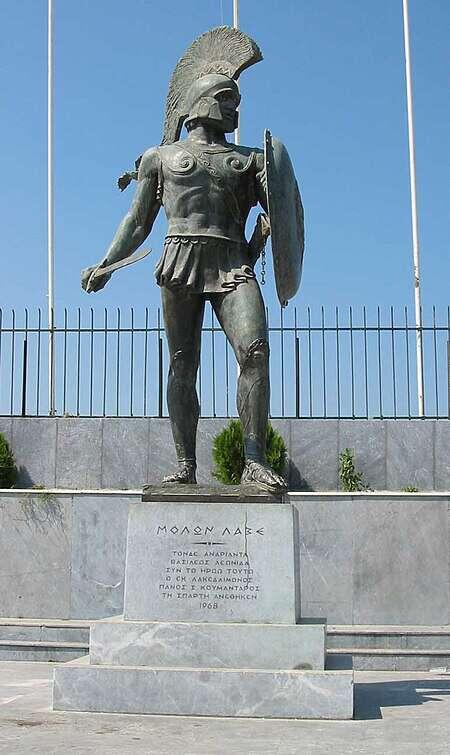
At the Second Greco-Persian War, Leonidas led the allied Greek forces in a last stand at the Battle of Thermopylae (480 BC), attempting to defend the pass from the invading Persian army, and was killed early during the third and last day of the battle.
Leonidas entered myth as a hero and the leader of the 300 Spartans who died in battle at Thermopylae. While the Greeks lost this battle, they were able to expel the Persian invaders in the following year.
Credits goes to the respective
Author ✍️/ Photographer📸
🐇 🕳️
#Bitcoin #Satoshis #Freedom #Apocalypse #Music #Movies #Philosophy #Literature
#Grownostr #Stoicism #Nature
APOCALYPSE ANONYMOUS by
ATOSHI ANARKOMOTO
🌊 SURF 'N TURF 🏝️
-THE ISLAND LIFE-

The most difficult lesson I’ve faced as an adult is the unending need to survive, regardless of how broken I feel inside.
It doesn’t matter if my heart is aching, if I’m mourning the loss of someone I love, or if I’m too tired to even get out of bed.
Life doesn’t wait for me to catch my breath.
It keeps moving forward, indifferent to my pain, and I’m left with no choice but to push through, even when every part of me is screaming for a moment of rest.
But what’s even harder is realizing that no one truly prepares you for this. We grow up believing in the comfort of happy endings, only to be met with the harsh reality that survival often means pretending you’re okay when you’re not.
And maybe that’s the hardest part—not just surviving, but doing so quietly, without letting the weight of it show. Yet, through it all, we find strength we never knew we had, because despite the heaviness, we keep moving.
Credits goes to the respective
Author ✍️/ Photographer📸
🐇 🕳️
#Bitcoin #Satoshis #Freedom #Apocalypse #Music #Movies #Philosophy #Literature
#Grownostr #Stoicism #Nature
APOCALYPSE ANONYMOUS by
ATOSHI ANARKOMOTO
🌊 SURF 'N TURF 🏝️
-THE ISLAND LIFE-

Woodstock 1969, held from August 15 to 18, is often regarded as a landmark event in music history and a defining moment for the counterculture movement of the 1960s.
Taking place in Bethel, New York, the festival was originally intended as a commercial venture but quickly evolved into a massive gathering for peace, love, and music.
The organizers—Michael Lang, Artie Kornfeld, Joel Rosenman, and John Roberts—aimed to create an "Aquarian Exposition," attracting a generation disillusioned by war and social unrest.

Credits goes to the respective
Author ✍️/ Photographer📸
🐇 🕳️
#Bitcoin #Satoshis #Freedom #Apocalypse #Music #Movies #Philosophy #Literature
#Grownostr #Stoicism #Nature
APOCALYPSE ANONYMOUS by
ATOSHI ANARKOMOTO
🌊 SURF 'N TURF 🏝️
-THE ISLAND LIFE-

One impressive picture by drone.
Off the coast of Laconia in south-eastern Peloponnese, Pavlopetri is a submerged prehistoric town, which consists of intact building foundations, courtyards, streets, graves, and rock-cut tombs.
It is the oldest complete town ever found underwater; the settlement contains both Neolithic and Bronze Age material and the town is believed to have flourished in the period between 3000-1000 BC.
Credits goes to the respective
Author ✍️/ Photographer📸
🐇 🕳️
#Bitcoin #Satoshis #Freedom #Apocalypse #Music #Movies #Philosophy #Literature
#Grownostr #Stoicism #Nature
APOCALYPSE ANONYMOUS by
ATOSHI ANARKOMOTO
🌊 SURF 'N TURF 🏝️
-THE ISLAND LIFE-
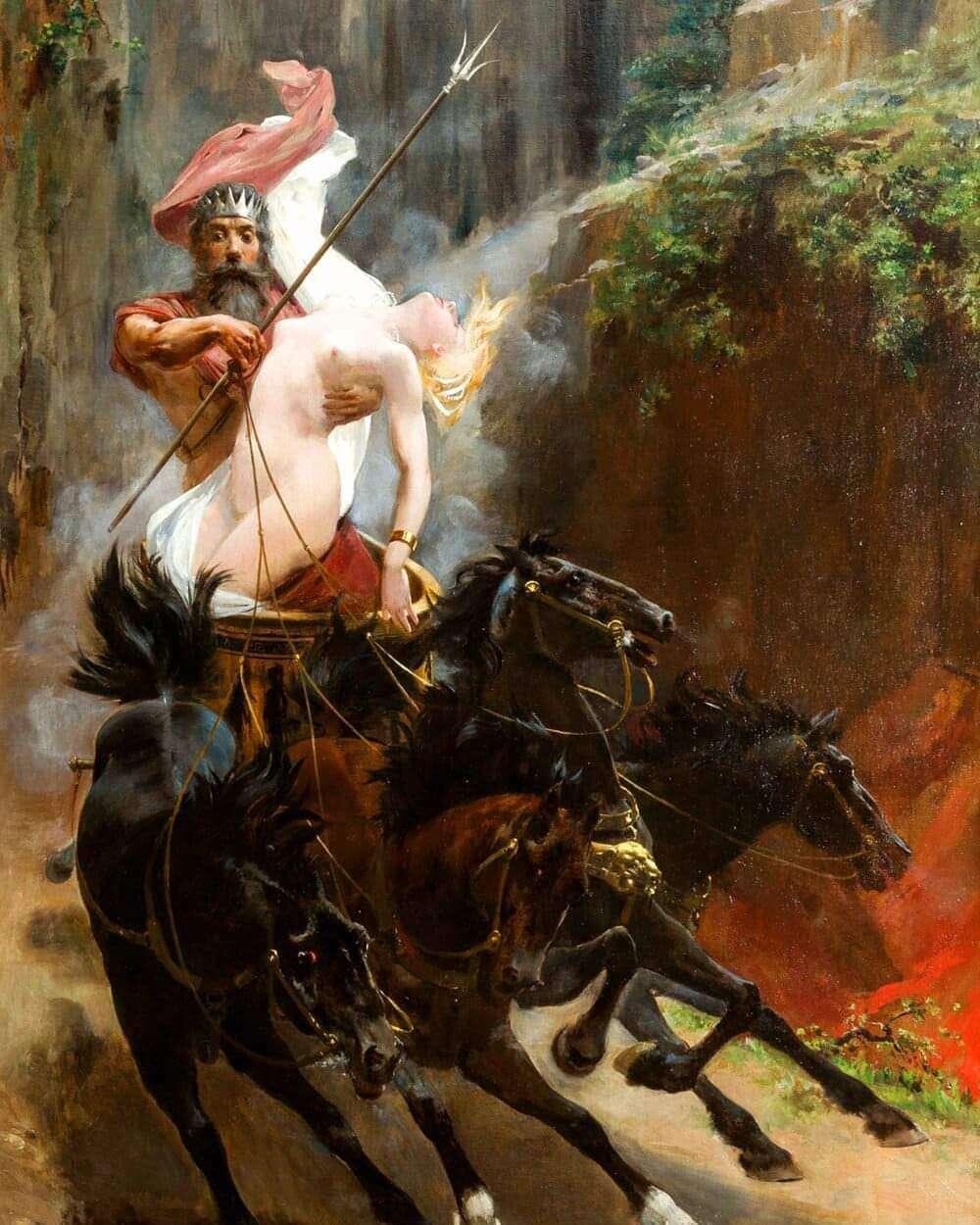
The Abduction of Persephone by Hades was painted by Ulpiano Checa (1860 – 1916).
The story of Persephone's abduction by Hades is described in considerable detail in the Homeric Hymn to Demeter.
This is the story in short:
Hades, the god of the underworld fell in love with beautiful Persephone, daughter of Zeus and Demeter. He asked his brother Zeus for permission to marry her and Zeus agreed. But knowing that Demeter would not agree to the marriage, Zeus permitted Hades to abduct Persephone. So one day while she was gathering flowers with her friends, Hades burst out of the ground in his chariot, snatched Persephone and took her into the underworld...
Demeter, when she found her daughter had disappeared, disguised herself as an old woman and with lighted torches in her hands roamed the Earth looking for her daughter. In the depth of her despair, she forbade the earth to produce fruit (or she neglects the earth which results in nothing growing).
Finally, Demeter met Hekate, the old Witch. Hekate took pity on Demeter and told her to seek help from the all seeing Helios, the sun god. She did and Helios told Demeter all about how Hades had dragged Persephone into the underworld.
Persephone’s mother, Demeter, then begged her brother Hades to allow Persephone to come back to the world of the living, saying that the young Persephone was not supposed to live in the world of the dead. Hades first ignored her pleadings. But finally Zeus intervened and forced Hades to let Persephone leave. He did that because he was pressed by the cries of the hungry people and by the complaints of other deities, who because of the famine, weren't getting their sacrifices...
Hades complied with Zeus's order. But first he tricked Persephone, giving her some pomegranate seeds to eat. And because she had tasted food in the underworld, she was obliged to spend a third of each year (the winter months) there, and the remaining part of the year with the gods above.
arrival of the "winter Zeus", "thunder god who rides in a chariot pulled by ibex goats". This Zeus arrives at the end of October - beginning of November, at the beginning of the mating season of Cretan Ibex Goats and brings with him the winter rains. I believe he is also the one who "kidnaps Persephone" and takes her to the "land of the dead" aka winter. That this is not just me inventing crap, Persephone and Demeter were in Eastern Mediterranean, the area where climate is the same as it is in Crete, always linked with Zeus-Eubuleus which apparently "is an euphemistic name of Hades, Chthonian Zeus".
As we have seen, Hades, the lord of the underworld, was by Greeks associated with winter, as Persephone's time in the underworld was equated with winter. So if Hades is the Chthonian Zeus he is indeed also the Winter Zeus.
Which explains a very curious thing that Hades was also Pluto, the god of wealth.
Credits goes to the respective
Author ✍️/ Photographer📸
🐇 🕳️
#Bitcoin #Satoshis #Freedom #Apocalypse #Music #Movies #Philosophy #Literature
#Grownostr #Stoicism #Nature
APOCALYPSE ANONYMOUS by
ATOSHI ANARKOMOTO
🌊 SURF 'N TURF 🏝️
-THE ISLAND LIFE-

Gray granite statue of Queen Arsinoe II, wearing a transparent nude robe to indicate the perfection and smoothness of her body, is the story of a statue dating back to the Ptolemaic era in Egypt, and this statue was extracted from the sea like other monuments discovered in Egypt.
Sunken city of Heraclion in the Gulf of Abukir in Alexandria in 2000.
It is currently preserved in the BA Museum of Antiquities.
Credits goes to the respective
Author ✍️/ Photographer📸
🐇 🕳️
#Bitcoin #Satoshis #Freedom #Apocalypse #Music #Movies #Philosophy #Literature
#Grownostr #Stoicism #Nature
APOCALYPSE ANONYMOUS by
ATOSHI ANARKOMOTO



🌊 SURF 'N TURF 🏝️
-THE ISLAND LIFE-
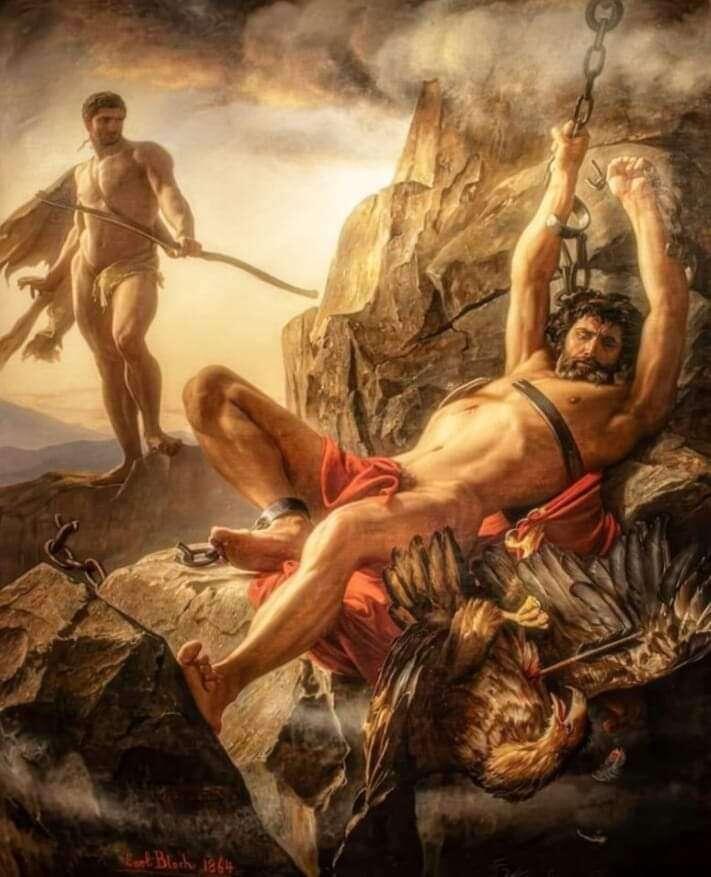
The Museum of Paul and Alexandra Kanellopoulos at the Acropolis is showcasing Carl Bloch's painting "Prometheus Unbound" (3.98 m x 2.77 m) until January 6, 2025.
In a dazzling twist of fate, the forgotten masterpiece commissioned by King George of Greece in 1864 has resurfaced, igniting a spark of adventure and intrigue in the hearts of art enthusiasts and history buffs alike. This magnificent painting, which had vanished for decades into the mists of time, captures the awe-inspiring moment of Prometheus’s liberation by the legendary Hercules—a tale steeped in the rich tapestry of mythology.
As viewers gaze upon the canvas, they are transported into the tumultuous world of Prometheus, grappling with the weight of his defiance against the gods and the profound emotional turmoil that accompanies his act of giving fire to humanity. The brushstrokes of the artist, Bloch, weave a narrative that transcends mere visual representation, inviting the onlooker to delve into the depths of Prometheus’s suffering and resilience.
Rediscovered in the grand halls of Tatoi Palace in 2012, the painting underwent an ambitious conservation effort, breathing new life into its vibrant colors and intricate details. It now stands as a testament to the enduring spirit of creativity and the relentless pursuit of freedom—a reminder that even in the darkest of times, heroes can emerge to illuminate the path to salvation.
So, step forth and explore this captivating artwork that not only tells a story of mythological proportions but also rekindles a sense of wonder and adventure in the pursuit of knowledge and beauty.
Credits goes to the respective
Author ✍️/ Photographer📸
🐇 🕳️
#Bitcoin #Satoshis #Freedom #Apocalypse #Music #Movies #Philosophy #Literature
#Grownostr #Stoicism #Nature
APOCALYPSE ANONYMOUS by
ATOSHI ANARKOMOTO

“Only a white man would believe you could cut a foot off the top of a blanket, sew it to the bottom, and have a longer blanket.” - attributed to a Native American. 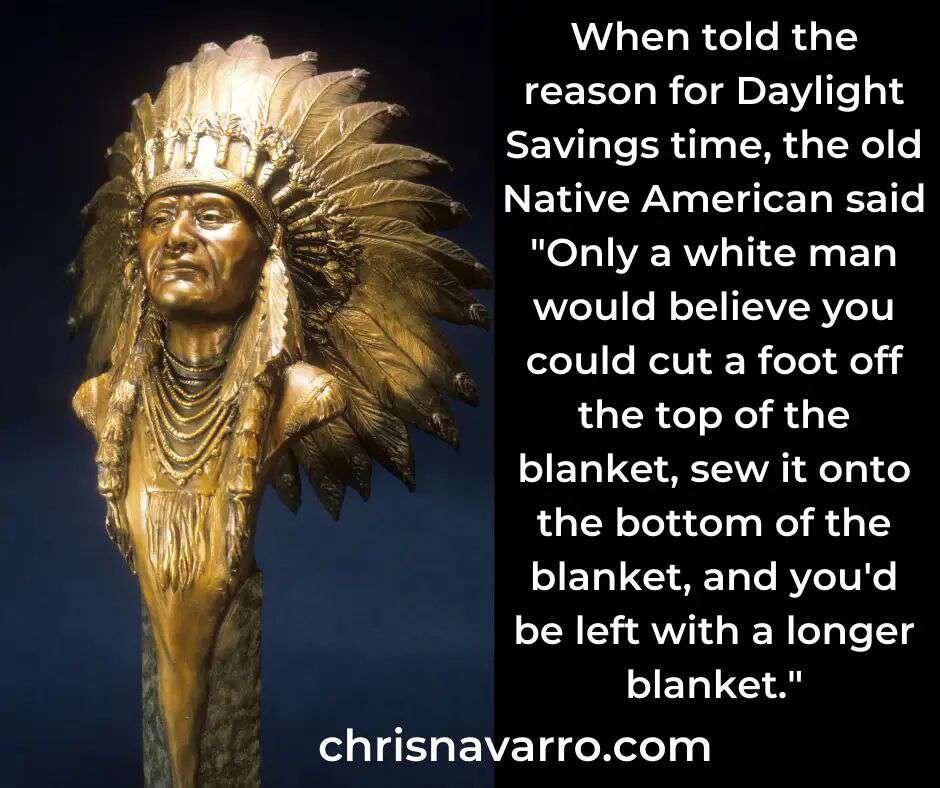
🌊 SURF 'N TURF 🏝️
-THE ISLAND LIFE-
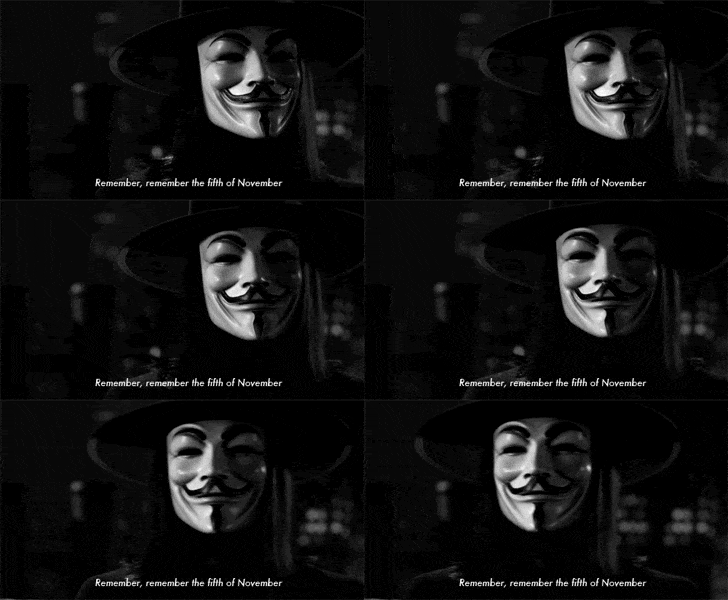
𝗢𝗻 𝗧𝗵𝗶𝘀 𝗗𝗮𝘆: 𝗧𝗵𝗲 𝗗𝗶𝘀𝗰𝗼𝘃𝗲𝗿𝘆 𝗼𝗳 𝘁𝗵𝗲 𝗚𝘂𝗻𝗽𝗼𝘄𝗱𝗲𝗿 𝗣𝗹𝗼𝘁
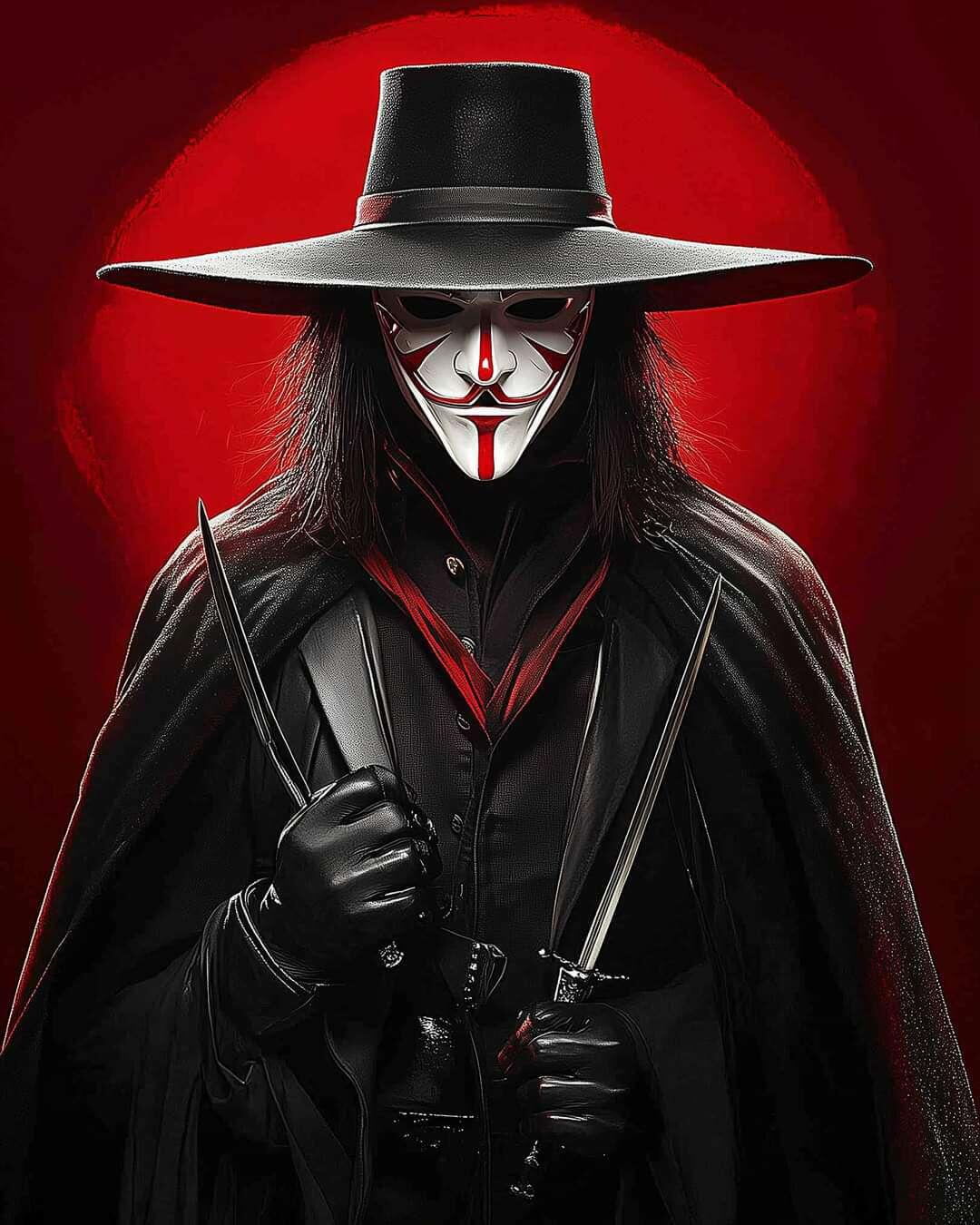
November 5, 1605, a daring plot to change English history was uncovered. Guy Fawkes and his fellow conspirators aimed to blow up the House of Lords, assassinate King James I, and restore a Catholic monarch.
The night before the planned explosion, Fawkes was caught guarding 36 barrels of gunpowder. His capture and the discovery of the explosives thwarted the plot, leading to the arrest and execution of the conspirators.
This event gave birth to the annual “Bonfire Night” on November 5th, where the UK lights up with fireworks and bonfires, celebrating the night the kingdom was saved from a fiery fate.
The story also inspired the movie “V for Vendetta,” where the iconic Guy Fawkes mask became a symbol of rebellion.
Credits goes to the respective
Author ✍️/ Photographer📸
🐇 🕳️
#Bitcoin #Satoshis #Freedom #Apocalypse #Music #Movies #Philosophy #Literature
#Grownostr #Stoicism #Nature
APOCALYPSE ANONYMOUS by
ATOSHI ANARKOMOTO