
NOT censorship-resistant
NOT decentralized
NOT freedom money
“Tether Reveals Partnerships with Secret Service, FBI”
https://cryptopotato.com/tether-reveals-partnerships-with-secret-service-fbi/

"Maybe they will come out for every miner and say: Hey you need to keep an eye out for these types of ordinal inscriptions and you can't mine anything that includes this sort of thing even though, hey once it's there, it's there. You can't double spend, you really can't double spend once or twice"
Ragnar Lifthrasir EPI #293
https://video.nostr.build/f93400e4d60e96d26376d361c5aeb9c9e9d405f6671437b3f48aed346a1a117e.mp4
WATCH VIDEO HERE 😎🥸: https://youtu.be/RslcbPKtW9U
Really enjoyed this episode. Ragnar has a great perspective on the use cases of bitcoin (property) vs. #monero #xmr (digital cash). Also, some interesting views on perhaps why the government hasn’t banned Monero. Thank you!

I reckon. NGU über alles.

I get the impression they don’t want to make changes to bitcoin. And they certainly don’t want to mimic any characteristics of #xmr #monero. They’re too busy pushing plebs to “other layers” and courting trad-fi/establishment types.
Monero is true P2P digital cash as it was meant to be: on-chain, decentralized, low fees and private.

Mullvad also accepts #XMR #Monero

I understand the scalability, and layers 2 and 3, etc. could provide a solution, but can they achieve the ideal characteristics that we seek with the base layer.
And regarding the base layer, I know hard forks are unpalatable, but how much longer can we stare the problem (ordinals) in the face and not talk about a fix?
What narrative?
Hal Finney in 2010:
"Actually there is a very good reason for Bitcoin-backed banks to exist, issuing their own digital cash currency, redeemable for bitcoins. Bitcoin itself cannot scale to have every single financial transaction in the world be broadcast to everyone and included in the block chain. There needs to be a secondary level of payment systems which is lighter weight and more efficient. Likewise, the time needed for Bitcoin transactions to finalize will be impractical for medium to large value purchases.
Bitcoin backed banks will solve these problems. They can work like banks did before nationalization of currency. Different banks can have different policies, some more aggressive, some more conservative. Some would be fractional reserve while others may be 100% Bitcoin backed. Interest rates may vary. Cash from some banks may trade at a discount to that from others.
George Selgin has worked out the theory of competitive free banking in detail, and he argues that such a system would be stable, inflation resistant and self-regulating.
I believe this will be the ultimate fate of Bitcoin, to be the "high-powered money" that serves as a reserve currency for banks that issue their own digital cash. Most Bitcoin transactions will occur between banks, to settle net transfers. Bitcoin transactions by private individuals will be as rare as... well, as Bitcoin based purchases are today."
https://bitcointalk.org/index.php?topic=2500.msg34211#msg34211
Engineering isn't a place for magical thinking. It's a place for trade-offs. Fortunately, tech has improved since Hal Finney's remarks in 2010. We have the Lightning network, side chains, apps that let you spread funds out across multiple different private chaumian mints, multiple ongoing research paths (eg bitcoin scrypt, zk proofs, etc).
“A purely peer-to-peer version of electronic cash would allow online payments to be sent directly from one party to another without going through a financial institution. Digital signatures provide part of the solution, but the main benefits are lost if a trusted third party is still required to prevent double-spending. We propose a solution to the double-spending problem using a peer-to-peer network.”
So is it peer-to-peer, or institution-to-institution?

Got it. So rather than deal with ordinals/inscriptions head-on, the message is Bitcoin is freedom money…if you can afford it.
But if you’re bags are small, let me recommend a pseudo-Bitcoin solution that might not be decentralized, or might not be totally censorship-resistant, or might be kinda custodial, or isn’t actually trustless.
Let’s find a real solution that doesn’t involve selling our souls. Right now, the currently vacuous narrative is crumbling. Sorry plebs. 🫠
For the plebs with small bags, this is untenable. It’s forcing them into centralized, custodial “solutions.” 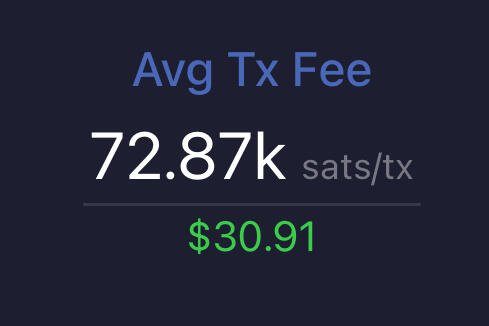
Why is the Fed telegraphing a pivot while CPI is 2x the target and unemployment is persistently below 4%?
Pretty simple to understand, really: (1) the government can’t continue to make interest payments at these levels; (2) treasury auctions are stressed and risk failing; and (3) the fractional reserve banking industry isn’t as healthy as everyone is pretending.
Bottom line, turned the money printer back on and let inflation rip. Position yourself, accordingly.
Hey Liz, here’s my “unhosted” wallet. Are you going to arrest me for not submitting to KYC/AML when I started using it. 🤬 

Not to mention, the taxes currently collected only cover 2/3 of government expenditures. The government is borrowing $2T a year from future taxpayers.
“The House Intelligence Committee's Surveillance 'Reform' Bill is a Farce”
“A Trojan Horse in a House Intel Committee Bill Massively Expands FISA 702 Surveillance”
Go with GrapheneOS
"Governments are spying on Apple and Google users through phone notifications, U.S. senator says"
Oh, here's another fraud case, from Dimon's own bank, no less. They paid $920M to make this one go away.
Dimon: “The only true use-case for it is criminals, drug traffickers … money laundering, tax avoidance.”
This has been largely debunked, but need we remind Jamie to what extent trad-fi and cuck bucks are used for criminal purposes...far outpaces crypto. It's not even close.
For that little LLC you have…
Goes into effect 1/1/24.
“Many business owners — mainly those who own small businesses — will need to start providing personal information about both the company and themselves to the Financial Crimes Enforcement Network.”
“For every day past the filing deadline, companies will be fined $500. If the violation continues, owners could face up to two years in prison and/or a fine of up to $10,000, according to the Financial Crimes Enforcement Network.”