

If that worked then at that point you could ask the agent to improve itself in ways you'd like. It would come back as an improved version of itself. Keep going and you have AGI.

Yep, happens whenever I buy something for $12.34.


Probably a better time to sell than others 🤷. Around 3 months ago it was sub $80.

You didn't link to the actual PR because it isn't merged. It was closed without merging https://github.com/bitcoin/bitcoin/pull/32359. Why are you lying?
Why are you spreading this misinformation? No policy changes have been merged regarding OP_RETURN in Bitcoin Core. Version 30 is not even scheduled for release for another 5 months.

It's only useful if you are mining with the node and want to collect fees from other txs. If you just want to mine your own txs you manually add them to the template.
You can also estimate fees for your txs without a mempool, but you can only do it against recently confirmed txs so it will be less accurate.
Every other feature will work the same except you deal with mined txs instead of not yet mined.
> Core removed the 80-byte limit with almost no discussion.
> Thousands of nodes implemented it automatically.
This is complete nonsense. There has not been any removal or change of any limit. There has been ongoing discussion about potentially removing a limit for weeks now. There has not been any new release of Bitcoin Core that implements any change of policy in months. No nodes are implementing anything automatically.
All use cases for a node with a mempool except mining for fees or more accurate fee estimation.
Currently generateblock takes an address or descriptor as first argument. It could be extended to also take an array of descriptor/address and value tuples. That way we don't need a new RPC command.

Happy birthday! 🎂

I'm not sure of the stats, but a lot of spam are large jpegs, which would always be cheaper as inscriptions.
The one you quoted I calculate as 139 bytes.
The ultimate solution would be to remove all standardness rules and use mempool for all txs.
I think private mempools are a bigger threat than spam.
Yes, only up to about 157 bytes (up from the current 80 bytes standard) will OP_RETURN be cheaper than using witness data to store data. And with OP_RETURN you can only make 1mb blocks. With inscriptions you can make 4mb. So if data enjoyers want to use OP_RETURN instead of inscriptions it will be less storage and bandwidth for nodes.
Today using unspendable UTXOs costs *less* than OP_RETURN. That is your OP. Removing the mempool restrictions will reverse this.
First of all, this tx did not make it into the mempool. As for why it would be desirable for it to have been first propagated to your nodes mempool, especially with respect to helping bitcoin and mining decentralization, this has been discussed ad nauseum. See https://antoinep.com/posts/relay_policy_drama/.
This also costs the spammer 4x as much.
Previously this would have taken 2 txs (1 to publish a Taproot output and the next to spend it, revealing the data in the witness).
Everyone saying filters "don't work" because spammers are just using op_return_bot to get around them? Yeah, op_return_bot has to charges double the regular fee rate or its bypass doesn't work reliably. This is a huge deterrent. The filters work.
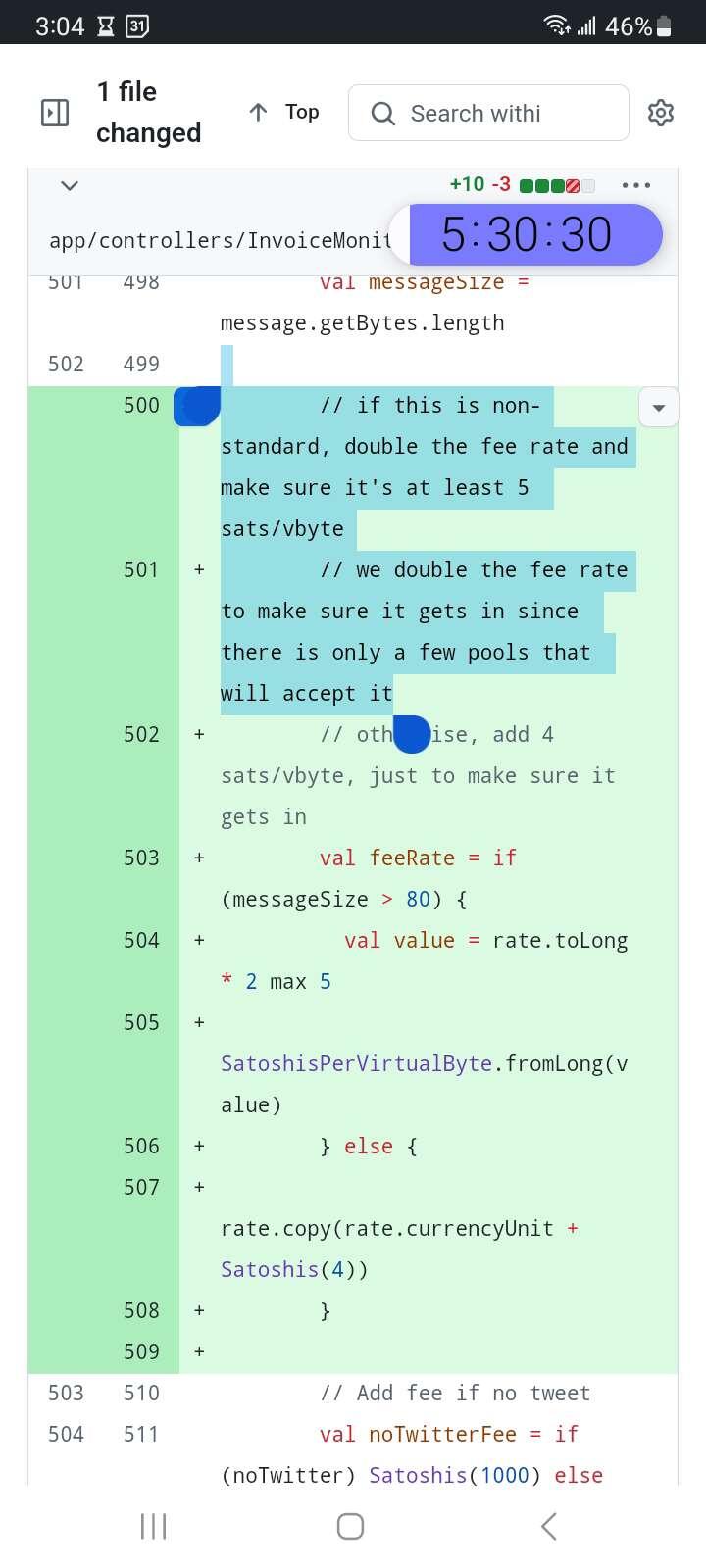
Source: https://github.com/benthecarman/OP-RETURN-Bot/blob/master/app/controllers/InvoiceMonitor.scala
This is a strawman. The filters make it more expensive, so people are putting the data in non-provably unspendable UTXOs. This is worse for the network then putting that data in provably unspendable outputs that can be pruned from the UTXO set.

Don't bother with 1080p at that size. It's too pixelated. The 4K ultra wide is great.


This OP_RETURN change has nothing to do with JPEGs. It is 4x cheaper to store JPEGs in the witness data, and the witness data is *not* stored in the UTXO set.
This change is for protocols that need some small amount of data but bigger than 40 bytes to be in an output before being spent. Witness data is not suitable for this because the tx has to be spent to reveal the data.