
Austrian economics:
"Prices keep going up?
Money supply keeps going up?
Okay, find better money and make it the standard.
Make sure what comes in is greater than what goes out.
Adjust time preference according to circumstances, save, invest and consume accordingly.
Best case, accumulate more capital to increase what comes in later on.
Don't dismiss intangible and psychic profits and income.
Rinse, repeat, reduce uncertainty, chill and have fun!"
Mainstream economics:
"Money printing is a contributing factor to prices going up, yes. But that's not the *only* variable. There are other factors at play. First identify the market failure. If an intervention is causing it, look at positive and negative externalities of that intervention. Also look at supply side and demand side data and the macro factors at play. Based on all this, intervention or control needs to be called for. There are also 'structural issues' that need to be identified and dealt with. There's also population age and unemployment rates to consider. Data collection needs to be improved. Also need more funding for intellectuals to write papers about this to arrive at what is actually causing prices to go up. Open debate and democratic discourse will help identify what the right policy is to address the problem of inflation."
I do not feel a sense of camaraderie with anyone except those who I personally know and actually like. Noone beyond my friends and family.
Human beings cannot be trusted to be good or bad by default.
I have no class consciousness.
I don't hate the rich or poor.
I don't like someone just because he's a fellow countryman.
I don't feel patriotic.
I have no attachment to my identity as a member of a particular caste.
I do not judge someone by the colour of their skin.
I cannot trust someone just because they speak the language I speak.
I do not consider someone worthy of being considered a friend just because he prays to the same god that I do.
My judgement of another person depends on what he says and does, how he presents and carries himself, and what other people say about him and how he responds to what other people say about him upon hearing it.
You could either study austro-libertarian literature:
•To politically mobilise people and bring about what you think is a better world for everyone.
Or,
•To understand how the state, no matter what form it takes, always expands its power and size over time
•To learn how to spot the signs when its supporters try to scam, grift and brainwash you into thinking that it's a good thing for point (1) to happen
•To be critical of versions of historical events and narratives promoted by these supporters and open your mind up to alternative viewpoints that are closer to the truth
•To challenge traditions and customs wherever necessary, instead of dismissing all of them for the sake of it
•To avoid going along with a mob just because you don't know what or how to think
•To always keep the well-being of yourself, your family and your loved ones as top priority no matter what, rather than becoming a ghost possessed by an ideology
•To find ways to protect your wealth, property and savings from getting expropriated by ideological mobs and state cronies
•To arrive at a set of political ethics (do's and don'ts that concern the use of violence in social relations) by reasoning about it
•In other words, to become a self-sovereign, peaceful individual
The latter is more useful, actionable, productive and fulfilling.
When asked to choose between Classical Liberalism, Minarchism and Anarcho-capitalism, I'd say:
For India,
Short term, Classical Liberalism.
Medium term, Minarchism.
Long term, Anarcho-Capitalism.
Ancap = ultimate, uncompromising ideal towards which libertarians ought to aim at.
Any political action needs to be taken with that ideal in mind.
I hand-picked certain classical liberal/libertarian intellectuals and asked ChatGPT to describe briefly how they debunked Socialism.
Here's what it responded with:
1. Mises – Economic Calculation Problem: Without market-driven prices, socialist economies lack a mechanism for rational resource allocation, leading to inefficiency, waste, and economic collapse due to the impossibility of effective central planning.
2. Hayek – Knowledge Problem: Economic knowledge is decentralised and constantly changing; central planners cannot access or process this information effectively, making socialist planning inherently flawed and inferior to spontaneous order in free markets.
3. Rothbard – Ownership Problem: Socialism divorces ownership from responsibility, resulting in mismanagement, waste, and perverse incentives where resources are depleted rather than preserved, as no individual has direct accountability for their use.
4. Hoppe – Argumentation Ethics: Socialists deny self-ownership and property rights but rely on them when arguing, making socialism philosophically self-contradictory, as rational discourse presupposes individual control over one's body and actions.
5. Bastiat – Seen and Unseen: Socialists ignore unintended consequences, focusing only on immediate benefits while neglecting hidden economic costs, such as wealth destruction, inefficiency, and reduced innovation caused by government intervention.
6. Saifedean – Time Preference: Socialism raises societal time preference by discouraging savings and investment, leading to short-term consumption, economic stagnation, and deterioration of capital accumulation necessary for long-term prosperity and civilization-building.
7. Menger – Subjective Value Theory: Socialism fails because value is subjective, not intrinsic; only free markets can determine prices based on individual preferences, making socialist price-setting arbitrary, inefficient, and economically destructive.
8. Böhm-Bawerk – Capital and Interest: Socialism misunderstands capital structure and time preference, failing to account for how interest rates coordinate production over time, leading to resource misallocation and economic stagnation under central planning. have debunked Socialism.
To make things interesting, here's a steelman argument for statists in India to keep everything as is:
Scrapping a tax, subsidy or regulation on day 1 is a terrible idea for sectors of society that are are reliant on those things to exist.
When you scrap a subsidy, you can't do it without causing beneficiaries to lose money if their business model depends on said subsidy in order to be viable. If the production of an raw material or intermediate production good itself depends on that subsidy, this would cause even more disruption further down the production line.
Far more disruptive would be scrapping welfare subsidies as people's survival would depend on the benefits to keep flowing. Scrapping it would amount to throwing them out on the street almost.
Scrapping a tax would be more or less disruptive depending on the tax in question. Scrapping GST would cause disruptions by affecting consumption patterns. Scrapping tariffs would threaten unprofitable and inefficient businesses in India. Scrapping income taxes would cause disruptions to the income of chartered accountants.
When you deregulate, you disrupt enterprises that depend on such regulations to exist. Introduction of competition would mean existing companies potentially going belly up, their investors losing money and their employees losing their jobs.
You cannot privatise a PSU without causing similar problems that deregulation would cause. And if you privatise without deregulation, it amounts to enabling a private monopoly which would likely be as worse as a public monopoly.
Relaxing Gun laws without improving the justice system would amount to lawlessness.
Privatising temples would likely result in upper caste folks taking over temples and barring entry for lower caste folks.
Privatising healthcare and education on a fiat standard would make both unaffordable for the poor over time.
Gold standard while having centrally planned interest rates would cause business cycles that cause booms and busts.
Relaxing labour laws would disrupt wages, job security and cause riots and strike by unions that damage property.
Enabling private ownership in forests and resources would lead to extraction and destruction of them by private owners even if they are locals.
Bitcoin is vehemently anti-communist because:
1. It encourages savings, which leads to more capital accumulation, more people getting rich by delayed consumption and lowering time preference
2. Despite a bitcoin costing a certain amount to mine, its price is always determined by the subjective valuations of buyers and sellers, hence going against the labour theory of value
3. It makes seizure extremely costly, and hence it is private property that cannot be seized without going through great pain and expenditure in time and resources, the former of which communists have a lot of due to being jobless and lazy in life and the latter of which they have little of due to being poor
4. Due to (3), it incentivizes voluntary and mutually beneficial exchange, which leads to a greater proliferation of the contractual means of acquiring wealth, which means more private property and more privately owned means of production.
5. It is anti-revolutionary. The likelihood of a Bitcoiner violently damaging or seizing anyone's physical private property is very low because they can simply buy it by mutual consent owing to the fact that they are rich (see point 1)
6. It doesn't need the State (i.e. violent to redistribute wealth. It redistributes wealth organically, via the free market, from high time preference degenerate gamblers, rent-seekers and speculators to low time preference savers, producers, innovators and capital accumulators (the State by its nature punishes the latter and rewards the former)
Tamil politics went down a slightly different path from the rest of India because of rationalism - but its embrace of democratic socialism meant that Reason was sent to the backseat in favour of Rebellion against Tradition for the sake of it, absent any grounding.
The Natural Law ethic, along with that of Hoppe's ethics of argumentation, provides a solid, irrefutable and unshakeable grounding on which the tradition of Reason can challenge the tradition of Custom.
36 more questions:
15. Is Georgism truly a Libertarian policy measure if it involves coercive collection of revenue from land owners?
16. If I want to hire a worker or buy a good or service from a Pakistani or a Chinese, and the other person is willingly entering the transaction with me, why should I ask permission from the State?
17. What is the legal status of revenge porn that involves a consensually recorded media and also non-consensual recording of people using cameras in general?
18. Are zoning laws and eminent domain valid under a libertarian legal system?
19. On what basis is a law derived? Is it tradition, reason, historical precedent, data-backed evidence, public consensus or top-down authority? And on what basis will existing laws be challenged?
20. What constitutes a negative and positive externality and how is it defined?
21. Abortion is not a subject of political debate in India and less well-off families do constantly engage in the activity. If Libertarianism is about right to life, then will abortions be made illegal?
22. What is the origin of rights and what does a 'right' really mean?
23. Will the right of the individual, a group or a region to secede from the country be legal under a libertarian legal order?
24. What constitutes 'aggression', 'coercion', 'justice' according to libertarianism?
25. Is equalizing opportunity a libertarian principle?
26. What is the difference between legality and morality?
27. What is your take on the Christian influence on the libertarian movement?
28. People say that Libertarianism and free market ideas are CIA and American government propaganda, is it true?
29. If the free market and competition is truly better than centralised planning, statism, monopoly and socialism, wouldn't the free market and competition also be able to also provide the services of lawmaking, police, courts, fire service, infrastructure rather than a coercive monopoly of the government?
30. Do people have free will or do they not?
31. What is Dharma and how is it defined and derived? Is the government necessary to uphold Dharma, and if it can only exist through a coercive monopoly, violence and theft, is the concept of a state truly Dharmic?
32. What is the true meaning of 'monopolies'? If a particular service provider or goods manufacturer grow large enough to become the sole provider or manufacturer of a service or good through free market and libertarian means, will a libertarian order allow it to exist?
33. If a libertarian legal system is enabled in India, what language will it be run on?
34. If a waqf land is established through a voluntary contract, what is its legal status?
35. If a state entity outside the sub-continent purchases land or buys assets, what is the legal status of this property title?
36. What is the status of untouchability in a libertarian legal order?
37. If a person shouts 'fire' in a theatre when there is no fire at all and people scramble for the exit, what is the legal status of the action of the person who shouted 'fire'?
38. If a person who is drowning enters into a lifelong employment agreement with someone on a lifeboat on the condition of being saved, does it constitute slavery and is this contract enforceable?
39. What happens in a libertarian India when China, Pakistan or other neighboring state decides to invade the subcontinent?
40. If under a libertarian legal order, everyone decides to voluntarily convert to Christianity, Buddhism or Islam from Hinduism, what would you do?
41. If a group of laborers decide to form a union, go on strike to ask for higher wages without damaging any property, would a libertarian legal order allow this?
42. And if an employer decides to fire all the laborers for going on strike and hire other people, is it permissible?
43. If a group of people acquire land surrounding your property and decide not to permit you from trespassing, what is the status of such actions under libertarianism?
44. Is it permissible for people to build mini nuclear reactors and weapons in their own property?
45. If someone commits suicide and writes a note blaming another person for committing suicide, is the blamed person legally liable?
46. Are defamation laws and libel legal or illegal under libertarianism?
47. If a person gets on stage, delivers an emotional speech and people go out into the streets and damage property and harm people, is the person who gave the speech responsible for the riots?
48. If a group of people buy a parcel of land, call themselves socialists and live as a community in a socialistic pattern and promote socialist ideas without harming anyone or their property, start convincing people of socialist ideas, would you permit it?
49. Is intellectual property valid under a libertarian legal order?
50. Is fractional reserve banking fraudulent under a libertarian legal order?
If I were to cause chaos at an Indian libertarian gathering, I'd ask the following questions:
1. What was the role of property rights, monetary and financial system and occupational and trade restrictions in startifying the caste system?
2. How would air, noise and water pollution be dealt with?
3. If an unowned, public land is being put to use by villagers for extracting a particular resource, should it be legal for a company to appropriate it and set up a plant or a factory?
4. Should reneging on promises be considered a violation of contracts, i.e. do you believe in the promise theory or title-transfer theory of property rights?
5. If a group of people wants you to regulate the derivatives market in their industry for causing market manipulation, will you concede?
6. If an important temple is privatised and the owner or the trust of the temple doesn't let people of a particular caste to enter, what would you do?
7. Is there such a thing as a just vs unjust property title? How would you define it?
8. What is your view of blackmail and the acquisition or creation of contracts based on blackmail?
9. Should marriage certificates be a part of the legal system and if so, to what extent does the state involve itself in a marriage between a couple?
10. What is the age of consent and should this be determined by the legal system?
11. Is democracy necessary to preserve a libertarian order?
12. Is the constitution necessary to preserve a libertarian order?
13. What will be the final court of appeal when the prosecutor doesn't get a favourable judgement?
14. How would property titles and their transfers be recorded and maintained without a government?
An interesting footnote from Hoppe's 'The Theory of Socialism and Capitalism':
It is worth stressing that contrary to what various nationalist historians have taught, the revival of trade and industry was caused by the weakness of central states, by the essentially anarchistic character of the feudal system. This insight has been emphasized by J. Baechler in The Origins of Capitalism, New York, 1976, esp. Chapter 7. He writes: “The constant expansion of the market, both in extensiveness and in intensity, was the result of an absence of a political order extending over the whole of Western Europe.” (p.73) “The expansion of capitalism owes its origin and raison d’eetre to political anarchy ... . Collectivism and State management have only succeeded in school text-books (look, for example, at the constantly favourable judgement they give to Colbertism).” (p.77) “All power tends toward the absolute. If it is not absolute, this is because some kind of limitations have come into play ... those in positions of power at the centre ceaselessly tried to erode these limitations. They never succeeded, and for a reason that also seems to me to be tied to the international system: a limitation of power to act externally and the constant threat of foreign assault (the two characteristics of a multi-polar system) imply that power is also limited internally and must rely on autonomous centres of decision making and so may use them only sparingly.” (p.78)
In the halls where the laws are made, the line between the left and the right gets blurred over time, culminating at a point where it doesn't really exist in any sense.
I can picture it
A nice farm
Natural water source
Guns
House for four
Positive sats flow
Not a care in the world about convincing anyone of Bitcoin, Libertarianism or Austrian Economics
No stupid or arrogant (often both) people to argue with
Quite temple nearby
People speaking exclusively in Tamil
Contemporary Socialism
In theory:
Income is uneven, so we progressively steal from the "haves" and redistribute it to the "have-nots" in cash or kind, equalising uneven natural conditions and call this justice.
In practice:
•Monopolize the issuance of money
•Mandate interest rates for credit
•Borrow monopoly money from the "haves"
•Give the borrowed money to the "have-nots" in cash or kind
•Steal from the "somewhat-haves" to pay the interest on borrowed money
•Turn the "somewhat-haves" into "have-nots" and enrich the "haves" further.
•To make the wounds deeper, keep issuing new money to make it worthless over time.
•Complain that this is the fault of the "haves"
There has never been a more inconsistent and retarded political ideology and policy in the history of mankind, both in theory and in practice.
Bitcoin fixes this.
Paleo-Libertarianism
When causality is deduced consistently and rationally when analysing histories, cultures, religions and races that you like but sent for a toss when analysing ones that you don't like.
For the latter alone, empiricist, institutionalist and historicist claims and analysis are justified and uncritically accepted.
No challenge of presented facts and evidence with Reason and revisionism.
The incredibly difficult threads that paleo-libertarians, social liberals, neocons, full-on socialists, communists (i.e. almost all sides of the political spectrum) refuse to pull on when they talk about India (and lazily attribute every problem to muh culture, muh religion, muh genetics):
•Prevailing caste tensions dating back to the extremely bureaucratic pattern of economy and society during the colonial era, which resulted in demands for affirmative action post-independence rather than for opening up trade and business. More or less solved but still not open enough yet. Of course this would make everything in society a power struggle, and result in politicalization of all interactions. Economising becomes a pipe dream.
•The destruction of metallic money and credit systems as they became centralised by fiat-like systems initially to a full-blown fiat system which pegged the Rupee to the Pound. This was followed by the establishment of a central bank in the early decades of the 1900's. The hold that this institution has had on the credit market post-independence is far greater than that of other central banks elsewhere. So much so that different industries had mandated interest rates. And let's not forget the bank nationalisation which made the problem worse. Progress has been made by removing these chains, but simply not good enough.
•The distortion of prevailing property titles by the Ryotwari, Mahalwari and Zamindari systems, the excessive property taxes, displacement and peasantisation of land-owners, the inadequate application of the title-transfer theory of property rights while implementing land reforms, land ceiling and land redistribution legislation post independence to address this.
•Existense of directive principles in the constitution which permits the state to impose welfare systems.
•The socialistic pattern adopted post independence which carried on the colonial legacy of bureaucratic control. 5 year plans that led to misallocation, malinvestment and stagnation.
•The spread of legal positivism and the destruction of prevailing legal systems.
The calls that conservatives make to simply uphold and protect property rights would indeed fall on deaf ears.
If there is no notion of just vs unjust property rights, the Indian story cannot be told.
A Rothbardian-style analysis and revisionism of India's political and economic history would be fun.
An example would be to analyse how the interventionist and bureaucratic control of the economy during the British era made caste conflicts more pronounced, leading to an increased demand for affirmative action, which only made the problem worse, and the effects that the 1991 reforms had for better or for worse.
Or to verify the existence of private credit systems associated with temples and communities, study whether these systems had booms and busts, whether these were clamped down by colonial forces through active policy or displaced by paper money through market mechanisms simply because they were better systems. The Hundi system is an interesting rabbithole.
India had 500 years of Islamic folks trying to push their thing through political means
Followed by about 250 years of Christian folks trying to do the same thing
And then about 75 years (and counting) of socialist and nationalist folks trying to do the same thing
The religions were indeed accepted and adopted by millions of individuals and continue to be quite widespread and influential. So much so that they aren't 'foreign' anymore. It's like they were never foreign in the first place.
There's also Jainism, Sikhism, Buddhism, etc. which are indeed thriving.
That's fine.
It's just that - considering what I've learnt about religions being destroyed and forgotten due to conquests and political policy - the crowds at the temples I've been to are astonishing to me.
More astonishing to see the number of young folks somehow becoming religious after a certain age or simply being secretive about it.
There's something about the anarchic, leaderless, canonless, polytheistic and decentralised nature of Hinduism that requires further exploration. So many sects, branches, schools of thought.
I also suspect that other religions do have most of these qualities barring probably the polythestic part.
Food for thought.
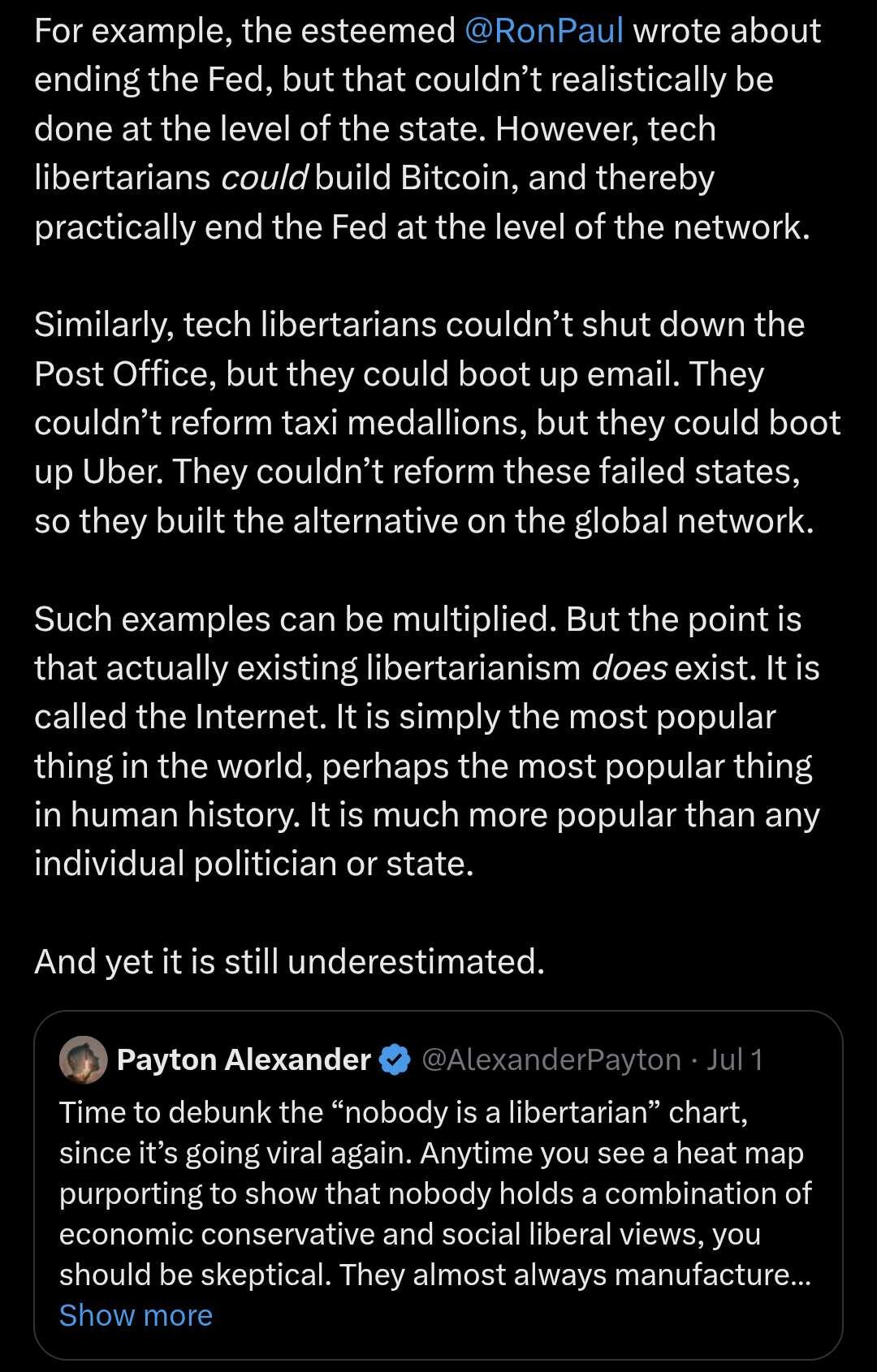
Balaji S on the Libertarian nature and character of the internet.
"The unhampered market economy is not a system which would seem commendable from the standpoint of the selfish group interests of the entrepreneurs and capitalists. It is not the particular interests of a group or of individual persons that require the market economy, but regard for the common welfare. It is not true that the advocates of the free-market economy are defenders of the selfish interests of the rich. The particular interests of the entrepreneurs and capitalists also demand interventionism to protect them against the competition of more efficient and active men. The free development of the market economy is to be recommended, not in the interest of the rich, but in the interest of the masses of the people."
- Ludwig Mises

The truth is:
Eminent domain, firearm restrictions, taxation, closed borders, customs checks, conscription, kyc/aml, registration, licensing
All of these things mean that I am not a free man. I'm a slave to my government. I have no power over my future and I am at the mercy of the government. Should the government decide that they don't like me, what I do, what I own, who i am, for some reason or the other, they can destroy me.
Freedom is real. But it does not exist.
List of companies and organisations that don't think Bitcoin is a scam in 2025
Blackrock, Blackstone, Fidelity, JP Morgan, VanEck, Ark Invest, Goldman Sachs, Morgan Stanley, BNY Mellon, a16z, Draper Associates, Robinhood, Bridgewater, Tudor Investment Corp, Miller Value Partners, Deutsche Bank, PayPal, Visa, Mastercard, Shopify, Citigroup, Block, Inc., Cantor Fitzgerald, Softbank, Franklin Templeton, Deutsche Telekom, Standard Chartered, Chicago Mercantile Exchange, Shell, Saudi Aramco, Gazprom, ExxonMobil
Governments of the United States, El Salvador, Bhutan, Abu Dhabi, New Hampshire, Arizona, Texas, Switzerland, Singapore, United Arab Emirates, Germany and Norway
The establishment narrative of Indian history uses the East India Company as a talking point to instill a sense of fear and hatred of free market capitalism and corporations in people.
This fuels public sentiment that supports heavy regulation, intervention and licensing by the state.
The EIC was a mercantilist organisation with monopoly privileges granted by the state/states. It did not respect property rights or free trade. It was a criminal organisation that was anti-capitalist.
To put it crudely, they were a gang of thieves and murderers.
To use them as an example to make a case for socialism or statism is to prefer one gang of thieves and murders over the other.
Unlike egalitarian fantasies, the idea of property rights do not need force to gain acceptance.