


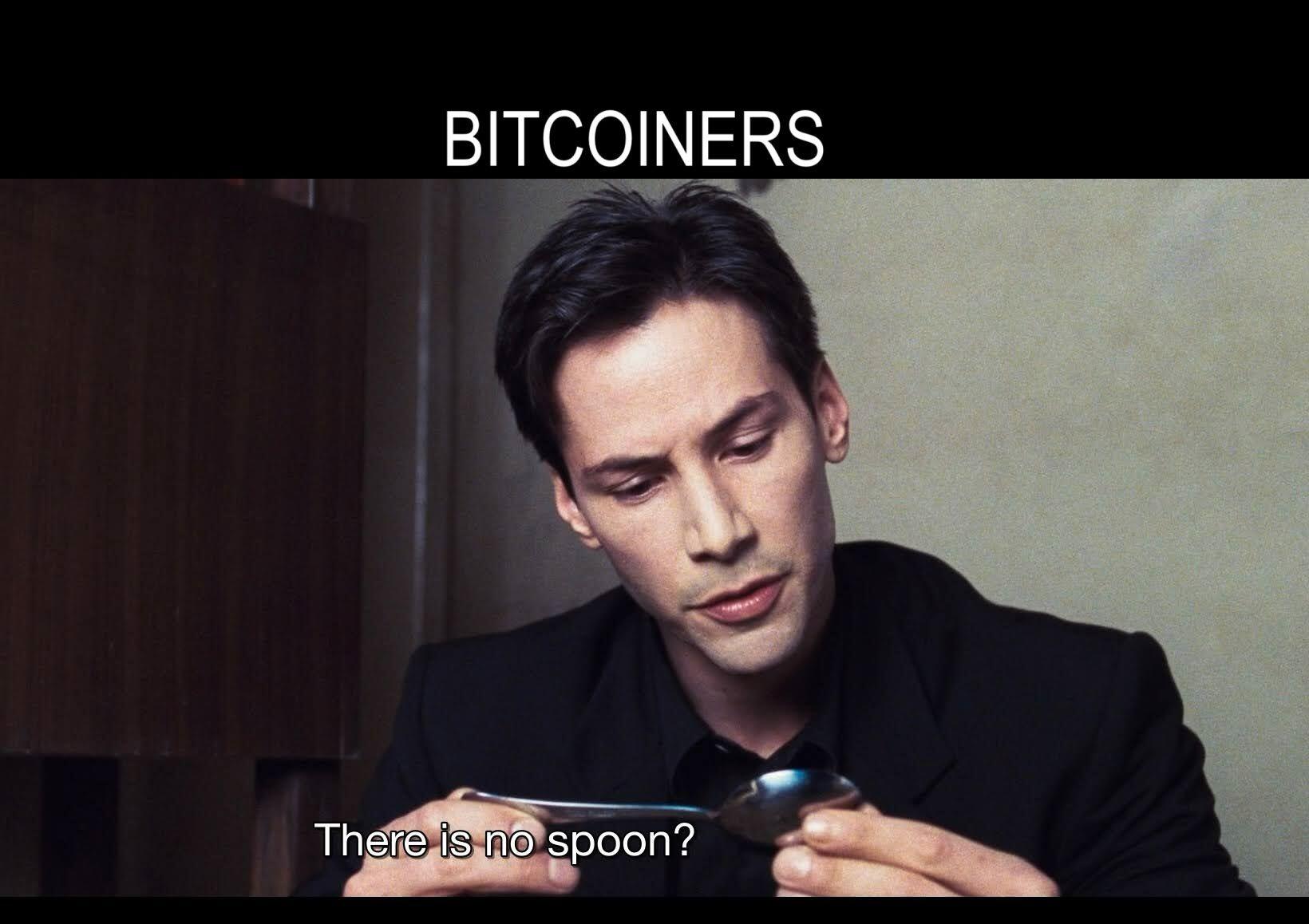
Apologies to fans of both. This is all in the spirit of fun! And, to get our minds off the market... 😅

Happy #Bitcoin Pizza Day! 🍕
May the 4th be with you! #bitcoin

$69K #Bitcoin watch, right now. 👀

It’s the thought that counts!? 😅 Whether it’s a like 👍 💜 and/or a 1 sat zap ⚡️.


Here's an excerpt from my August 2022 article on Lightning that has relevance for today:
https://www.lynalden.com/lightning-network/
Criticism 6) It Has a Scaling Ceiling for Self-Custodial Users
Lightning greatly increases the transaction volume that is possible on the Bitcoin network. However, opening and closing a Lightning channel still requires an on-chain transaction, which means that in its current form, the Bitcoin/Lightning stack still can’t scale to billions of people using it self-custodially.
Specifically, there are block space limits to how many people can use it fully self-custodially on a regular basis, unless certain base layer forks allow for more throughput.
For any network, there are inescapable technical trade-offs. To ensure the widespread auditability and immutability of the base layer, there are some constraints that are hard to overcome.
I view many other blockchain designers as trying to over-engineer their systems. Any solution needs to have product-market fit. Not everybody wants a fully self-custodial experience. Some people want the convenience of using a custodial service of some sort. Bitcoin/Lightning gives optionality to people around the world, but people can see fit to use whichever portion of the stack that they want.
To quantify it, the Bitcoin/Lightning stack can be semi-regularly used by tens of millions of people self-custodially (or more than that over time if many of them are just holding it in cold storage). Custodial services can scale that to higher numbers. For example, all of the tens of millions of accounts on Cash App technically have access to the Lightning network, through nodes and channels operated by Cash App. The same is true for people on Strike, River, and similar types of apps.
At the current time, the Bitcoin network is being criticized by some opponents for low fees and thus supposedly low long-term censorship resistance as the block subsidy winds down (meaning there is not overwhelming demand for its block space at the current time, which if that state were to persist indefinitely could eventually result in a low cost to control over half of the mining share), while it is simultaneously being criticized for not being able to scale self-custodially to everyone in the world (meaning its block space is not nearly big enough to fulfill such enormous potential demand). These are mostly mutually exclusive concerns.
If the combination of the Bitcoin/Lightning stack eventually reaches severe growing pains against the number of people that want to interact with it fully self-custodially (a good thing), then there are additional areas of development that can increase its scaling potential, via ways to allow more users to share a given channel, which are beyond the technical scope of this article.
On the other hand, if the network doesn’t grow much and its block space does not increase in value (a bad thing), then its scaling limitations are a non-issue.
At the current time, the Bitcoin/Lightning stack provides tremendous scaling potential compared to the number of people that currently use the network. The network doesn’t need to overbuild for market conditions that don’t exist yet, although of course it’s good for developers to be thinking about long-term scaling options.
As the saying goes, “necessity is the mother of invention”, and if/when the network encounters persistently high base layer fees, tons of base layer transactions being used to open lightning channels, and an inability to onboard all of the users that want to onboard to the network self-custodially, then that would spark more interest in developing further scaling solutions, including the possibility of new broad-consensus soft forks and other changes.
I remembered that your article was one of the few out there that discussed about the “network layering approach” to address the scaling issues of cryptocurrencies, which is the approach of Lightning using bitcoin.
I have been trying out Lightning lately, although only via the custodial way. From what I can understand, it seems like to be able to do self-custody one needs to have some skills involving hardware configuration, some software engineering, and networking.
@npub1teawtzxh6y02cnp9jphxm2q8u6xxfx85nguwg6ftuksgjctvavvqnsgq5u Verifying My Public Key: "@adams_ko"
nostr:npub1rxysxnjkhrmqd3ey73dp9n5y5yvyzcs64acc9g0k2epcpwwyya4spvhnp8
Hi, your YouTube video on #bitcoin #UTXO consolidation was quite informative and insightful, especially now that **a lot** more people will be going into bitcoin due to the #bitcoinETF approval. It should be a *rule of thumb*, or until the economics of the bitcoin blockchain changes, "to avoid creating a UTXO => 5,000 sats".
Aside from the financial implications stemming from the #bitcoinETF approval by the US #SEC, that this in effect makes #bitcoin legal, right? This means that they cannot "outlaw" $BTC itself? In the case of *cash*, cash per se is not "illegal", but the acts involving cash can be illegal, right? #KYC #AML
#bitcoinETF Approval by #SEC
https://x.com/adams_ko/status/1745195110772728205?s=46&t=hPkOmixdsj9momXDMst0GA

“A Chinese tech company has succeeded in cracking the encryption around Apple’s #AirDrop wireless file sharing function to identify users of the popular feature” — https://www.cnn.com/2024/01/10/tech/china-apple-airdrop-encryption-hnk-intl?cid=ios_appChina claims it has cracked Apple AirDrop’s encryption to identify senders $AAPL #Apple #CyberSecurity

Happy holidays 🎄 
Not a deep technical person myself, but wouldn’t it be cool and useful, if Nostr has a mesh network capability too, aside from using relays.