
RC Cars With First Person Video, All With An ESP32
Those little ESP32-CAM boards which mate the WiFi-enabled microcontroller with a small parallel-interface camera module have been with us for years, and while they are undeniably cool to play with, they sometimes stretch the available performance in trying to process and stream video. [Mattsroufe] has made a very cool project with one of them, not only managing to stream video from a small model car, but also to control the steering and motor by means of servos and a little motor driver.
Sadly it’s not entirely a stand-alone device, as the ESP32 streams video to a web server with some Python code to handle the controls. The server can aggregate several of them on one page though, for perhaps a little real-life quad-screen Mario Kart action if you have enough of the things. We can see that this idea has plenty of potential beyond the mere fun of driving a toy car around though, but to whet your appetite there’s a demo video below.
We’ve seen enough of the ESP32-cam before, but perhaps more as a photographic device.
youtube.com/embed/OubYFXmvA1E?…
hackaday.com/2025/02/06/rc-car…
 ?w=800
Solid Tips for Designing Assistive Technology (Or Anything Else, Really)
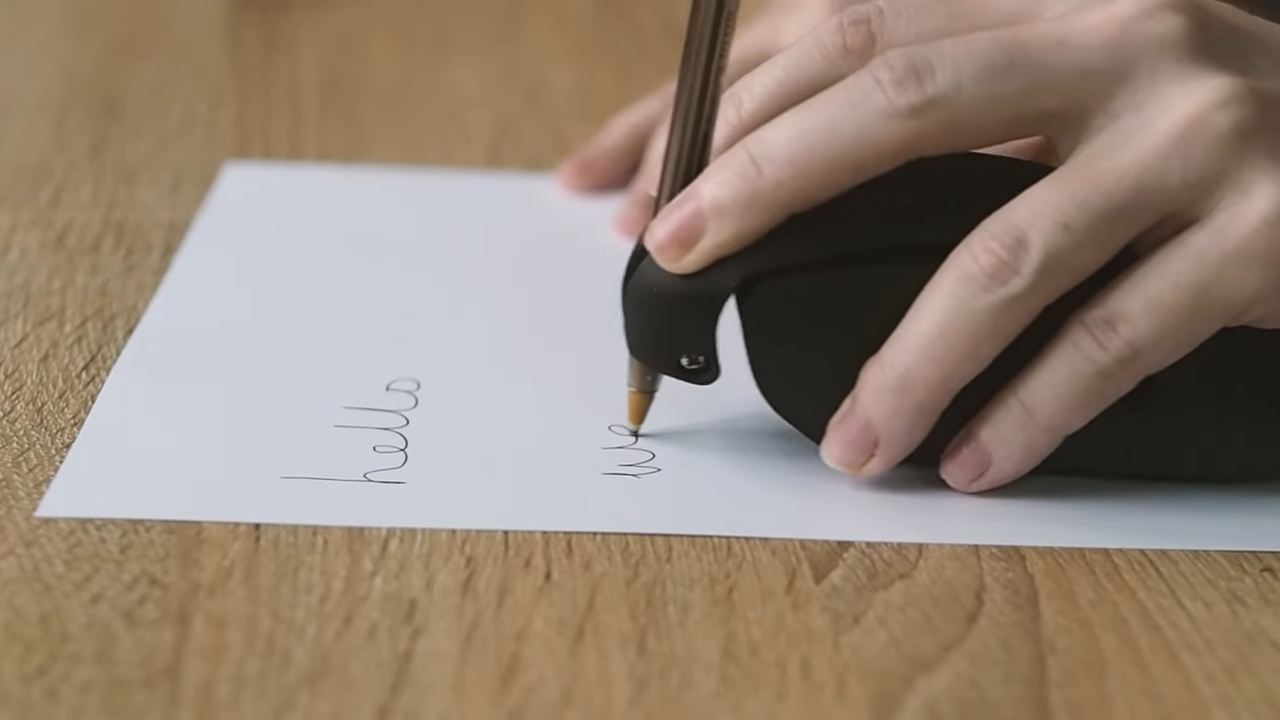
Do you make things, and have you got almost ten minutes to spare? If not, make the time because this video by [PrintLab] is chock-full of healthy and practical design tips. It’s about effective design of Assistive Technology, but the design concepts extend far beyond that scope.
It’s about making things that are not just functional tools, but objects that are genuinely desirable and meaningful to people’s lives. There are going to be constraints, but constraints aren’t limits on creativity. Heck, some of the best devices are fantastic in their simplicity, like this magnetic spoon.
It’s not just about functionality. Colors, textures, and style are all meaningful — and have never been more accessible.
One item that is particularly applicable in our community is something our own [Jenny List] has talked about: don’t fall into the engineer-saviour trap. The video makes a similar point in that it’s easy and natural to jump straight into your own ideas, but it’s critical not to make assumptions. What works in one’s head may not work in someone’s actual life. The best solutions start with a solid and thorough understanding of an issue, the constraints, and details of people’s real lives.
Another very good point is that designs don’t spring fully-formed from a workbench, so prototype freely using cardboard, models, 3D printing, or whatever else makes sense to you. Don’t be stingy with your prototyping! As long as you’re learning something each time, you’re on the right path.
And when a design is complete? It has the potential to help others, so share it! But sharing and opening your design isn’t just about putting the files online. It’s also about making it as easy as possible for others to recreate, integrate, or modify your work for their own needs. This may mean making clear documentation or guides, optimizing your design for ease of editing, and sharing the rationale behind your design choices to help others can build on your work effectively.
The whole video is excellent, and it’s embedded here just under the page break. Does designing assistive technology appeal to you? If so, then you may be interested in the Make:able challenge which challenges people to design and make a 3D printable product (or prototype) that improves the day-to-day life of someone with a disability, or the elderly. Be bold! You might truly help someone’s life.
youtube.com/embed/vJV08sxxMKE?…
hackaday.com/2025/02/06/solid-…
 ?w=800
 ?w=400
T1 is a RISC-V Cray
The crux of most supercomputers is the ability to operate on many pieces of data at once — something video cards are good at, too. Enter T1 (short for Torrent-1), a RISC-V vector inspired by the Cray X1 vector machine.
T1 has support for features, including lanes and chaining. The chip contains a version of the Rocket Core for scalar operations, but there’s no official support for using it. The project claims you could easily replace that core with any other RISC-V CPU IP.
By focusing on parallelism instead of out of order execution, the design gets to skip branch prediction, register renaming, and similar problems.
There is an emulator if you want to experiment. You can even grab a docker image for easy installation. This doesn’t look like something you could pick up in an hour, so prepare to spend some time. Everything is bare-metal, too, so leave your favorite development tools at home.
The project uses Chisel, which we’ve covered before. The build system seems very complex, but based on Nix Flakes, so it should be understandable.
If your high-performance RISC-V dreams are more conventional, there’s work going on in that area, too.
Title graphic from Freepik.
hackaday.com/2025/02/06/t1-is-…
 ?w=800
Running Doom on an Apple Lightning to HDMI Adapter
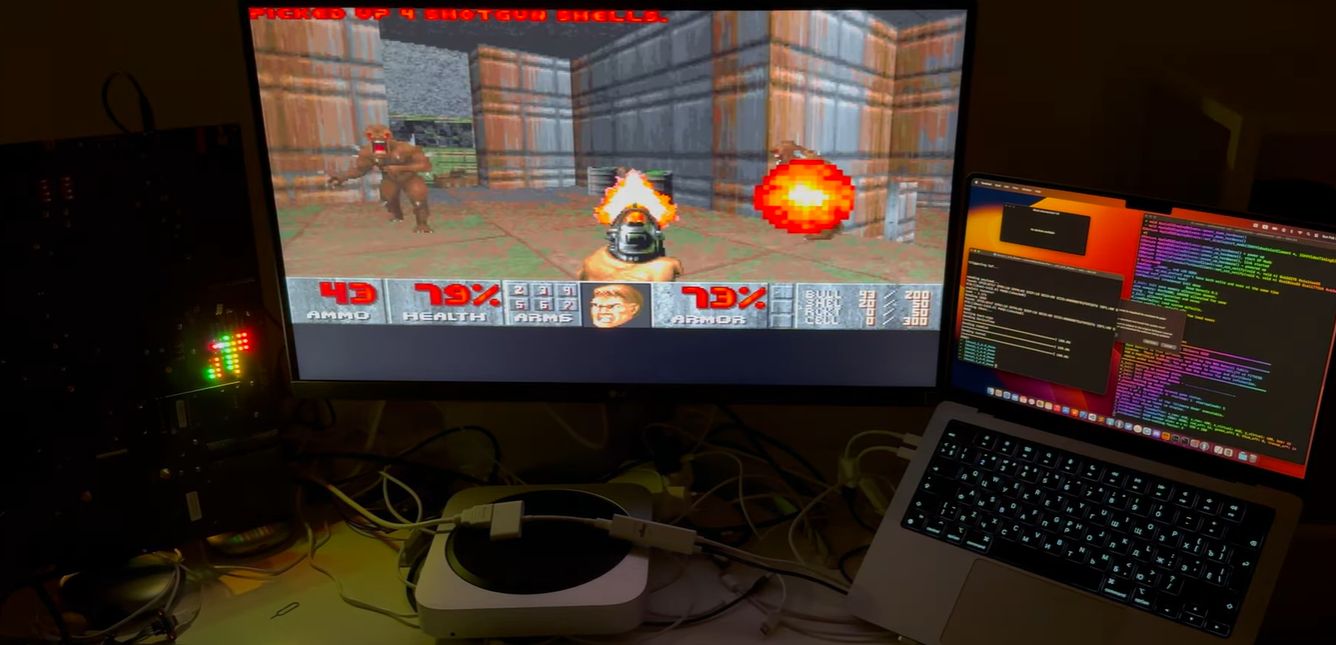
As a general rule of thumb, anything that has some kind of display output and a processor more beefy than an early 90s budget PC can run Doom just fine. As [John] AKA [Nyan Satan] demonstrates in a recent video, this includes running the original Doom on an Apple Lightning to HDMI Adapter. These adapters were required after Apple moved to Lightning from the old 30-pin connector which had dedicated pins for HDMI output.
As the USB 2.0 link used with Lightning does not have the bandwidth for 1080p HDMI, compression was used, requiring a pretty beefy processor in the adapter. Some enterprising people at the time took a hacksaw to one of these adapters to see what’s inside them and figure out the cause of the visual artifacts. Inside is a 400 MHz ARM SoC made by Samsung lovingly named the S5L8747. The 256 MB of RAM is mounted on top of the package, supporting the RAM disk that the firmware is loaded into.
Although designed to only run the Apple-blessed firmware, these adapters are susceptible to the same Checkm8 bootROM exploit, which enables the running of custom code. [John] adapted this exploit to target this adapter, allowing this PoC Doom session to be started. As the link with the connected PC (or Mac) is simply USB 2.0, this presumably means that sending keyboard input and the like is also possible, though the details are somewhat scarce on this aspect.
youtube.com/embed/4XCkeN0XuqA?…
hackaday.com/2025/02/06/runnin…
 ?w=800
A Great Use for AI: Wasting Scammers Time!
We may have found the killer app for AI. Well, actually, British telecom provider O2 has. As The Guardian reports, they have an AI chatbot that acts like a 78-year-old grandmother and receives phone calls. Of course, since the grandmother—Daisy, by name—doesn’t get any real phone calls, anyone calling that number is probably a scammer. Daisy’s specialty? Keeping them tied up on the phone.
While this might just seem like a prank for revenge, it is actually more than that. Scamming people is a numbers game. Most people won’t bite. So, to be successful, scammers have to make lots of calls. Daisy can keep one tied up for around 40 minutes or more.
You can see some of Daisy’s antics in the video below. Or listen to Daisy do her thing in the second video. When a bogus tech support agent tried to direct Daisy to the Play Store, she replied, “Did you say pastry?” Some of them became quite flustered. She even has her own homepage.
While we have mixed feelings about some AI applications, this is one we think everyone can get onboard with. Well, everyone but the scammers.
It might not do voice, but you can play with local AI models easily now. Spoofing scammers is the perfect job for the worst summer intern ever.
youtube.com/embed/RV_SdCfZ-0s?…
youtube.com/embed/bL9iJJICOLc?…
hackaday.com/2025/02/06/a-grea…
 ?w=800