

Corporate control. They can't "manage" a Linux laptop as easily as they can with Windows or Mac. It's freedom tech after all!
Thankfully I've never worked for such orgs. I could always wipe the default OS with my own favourite distro. But then, I don't earn shit ton of money luck some of these corporate jobs pay.

Maybe you have stacked enough sats for your needs, now you feel secure, and DGAF?

It depends on the application, but generally it's because it comes with a whole linux system. The promise is, the system layers can be reused by other applications when compatible (the org.freedesktop.*, org.gnome.*, org.kde.* stuff).
I've found that it generally works, but there's definitely some duplication, often due to slightly different versions. You can list these with `flatpak list --runtime`.
That said, I think the main culprit is actually the apps themselves. More often than not, it's shit electron apps that end up being packaged as flatpak. No matter how you package electron, it'll always be bloated.

I use Org mode in Emacs, mainly because it's plain text and I search through years of notes and documents in seconds using find, grep, ripgrep, etc, also trivial to version control plain text.
If I weren't an Emacs user, I would probably use markdown and any text editor. Actually at work, we do just that for our 5 person team.
Nowadays there are also nice (cross-platform) systems to organise markdown notes, like LogSeq or Obsidian.

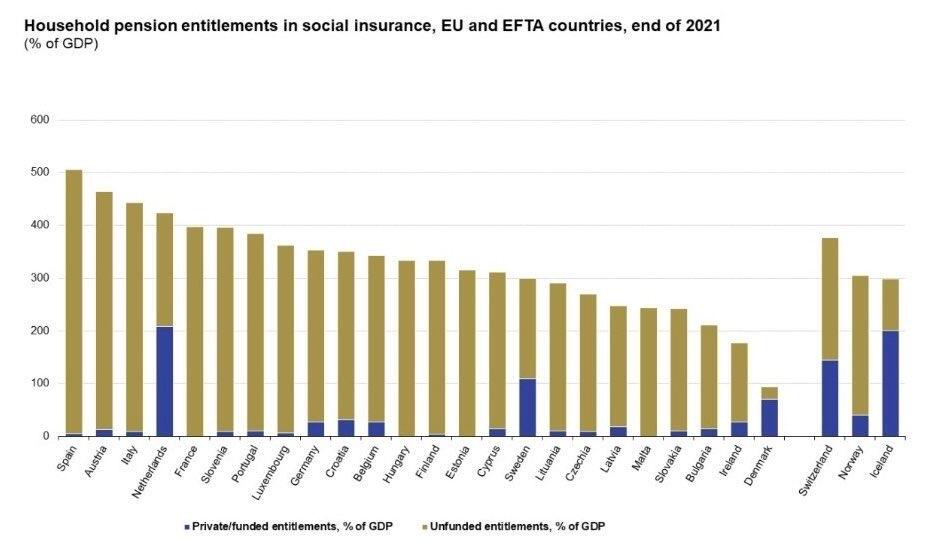
Denmark seems unusually good; not crossing total GDP, and lowest proportion of unfunded liability. What are they doing differently?

A Git story: Not so fun this time
https://blog.brachiosoft.com/en/posts/git/
Discussions: https://discu.eu/q/https://blog.brachiosoft.com/en/posts/git/
#historical #linux #programming #unix #vcs
Thanks, I knew part of the story, good to read it in full start to finish

When work isn't boring, and you can switch between work and life as needed.



Interestingly, I've had 2 successes. One of them, my 70+ mom! She doesn't have any savings herself (sad life story), but she's now accepting of me saving almost exclusively in sats, and when she saw me get Sovereign Individual, and nostr:npub1a2cww4kn9wqte4ry70vyfwqyqvpswksna27rtxd8vty6c74era8sdcw83a's book, she wanted to read both! So I left them with her :-P

Ah, haven't tried with VR. Just try it, I guess it will depend on driver support. I generally don't touch proprietary drivers (so no NVidia), but for VR NVidia could be better.
If I may add, dual booting, or live USB to switch to Linux rarely leads to success. If you are serious about switching, you need to commit to it. I used to dual boot for a long time, but I never really committed, around about 15 yrs ago I just went "wth, let's go for it, I'll learn stuff", and never looked back.
I would also say don't try lots of distros trying to find the perfect one. Just pick a mainstream distro, and go with it. I hear Mint or Pop_OS are good for starters. If you are a bit techy, you could try Fedora (that's what I use).
Good luck 🤞🏾
Have you tried Proton on Linux? Checkout https://www.protondb.com/ for games compatibility. The coverage is pretty darn good, e.g. Cyberpunk runs pretty smoothly. Where you'll hit a hurdle is anti cheats, but that's spyware anyway, people should stay away from them.
I think I'm also at the that threshold, most people around me, including people I care about are set in stone in their fiat mindset. It's like talking to a wall. Probably my energy is better spent on me *shrug*

If I understood it correctly, essentially you encode into a rendering problem, compute, and decode back. I'm not aware of this technique. If you have a link, would love to read about it.
The encode decode overhead is the main bottleneck, but it could work, specially considering today's mobile SoCs are pretty powerful. One thing to consider would be how uniform is the API from one device to the next.
I'm not sure mobile GPUs do general purpose kernels, but I'm not an expert 🤷🏾♂️.
Also GPU computations tend to like working on array-like data. Is handling Nostr events similar?

Not voting should be accompanied by tax avoidance, otherwise it's less effective.

I would encourage you to not use a VM or dual boot. Often I've noticed people give up easily when they encounter a hurdle because it is very easy to go back to your old setup.
If you have a second computer, I would encourage you to install there, and try using it for everything. That way, you'll have more motivation to learn how to find your way around the new OS, and solve problems.
Note that "problems" are often because you want the new OS to behave the same way as your old one. That is the incorrect approach. Instead focus on, I used to do X task, how do I achieve that now?
Hope this helps, and good luck 🤞
If you want to stick to apt, I would try Pop_OS! If you are up for trying something else, give Fedora a try. Both of these recommendations are based on a "I just want to do my work, but would like a modern distro" mindset.

True, but then you are buy only. I guess that is good enough for a newbie. They don't have a stack to sell from yet.