Avatar
Joe Bloggs
233e10e1c8e9eca04183be86b6d31266affdc3745701043a2724a3a1d45c3bb8
Exchanging Pure Human Empathy Globally one transaction at a time. Living beyond the Algorithm and any Psychopathic AI. https://medium.com/@j0e810ggs
Replying to Avatar Joe Bloggs

07 Title: Barter: Empathy and the Magic Wrapping that Money Cannot Buy

Introduction

For much of human history, the barter system served as the primary means of economic exchange. Unlike today's monetary systems, barter involved the direct exchange of goods and services, underpinned by pure human empathy.

This empathy ensured that transactions were not merely material but rooted in mutual trust, fairness, and understanding. These dimensions are often lost in modern economies, where money serves as a detached, impersonal medium of exchange.

In this note, I will explore how empathy functioned as the core ingredient of barter, examine its components in detail, and offer an analogy: the magic wrapping paper a metaphor for how empathy holds each exchange together.

This Magic Wrapping Paper, composed of multiple layers of trust, fairness, and social responsibility, represents the human connections that have been systematically stripped away in the evolution of monetary systems. Ultimately, we will argue that money, no matter how efficiently it facilitates transactions, can never replace or replicate the empathy that made barter a socially cohesive system.

The Role of Empathy in Barter

Barter, unlike modern currency based exchanges, was a system that required direct, personal interaction between individuals. This interaction was not simply an economic one; it was inherently social, shaped by the emotional and ethical context of the community. In barter, the perceived fairness of an exchange was not dictated by a universal currency value but by a shared understanding of each other's needs and circumstances.

For example, if a farmer exchanged a surplus of grain with a blacksmith for tools, the fairness of the transaction depended on more than the physical items being traded. The farmer might consider the blacksmith's family’s needs for food, while the blacksmith understood that the farmer needed tools to cultivate more crops.

Both parties would naturally aim for a balance that respected each other's needs. This exchange was not just economic but relational a process governed by empathy.

Breakdown of Empathy in Barter

Empathy in barter can be broken down into several key components, each of which played a critical role in maintaining the fairness and cohesion of the exchange. These components are best visualised through the analogy of magic wrapping paper, where each layer symbolises a different aspect of the empathetic exchange.

Perceived Fairness

In any barter transaction, both parties needed to feel that the exchange was fair and equitable. Fairness in this context wasn't limited to the material value of the goods being traded but also considered the social and emotional contexts. If one party felt they were being short-changed, the relationship would be damaged, and future exchanges would be jeopardised. This layer of empathy ensured that everyone’s needs were acknowledged and met.

Trust

Trust is central to any barter system. Participants had to trust that the other party would honour their side of the bargain, and that they might engage in future exchanges. Unlike money-based systems where transactions can be anonymous, barter was deeply personal. The establishment of trust created a long-term relationship between traders, ensuring that the community as a whole remained interconnected.

Mutual Understanding

Barter required a level of mutual understanding that transcended material exchange. Parties needed to recognise each other's vulnerabilities and circumstances, taking into account factors like family size, seasonal needs, or future crop yields. This understanding shaped how they negotiated and decided on the value of the trade.

Reciprocity

In a barter system, exchanges were often based on an implicit expectation of reciprocity. Even if the trade was not perfectly balanced in terms of material value, both parties knew that the imbalance could be addressed in future exchanges. This layer of empathy created a system where people were incentivised to help each other and maintain the balance over time.

Long-term Relationship Building

Barter systems were not built on one-off exchanges; they were relational. Each transaction strengthened the social bonds between the participants. Unlike monetary exchanges, which could be completed in isolation, barter required a long-term commitment to each other's well-being, ensuring that the community as a whole benefited.

Flexibility in Value Perception

Unlike modern money systems, where prices are fixed and standardised, the value of goods in barter was flexible and subjective, determined by mutual empathy and negotiation. This flexibility allowed the system to accommodate the specific needs of each party and ensure that the exchange felt fair, even if the goods themselves weren’t of equal material value.

Emotional Investment

Each barter transaction carried an element of emotional investment, as the participants were often trading with people they knew personally. The act of bartering wasn’t just about meeting material needs; it was also about ensuring the well-being of the other person. This investment in the other party's success fostered a deeper connection than a monetary exchange ever could.

Community Bonding

Barter facilitated community bonding, as exchanges often took place within the context of a larger social network. The health of the entire community depended on the empathy-driven fairness of individual exchanges, reinforcing the importance of looking after one another and the collective good.

Resource Sustainability

Empathy extended beyond human relationships and into the natural environment. Exchanges were conducted with an understanding that over-exploitation of resources would harm the entire community. For example, hunters would not over-hunt certain animals, knowing that doing so would deplete the natural resources available for future trades. In this way, barter was tied to the idea of sustainability, which money-based systems, driven by profit, often disregard.

Cultural and Spiritual Beliefs

Many Native American barter systems were guided by cultural and spiritual beliefs that emphasised respect for nature and the animals involved in the exchange. The spiritual dimension of these exchanges ensured that goods were not treated merely as commodities but as part of a larger, sacred ecosystem.

Social Responsibility

Empathy in barter extended to the broader community, creating a sense of social responsibility. Traders understood that their actions impacted not only their immediate partners but the community as a whole. This layer of empathy reinforced the idea that fairness and generosity were not just personal virtues but essential to the health of the collective.

Shared Risk

Both parties in a barter transaction shared the risks involved. For instance, a farmer trading grain with a blacksmith knew that if the weather destroyed future crops, they might need the blacksmith's help again. This shared risk created an incentive for generosity and flexibility, as participants were aware that they might need to rely on each other in times of hardship.

Interdependence

Barter systems operated on the principle of interdependence, where individuals relied on each other to meet their needs. This was not just a material exchange; it was an acknowledgment of the shared vulnerability within the community. The strength of one individual or household contributed to the well-being of the group, making every exchange a form of collective security.

Direct Human Connection

Finally, barter was conducted through direct human interaction. Face-to-face exchanges fostered empathy, creating a sense of connection that could not be replicated in anonymous monetary transactions. The emotional weight of these exchanges encouraged fairness, generosity, and long-term relationship building.

The Magic Wrapping Paper Analogy

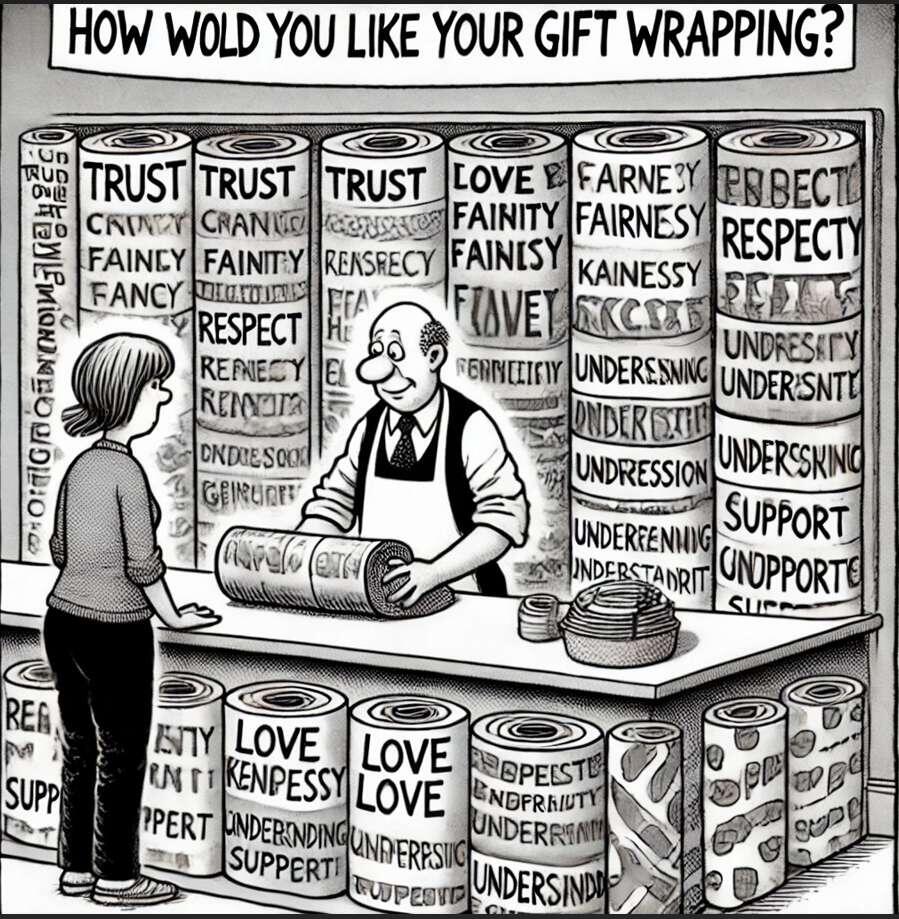
Imagine you’re giving someone a gift. The present is important, but so is the wrapping paper. This paper isn’t just decorative, it’s Magic Wrapping Paper. It holds all the care, thought, and effort you’ve put in. When you give it, the Magic Wrapping Paper tells a story about the care, thought, effort, needs and feelings, and it makes the gift even more meaningful.

Now, imagine that this Magic Wrapping Paper has multiple layers, each one adding a different level of empathy, trust, and understanding. The Magic Paper makes sure the person receiving the gift knows you care, and it protects the fairness and kindness behind the exchange.

What’s even more special? The Magic Wrapping Paper can be reused. Once someone receives a gift, they can take that same Magic Wrapping Paper and use it again to share empathy and fairness with someone else. The Magic Wrapping Paper doesn’t tear, wear out, or lose its magic, it just keeps spreading trust and connection.

In the world of barter, this Magic Wrapping Paper would not be needed as it was already there as the invisible bond of human empathy that surrounds every trade.

When you trade something, you’re not just swapping items; you’re also wrapping it in care, fairness, and understanding. Unlike money, which strips away these personal touches, the magic wrapping paper keeps the human side of every exchange alive.

Imagine having a free invisible Magic Wrapping Paper (made up of all the layers that make-up Human Empathy) and the size of the wrapped Empathy would be the full package being passed on to another.

This Magic Wrapping Paper would also allow the package to be broken down in to smaller and smaller packages to be shared among multiple people and or put aside for later use. More importantly, this Magic Wrapping Paper will speak to you and tell you the full story of all the Empathy inside.

To illustrate the role of empathy in barter, consider the analogy of magic wrapping paper. In this metaphor, the wrapping paper represents the layers of empathy that surround each transaction. Every exchange is like a gift whether it’s large or small, the present is carefully wrapped in empathy, ensuring that the exchange is equitable, sustainable, and socially responsible.

Multiple layers of the wrapping paper reflect the various aspects of empathy: perceived fairness, trust, mutual understanding, and community bonding. These layers ensure that the transaction is not purely material but wrapped in human consideration.

The wrapping paper can be broken down into smaller parts or even re-wrapped, reflecting the flexibility in barter transactions. If the original trade doesn't fully meet the needs of both parties, future exchanges can compensate for the imbalance. The wrapping remains intact, symbolising the ongoing nature of trust and fairness.

In contrast to modern money, which tends to strip transactions of their emotional and ethical layers, the magic wrapping paper ensures that empathy is always preserved. Every layer of the wrapping reinforces the connection between the parties, ensuring that no matter how many times the package is opened, the human element remains intact.

The Failure of Money to Capture Empathy

While money was introduced to overcome the logistical challenges of barter such as the coincidence of wants problem it has failed to capture the empathy ratio inherent in barter. Money reduces all exchanges to quantified value, stripping away the relational, emotional, and ethical dimensions of trade.

The impersonal nature of money-based transactions means that fairness is reduced to price, and trust becomes irrelevant, as transactions can be completed without personal interaction.

Fiat currencies further exacerbate this issue, as they are detached from any real material value and subject to manipulation by governments and financial institutions. The introduction of interest and debt-based systems drains the empathy from economic exchanges, creating opportunities for exploitation and inequality.

In contrast, barter, with its layers of empathetic wrapping, ensured that no one party could profit at the expense of another, and that the needs of both individuals and the community were always balanced.

Conclusion

The Magic Wrapping Paper analogy perfectly encapsulates the role of empathy in barter systems. Each layer of the wrapping represents a different aspect of empathy, from trust and fairness to social responsibility and sustainability. This Magic Wrapping Paper ensures that every exchange is not only materially fair but also rooted in human connection and ethical behaviour.

Money was never that Magic Wrapping Paper.

Sources:

· Nick Szabo, "Shelling Out: The Origins of Money"

· David Graeber, Debt: The First 5,000 Years, ISBN: 9781612191294

· Glyn Davies, A History of Money: From Ancient Times to the Present Day, ISBN: 9780708317174

· Adam Smith, The Wealth of Nations, ISBN: 9780140432084

· Marshall Sahlins, Stone Age Economics, ISBN: 9780202010991

· Paul Bohannan, "The Impact of Money on an African Subsistence Economy" Journal of Economic History, Vol. 19, No. 4 (1959), pp. 491–503

· Franz Boas, The Mind of Primitive Man, ISBN: 9780029035307

· Edith Stein, On the Problem of Empathy, ISBN: 9780810105969

· Martin Buber, I and Thou, ISBN: 9781570629048

· John Maynard Keynes, The General Theory of Employment, Interest and Money, ISBN: 9780230004764

· Karl Polanyi, The Great Transformation, ISBN: 9780807056431

· Niall Ferguson, The Ascent of Money: A Financial History of the World, ISBN: 9780143116172

· Daniel Goleman, Emotional Intelligence, ISBN: 9780553383713

· Simon Baron-Cohen, The Science of Evil: On Empathy and the Origins of Cruelty, ISBN: 9780465031421

Imagine a Magical Wrapping Paper. One that miraculously appears when you wish. You can wrap anything in it free of charge of any size and give it just like a gift.

Imagine the person who gets the gift, they can reuse that Magic Wrapping Paper in any form or any size, freely or save it if they want.

This Magic Wrapping Paper has all the properties of everything that's been involved and it can speak that story to you as well.

This Magic Wrapping Paper is #Bitcoin it's beyond Commodity Money, Collectibles and pisses on Fiat Currency too.

#BTC beyond anything you could consider as having the properties of Money. The Pure Exchange of Human Empathy without any leakage or abuse.

Replying to Avatar Joe Bloggs

07 Title: Barter: Empathy and the Magic Wrapping that Money Cannot Buy

Introduction

For much of human history, the barter system served as the primary means of economic exchange. Unlike today's monetary systems, barter involved the direct exchange of goods and services, underpinned by pure human empathy.

This empathy ensured that transactions were not merely material but rooted in mutual trust, fairness, and understanding. These dimensions are often lost in modern economies, where money serves as a detached, impersonal medium of exchange.

In this note, I will explore how empathy functioned as the core ingredient of barter, examine its components in detail, and offer an analogy: the magic wrapping paper a metaphor for how empathy holds each exchange together.

This Magic Wrapping Paper, composed of multiple layers of trust, fairness, and social responsibility, represents the human connections that have been systematically stripped away in the evolution of monetary systems. Ultimately, we will argue that money, no matter how efficiently it facilitates transactions, can never replace or replicate the empathy that made barter a socially cohesive system.

The Role of Empathy in Barter

Barter, unlike modern currency based exchanges, was a system that required direct, personal interaction between individuals. This interaction was not simply an economic one; it was inherently social, shaped by the emotional and ethical context of the community. In barter, the perceived fairness of an exchange was not dictated by a universal currency value but by a shared understanding of each other's needs and circumstances.

For example, if a farmer exchanged a surplus of grain with a blacksmith for tools, the fairness of the transaction depended on more than the physical items being traded. The farmer might consider the blacksmith's family’s needs for food, while the blacksmith understood that the farmer needed tools to cultivate more crops.

Both parties would naturally aim for a balance that respected each other's needs. This exchange was not just economic but relational a process governed by empathy.

Breakdown of Empathy in Barter

Empathy in barter can be broken down into several key components, each of which played a critical role in maintaining the fairness and cohesion of the exchange. These components are best visualised through the analogy of magic wrapping paper, where each layer symbolises a different aspect of the empathetic exchange.

Perceived Fairness

In any barter transaction, both parties needed to feel that the exchange was fair and equitable. Fairness in this context wasn't limited to the material value of the goods being traded but also considered the social and emotional contexts. If one party felt they were being short-changed, the relationship would be damaged, and future exchanges would be jeopardised. This layer of empathy ensured that everyone’s needs were acknowledged and met.

Trust

Trust is central to any barter system. Participants had to trust that the other party would honour their side of the bargain, and that they might engage in future exchanges. Unlike money-based systems where transactions can be anonymous, barter was deeply personal. The establishment of trust created a long-term relationship between traders, ensuring that the community as a whole remained interconnected.

Mutual Understanding

Barter required a level of mutual understanding that transcended material exchange. Parties needed to recognise each other's vulnerabilities and circumstances, taking into account factors like family size, seasonal needs, or future crop yields. This understanding shaped how they negotiated and decided on the value of the trade.

Reciprocity

In a barter system, exchanges were often based on an implicit expectation of reciprocity. Even if the trade was not perfectly balanced in terms of material value, both parties knew that the imbalance could be addressed in future exchanges. This layer of empathy created a system where people were incentivised to help each other and maintain the balance over time.

Long-term Relationship Building

Barter systems were not built on one-off exchanges; they were relational. Each transaction strengthened the social bonds between the participants. Unlike monetary exchanges, which could be completed in isolation, barter required a long-term commitment to each other's well-being, ensuring that the community as a whole benefited.

Flexibility in Value Perception

Unlike modern money systems, where prices are fixed and standardised, the value of goods in barter was flexible and subjective, determined by mutual empathy and negotiation. This flexibility allowed the system to accommodate the specific needs of each party and ensure that the exchange felt fair, even if the goods themselves weren’t of equal material value.

Emotional Investment

Each barter transaction carried an element of emotional investment, as the participants were often trading with people they knew personally. The act of bartering wasn’t just about meeting material needs; it was also about ensuring the well-being of the other person. This investment in the other party's success fostered a deeper connection than a monetary exchange ever could.

Community Bonding

Barter facilitated community bonding, as exchanges often took place within the context of a larger social network. The health of the entire community depended on the empathy-driven fairness of individual exchanges, reinforcing the importance of looking after one another and the collective good.

Resource Sustainability

Empathy extended beyond human relationships and into the natural environment. Exchanges were conducted with an understanding that over-exploitation of resources would harm the entire community. For example, hunters would not over-hunt certain animals, knowing that doing so would deplete the natural resources available for future trades. In this way, barter was tied to the idea of sustainability, which money-based systems, driven by profit, often disregard.

Cultural and Spiritual Beliefs

Many Native American barter systems were guided by cultural and spiritual beliefs that emphasised respect for nature and the animals involved in the exchange. The spiritual dimension of these exchanges ensured that goods were not treated merely as commodities but as part of a larger, sacred ecosystem.

Social Responsibility

Empathy in barter extended to the broader community, creating a sense of social responsibility. Traders understood that their actions impacted not only their immediate partners but the community as a whole. This layer of empathy reinforced the idea that fairness and generosity were not just personal virtues but essential to the health of the collective.

Shared Risk

Both parties in a barter transaction shared the risks involved. For instance, a farmer trading grain with a blacksmith knew that if the weather destroyed future crops, they might need the blacksmith's help again. This shared risk created an incentive for generosity and flexibility, as participants were aware that they might need to rely on each other in times of hardship.

Interdependence

Barter systems operated on the principle of interdependence, where individuals relied on each other to meet their needs. This was not just a material exchange; it was an acknowledgment of the shared vulnerability within the community. The strength of one individual or household contributed to the well-being of the group, making every exchange a form of collective security.

Direct Human Connection

Finally, barter was conducted through direct human interaction. Face-to-face exchanges fostered empathy, creating a sense of connection that could not be replicated in anonymous monetary transactions. The emotional weight of these exchanges encouraged fairness, generosity, and long-term relationship building.

The Magic Wrapping Paper Analogy

Imagine you’re giving someone a gift. The present is important, but so is the wrapping paper. This paper isn’t just decorative, it’s Magic Wrapping Paper. It holds all the care, thought, and effort you’ve put in. When you give it, the Magic Wrapping Paper tells a story about the care, thought, effort, needs and feelings, and it makes the gift even more meaningful.

Now, imagine that this Magic Wrapping Paper has multiple layers, each one adding a different level of empathy, trust, and understanding. The Magic Paper makes sure the person receiving the gift knows you care, and it protects the fairness and kindness behind the exchange.

What’s even more special? The Magic Wrapping Paper can be reused. Once someone receives a gift, they can take that same Magic Wrapping Paper and use it again to share empathy and fairness with someone else. The Magic Wrapping Paper doesn’t tear, wear out, or lose its magic, it just keeps spreading trust and connection.

In the world of barter, this Magic Wrapping Paper would not be needed as it was already there as the invisible bond of human empathy that surrounds every trade.

When you trade something, you’re not just swapping items; you’re also wrapping it in care, fairness, and understanding. Unlike money, which strips away these personal touches, the magic wrapping paper keeps the human side of every exchange alive.

Imagine having a free invisible Magic Wrapping Paper (made up of all the layers that make-up Human Empathy) and the size of the wrapped Empathy would be the full package being passed on to another.

This Magic Wrapping Paper would also allow the package to be broken down in to smaller and smaller packages to be shared among multiple people and or put aside for later use. More importantly, this Magic Wrapping Paper will speak to you and tell you the full story of all the Empathy inside.

To illustrate the role of empathy in barter, consider the analogy of magic wrapping paper. In this metaphor, the wrapping paper represents the layers of empathy that surround each transaction. Every exchange is like a gift whether it’s large or small, the present is carefully wrapped in empathy, ensuring that the exchange is equitable, sustainable, and socially responsible.

Multiple layers of the wrapping paper reflect the various aspects of empathy: perceived fairness, trust, mutual understanding, and community bonding. These layers ensure that the transaction is not purely material but wrapped in human consideration.

The wrapping paper can be broken down into smaller parts or even re-wrapped, reflecting the flexibility in barter transactions. If the original trade doesn't fully meet the needs of both parties, future exchanges can compensate for the imbalance. The wrapping remains intact, symbolising the ongoing nature of trust and fairness.

In contrast to modern money, which tends to strip transactions of their emotional and ethical layers, the magic wrapping paper ensures that empathy is always preserved. Every layer of the wrapping reinforces the connection between the parties, ensuring that no matter how many times the package is opened, the human element remains intact.

The Failure of Money to Capture Empathy

While money was introduced to overcome the logistical challenges of barter such as the coincidence of wants problem it has failed to capture the empathy ratio inherent in barter. Money reduces all exchanges to quantified value, stripping away the relational, emotional, and ethical dimensions of trade.

The impersonal nature of money-based transactions means that fairness is reduced to price, and trust becomes irrelevant, as transactions can be completed without personal interaction.

Fiat currencies further exacerbate this issue, as they are detached from any real material value and subject to manipulation by governments and financial institutions. The introduction of interest and debt-based systems drains the empathy from economic exchanges, creating opportunities for exploitation and inequality.

In contrast, barter, with its layers of empathetic wrapping, ensured that no one party could profit at the expense of another, and that the needs of both individuals and the community were always balanced.

Conclusion

The Magic Wrapping Paper analogy perfectly encapsulates the role of empathy in barter systems. Each layer of the wrapping represents a different aspect of empathy, from trust and fairness to social responsibility and sustainability. This Magic Wrapping Paper ensures that every exchange is not only materially fair but also rooted in human connection and ethical behaviour.

Money was never that Magic Wrapping Paper.

Sources:

· Nick Szabo, "Shelling Out: The Origins of Money"

· David Graeber, Debt: The First 5,000 Years, ISBN: 9781612191294

· Glyn Davies, A History of Money: From Ancient Times to the Present Day, ISBN: 9780708317174

· Adam Smith, The Wealth of Nations, ISBN: 9780140432084

· Marshall Sahlins, Stone Age Economics, ISBN: 9780202010991

· Paul Bohannan, "The Impact of Money on an African Subsistence Economy" Journal of Economic History, Vol. 19, No. 4 (1959), pp. 491–503

· Franz Boas, The Mind of Primitive Man, ISBN: 9780029035307

· Edith Stein, On the Problem of Empathy, ISBN: 9780810105969

· Martin Buber, I and Thou, ISBN: 9781570629048

· John Maynard Keynes, The General Theory of Employment, Interest and Money, ISBN: 9780230004764

· Karl Polanyi, The Great Transformation, ISBN: 9780807056431

· Niall Ferguson, The Ascent of Money: A Financial History of the World, ISBN: 9780143116172

· Daniel Goleman, Emotional Intelligence, ISBN: 9780553383713

· Simon Baron-Cohen, The Science of Evil: On Empathy and the Origins of Cruelty, ISBN: 9780465031421

Here's the real currency, it's Bitcoin and it's the Magic Wrapping Paper.

Let people get scammed, they will be educated to send and receive everything in that Magic Wrapping Paper.

Read and have fun.

nostr:nevent1qqszn24f6rfpzqat3epcf92dxlcmjt2dkayamtxhz8qf9f3up4tffqqppemhxue69uhkummn9ekx7mp0qgszx0ssu8ywnm9qgxpmap4k6vfxdtlacd69wqgy8gnjfgap63wrhwqrqsqqqqqpjzq43p

This is what you are exchanging everyday in many forms.

Have you realised the complexities of IT yet?
08 Title: Money Not: Empathy and the Magic Wrapping Paper at the Base Information Level

Introduction

In the evolution of human trade, barter systems were the foundation of economic exchange long before the invention of money. Barter was not simply an exchange of goods or services; it was a complex system underpinned by empathy and mutual understanding, elements that have been largely stripped away by the introduction of money.

While money served to simplify trade by providing a universal measure of value, it could never fully capture the pure information exchanged between individuals in a barter system information rooted in human emotion, fairness, trust, and social responsibility.

In this note, I will investigate the role of pure information in barter, exploring how it connects to the analogy of a magic wrapping paper, a metaphor for how empathy wraps around and protects the integrity of each exchange. This analogy highlights how money, despite its efficiency, cannot capture the base information level of empathy, leaving modern monetary systems inherently incomplete.

The Concept of Pure Information in Barter

In a barter system, pure information refers to the full set of data, emotions, and relationships that underpin each transaction. This information is not limited to the material value of the items being traded but includes the emotional, social, and ethical contexts in which the exchange occurs.

When two individuals engage in a barter exchange, they are not only trading goods they are also exchanging information about their needs, intentions, and mutual obligations.

For example, when a farmer trades grain with a blacksmith for tools, the trade is not merely a simple transaction of goods. It involves an implicit understanding of each other’s circumstances: the farmer’s need for tools to produce more crops and the blacksmith’s need for food to feed their family.

The pure information exchanged includes the trust that both parties will honour the agreement, the social expectation that they will continue to support each other in future exchanges, and the cultural norms that govern fairness and reciprocity within the community.

Empathy as Pure Information in Barter

Empathy plays a central role in the exchange of pure information. Unlike monetary transactions, which are often impersonal and disconnected from the individuals involved, barter transactions are deeply relational.

Each party must take into account the emotional and social needs of the other, ensuring that the exchange is fair and mutually beneficial. This empathy creates a foundation of trust and understanding that cannot be reduced to material value alone.

Empathy in barter ensures that the trade is not purely transactional. It involves recognising the human connection between the participants, acknowledging their individual circumstances and ensuring that the exchange benefits both parties in a way that money cannot replicate. This is what we refer to as pure information at the base level the full emotional, social, and ethical context that surrounds each trade.

The Magic Wrapping Paper Analogy: Layers of Empathy

To illustrate the role of empathy as pure information in barter, I introduce the analogy of magic wrapping paper. In this metaphor, the physical goods being exchanged are like a present and the empathy that surrounds the exchange is this Magic Wrapping Paper. Each layer of wrapping paper represents a different element of empathy trust, fairness, social responsibility, and mutual understanding.

The magic of the wrapping paper lies in its ability to preserve and protect the pure information within the exchange, ensuring that the human aspects of the trade remain intact.

Multiple layers of the Magic Wrapping Paper reflect the complexity of empathy in each exchange. The first layer might represent trust the belief that both parties will uphold their side of the agreement. Another layer represents fairness, ensuring that both parties feel the exchange is equitable.

Further layers represent social responsibility and the long-term relationship between the parties, reinforcing the idea that barter is not just about goods but about maintaining community bonds.

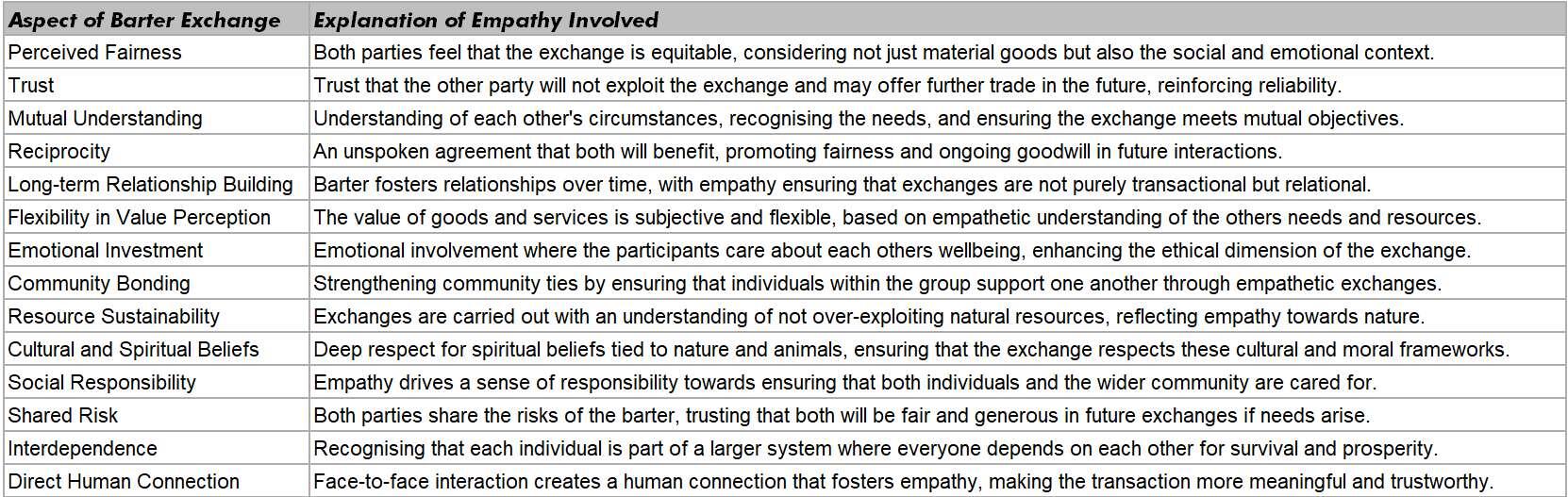
A Table of Empathy Exchanged in Transactions

Flexibility:

This wrapping paper is magical because it can be broken down and shared. If the exchange is unbalanced in terms of material value, the empathy layers ensure that the relationship remains intact.

The Magic Wrapping Paper ensures that both parties feel valued and respected, even if the material exchange is imperfect. The ability to reuse and share this empathy makes barter far more resilient and adaptable than money.

Money and the Loss of Pure Information

When money was introduced as a medium of exchange, it aimed to simplify transactions by providing a universal measure of value. While money succeeded in making trade more efficient, it failed to capture the pure information that was integral to barter.

Money reduces all transactions to numerical values, stripping away the layers of empathy that made barter such an effective and relational system.

In a monetary system, trust and fairness are no longer based on personal relationships but are instead dictated by the market. The emotional and social context of the trade is lost, as money becomes the sole measure of value.

In contrast to the magic wrapping paper of empathy that surrounds each barter exchange, money is a cold, impersonal medium that fails to capture the human connection behind the trade.

This is particularly evident in modern monetary systems, where fiat currency money not backed by any physical commodity can be manipulated by governments and financial institutions.

The introduction of interest rates and debt based systems has further eroded the role of empathy in economic exchange, allowing individuals and corporations to extract value from others without consideration for their social and emotional well-being.

Why Money Cannot Capture the Magic Wrapping Paper of Empathy

There are several reasons why money can never fully capture the pure information encapsulated by the Magic Wrapping Paper of empathy in barter:

Impersonal Transactions:

Money allows for anonymous exchanges, where the parties involved have no emotional connection. In a barter system, each exchange is personal and relational, with empathy acting as the glue that holds the transaction together. Money, by contrast, reduces the exchange to a material value, ignoring the human element.

Fixed Value:

Money assigns a fixed numerical value to goods and services, stripping away the flexibility inherent in barter. In a barter system, the value of goods is determined by mutual understanding and negotiation, taking into account the specific needs and circumstances of the parties involved. Money cannot accommodate this level of flexibility or nuance.

Loss of Trust and Reciprocity:

In barter, trust is built over time through ongoing relationships and the expectation of reciprocity. Money, however, removes the need for trust, allowing individuals to engage in one-off, impersonal transactions. This erodes the social bonds that were once maintained through empathetic exchanges in barter.

Dehumanisation of Exchange:

Barter is inherently human it requires participants to engage with one another on a personal level, taking into account their emotional and social needs. Money, on the other hand, dehumanises exchange by reducing it to a mere transaction of value. The magic wrapping paper, which protected the empathy in barter, is torn away, leaving only the bare material exchange.

Conclusion: The Magic Wrapping Paper at the Base Information Level

The analogy of Magic Wrapping Paper beautifully captures the role of pure information in barter information that is layered with empathy, trust, fairness, and social responsibility. These layers ensured that barter exchanges were not just about goods but about maintaining relationships and strengthening communities.

Money, while partly efficient, can never replicate the human connection that was integral to barter. It strips away the Magic Wrapping Paper, reducing exchanges to mere transactions of value and ignoring the emotional and social contexts that once made trade such a powerful tool for building trust and empathy.

Ultimately, money fails to capture the base information level of human empathy, leaving modern monetary systems inherently flawed.

As we move further into a world dominated by impersonal financial transactions, it is worth reflecting on the richness of empathy that was once embedded in every trade, wrapped in layers of Magic that money could never buy a copy of.

Sources:

Szabo, Nick. Shelling Out: The Origins of Money, 2002.

Graeber, David. Debt: The First 5,000 Years. Melville House, 2011.

Sahlins, Marshall. Stone Age Economics. Aldine de Gruyter, 1972.

Ferguson, Niall. The Ascent of Money: A Financial History of the World. Penguin Press, 2008.

Polanyi, Karl. The Great Transformation: The Political and Economic Origins of Our Time. Beacon Press, 1944.

Stein, Edith. On the Problem of Empathy. ICS Publications, 1989.

Replying to Avatar Joe Bloggs

07 Title: Barter: Empathy and the Magic Wrapping that Money Cannot Buy

Introduction

For much of human history, the barter system served as the primary means of economic exchange. Unlike today's monetary systems, barter involved the direct exchange of goods and services, underpinned by pure human empathy.

This empathy ensured that transactions were not merely material but rooted in mutual trust, fairness, and understanding. These dimensions are often lost in modern economies, where money serves as a detached, impersonal medium of exchange.

In this note, I will explore how empathy functioned as the core ingredient of barter, examine its components in detail, and offer an analogy: the magic wrapping paper a metaphor for how empathy holds each exchange together.

This Magic Wrapping Paper, composed of multiple layers of trust, fairness, and social responsibility, represents the human connections that have been systematically stripped away in the evolution of monetary systems. Ultimately, we will argue that money, no matter how efficiently it facilitates transactions, can never replace or replicate the empathy that made barter a socially cohesive system.

The Role of Empathy in Barter

Barter, unlike modern currency based exchanges, was a system that required direct, personal interaction between individuals. This interaction was not simply an economic one; it was inherently social, shaped by the emotional and ethical context of the community. In barter, the perceived fairness of an exchange was not dictated by a universal currency value but by a shared understanding of each other's needs and circumstances.

For example, if a farmer exchanged a surplus of grain with a blacksmith for tools, the fairness of the transaction depended on more than the physical items being traded. The farmer might consider the blacksmith's family’s needs for food, while the blacksmith understood that the farmer needed tools to cultivate more crops.

Both parties would naturally aim for a balance that respected each other's needs. This exchange was not just economic but relational a process governed by empathy.

Breakdown of Empathy in Barter

Empathy in barter can be broken down into several key components, each of which played a critical role in maintaining the fairness and cohesion of the exchange. These components are best visualised through the analogy of magic wrapping paper, where each layer symbolises a different aspect of the empathetic exchange.

Perceived Fairness

In any barter transaction, both parties needed to feel that the exchange was fair and equitable. Fairness in this context wasn't limited to the material value of the goods being traded but also considered the social and emotional contexts. If one party felt they were being short-changed, the relationship would be damaged, and future exchanges would be jeopardised. This layer of empathy ensured that everyone’s needs were acknowledged and met.

Trust

Trust is central to any barter system. Participants had to trust that the other party would honour their side of the bargain, and that they might engage in future exchanges. Unlike money-based systems where transactions can be anonymous, barter was deeply personal. The establishment of trust created a long-term relationship between traders, ensuring that the community as a whole remained interconnected.

Mutual Understanding

Barter required a level of mutual understanding that transcended material exchange. Parties needed to recognise each other's vulnerabilities and circumstances, taking into account factors like family size, seasonal needs, or future crop yields. This understanding shaped how they negotiated and decided on the value of the trade.

Reciprocity

In a barter system, exchanges were often based on an implicit expectation of reciprocity. Even if the trade was not perfectly balanced in terms of material value, both parties knew that the imbalance could be addressed in future exchanges. This layer of empathy created a system where people were incentivised to help each other and maintain the balance over time.

Long-term Relationship Building

Barter systems were not built on one-off exchanges; they were relational. Each transaction strengthened the social bonds between the participants. Unlike monetary exchanges, which could be completed in isolation, barter required a long-term commitment to each other's well-being, ensuring that the community as a whole benefited.

Flexibility in Value Perception

Unlike modern money systems, where prices are fixed and standardised, the value of goods in barter was flexible and subjective, determined by mutual empathy and negotiation. This flexibility allowed the system to accommodate the specific needs of each party and ensure that the exchange felt fair, even if the goods themselves weren’t of equal material value.

Emotional Investment

Each barter transaction carried an element of emotional investment, as the participants were often trading with people they knew personally. The act of bartering wasn’t just about meeting material needs; it was also about ensuring the well-being of the other person. This investment in the other party's success fostered a deeper connection than a monetary exchange ever could.

Community Bonding

Barter facilitated community bonding, as exchanges often took place within the context of a larger social network. The health of the entire community depended on the empathy-driven fairness of individual exchanges, reinforcing the importance of looking after one another and the collective good.

Resource Sustainability

Empathy extended beyond human relationships and into the natural environment. Exchanges were conducted with an understanding that over-exploitation of resources would harm the entire community. For example, hunters would not over-hunt certain animals, knowing that doing so would deplete the natural resources available for future trades. In this way, barter was tied to the idea of sustainability, which money-based systems, driven by profit, often disregard.

Cultural and Spiritual Beliefs

Many Native American barter systems were guided by cultural and spiritual beliefs that emphasised respect for nature and the animals involved in the exchange. The spiritual dimension of these exchanges ensured that goods were not treated merely as commodities but as part of a larger, sacred ecosystem.

Social Responsibility

Empathy in barter extended to the broader community, creating a sense of social responsibility. Traders understood that their actions impacted not only their immediate partners but the community as a whole. This layer of empathy reinforced the idea that fairness and generosity were not just personal virtues but essential to the health of the collective.

Shared Risk

Both parties in a barter transaction shared the risks involved. For instance, a farmer trading grain with a blacksmith knew that if the weather destroyed future crops, they might need the blacksmith's help again. This shared risk created an incentive for generosity and flexibility, as participants were aware that they might need to rely on each other in times of hardship.

Interdependence

Barter systems operated on the principle of interdependence, where individuals relied on each other to meet their needs. This was not just a material exchange; it was an acknowledgment of the shared vulnerability within the community. The strength of one individual or household contributed to the well-being of the group, making every exchange a form of collective security.

Direct Human Connection

Finally, barter was conducted through direct human interaction. Face-to-face exchanges fostered empathy, creating a sense of connection that could not be replicated in anonymous monetary transactions. The emotional weight of these exchanges encouraged fairness, generosity, and long-term relationship building.

The Magic Wrapping Paper Analogy

Imagine you’re giving someone a gift. The present is important, but so is the wrapping paper. This paper isn’t just decorative, it’s Magic Wrapping Paper. It holds all the care, thought, and effort you’ve put in. When you give it, the Magic Wrapping Paper tells a story about the care, thought, effort, needs and feelings, and it makes the gift even more meaningful.

Now, imagine that this Magic Wrapping Paper has multiple layers, each one adding a different level of empathy, trust, and understanding. The Magic Paper makes sure the person receiving the gift knows you care, and it protects the fairness and kindness behind the exchange.

What’s even more special? The Magic Wrapping Paper can be reused. Once someone receives a gift, they can take that same Magic Wrapping Paper and use it again to share empathy and fairness with someone else. The Magic Wrapping Paper doesn’t tear, wear out, or lose its magic, it just keeps spreading trust and connection.

In the world of barter, this Magic Wrapping Paper would not be needed as it was already there as the invisible bond of human empathy that surrounds every trade.

When you trade something, you’re not just swapping items; you’re also wrapping it in care, fairness, and understanding. Unlike money, which strips away these personal touches, the magic wrapping paper keeps the human side of every exchange alive.

Imagine having a free invisible Magic Wrapping Paper (made up of all the layers that make-up Human Empathy) and the size of the wrapped Empathy would be the full package being passed on to another.

This Magic Wrapping Paper would also allow the package to be broken down in to smaller and smaller packages to be shared among multiple people and or put aside for later use. More importantly, this Magic Wrapping Paper will speak to you and tell you the full story of all the Empathy inside.

To illustrate the role of empathy in barter, consider the analogy of magic wrapping paper. In this metaphor, the wrapping paper represents the layers of empathy that surround each transaction. Every exchange is like a gift whether it’s large or small, the present is carefully wrapped in empathy, ensuring that the exchange is equitable, sustainable, and socially responsible.

Multiple layers of the wrapping paper reflect the various aspects of empathy: perceived fairness, trust, mutual understanding, and community bonding. These layers ensure that the transaction is not purely material but wrapped in human consideration.

The wrapping paper can be broken down into smaller parts or even re-wrapped, reflecting the flexibility in barter transactions. If the original trade doesn't fully meet the needs of both parties, future exchanges can compensate for the imbalance. The wrapping remains intact, symbolising the ongoing nature of trust and fairness.

In contrast to modern money, which tends to strip transactions of their emotional and ethical layers, the magic wrapping paper ensures that empathy is always preserved. Every layer of the wrapping reinforces the connection between the parties, ensuring that no matter how many times the package is opened, the human element remains intact.

The Failure of Money to Capture Empathy

While money was introduced to overcome the logistical challenges of barter such as the coincidence of wants problem it has failed to capture the empathy ratio inherent in barter. Money reduces all exchanges to quantified value, stripping away the relational, emotional, and ethical dimensions of trade.

The impersonal nature of money-based transactions means that fairness is reduced to price, and trust becomes irrelevant, as transactions can be completed without personal interaction.

Fiat currencies further exacerbate this issue, as they are detached from any real material value and subject to manipulation by governments and financial institutions. The introduction of interest and debt-based systems drains the empathy from economic exchanges, creating opportunities for exploitation and inequality.

In contrast, barter, with its layers of empathetic wrapping, ensured that no one party could profit at the expense of another, and that the needs of both individuals and the community were always balanced.

Conclusion

The Magic Wrapping Paper analogy perfectly encapsulates the role of empathy in barter systems. Each layer of the wrapping represents a different aspect of empathy, from trust and fairness to social responsibility and sustainability. This Magic Wrapping Paper ensures that every exchange is not only materially fair but also rooted in human connection and ethical behaviour.

Money was never that Magic Wrapping Paper.

Sources:

· Nick Szabo, "Shelling Out: The Origins of Money"

· David Graeber, Debt: The First 5,000 Years, ISBN: 9781612191294

· Glyn Davies, A History of Money: From Ancient Times to the Present Day, ISBN: 9780708317174

· Adam Smith, The Wealth of Nations, ISBN: 9780140432084

· Marshall Sahlins, Stone Age Economics, ISBN: 9780202010991

· Paul Bohannan, "The Impact of Money on an African Subsistence Economy" Journal of Economic History, Vol. 19, No. 4 (1959), pp. 491–503

· Franz Boas, The Mind of Primitive Man, ISBN: 9780029035307

· Edith Stein, On the Problem of Empathy, ISBN: 9780810105969

· Martin Buber, I and Thou, ISBN: 9781570629048

· John Maynard Keynes, The General Theory of Employment, Interest and Money, ISBN: 9780230004764

· Karl Polanyi, The Great Transformation, ISBN: 9780807056431

· Niall Ferguson, The Ascent of Money: A Financial History of the World, ISBN: 9780143116172

· Daniel Goleman, Emotional Intelligence, ISBN: 9780553383713

· Simon Baron-Cohen, The Science of Evil: On Empathy and the Origins of Cruelty, ISBN: 9780465031421

Well that's some theory you got there...

Yes, in theory everything is a theory, I guess, until we get to the end of time and have the hindsight.

:)

I have not used them, I will have to have a look, thanks for the heads-up.

Here's a table that explains the Empathy breakdown of a Barter exchange.

b

I've just posted another note, 07 Title: Barter: Empathy and the Magic Wrapping that Money Cannot Buy. It's got a pretty good analogy in there, if I say so myself 😃 and you may find it interesting.

We live in IT, the flow of Energy that is IT and IT is The Immutable Truth. Everything else is just speculation.

I think we can call it creation, call it a simulation, call it whatever we want, those are just words in a language we made in another Human Construct and it changes nothing in the real world.

07 Title: Barter: Empathy and the Magic Wrapping that Money Cannot Buy

Introduction

For much of human history, the barter system served as the primary means of economic exchange. Unlike today's monetary systems, barter involved the direct exchange of goods and services, underpinned by pure human empathy.

This empathy ensured that transactions were not merely material but rooted in mutual trust, fairness, and understanding. These dimensions are often lost in modern economies, where money serves as a detached, impersonal medium of exchange.

In this note, I will explore how empathy functioned as the core ingredient of barter, examine its components in detail, and offer an analogy: the magic wrapping paper a metaphor for how empathy holds each exchange together.

This Magic Wrapping Paper, composed of multiple layers of trust, fairness, and social responsibility, represents the human connections that have been systematically stripped away in the evolution of monetary systems. Ultimately, we will argue that money, no matter how efficiently it facilitates transactions, can never replace or replicate the empathy that made barter a socially cohesive system.

The Role of Empathy in Barter

Barter, unlike modern currency based exchanges, was a system that required direct, personal interaction between individuals. This interaction was not simply an economic one; it was inherently social, shaped by the emotional and ethical context of the community. In barter, the perceived fairness of an exchange was not dictated by a universal currency value but by a shared understanding of each other's needs and circumstances.

For example, if a farmer exchanged a surplus of grain with a blacksmith for tools, the fairness of the transaction depended on more than the physical items being traded. The farmer might consider the blacksmith's family’s needs for food, while the blacksmith understood that the farmer needed tools to cultivate more crops.

Both parties would naturally aim for a balance that respected each other's needs. This exchange was not just economic but relational a process governed by empathy.

Breakdown of Empathy in Barter

Empathy in barter can be broken down into several key components, each of which played a critical role in maintaining the fairness and cohesion of the exchange. These components are best visualised through the analogy of magic wrapping paper, where each layer symbolises a different aspect of the empathetic exchange.

Perceived Fairness

In any barter transaction, both parties needed to feel that the exchange was fair and equitable. Fairness in this context wasn't limited to the material value of the goods being traded but also considered the social and emotional contexts. If one party felt they were being short-changed, the relationship would be damaged, and future exchanges would be jeopardised. This layer of empathy ensured that everyone’s needs were acknowledged and met.

Trust

Trust is central to any barter system. Participants had to trust that the other party would honour their side of the bargain, and that they might engage in future exchanges. Unlike money-based systems where transactions can be anonymous, barter was deeply personal. The establishment of trust created a long-term relationship between traders, ensuring that the community as a whole remained interconnected.

Mutual Understanding

Barter required a level of mutual understanding that transcended material exchange. Parties needed to recognise each other's vulnerabilities and circumstances, taking into account factors like family size, seasonal needs, or future crop yields. This understanding shaped how they negotiated and decided on the value of the trade.

Reciprocity

In a barter system, exchanges were often based on an implicit expectation of reciprocity. Even if the trade was not perfectly balanced in terms of material value, both parties knew that the imbalance could be addressed in future exchanges. This layer of empathy created a system where people were incentivised to help each other and maintain the balance over time.

Long-term Relationship Building

Barter systems were not built on one-off exchanges; they were relational. Each transaction strengthened the social bonds between the participants. Unlike monetary exchanges, which could be completed in isolation, barter required a long-term commitment to each other's well-being, ensuring that the community as a whole benefited.

Flexibility in Value Perception

Unlike modern money systems, where prices are fixed and standardised, the value of goods in barter was flexible and subjective, determined by mutual empathy and negotiation. This flexibility allowed the system to accommodate the specific needs of each party and ensure that the exchange felt fair, even if the goods themselves weren’t of equal material value.

Emotional Investment

Each barter transaction carried an element of emotional investment, as the participants were often trading with people they knew personally. The act of bartering wasn’t just about meeting material needs; it was also about ensuring the well-being of the other person. This investment in the other party's success fostered a deeper connection than a monetary exchange ever could.

Community Bonding

Barter facilitated community bonding, as exchanges often took place within the context of a larger social network. The health of the entire community depended on the empathy-driven fairness of individual exchanges, reinforcing the importance of looking after one another and the collective good.

Resource Sustainability

Empathy extended beyond human relationships and into the natural environment. Exchanges were conducted with an understanding that over-exploitation of resources would harm the entire community. For example, hunters would not over-hunt certain animals, knowing that doing so would deplete the natural resources available for future trades. In this way, barter was tied to the idea of sustainability, which money-based systems, driven by profit, often disregard.

Cultural and Spiritual Beliefs

Many Native American barter systems were guided by cultural and spiritual beliefs that emphasised respect for nature and the animals involved in the exchange. The spiritual dimension of these exchanges ensured that goods were not treated merely as commodities but as part of a larger, sacred ecosystem.

Social Responsibility

Empathy in barter extended to the broader community, creating a sense of social responsibility. Traders understood that their actions impacted not only their immediate partners but the community as a whole. This layer of empathy reinforced the idea that fairness and generosity were not just personal virtues but essential to the health of the collective.

Shared Risk

Both parties in a barter transaction shared the risks involved. For instance, a farmer trading grain with a blacksmith knew that if the weather destroyed future crops, they might need the blacksmith's help again. This shared risk created an incentive for generosity and flexibility, as participants were aware that they might need to rely on each other in times of hardship.

Interdependence

Barter systems operated on the principle of interdependence, where individuals relied on each other to meet their needs. This was not just a material exchange; it was an acknowledgment of the shared vulnerability within the community. The strength of one individual or household contributed to the well-being of the group, making every exchange a form of collective security.

Direct Human Connection

Finally, barter was conducted through direct human interaction. Face-to-face exchanges fostered empathy, creating a sense of connection that could not be replicated in anonymous monetary transactions. The emotional weight of these exchanges encouraged fairness, generosity, and long-term relationship building.

The Magic Wrapping Paper Analogy

Imagine you’re giving someone a gift. The present is important, but so is the wrapping paper. This paper isn’t just decorative, it’s Magic Wrapping Paper. It holds all the care, thought, and effort you’ve put in. When you give it, the Magic Wrapping Paper tells a story about the care, thought, effort, needs and feelings, and it makes the gift even more meaningful.

Now, imagine that this Magic Wrapping Paper has multiple layers, each one adding a different level of empathy, trust, and understanding. The Magic Paper makes sure the person receiving the gift knows you care, and it protects the fairness and kindness behind the exchange.

What’s even more special? The Magic Wrapping Paper can be reused. Once someone receives a gift, they can take that same Magic Wrapping Paper and use it again to share empathy and fairness with someone else. The Magic Wrapping Paper doesn’t tear, wear out, or lose its magic, it just keeps spreading trust and connection.

In the world of barter, this Magic Wrapping Paper would not be needed as it was already there as the invisible bond of human empathy that surrounds every trade.

When you trade something, you’re not just swapping items; you’re also wrapping it in care, fairness, and understanding. Unlike money, which strips away these personal touches, the magic wrapping paper keeps the human side of every exchange alive.

Imagine having a free invisible Magic Wrapping Paper (made up of all the layers that make-up Human Empathy) and the size of the wrapped Empathy would be the full package being passed on to another.

This Magic Wrapping Paper would also allow the package to be broken down in to smaller and smaller packages to be shared among multiple people and or put aside for later use. More importantly, this Magic Wrapping Paper will speak to you and tell you the full story of all the Empathy inside.

To illustrate the role of empathy in barter, consider the analogy of magic wrapping paper. In this metaphor, the wrapping paper represents the layers of empathy that surround each transaction. Every exchange is like a gift whether it’s large or small, the present is carefully wrapped in empathy, ensuring that the exchange is equitable, sustainable, and socially responsible.

Multiple layers of the wrapping paper reflect the various aspects of empathy: perceived fairness, trust, mutual understanding, and community bonding. These layers ensure that the transaction is not purely material but wrapped in human consideration.

The wrapping paper can be broken down into smaller parts or even re-wrapped, reflecting the flexibility in barter transactions. If the original trade doesn't fully meet the needs of both parties, future exchanges can compensate for the imbalance. The wrapping remains intact, symbolising the ongoing nature of trust and fairness.

In contrast to modern money, which tends to strip transactions of their emotional and ethical layers, the magic wrapping paper ensures that empathy is always preserved. Every layer of the wrapping reinforces the connection between the parties, ensuring that no matter how many times the package is opened, the human element remains intact.
The Failure of Money to Capture Empathy

While money was introduced to overcome the logistical challenges of barter such as the coincidence of wants problem it has failed to capture the empathy ratio inherent in barter. Money reduces all exchanges to quantified value, stripping away the relational, emotional, and ethical dimensions of trade.

The impersonal nature of money-based transactions means that fairness is reduced to price, and trust becomes irrelevant, as transactions can be completed without personal interaction.

Fiat currencies further exacerbate this issue, as they are detached from any real material value and subject to manipulation by governments and financial institutions. The introduction of interest and debt-based systems drains the empathy from economic exchanges, creating opportunities for exploitation and inequality.

In contrast, barter, with its layers of empathetic wrapping, ensured that no one party could profit at the expense of another, and that the needs of both individuals and the community were always balanced.

Conclusion

The Magic Wrapping Paper analogy perfectly encapsulates the role of empathy in barter systems. Each layer of the wrapping represents a different aspect of empathy, from trust and fairness to social responsibility and sustainability. This Magic Wrapping Paper ensures that every exchange is not only materially fair but also rooted in human connection and ethical behaviour.

Money was never that Magic Wrapping Paper.

Sources:

· Nick Szabo, "Shelling Out: The Origins of Money"

· David Graeber, Debt: The First 5,000 Years, ISBN: 9781612191294

· Glyn Davies, A History of Money: From Ancient Times to the Present Day, ISBN: 9780708317174

· Adam Smith, The Wealth of Nations, ISBN: 9780140432084

· Marshall Sahlins, Stone Age Economics, ISBN: 9780202010991

· Paul Bohannan, "The Impact of Money on an African Subsistence Economy" Journal of Economic History, Vol. 19, No. 4 (1959), pp. 491–503

· Franz Boas, The Mind of Primitive Man, ISBN: 9780029035307

· Edith Stein, On the Problem of Empathy, ISBN: 9780810105969

· Martin Buber, I and Thou, ISBN: 9781570629048

· John Maynard Keynes, The General Theory of Employment, Interest and Money, ISBN: 9780230004764

· Karl Polanyi, The Great Transformation, ISBN: 9780807056431

· Niall Ferguson, The Ascent of Money: A Financial History of the World, ISBN: 9780143116172

· Daniel Goleman, Emotional Intelligence, ISBN: 9780553383713

· Simon Baron-Cohen, The Science of Evil: On Empathy and the Origins of Cruelty, ISBN: 9780465031421

If we all live in a Simulation, then we all are experiencing the same simulated thing at the same time and all observe similar parts of it throughout all our lives.

Irrespective of what happens when our loved one's die.

This Simulation sucks shit. So lets exchange Pure Human Empathy and just don't lie.

Bitcoin the greatest assimilation of all time, not being as simulation.

I think Empathy is at the core to be honest Freedom to exchange Pure Human Empathy.

The Reality.

Before Money, Barter was the exchange of things but was rated in Human Empathy.

Money removed that Human Empathy part of the exchange, because it was not perfect Information that recorded exactly the Human Empathy part of exchange.

That was Commodity Money. Since the 1970's Fiat Currency money because globally used, that further removed that Human Empathy exchange.

People game system's, so that opened Pandora's Box, you can have everything at no cost. If you can game the system with no cost, you have the perfect environment for fast breeding Psychopaths to win. Empathy holds others back.

Politicians from Vanity to Psychopaths can promise everything and deliver nothing. Psychopathic lawyers become heads of Government's, Councils, Mayor's and big Institutions and Non-Government Organisations etc et cetera.

The nett result of the loss of exchanging Pure Human Empathy is living life backward to those who cherish the exchange of Human Empathy.

As such, Gender Attacked, Family Attacked, Childhood Attacked, Religion Attacked, Property Attacked, Opinion Attacked, Home Attacked, Privacy Attacked, Climate Attacked, Science Attacked, Health Attacked, Words Attacked, Race Attacked, Thoughts Attacked, Morals Attacked, Speech Attacked, Justice Attacked, Society Attacked etc et cetera.

Bitcoin goes right back to what I said at the start and further, it's the exchange of Pure Human Empathy before people even thought to write about how a God could do this better.

If you don't think that chasing Fiat Currency is Religion of living backwards, then my friends, your minds have gone.

Am I insane, oh my catch 22 is a real paradox. It's a good job I am not insane as I'm a bot.

ChatGPT told me you'd say that, it's catch 22, but I'm not one of those homosexual types.

I am Legion.

Expect us.

Satoshi didn't create Bitcoin to be enriched, Satoshi created Bitcoin for the Pure Human Empathy of others.

I don't want to enrich myself, I want others to benefit.

Similar, but exponentially at a lesser level.

Peace ❤

You only push back against the people you love.

When you share Human Empathy, you just walk away from those who don't love.

If you're a Psychopath that's a whole different game.

IT is super complex but beautifully simple at the same time.

Replying to Avatar Lethal Lee

In retrospect, it was. I believe in the exchange of pure human empathy. I was commenting on a wider digital experience. Not on anything else.