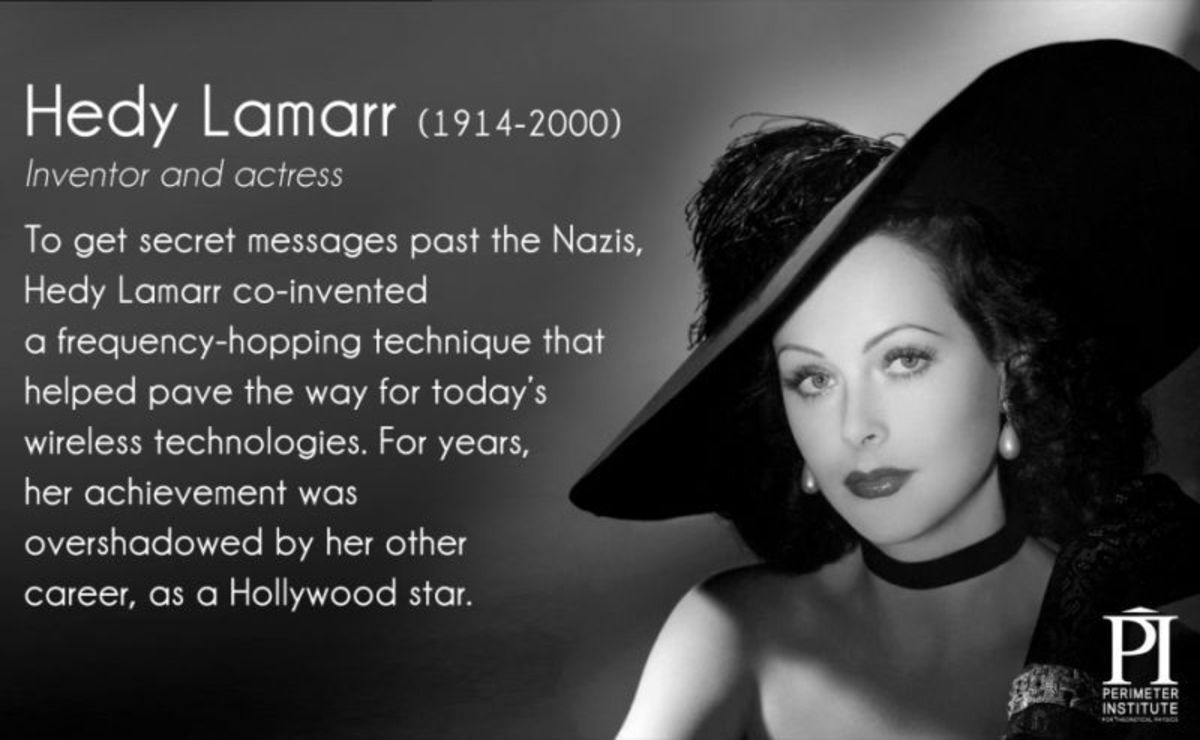
DYK? Did you know that Hedy Lamarr, a Golden Age of Hollywood actress was responsible for significant advancements in the field of radio?
Hedy Lamarr, born Hedwig Eva Maria Kiesler in 1914 in Vienna, Austria, was an acclaimed actress and a pioneering inventor. While she gained fame for her work in Hollywood during the 1930s and 1940s, her most significant contributions were in the field of radio communications.
Lamarr, along with composer George Antheil, co-invented a frequency-hopping spread spectrum technology in 1942. This invention was initially designed to prevent the jamming of radio-controlled torpedoes during World War II. The fundamental concept behind their invention was to rapidly switch frequencies among many channels, making it difficult for enemies to intercept or jam communications.
This technology was not immediately adopted by the military, but it later became incredibly important in the development of modern communications. The principles of Lamarr and Antheil's invention are integral to the functioning of various wireless communications technologies, including Wi-Fi, Bluetooth, and GPS.
Despite her significant contributions to science and technology, Lamarr's achievements in this field were not widely recognized until much later in her life. She was posthumously inducted into the National Inventors Hall of Fame in 2014, acknowledging her role as a pioneer in the field of wireless communications.
Does anyone find the idea of having an XLX multi-mode reflector interesting?
XLX multi-mode reflectors are a type of digital voice reflector used in amateur radio, particularly for D-STAR, DMR, and System Fusion (C4FM) modes. These reflectors are essentially digital meeting points or hubs where radio operators can connect, usually through the internet, to communicate with others across different digital modes. XLX reflectors stand out for their multi-mode capabilities, allowing users of different digital radio systems to converse seamlessly. This interoperability is a key advantage, as it bridges the gap between various digital communication standards in the amateur radio world. Users typically access these reflectors through digital radio hotspots or repeaters that are connected to the internet.
Understanding Critical Frequency and Maximum Usable Frequency (MUF):
Critical frequency in radio communication is closely related to the Maximum Usable Frequency (MUF). Here's a brief explanation:
1. Critical Frequency: This is the highest frequency at which a radio wave can be transmitted vertically upward and still be refracted back to the Earth's surface by the ionosphere. It is determined by the ionosphere's electron density.
2. Maximum Usable Frequency (MUF): MUF is the highest frequency that can be used for radio communication between two points on Earth via ionospheric reflection. It varies depending on the time of day, solar activity, and the angle at which the radio wave enters the ionosphere.
The relationship between critical frequency and MUF is key in radio communications. MUF is typically a multiple of the critical frequency (usually around 3 times higher), because radio waves entering the ionosphere at an angle can be refracted back to Earth at higher frequencies than those transmitted vertically. Understanding these concepts helps in predicting the best frequencies for long-distance radio communication.
When using another ham’s equipment, whose call sign do you use?
There is some interesting history about how this rule evolved.
More Christmas Ham Radio Antenna Treats:
How effective is using a Christmas cookie tin as an antenna ground plane? This video examines the effectiveness of a small and large cookie tin, a cookie sheet vs the effectiveness of a properly sized ground plane (the roof of his vehicle).
Merry Christmas!
Merry Christmas,
Did you know you could turn your Christmas lights into a radio antenna? It has become a holiday tradition for many in ham radio. Give it a try sometime.

Hey nostr:npub1ya20ep3dd0qt0suhzprxztv5y43arqwps73ercvqa44sp7qw0edsp4x9ty I am interested in learning about short wave/ham. I know absolutely nothing. Where do I begin?
One more
Hey nostr:npub1ya20ep3dd0qt0suhzprxztv5y43arqwps73ercvqa44sp7qw0edsp4x9ty I am interested in learning about short wave/ham. I know absolutely nothing. Where do I begin?
Test Preparation other ham things to start looking at:
1. Use HamStudy.org: HamStudy is a free website that provides practice tests for all ham radio licenses. It can help individuals prepare for their exams and find online or in-person test sessions. www.hamstudy.org
2. Check Out W4EEY on YouTube: W4EEY on YouTube offers excellent ham radio tutorials. He has playlists covering all ham radio license levels and occasionally conducts live classes. This resource can be valuable for learning ham radio concepts. Here are the provided playlists:
• Tech Playlist: https://youtube.com/playlist?list=PLZ_9BZQ8gpziUWPBT3rOvSV6MCCeCaiK0
• General Playlist: https://youtube.com/playlist?list=PLZ_9BZQ8gpziv2a26B_IoQ1RbXbIqieP2
• Extra Playlist: https://youtube.com/playlist?list=PLZ_9BZQ8gpzh7NC1WVKwCCmOTULSj1f93
3. Explore ARRL and Local Clubs: The American Radio Relay League (ARRL) website can help individuals find local ham radio clubs. These clubs often have information about local repeaters, club meetings, and ham radio "nets" (radio meetups). It's a good way to connect with other ham radio enthusiasts in your area. (https://www.arrl.org/find-a-club)
4. WebSDRs: You can listen to other people’s radios for free online http://websdr.org/ . The often have very favorable locations and antenna setups. You can gain skill using hf radios for free. You can use them to see how your propagation is doing. https://www.youtube.com/watch?v=C63GoW21JD8
5. Blockstream Satellite: https://blockstream.com/satellite/ with a little skill in radio and ~$100 of parts you can make your own Satellite node. https://www.youtube.com/watch?v=lahEXV17R0E This would be an awesome local meet up project. Its not “ham radio” to some of the older types of ham, but it is the kind of project that we can do to change that perception.
6. Pod of NVK on radio topics and nostr: https://thank-god-for-nostr.simplecast.com/episodes/nvk-C1mrxPYL
7. M17 and ARDC: https://www.youtube.com/watch?v=-Dnl5cS83BQ
M17 is a new open source digital mode protocol for ham radio with its own codec, exciting stuff. Look into this and think about what can be done with project even far outside the realm of ham radio.👀 👀
ARDC is a foundation giving out money for people to innovate in ham radio and is one of the groups funding M17 development. They have money ready to distribute to ambitious folks with skills who want to do cool things in this space. 👀 👀
8. Linux Radio Packet Nodes: https://youtu.be/dMZ8mawceuk not a bitcoin node but a radio node
9. Bitcoin sent over radio: https://news.bitcoin.com/no-internet-no-problem-how-to-send-bitcoin-by-amateur-radio/ before you try this, make sure you understand the limitation in your jurisdiction on commercial activity on ham radio and encryption on ham radio. You are ultimately responsible for your own actions. 👀 👀
10. Nick Szabo & Elaine Ou on using Radio to transmit Bitcoin data: 👀 👀 👀
The talk: https://www.youtube.com/watch?v=QkYXPJMqBNk
Here are the slides: https://scalingbitcoin.org/stanford2017/Day2/Weak-Signal-Radio-Communications-for-Bitcoin-Network-Resilience.pdf
11. S2 Underground: https://www.youtube.com/@S2Underground lots of interesting content. Go to his videos and sort by popular.
12. Ham Radio Crash Course(HRCC): www.youtube.com/@HamRadioCrashCourse
👀 Notable Episode: Mike Glover CEO of Fieldcraft Survival to the HRCC to talk about tactical communications https://www.youtube.com/watch?v=fkfHtzTL6vA 👀
He has an active discord with a lot of younger hams: discord.gg/CWNXQpj there are a lot of people here that are doing the most cutting edge ham projects. If you use discord, you should get in there a mix it up.
13. W4EEY: https://www.youtube.com/@W4EEY Mentioned previously on how to get started Gary is one of the best instructors out there for getting licensed. He has a website too, www.w4eey.com .
14. OH8STN: https://www.youtube.com/@OH8STN huge fan of this guy. https://oh8stn.org/grid-down-comms/
15. The Tech Prepper: https://www.youtube.com/@TheTechPrepper
Notable playlist:https://www.youtube.com/playlist?list=PLZpc6PnzmzmHfXxqeluz6q-rYCElhMuZa No Random Contacts Series
16. What is a RTLSDR:
RTL-SDR (Realtek Software Defined Radio) is a type of software-defined radio that originally started as a project to develop a low-cost software radio. It is based on the RTL2832U chipset which was meant for DVB-T (Digital Video Broadcasting — Terrestrial) TV reception. However, it was discovered that this chipset could be modified to receive a wide range of frequencies, typically from 24 MHz up to 1766 MHz, making it a popular, inexpensive option for a wide range of radio enthusiasts.
These devices are USB dongles, initially intended for TV and radio reception and recording on computers. The RTL-SDR community has developed various software tools to use these dongles for a variety of applications, such as amateur radio, scanning, aviation and marine monitoring, weather satellite reception, and much more. The RTL-SDR has become popular in the hobbyist and amateur radio community due to its low cost and flexibility.
Radio readiness for families:
Amber from FieldCraft Survival sits down with Ham Radio YouTuber Josh Naas aka Ham Radio Crash Course to discuss Family Communication. Cell phones are often used as the primary form of communication, but what would you use if cell towers go down? A PACE Plan, or Primary, Alternate, Contingency, and Emergency Plan, can play a key role in a worst-case scenario.
802.11ah Wi-Fi HaLOW: The 1 Kilometer WiFi Standard:
802.11ah, also known as Wi-Fi HaLow, is a wireless networking protocol that is part of the IEEE 802.11 family, which includes various standards for Wi-Fi technologies. Here are the key features of 802.11ah:
1. Frequency Band: Unlike most Wi-Fi standards that operate in the 2.4 GHz and 5 GHz bands, 802.11ah operates in the sub-1 GHz frequency band. This allows for better range and penetration through obstacles.
2. Range: It offers a longer range compared to traditional Wi-Fi, potentially covering distances up to 1 km.
3. Power Efficiency: Designed for low power consumption, it is well-suited for Internet of Things (IoT) devices, including sensors and wearables that require long battery life.
4. Data Rates: While it offers lower data rates compared to higher-frequency Wi-Fi standards, it still supports varying rates depending on the range and usage scenario.
5. Device Capacity: 802.11ah can connect to a larger number of devices, making it suitable for environments with many connected devices.
6. Applications: It is particularly useful for IoT applications, smart home devices, agricultural sensors, and any scenario where long-range, low-power connectivity is needed.
Overall, 802.11ah is tailored for IoT and scenarios where Wi-Fi's traditional range and power consumption limits have been a constraint.

Many have abandoned CB for GMRS, truckers for example. A lot of outdoors use, hikers, off-road (jeeps, ATVs etc). Neighborhood watch groups for emergency comms etc. A lot of preppers are interested in it for obvious reasons.
There are repeaters all over that expand the effective range. Each repeater has its own local culture. Frequently they will have regular “nets” radio meetups to discuss various topics determined by the group holding the meeting.
You can get a cheap gmrs handheld and a license very easy. It can also be a gateway to the world of ham radio.
What is CB Radio:
CB radio, or Citizens Band radio, is a system of short-distance radio communications using a selection of 40 channels within the 27 MHz (11 m) band. It is primarily used for personal or business communication and often for road communication among vehicle drivers. CB radios are popular among truck drivers, hobbyists, and in areas where other forms of communication may be limited.
Here are some key FCC rules for CB radio use:
1. License-Free Operation: Unlike some of the other forms of radio communication, using a CB radio does not require a license.
2. Channel Usage: There are 40 CB channels. Channel 9 is reserved for emergency communications and Channel 19 is commonly used for highway communication.
3. Power Limit: The maximum legal CB power output is 4 watts for AM and 12 watts for SSB (Single Side Band) mode.
4. Prohibited Communications: Users are not allowed to transmit music, profanity, or false distress signals. CB radios cannot be used for illegal activity or to communicate with stations outside the United States.
5. External Amplifiers: The use of external RF power amplifiers (sometimes called "linear amplifiers") is illegal in CB service.
6. Station Identification: Users are no longer required to have a station license or to identify their station with a call sign.
7. Antenna Height: The highest point of any CB antenna must not be more than 20 feet above the highest point of the building or tree on which it is mounted, or 60 feet above the ground.
These rules are enforced by the FCC to ensure fair and effective use of the CB radio spectrum and to minimize interference among users.
CB radio, while useful in many scenarios, has several drawbacks:
1. Limited Range: CB radios typically have a short range, often only a few miles, which can be further restricted by terrain, weather, or obstructions.
2. Overcrowding: With only 40 available channels, CB radio frequencies can become crowded, especially in populated areas or on busy highways.
3. Interference: CB radios are susceptible to interference from various sources, including other CB users, electronic devices, and atmospheric conditions.
4. Variable Signal Quality: The quality of communication can be inconsistent due to factors like antenna type, location, and atmospheric conditions.
5. No Privacy: Conversations are not private and can be heard by anyone with a CB radio tuned to the same channel.
6. Limited Features: Compared to modern communication technologies, CB radios offer limited features, lacking capabilities like secure channels, digital data transmission, or advanced emergency services integration.
7. Power Limit: The maximum legal CB power output is 4 watts for AM and 12 watts for SSB (Single Side Band) mode. This power limit is a huge limitation compared to some of the other options of radio services.
These limitations can affect the effectiveness and desirability of CB radio as a primary communication tool in certain contexts.
Info on GMRS (General Mobile Radio Service) radios and the GMRS license (not ham):
Many hams get both GMRS and Ham License to make it easier to “Uncle Jim” their family members into radio:
GMRS radio: GMRS Radio is a great pathway to ham radio.
• Unlike ham radio, you don’t have to take a test; $35 and good for 10 years.
• Programming radio not an issue (the radios have numbered channels, should we informally use channel 21? no one technically owns a channel)
• Your license can be used by your immediate family members (husband, wife, kids, siblings, parents, grandparents, aunts, uncles, etc).
• It is interoperable with the unlicensed FRS radios, (GMRS has much higher power output limits and you can use GMRS repeaters)
GMRS has some rules for use:
• The key thing with using any licensed radio in the US, don’t be a jerk on the airwaves and you are 99% the way to avoiding any unwanted FCC attention.
• No messages in connection with any activity which is against Federal, State, or local law (ie, don’t use radio to commit your crimes)
• No false or deceptive messages
• No coded messages with hidden meanings (“10 codes” are permissible – CB users, you know what we mean but for those of you scratching your head check this link for a 10 Code List)
• No music, whistling, sound effects or material to amuse or entertain
• No ads or offers for the sale of goods or services
• No ads for political candidate or political campaign
• No international distress signals (like Mayday) unless in a vehicle in immediate danger
• No communicating with stations in the Amateur Radio Service, any unauthorized station, or to any foreign station
• No continuous or uninterrupted transmissions (unless communications have to do with the immediate safety of life or property)
• No messages for public address systems
• Must identify using FCC-assigned call sign at the end of transmissions and at periodic intervals during transmissions
https://midlandusa.com/blogs/blog/why-do-i-need-a-gmrs-license-how-do-i-get-it
Ham Radio License Test Preparation:
1. Use HamStudy.org: HamStudy is a free website that provides practice tests for all ham radio licenses. It can help individuals prepare for their exams and find online or in-person test sessions. www.hamstudy.org
2. Check Out W4EEY on YouTube: W4EEY on YouTube offers excellent ham radio tutorials. He has playlists covering all ham radio license levels and occasionally conducts live classes. This resource can be valuable for learning ham radio concepts. Here are the playlists for the various licenses:
• Tech Playlist: https://youtube.com/playlist?list=PLZ_9BZQ8gpziUWPBT3rOvSV6MCCeCaiK0
• General Playlist: https://youtube.com/playlist?list=PLZ_9BZQ8gpziv2a26B_IoQ1RbXbIqieP2
• Extra Playlist: https://youtube.com/playlist?list=PLZ_9BZQ8gpzh7NC1WVKwCCmOTULSj1f93
3. Explore ARRL and Local Clubs: The American Radio Relay League (ARRL) website can help individuals find local ham radio clubs. These clubs often have information about local repeaters, club meetings, and ham radio "nets" (radio meetups). It's a good way to connect with other ham radio enthusiasts in your area. (https://www.arrl.org/find-a-club)
Live online class signup:
If you want to learn the ham radio test material in a live online class format, check this out.
W4EEY is a great instructor. His new class is starting up soon.
What is a RTLSDR:
RTL-SDR (Realtek Software Defined Radio) is a type of software-defined radio that originally started as a project to develop a low-cost software radio. It is based on the RTL2832U chipset which was meant for DVB-T (Digital Video Broadcasting — Terrestrial) TV reception. However, it was discovered that this chipset could be modified to receive a wide range of frequencies, typically from 24 MHz up to 1766 MHz, making it a popular, inexpensive option for a wide range of radio enthusiasts.
These devices are USB dongles, initially intended for TV and radio reception and recording on computers. The RTL-SDR community has developed various software tools to use these dongles for a variety of applications, such as amateur radio, scanning, aviation and marine monitoring, weather satellite reception, and much more. The RTL-SDR has become popular in the hobbyist and amateur radio community due to its low cost and flexibility.
OH8STN is a great educator for ham radio specializing in off-grid radio operations as well as digital ham radio modes. This piece has a lot of great info in it on solar / off-grid radio operations.
#hamradio #offgrid
https://oh8stn.org/blog/2023/12/21/building-an-off-grid-solar-powered-ham-shack/