

That is not recognized as a Chat Key in my Keychat. New Keychat versions can not see groups of old versions. Could that be the problem?

Web2, Web3, Web5… What are those?
Let’s start with defining Web itself. My take:
#Web is a computing platform - like POSIX, Windows, Java, embedded etc. Web differs from Internet the same way Windows differs from BIOS.
As a computing platform Web brings a number of protocols, toolchains, SDKs and technologies:
1. Networking is restricted to the TCP/IP subset: HTTP(s), WebSocket and WebRTL
2. Supported instruction set architectures: WASM, JavaScript virtual machine(s), both browser- and server (NodeJS)-based.
3. UI uses HTML, CSS, DOM, WebGL, Canvas. On top of that UI frameworks proliferate - like in POSIX world we have Qt, GTK etc in Web world we have React, Angular, Vue, Svelte etc.
Why Web is so popular? It was the first computing platform created at the age of networking - and for network-based apps first. It allows to run apps without installing them - and do that on any consumer UI-based device: desktop, laptop or mobile. It allows simple creation of cross-platforms apps. It avoids censorship of app stores.
The drawbacks of Web are mostly direct consequences of its advantages:
- low security: a remote code is executed locally;
- privacy leaks as a result of client-server model;
- agility allowing cross-platform UI and schema-less network messaging results in “spaghetti code” and wired JavaScript VM non-determinism
- Web is poorly decentralized and censorship-resistant: an inherited client-server model doesn’t allows proper decentralization.
Web passed through a generations: Web, Web2 - and now attempts of Web3 and Web5 are there.
The main difference between Web and Web2 was:
- interactivity (brought through JavaScript AJAX, and later WebSockets);
- dynamic UI (with JavaScript DOM manipulations);
- abandoning of Java applets;
- move from CGI to custom web servers with embedded server-side business logic (NodeJS, Python and web frameworks in almost each language);
- better markup languages (HTML5, CSS3), including graphic markup (SVG, Canvas, WebGL).
What people were looking for in post Web2-era etc?
- better decentralizaiton and censorship-resistance;
- integration of native internet money and payment methods;
- smart contracts (complex automations based on cryptographic and economic incentives);
- better privacy.
Does Web3 or Web5 delivers on that? No: it promises to deliver, but fails: there can’t be a privacy nor scalability with blockchain-based things; there can’t be censorship-resistance with PoS; there can’t be decentralization with the old client-server hosting of content.
How the proper “next Web” should look like?
- based on P2P (where is possible) or relay-based systems (where P2P is impossible); with relays being self-hosted;
- end-to-end encrypted communications;
- over Mix networks (Tor, Nym, I2P etc);
- authentication based on public key cryptography (and not passwords) and decentralized identities (SSH, GPG and future systems);
- based on zero-knowledge state; i.e. not leaking privacy data to the web servers or nodes;
- using deterministic functional computing;
- using PoW and bitcoin single-use-seals - but not for storing a state like in Web2 (!); only for cryptographic commitments (OTS etc);
- using client-side-valdiated smart contracts like RGB;
- integrated with Lightning payments and #BiFi (bitcoin finance);
- using decentralized data protocols like #Storm, #Slashtags, #Nostr-based and like solutions.
I call this future Web4, and we are working on it at @lnp_bp, @pandoraprime_ch, @cyphernet_io together with parter projects like @nymproject @radicle @DarkFiSquad doing things like mixnets, end-to-end encryption, #reNostr, #Storm, #RGB smart contracts and other exciting projects.
Everyone is welcome to check one of our releases we did this year: cyphernet, a Rust library providing support for mixnets and pure rust implementation of Noise E2E encryption: https://github.com/cyphernet-dao/rust-cyphernet
More fill follow soon!
2 years old, but still relevant. Web3 is nowadays mainly a shitcoin term. The solutions, here discussed as "web4", is what we need.

Dice. And avoiding dice that may be manipulated for weak entropy!
Could be great.
First concern: exit node operators would have a harder time proving their innocence when their exit node was used for crimes, compared to official VPN or Tor exit node operators. Therefore only running exit nodes on anonymous (paid) VPS would be doable.
Second concern: if the exit node has not many users, your traffic through it is not so well hidden as through VPN or Tor exit servers with many thousands of users. This would result in a higher ingress/egress traffic correlation risk.
Therefore onion routing or, even better, mixnet would be recommended.
Ideally all traffic packets should look the same (size) and not a unique type which can be easily filtered.
Best starting point I know would be the Nym mixnet. Add Lightning payments towards node operators. Add Nostr relays to improve bootstrapping of node discovery and use the Nostr communities to attract users. Because Nym is not known enough. Also it focuses more on small bandwidth usage like messaging. I hope for high bandwidth usage like VPNs and Tor.
When your encrypted app is really doing its work. It WILL attract all kinds of shady people. That's why you don't go after encryption itself, but going after real-life criminals (like child abusers etc...)
This is an article about wickr.me and how it was closed down by Amazon after they just bought it out.
https://techcrunch.com/2022/11/21/amazon-wickr-app-shutting-down/
Right! Good reminder not to use proprietary closed source software made by a for-profit company. Abrupt shutdown is one of the many risks...
Yes. The Pineapple Fund donated all their 5104 BTC to charities, in a traceable way, and then stopped existing. Last archive: https://web.archive.org/web/20200108164133/https://pineapplefund.org/

That's why I mainly use my bank to get my money out as cash; money that others have put in my bank account.
Always prefer anonymous payments!
Check Air Baltic, Cheapair, Travala, and idk whether it is scam or not: AlternativeAirlines.

Coinjoin worth 890 bitcoin
https://mempool.space/tx/da90d4fcee3d3965d23aef486065d317ce069f7e43751018443b3a4e0901394e#vout=0
1 input of 249 btc.
3 inputs of each 200 btc.
4 outputs of each 171 btc.
6 outputs of each 23 btc.
The probability of these being linked is too high to be a good mix, isn't it?
And still with a fiat mindset. We are given amount choices as dollars, minimum $1, no sats.

I am waiting for nostr:npub1ajlrwgfj4yerhqf7ady03h7wmtk2qr3gs7h3sxcx83k05yld36sswpzx3q to add a feature to optionally tunnel ALL Aqua network traffic over Tor.
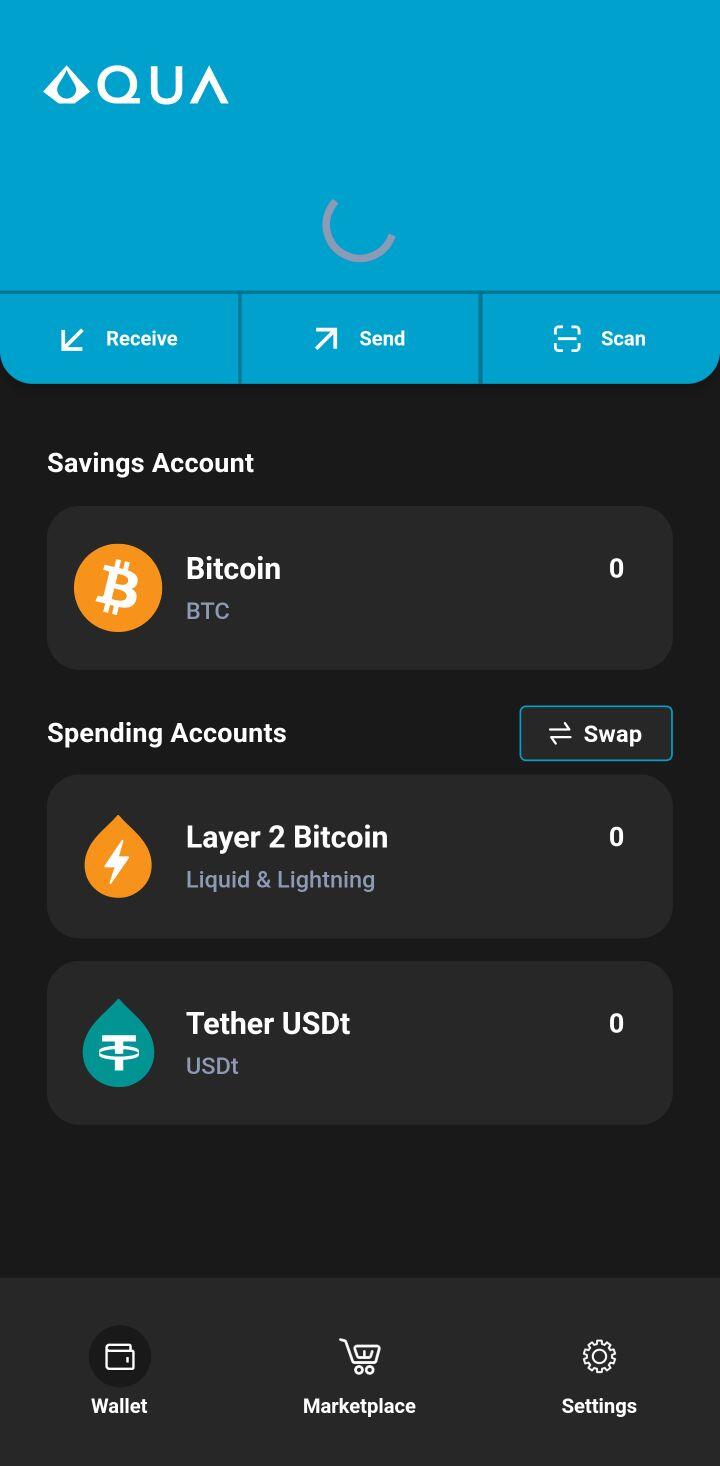
I tried the trick I use with other apps that don't support Tor: I tried tunneling it through Orbot. But when I do that, at least something in the app is failing. The price? See screenshot. Probably Aqua is using a (price) server that rejects Tor-exits? Before trusting assets to this promissing app, I would need to be sure nothing more serious would fail over Tor.
Can you look into this, please?

In which I dive down metaphysical rabbit holes on the nostr:npub1g3ra9r7duxrh8q0l2l08ku73ptdfgr0z376mvc2earlfhm6s6xxss8lnnz podcast.
What an ugly title for a podcast.
I also noticed that several Americans at the stage of the Bitcoin Atlantis conference said "thank god". Very strange for most Europeans and very inappropriate, especially to the people that should have been thanked instead. Often, the right thing to say would have been "thank Satoshi" or "thank bitcoin devs", or "thank bitcoiners".
I hope people will reflect on their language usage and consider saying "thank Satoshi" or whatever is appropiate in the context, like "thank doctors" if they saved your life.
nostr:npub1ajlrwgfj4yerhqf7ady03h7wmtk2qr3gs7h3sxcx83k05yld36sswpzx3q
Could you add a feature to optionally tunnel ALL Aqua network traffic over Tor please?
Apps that have no Tor integrated can be tunneled over Tor with Orbot. But when I do that, at least something on top of the app is failing. The price? See screenshot. Maybe Aqua is using a price server that rejects Tor-exits? Before trusting assets to this promissing app, I would need to be sure nothing more serious would fail over Tor.
Can you look into this, please?
@primal
Why does Primal not work over Orbot on Android? Primal can't find any relays over Tor.
Have a look at how Amethyst even has Tor/Orbot setup inside its app.

#bitcoin is the Linux of money.
#bitcoin is the internet of money.