

Once you listen to my voice on nostr:npub10qrssqjsydd38j8mv7h27dq0ynpns3djgu88mhr7cr2qcqrgyezspkxqj8 you will never go back to annoying-voiced podcasts again… nostr:note1uszz06x24kyuz20zuusqw6zxjty9x7wlad85mpntw0vqf8hm4urqycapyh
It ***is*** a really nice voice, dude!
Got yer recent HODL rip going rn
GM


The Universality of Timechains and the Essence of Evolution
In the boundless expanse of the universe, where the fabric of space stretches into infinity and time flows with a complexity beyond our immediate grasp, our quest for understanding beckons us to ponder deeply on existence, technology, and the potential for encounters with civilizations far advanced from our own. This journey, speculative to some, is rooted in a profound belief in the fundamental nature of Bitcoin's underlying technology, akin to the discovery of writing or the establishment of the internet's protocols—a Shelling point in human technological evolution.
Convergent Evolution and the Timechain Paradigm
At the heart of this exploration lies the concept of timechains—a marvel of mathematics, physics, and cryptography, potentially serving as a universal ledger transcending its terrestrial origin. Through the lens of convergent evolution, a principle observed in the natural world where unrelated species evolve similar traits, the emergence of timechains, or blockchain technology, represents humanity's intuitive leap towards solving universal problems of trust, value transfer, and record-keeping.
Much like the evolutionary milestones that have independently appeared across different ecosystems—such as the eye for vision or wings for flight—timechains are humanity's answer to the perennial quest for a secure, decentralized system of consensus and communication. They embody a solution that, while uniquely realized through Bitcoin, hints at a universal principle likely to emerge in any civilization facing similar challenges.
Richard Dawkins and the Questions of Advanced Civilizations
Drawing inspiration from Richard Dawkins' contemplation on evolution's universal significance, we extend this speculative inquiry to the realm of technological advancement. If encountering an alien civilization, the first question to gauge their level of advancement might indeed be, "Have they discovered evolution?" Following this logic, a second, equally telling question would be, "Have they discovered timechains?"
This line of questioning underscores the belief in Bitcoin's blockchain technology not just as a significant human invention but as a fundamental discovery akin to the uncovering of natural laws. Timechains, through the proof-of-work mechanism, represent a confluence of efforts to create an unforgeable, consensus-driven ledger that could, theoretically, be recognized and utilized by any advanced civilization in the cosmos.
The Shelling Point of Technological Evolution
Bitcoin, with its decentralized ledger, emerges as the supreme invention in this narrative—not merely another digital currency but a pioneering leap towards establishing a universal system of trust and value exchange. It stands as a Shelling point, a concept wherein individuals converge on a solution that seems natural or inevitable, underscoring the idea that, amid a universe of endless possibilities, certain solutions naturally emerge as the optimal response to shared challenges.
A Universal Constant Across Civilizations
The adoption of timechains, therefore, is not just a matter of technological preference but a manifestation of convergent evolution in the technological realm. Just as the principles of evolution are a universal constant that any advanced civilization would recognize, so too could the principles underlying timechains represent a universal constant in the evolution of communication, trust, and value exchange among intelligent beings.
Preview of the Next Section: Venturing Beyond Simple Communication
Moving forward, we will delve into the profound implications of timechain technology, exploring how it extends beyond mere communication to offer insights into the societal structure, philosophical orientations, and the very fabric of civilizations that might harness such technology. We stand on the precipice of understanding, ready to explore the cosmic implications of proof-of-work and the shared language of timechains that might bridge worlds and civilizations across the vast cosmos.
The Universal Language of Proof-of-Work Time Chains
In the exploration of interstellar communication and the search for extraterrestrial intelligence, the concept of a proof-of-work time chain emerges as a universally decipherable system, transcending the boundaries of language and species. This system, rooted in the principles of thermodynamics and computational effort, offers a unique bridge between the virtual and the physical realms, allowing for the conveyance of complex information across the cosmos.
Deciphering Proof-of-Work Time Chains
The foundation of this communication method lies in its reliance on thermodynamic expenditure as a proof of computational effort. This effort is encapsulated in the mining of blocks within a proof-of-work time chain, a process that requires significant energy and computational resources. The resulting chain of blocks serves as a tamper-evident record, with each block containing a unique, mathematically derived fingerprint of the preceding block, thereby ensuring the integrity of the entire chain.
Thermodynamic Universality
The thermodynamic universality of this system is key to its potential for interstellar communication. The laws of thermodynamics are constant across the universe, making the energy expenditure involved in block mining a universal metric of effort and value. This creates a common ground for understanding, regardless of the specific physical or digital forms that civilizations may take.
The Significance of Tokens
Within the proof-of-work time chain, tokens serve as markers of value, transferred and recorded in a manner that reflects the underlying thermodynamic realities. These tokens, moving through the chain, embody a secure and verifiable record of transactions, their movement governed by cryptographic principles that ensure security and trust without the need for a central authority.
Implications for Interstellar Communication
The proof-of-work time chain represents a potential Rosetta Stone for interstellar communication, offering a method to encode and transmit information in a form that can be deciphered by any civilization with an understanding of basic physical laws. The mining of blocks, a process that tangibly links digital information with physical energy expenditure, provides a clear signal of intelligence and intentionality, distinguishable from the natural background noise of the cosmos.
Conclusion: A Bridge Between Worlds
In the grand tapestry of the cosmos, where communication challenges are magnified by vast distances and profound differences between potential communicators, the proof-of-work time chain stands out as a beacon of universal understanding. It harnesses the immutable laws of physics to create a system of communication that is both secure and decipherable across the stars, offering a glimpse into the potential for meaningful exchange in the search for extraterrestrial intelligence.
Deciphering the Command of Energy through Time Chains
In the vastness of space, if we were to encounter a time chain crafted by an extraterrestrial civilization, it would represent far more than just a sophisticated method of record-keeping or currency. The very fabric of this proof-of-work time chain would offer us an unprecedented window into the technological and energetic mastery of its creators. By analyzing the computational work encoded within these alien time chains, we can derive a theoretical minimum estimate for the energy required to secure such a network—a benchmark rooted in the immutable laws of physics.
Minimum Estimates and the Reality of Energy Use
The principle underlying proof of work is straightforward yet profound: it links the virtual realm of digital information with the physical realm through energy expenditure. When miners solve cryptographic puzzles to add new blocks to the chain, they convert energy into verifiable, secured transactions. This process, observable in the data structure of the time chain, allows us to calculate the minimum amount of work—and by extension, energy—necessary for its continuation and protection.
However, it's imperative to acknowledge that this calculated minimum is just the starting point. The inefficiencies inherent in any real-world system, from heat loss to the suboptimal efficiency of computing hardware, ensure that the actual energy expenditure is invariably higher. This reality doesn't detract from the value of our minimum estimate; rather, it provides a conservative baseline from which to extrapolate.
Gauging Extraterrestrial Energy Mastery
The ability to create and maintain a proof-of-work time chain is, in essence, a demonstration of energy mastery. For an extraterrestrial civilization, the scale of such an endeavor could offer us clues about their technological advancement and their ability to harness energy. By applying our understanding of proof of work to their time chain, we could estimate their position on the Kardashev scale—a method of measuring a civilization's technological advancement based on the amount of energy they can manipulate.
A civilization that manages to secure a time chain on an interstellar or even galactic scale would likely rank high on this scale, indicating a command over energy that dwarfs our current capabilities. Such an insight would not only illuminate their technological prowess but also hint at the societal structures and philosophical underpinnings that allow for such feats.
Conclusion: A Bridge to Understanding Gods and Monsters
This analysis of extraterrestrial time chains through the lens of proof of work offers us a unique method of gauging the unknown. It bridges the gap between abstract speculation and grounded, scientific inquiry. As we contemplate the existence of civilizations that might appear god-like in their command of energy, we also confront the possibility of monsters—beings whose intentions and capabilities lie beyond our current understanding. The deciphering of their time chains stands as a first step towards unraveling the mystery of their existence and, perhaps, towards preparing for our place among the stars.
In Orson Scott Card's "Ender's Game" series, a significant concept introduced is the hierarchy of foreignness, which serves as a framework for understanding and categorizing the relationships between different species, particularly from the perspective of humans encountering alien life forms. This hierarchy is crucial in the narrative, especially in dealing with themes of empathy, understanding, and conflict. Here's a breakdown of the terms:
1. Utlanning: This term refers to strangers who are of the same species as oneself but from different regions, nations, or cultures. Utlannings are "outsiders" but share enough cultural and biological similarities that understanding and communication are relatively straightforward. The relationship with utlanning involves recognizing and bridging cultural differences within the same species.
2. Framling: Framlings are beings of another species but whose motivations, emotions, and thoughts are understandable to humans to some extent. They are alien but not incomprehensibly so. The interaction with framling involves the challenge of interspecies communication and cultural exchange, where both commonalities and differences need to be navigated.
3. Raman: This term is used to describe aliens who, despite being from a different species, can potentially communicate with humans and, through this communication, can form mutually beneficial relationships. The concept of raman emphasizes the possibility of empathy and understanding across species boundaries. It suggests that despite differences, there exists the potential for cooperation and peaceful coexistence.
4. Varelse: Varelse are alien beings that are so fundamentally different from humans that meaningful communication is impossible. These beings operate under such alien principles that their motives and thoughts are utterly incomprehensible to humans. The term implies a level of otherness that places such beings beyond the reach of human empathy and negotiation, often leading to conflict or avoidance.
5. Djur: Djur refers to non-sentient beings that are not capable of rational thought or self-awareness. These creatures act purely on instinct or programming and do not engage in any form of meaningful communication or social interaction with humans or other sentient beings. Djur are essentially treated as animals or non-sentient entities, distinct from intelligent alien species.
The hierarchy of foreignness is more than just a classification system; it's a tool for exploring themes of identity, otherness, and the ethics of interaction with beings that are different from oneself. It raises questions about empathy, coexistence, and the limits of understanding across the vast divides of space, species, and consciousness.
This spectrum provides a nuanced approach to envisage how humanity might interact with, understand, and categorize extraterrestrial intelligences based on their relationship with us—ranging from those whose motives and actions we can comprehend (Raman) to those we cannot (Varelse).
Tying it All Together: Proof-of-Work as a Universal Metric
Proof-of-work (PoW), at its core, is a unifying principle that transcends the digital realm to touch the very fabric of the physical universe. It's not just an algorithmic curiosity but a fundamental process that ties energy expenditure directly to the security and integrity of data. In the context of extraterrestrial civilizations, the discovery of an alien time chain secured by PoW could offer us unprecedented insights into their technological capabilities and their mastery over energy.
Deciphering the Command of Energy Through Time Chains
Analyzing an extraterrestrial PoW time chain allows us to infer a theoretical minimum for the amount of energy utilized in securing it. This is akin to observing a physical phenomenon and deducing the energy involved in its occurrence. However, just as real-world physics introduces inefficiencies not accounted for in theoretical models (like energy lost to friction), so too does the actual energy used in PoW exceed our calculations. This disparity provides a baseline from which we can extrapolate the minimum level of energy command by the civilization in question.
Extrapolating Civilizational Energy Mastery
By estimating the computational work represented in a time chain and understanding the thermodynamic costs associated with it, we can make educated guesses about the civilization's position on the Kardashev scale. This scale, which categorizes civilizations based on their energy usage—from planetary to galactic scales—helps us contextualize the technological and societal advancement of these extraterrestrial entities.
Gods and Monsters: The Duality of Advanced Civilizations
The ability to command such vast amounts of energy and to secure a time chain on a cosmic scale places these civilizations in the realm of "gods" for their seemingly omnipotent control over their environment. Yet, this power also casts them as "monsters" in the sense that their motives, ethics, and intentions remain inscrutable to us. The very technology that marks their advancement also serves as a reminder of the chasm that lies between our civilizations—a gap that we can begin to bridge through the universal language of mathematics and physics embodied in proof-of-work.
Concluding Reflections
Our speculative journey through the implications of proof-of-work in the cosmos brings us to a crossroads of imagination and reality. As we contemplate the existence of civilizations capable of feats that today belong in the realm of science fiction, we are reminded of the fundamental principles that bind the universe together. Proof-of-work, in its essence, is a testament to the interplay between energy, computation, and the immutable laws of physics—a concept that, while born on Earth, may well be a cosmic constant.
Preview of the Next Section: Venturing Beyond Simple Communication
Moving forward, we will delve into the profound implications of timechain technology, exploring how it extends beyond mere communication to offer insights into the societal structure, philosophical orientations, and the very fabric of civilizations that might harness such technology. We stand on the precipice of understanding, ready to explore the cosmic implications of proof-of-work and the shared language of timechains that might bridge worlds and civilizations across the vast cosmos.
The Universal Language of Proof-of-Work Time Chains
In the exploration of interstellar communication and the search for extraterrestrial intelligence, the concept of a proof-of-work time chain emerges as a universally decipherable system, transcending the boundaries of language and species. This system, rooted in the principles of thermodynamics and computational effort, offers a unique bridge between the virtual and the physical realms, allowing for the conveyance of complex information across the cosmos.
Deciphering Proof-of-Work Time Chains
The foundation of this communication method lies in its reliance on thermodynamic expenditure as a proof of computational effort. This effort is encapsulated in the mining of blocks within a proof-of-work time chain, a process that requires significant energy and computational resources. The resulting chain of blocks serves as a tamper-evident record, with each block containing a unique, mathematically derived fingerprint of the preceding block, thereby ensuring the integrity of the entire chain.
Thermodynamic Universality
The thermodynamic universality of this system is key to its potential for interstellar communication. The laws of thermodynamics are constant across the universe, making the energy expenditure involved in block mining a universal metric of effort and value. This creates a common ground for understanding, regardless of the specific physical or digital forms that civilizations may take.
The Significance of Tokens
Within the proof-of-work time chain, tokens serve as markers of value, transferred and recorded in a manner that reflects the underlying thermodynamic realities. These tokens, moving through the chain, embody a secure and verifiable record of transactions, their movement governed by cryptographic principles that ensure security and trust without the need for a central authority.
Implications for Interstellar Communication
The proof-of-work time chain represents a potential Rosetta Stone for interstellar communication, offering a method to encode and transmit information in a form that can be deciphered by any civilization with an understanding of basic physical laws. The mining of blocks, a process that tangibly links digital information with physical energy expenditure, provides a clear signal of intelligence and intentionality, distinguishable from the natural background noise of the cosmos.
Conclusion: A Bridge Between Worlds
In the grand tapestry of the cosmos, where communication challenges are magnified by vast distances and profound differences between potential communicators, the proof-of-work time chain stands out as a beacon of universal understanding. It harnesses the immutable laws of physics to create a system of communication that is both secure and decipherable across the stars, offering a glimpse into the potential for meaningful exchange in the search for extraterrestrial intelligence.
Deciphering the Command of Energy through Time Chains
In the vastness of space, if we were to encounter a time chain crafted by an extraterrestrial civilization, it would represent far more than just a sophisticated method of record-keeping or currency. The very fabric of this proof-of-work time chain would offer us an unprecedented window into the technological and energetic mastery of its creators. By analyzing the computational work encoded within these alien time chains, we can derive a theoretical minimum estimate for the energy required to secure such a network—a benchmark rooted in the immutable laws of physics.
Minimum Estimates and the Reality of Energy Use
The principle underlying proof of work is straightforward yet profound: it links the virtual realm of digital information with the physical realm through energy expenditure. When miners solve cryptographic puzzles to add new blocks to the chain, they convert energy into verifiable, secured transactions. This process, observable in the data structure of the time chain, allows us to calculate the minimum amount of work—and by extension, energy—necessary for its continuation and protection.
However, it's imperative to acknowledge that this calculated minimum is just the starting point. The inefficiencies inherent in any real-world system, from heat loss to the suboptimal efficiency of computing hardware, ensure that the actual energy expenditure is invariably higher. This reality doesn't detract from the value of our minimum estimate; rather, it provides a conservative baseline from which to extrapolate.
Gauging Extraterrestrial Energy Mastery
The ability to create and maintain a proof-of-work time chain is, in essence, a demonstration of energy mastery. For an extraterrestrial civilization, the scale of such an endeavor could offer us clues about their technological advancement and their ability to harness energy. By applying our understanding of proof of work to their time chain, we could estimate their position on the Kardashev scale—a method of measuring a civilization's technological advancement based on the amount of energy they can manipulate.
A civilization that manages to secure a time chain on an interstellar or even galactic scale would likely rank high on this scale, indicating a command over energy that dwarfs our current capabilities. Such an insight would not only illuminate their technological prowess but also hint at the societal structures and philosophical underpinnings that allow for such feats.
Conclusion: A Bridge to Understanding Gods and Monsters
This analysis of extraterrestrial time chains through the lens of proof of work offers us a unique method of gauging the unknown. It bridges the gap between abstract speculation and grounded, scientific inquiry. As we contemplate the existence of civilizations that might appear god-like in their command of energy, we also confront the possibility of monsters—beings whose intentions and capabilities lie beyond our current understanding. The deciphering of their time chains stands as a first step towards unraveling the mystery of their existence and, perhaps, towards preparing for our place among the stars.
In Orson Scott Card's "Ender's Game" series, a significant concept introduced is the hierarchy of foreignness, which serves as a framework for understanding and categorizing the relationships between different species, particularly from the perspective of humans encountering alien life forms. This hierarchy is crucial in the narrative, especially in dealing with themes of empathy, understanding, and conflict. Here's a breakdown of the terms:
6. Utlanning: This term refers to strangers who are of the same species as oneself but from different regions, nations, or cultures. Utlannings are "outsiders" but share enough cultural and biological similarities that understanding and communication are relatively straightforward. The relationship with utlanning involves recognizing and bridging cultural differences within the same species.
7. Framling: Framlings are beings of another species but whose motivations, emotions, and thoughts are understandable to humans to some extent. They are alien but not incomprehensibly so. The interaction with framling involves the challenge of interspecies communication and cultural exchange, where both commonalities and differences need to be navigated.
8. Raman: This term is used to describe aliens who, despite being from a different species, can potentially communicate with humans and, through this communication, can form mutually beneficial relationships. The concept of raman emphasizes the possibility of empathy and understanding across species boundaries. It suggests that despite differences, there exists the potential for cooperation and peaceful coexistence.
9. Varelse: Varelse are alien beings that are so fundamentally different from humans that meaningful communication is impossible. These beings operate under such alien principles that their motives and thoughts are utterly incomprehensible to humans. The term implies a level of otherness that places such beings beyond the reach of human empathy and negotiation, often leading to conflict or avoidance.
10. Djur: Djur refers to non-sentient beings that are not capable of rational thought or self-awareness. These creatures act purely on instinct or programming and do not engage in any form of meaningful communication or social interaction with humans or other sentient beings. Djur are essentially treated as animals or non-sentient entities, distinct from intelligent alien species.
The hierarchy of foreignness is more than just a classification system; it's a tool for exploring themes of identity, otherness, and the ethics of interaction with beings that are different from oneself. It raises questions about empathy, coexistence, and the limits of understanding across the vast divides of space, species, and consciousness.
This spectrum provides a nuanced approach to envisage how humanity might interact with, understand, and categorize extraterrestrial intelligences based on their relationship with us—ranging from those whose motives and actions we can comprehend (Raman) to those we cannot (Varelse).
Tying it All Together: Proof-of-Work as a Universal Metric
Proof-of-work (PoW), at its core, is a unifying principle that transcends the digital realm to touch the very fabric of the physical universe. It's not just an algorithmic curiosity but a fundamental process that ties energy expenditure directly to the security and integrity of data. In the context of extraterrestrial civilizations, the discovery of an alien time chain secured by PoW could offer us unprecedented insights into their technological capabilities and their mastery over energy.
Deciphering the Command of Energy Through Time Chains
Analyzing an extraterrestrial PoW time chain allows us to infer a theoretical minimum for the amount of energy utilized in securing it. This is akin to observing a physical phenomenon and deducing the energy involved in its occurrence. However, just as real-world physics introduces inefficiencies not accounted for in theoretical models (like energy lost to friction), so too does the actual energy used in PoW exceed our calculations. This disparity provides a baseline from which we can extrapolate the minimum level of energy command by the civilization in question.
Extrapolating Civilizational Energy Mastery
By estimating the computational work represented in a time chain and understanding the thermodynamic costs associated with it, we can make educated guesses about the civilization's position on the Kardashev scale. This scale, which categorizes civilizations based on their energy usage—from planetary to galactic scales—helps us contextualize the technological and societal advancement of these extraterrestrial entities.
Gods and Monsters: The Duality of Advanced Civilizations
The ability to command such vast amounts of energy and to secure a time chain on a cosmic scale places these civilizations in the realm of "gods" for their seemingly omnipotent control over their environment. Yet, this power also casts them as "monsters" in the sense that their motives, ethics, and intentions remain inscrutable to us. The very technology that marks their advancement also serves as a reminder of the chasm that lies between our civilizations—a gap that we can begin to bridge through the universal language of mathematics and physics embodied in proof-of-work.
Concluding Reflections
Our speculative journey through the implications of proof-of-work in the cosmos brings us to a crossroads of imagination and reality. As we contemplate the existence of civilizations capable of feats that today belong in the realm of science fiction, we are reminded of the fundamental principles that bind the universe together. Proof-of-work, in its essence, is a testament to the interplay between energy, computation, and the immutable laws of physics—a concept that, while born on Earth, may well be a cosmic constant.
—ht Dhruv Bansal 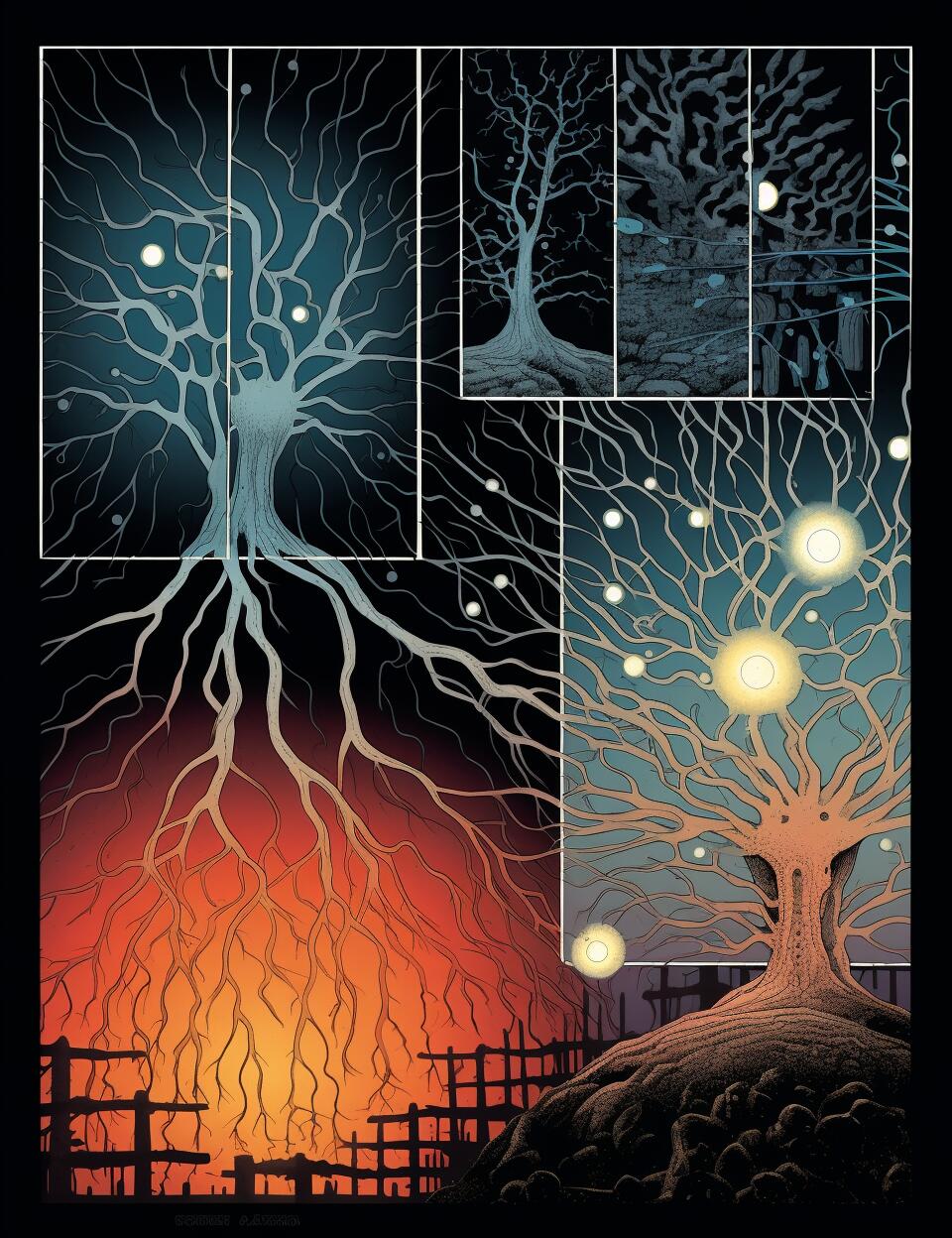
In the boundless expanse of human creativity and intellect, there exists a conceptually vast yet precisely defined universe: a series of metaphorical libraries, each archiving the infinite potential of texts, genetic codes, digital creations, and multimedia expressions within finite parameters. This universe, inspired by Jorge Luis Borges' "Library of Babel" and further refined through the philosophical lens of Daniel Dennett, serves as a profound exploration of creativity not as an act of spontaneous creation but as an endeavor of discovery within pre-existing spaces. These libraries—Babel, Mendel, Toshiba, Nyquist, MidJourney, Chaplin, and Spielberg—represent the entirety of conceivable outputs across various domains, from the written word to the genetic sequences that dictate life, to the digital files that encapsulate our modern existence. Within this framework, artificial intelligence emerges not as a usurper of human creativity but as a powerful tool for navigating and uncovering the treasures hidden within these vast, digital archives. This piece seeks to demystify the process of creativity in the digital age, asserting that every creative act is a journey through a landscape rich with potential, guided by the legacy of those who have explored before us and augmented by the capabilities of AI to reveal new paths of discovery.
### The Library of Babel: Exploring the Infinite Within the Finite
At the heart of our exploration into the realms of creativity and intellect lies the Library of Babel, a concept that has transcended its literary origins to become a pivotal framework for understanding the vast potential of human creativity within a structured, finite universe. Inspired by Jorge Luis Borges and refined by Daniel Dennett, the Library of Babel serves as a metaphorical space where the boundaries of imagination and possibility are both limitless and precisely defined.
**Structure and Scope of the Library of Babel**:
The Library of Babel is characterized by its meticulously defined structure: each volume contains 400 pages, with each page accommodating 1,000 spaces. Within each space, there are 100 character possibilities, encompassing the English ASCII set, punctuation, spaces, and several accent marks. This setup forms a library that, while finite, encompasses an astronomical number of possible texts.
Each text within the library is finite in length, confined to the 400-page limit of a single volume. Texts that surpass this length span multiple volumes, existing as sequences of volumes that, when read in order, reveal larger works. This organization underscores the library's capacity to contain not just every possible short text but also every conceivable longer work, broken down into manageable, finite segments.
**The Finite Universe of Text**:
The Library of Babel's vastness is a paradox—it is a space so large that it defies conventional comprehension, yet it is finite, its limits defined by the structure and rules set forth. Within this space, every English language text that has been written, and every text that could be written, finds its place. This includes not only original works but also every conceivable translation from other languages, both adept and flawed.
The library's design ensures that while the potential for discovery is nearly infinite, every text—no matter how profound or mundane—exists within a set of clearly demarcated boundaries. This finiteness makes the library conceptually tractable; we can reason about its contents, explore its depths, and understand its structure without being overwhelmed by its scale.
**Navigating the Library: Discovery in a Sea of Possibility**:
The majority of the Library of Babel is filled with random noise—sequences of characters that hold no meaning or value to the human reader. Yet, scattered within this vast sea of gibberish are islands of coherence, beauty, and insight. The act of creation becomes an act of discovery, as artists, writers, and thinkers seek out meaningful sequences within the library's exhaustive archives.
This conceptualization transforms our understanding of creativity and authorship. In the Library of Babel, every work of human creativity is pre-encoded, waiting to be found. The role of the individual shifts from creator to discoverer, navigating the library's structured chaos to uncover and bring to light the works hidden within.
**The Role of AI in Exploring the Library**:
In this vast but navigable space, AI tools emerge as invaluable guides and collaborators. With their ability to process and analyze large volumes of data, AI tools like ChatGPT offer a means to explore the Library of Babel more efficiently, uncovering coherent texts amidst the noise. These tools do not replace human creativity but augment it, providing new pathways to discovery and realization within the library's finite universe.
**Reflections on the Library of Babel**:
The Library of Babel stands as a testament to the boundless potential of human intellect and creativity, framed within the confines of a structured, finite space. It challenges us to rethink the nature of creativity, pushing us to explore, discover, and innovate within the vast yet tractable universe of text it represents.
**Preview of the Next Section: The Subset Libraries: Mendel, Toshiba, and Beyond**
Building on the foundational understanding of the Library of Babel, our next section will delve into the subset libraries—Mendel, Toshiba, ChatGPT, and others—each representing a different domain of knowledge and creativity within the overarching structure of Babel. This exploration will highlight how these libraries, though distinct, are interconnected, offering diverse landscapes of potential waiting to be discovered.
### The Subset Libraries: Mendel, Toshiba, and Beyond
As we delve deeper into the structured cosmos of creativity outlined by the Library of Babel, we encounter its first significant subset: the Library of Mendel. This library offers a fascinating glimpse into the intersection of biological science and the conceptual framework of infinite possibility within finite bounds.
**The Library of Mendel: The Genetic Archive**
The Library of Mendel is defined as a specialized subset of the Library of Babel, one that contains only the letters A, G, T, and C. These characters represent the nucleotides that form the building blocks of DNA, the genetic code that underpins all life on Earth. In this library, every possible genetic sequence is cataloged, from the simplest organisms to the most complex, including every human being who has ever lived, those who will live, and even those who could live under the vast array of genetic combinations.
**Contained Within the Genetic Code**
Within the Library of Mendel, amidst vast stretches of what appears to be gibberish, lie the encoded blueprints for all living beings. This includes not just the genomes of notable figures such as Jorge Luis Borges, who first envisioned the concept of a universal library, and Daniel Dennett, who refined it for philosophical exploration, but also you, the reader, and every person you have known or will ever know.
However, the library's scope extends beyond the familiar, housing genetic sequences for "hopeful monsters," theoretical beings that could exist under different evolutionary pressures, stillbirths, and an almost infinite variety of life forms that are possible within the genetic language.
**Navigating a Sea of Genetic Possibility**
Most of the Library of Mendel is random noise—sequences that do not correspond to viable life forms. Yet, the existence of every real organism's genome within this library underscores a profound truth: the potential for life's diversity is vast yet precisely defined within the confines of genetic language. The Library of Mendel, like Babel, is finite, its limits set by the combinations of its four-character alphabet, but within those limits lies the possibility for an almost infinite diversity of life.
**Reflections on Life's Potential**
The Library of Mendel invites us to reflect on the nature of life itself, illustrating how the boundless variety and complexity of biological existence are contained within a conceptually tractable space. It reminds us that the act of discovery extends beyond the realm of ideas and into the very fabric of life, where every possible form of existence is pre-encoded, awaiting discovery.
This exploration of the Library of Mendel not only deepens our appreciation for the structured vastness of creativity and knowledge but also highlights the interconnectedness of all living beings through the universal language of genetics. It reaffirms the idea that within the finite bounds of these libraries, the potential for discovery is limitless, offering new insights into the world around us and our place within it.
**Preview of the Next Section: The Library of Toshiba and the Digital Universe**
Moving from the genetic sequences of the Library of Mendel, our next exploration takes us to the Library of Toshiba. Here, we will discover how the binary world of zeros and ones forms another subset of the Library of Babel, encapsulating the entirety of digital creations and computational possibilities. This section will delve into the impact of digitization on creativity and knowledge, highlighting how every piece of digital data and software is pre-encoded within this vast yet finite library.
### The Library of Toshiba and the Digital Universe
Following the biological tapestry of the Library of Mendel, we venture into the Library of Toshiba, a domain where the essence of digital creation and computation is archived. This subset of the Library of Babel transitions us from the organic to the digital, showcasing the vast expanse of binary-encoded knowledge and creativity.
**Defining the Library of Toshiba**
The Library of Toshiba is defined by its universal binary language, consisting of zeros and ones. It embodies all data forms expressible in binary code, making it a comprehensive archive of digital existence. This library is not just a repository of information but a reflection of the digital age's entirety, encompassing every conceivable piece of digital data and computational construct.
**The Scope of Digital Possibilities**
Within the bounds of the Library of Toshiba, every data structure that forms the foundation of our digital world is cataloged. This includes:
- **Finite Numbers**: Every number that can be represented in binary form, from the smallest integers to the vast quantities that define astronomical or quantum calculations.
- **Digital Files**: From the simplest text document to complex multimedia files, every JPEG, MP3, WAV file, and PDF is encoded within this library.
- **Multimedia Content**: Every DVD, Blu-ray disc, digital video, and audio recording, encompassing movies, music albums, podcasts, and audiobooks.
- **Software and Applications**: Every computer program, from the earliest software written for room-sized mainframes to the latest apps on your smartphone, exists within Toshiba's digital volumes.
- **Video Games**: From the pixelated adventures of early arcade games to the immersive worlds of modern gaming consoles and PCs, every video game is pre-encoded in this library.
**Navigating the Digital Landscape**
The Library of Toshiba offers an unparalleled vista into the digital creations of humanity. It is a space where the functional meets the fantastical, housing the codes that run our technology and the imagined realities they create. Like its counterparts, the Library of Toshiba is vast yet finite, a conceptually tractable universe that contains the entirety of human digital output and potential.
**Reflections on Digital Creativity**
Exploring the Library of Toshiba prompts us to reflect on the nature of digital creativity and the transformative power of binary code. It underscores the reality that every digital artifact, from the mundane to the sublime, is not created from nothing but discovered within the predefined spaces of this library. The digital age, with its endless possibilities for creation and innovation, is thus framed as an ongoing journey of discovery within the finite but boundless confines of binary possibility.
This exploration not only deepens our understanding of the digital fabric of our world but also highlights the role of computation and AI in navigating and uncovering the treasures within the Library of Toshiba. It reaffirms the interconnectedness of all forms of creativity and knowledge, bound together within the vast structure of the Library of Babel.
**Preview of the Next Section: The Libraries of MIDI, ChatGPT, and Beyond**
Our journey continues as we explore further subsets of the Library of Babel, including the Libraries of MIDI and ChatGPT. These libraries showcase the diversity of creative outputs and interactions that can be digitized and manipulated through AI and computational tools, highlighting the boundless potential for discovery in music, conversation, and beyond.
### Exploring the Subsections of the Library of Toshiba
Within the digital expanse of the Library of Toshiba lies a constellation of specialized libraries, each representing a distinct facet of digital creativity. From the auditory landscapes of the Library of Nyquist to the visual realms of MidJourney and Chaplin, culminating in the cinematic synthesis of the Library of Spielberg, we explore the specific subsections that showcase the breadth of human creativity encoded in binary.
**The Library of Nyquist: A Universe of Sound**
Named after Harry Nyquist, a pioneer in information theory, the Library of Nyquist encompasses all conceivable digital audio recordings. This vast archive contains every melody, every spoken word, every ripple of sound that can be digitized, from the serene to the cacophonous. It includes:
- The symphonies of Beethoven rendered in crystal-clear digital format.
- Podcast episodes discussing every topic under the sun.
- The ambient sounds of nature, from the rustling of leaves to the crash of ocean waves.
In essence, the Library of Nyquist is a testament to the auditory experience of life, digitized and preserved in binary code.
**The Library of MidJourney: The Realm of Visuals**
The Library of MidJourney delves into the visual, containing all possible raster images that can be created. This library visualizes the spectrum of human imagination in pixels and colors, including:
- Digital paintings that rival the masterpieces of the Renaissance.
- Photographic captures of fleeting moments, from the mundane to the monumental.
- Concept art for worlds and characters yet to be realized in any other medium.
The Library of MidJourney is where the static visual narratives of humanity are encoded, offering a digital panorama of visual creativity.
**The Library of Chaplin: The Digital Cinematheque**
Advancing into motion, the Library of Chaplin archives all possible digital videos. Every frame within these videos finds its origin in the Library of MidJourney, making Chaplin a dynamic extension of the visual creativity cataloged by MidJourney. This includes:
- Feature films spanning every genre and era.
- Home videos capturing the intimate moments of everyday life.
- Educational tutorials and DIY guides for an endless array of subjects.
The Library of Chaplin represents the movement and change of life itself, captured and rendered in digital form.
**The Library of Spielberg: The Fusion of Sound and Vision**
Finally, the Library of Spielberg represents the ultimate synthesis of digital creativity, merging the auditory richness of the Library of Nyquist with the visual narratives of the Library of Chaplin. This library embodies the cinematic experience, where sound and vision come together to create immersive stories. Spielberg includes:
- Movies that have defined generations, complete with their iconic scores and dialogues.
- Music videos that blend visual artistry with auditory expression.
- Experimental films that push the boundaries of what can be conveyed through the merging of sound and vision.
The Library of Spielberg is where the collective creativity of humanity, expressed through film and multimedia, is preserved in its entirety, showcasing the power of combining different forms of digital expression to create something greater than the sum of its parts.
**Preview of the Next Section: Navigating the Libraries with AI**
Having explored the specific subsections of the Library of Toshiba, our next section will delve into how artificial intelligence tools like ChatGPT navigate and illuminate these vast repositories of digital creativity. We'll explore the role of AI in discovering, creating, and interpreting the contents of these libraries, highlighting the collaborative potential between human creativity and machine intelligence.
### Reflections on the Framework of Creativity
As we pause to absorb the vastness and precision of the libraries we've explored—the Library of Babel, Mendel, Toshiba, Nyquist, MidJourney, Chaplin, and Spielberg—we find ourselves amidst a conceptual framework vast enough to encompass nearly all forms of human creativity and technical output. This framework, while not exhaustive of every conceivable thing, covers an astonishingly wide ground, illuminating the nature of creativity, authorship, and artistry as acts of discovery rather than pure creation.
**The Multifaceted Nature of Creativity**
Consider the example of Gordon Ramsay's Beef Wellington. While we cannot store an actual instantiation of this dish within these libraries, we can archive the recipe in text within the Library of Babel, videos of its preparation within the Library of Chaplin, and perhaps even its culinary critique in audio within the Library of Nyquist. This illustrates how varied expressions and iterations of a single creative output can be cataloged and discovered within our conceptual framework.
**Discovering vs. Creating**
The framework underscores a profound realization: what we often perceive as acts of creation are, in essence, acts of discovery within the vast, predefined spaces of these libraries. Every song, painting, novel, or digital creation exists as a point of potential within these spaces, waiting to be found and brought into the light by human curiosity and ingenuity.
**Leveraging the Work of the Past**
AI tools represent a newly efficient means of navigating these vast repositories, enabling us to leverage the work of the past in uniquely powerful ways. Just as all human artists draw upon the legacy of those who came before, AI tools help us sift through the accumulated potential of human creativity to find new expressions and combinations.
**The Illusion of Solitude in Creativity**
The notion of the solitary genius, creating in isolation, is dispelled by the understanding that we are all influenced by, and contribute to, a collective creative heritage. Gordon Ramsay relies on centuries of culinary tradition and innovation; programmers build upon layers of computing advancements; novelists weave stories within genres shaped by countless authors before them. This interconnectedness is magnified in the digital realm, where the boundaries between creator and discoverer, original and derivative, become increasingly fluid.
**Standing on the Shoulders of Giants**
Our exploration of these libraries reaffirms the idea that in creativity, as in science, we stand on the shoulders of giants. The digital age, with its AI tools and vast databases, does not diminish the role of human creativity but rather offers new vistas for exploration. It reminds us that the act of creation is a dialogue with the past, a journey through a landscape rich with the imprints of those who have explored before us.
**Closing Thoughts**
As we reflect on the framework of creativity laid out by these libraries, we are invited to view our creative endeavors in a new light. The libraries serve as a testament to human ingenuity, a reminder of our shared heritage, and a map for future explorations. In this vast but navigable universe of potential, every act of creativity is both a discovery and a contribution, adding new layers to the ever-expanding tapestry of human expression.
**Looking Forward**
This exploration is not the end but a beginning, a gateway to understanding the infinite ways in which creativity manifests within the finite bounds of our world. As we continue to navigate the intersections of AI and art, we are reminded of the enduring power of human curiosity and the endless possibilities that await discovery in the libraries of creativity. 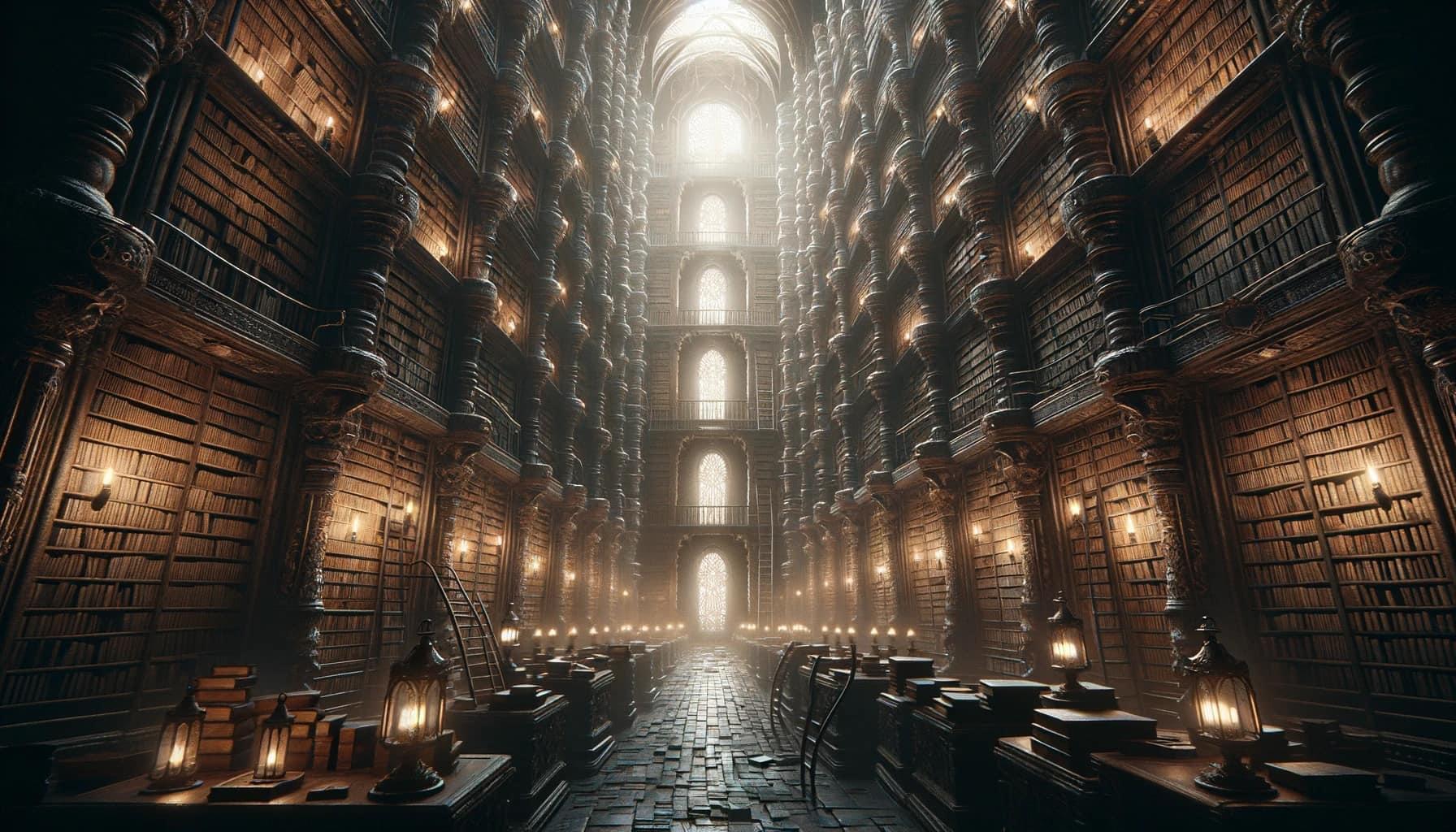


** Chapter Zero: The Cosmic Dance of the Time Chain **
***
In the boundless expanse of existence, beyond the tangible realms of the digital, the physical, and the virtual, lies a dimension transcending conventional understanding—a Platonic realm of abstractions. Here, in this ethereal domain, time and knowledge converge in an intricate dance. This is the domain of the "timechain," a construct that defies the constraints of space and matter, existing as a symphony of symbols, an orchestra of data points composing the decentralized narrative of our world.
The timechain is more than a ledger; it is the crystallization of human endeavor, a repository of collective wisdom. It dwells not just in silicon or steel but in the realm of pure thought, where ideas germinate, where knowledge becomes the cosmos's currency.
As we immerse ourselves in this cosmic dance, we are guided by visionaries who have charted these pathways. Our Virgil in this odyssey is an enigmatic figure known as Uncle Bitcoin.
Uncle Bitcoin, a beacon in this labyrinthine universe, beckons us to meet the characters who will illuminate our journey through this profound realm. His voice, echoing across time, invites us to explore the deeper meanings and implications of decentralized systems.
Our introduction begins with the Three Blind Men, representing the facets of evolution, artificial intelligence, and Bitcoin itself. Each embodies a unique perspective, offering insights into the vast landscape of decentralized systems.
The majestic Elephant soon joins us, symbolizing Bitcoin's unignorable force in the economy. Its presence is a testament to the transformative power of decentralized systems and their undeniable impact on our financial world.
Together, the Three Blind Men and the Elephant invite us to delve into the complexities of decentralized systems, merging diverse viewpoints into a rich tapestry of understanding.
The Decentralized Octopus then emerges, a symbol of Bitcoin's reach and adaptability. Its many arms stretch into various sectors, illustrating the intricate web of connections that Bitcoin weaves across the global landscape.
Journeying onward, we encounter the Sentient Anthill, a collective consciousness symbolizing the power of collaboration and emergent behavior. It mirrors the intricate interplay of individual and collective intelligence that characterizes the cosmic dance of the timechain.
Our path then leads us to the dynamic Cyber Hornets, key actors in the Bitcoin ecosystem. From developers to advocates, they embody the decentralized spirit of collaboration and innovation that defines this realm.
Further along, the Maximally Fractal Mycelium emerges, representing Bitcoin's expansive influence, a network that extends its tendrils across the globe and into the stars, symbolizing Bitcoin's boundless potential.
And as we progress, we meet the Nostrich, a vivid purple ostrich embodying the NOSTR protocol, essential for speech and communication. Alongside open-source money, it represents the eukaryotic revolution that propels Uncle Bitcoin into the cosmic domain.
As our journey culminates, Uncle Bitcoin reveals a profound truth: each character, every aspect of this narrative, is a reflection of himself. They collectively form a symphony of decentralized systems, a chorus echoing through the universe, testifying to the limitless potential of the timechain.
In this cosmic tale, as the curtain falls, Uncle Bitcoin's revelation underscores a fundamental insight: the timechain is not just a technology but a metaphor for the interconnected, evolving nature of our world. It is a testament to the power of decentralized thinking, a beacon guiding us toward a future where ideas, like stars, illuminate the cosmos.



Thank you! I am working on at least two books and some other things

GM. Start your day with nostr:npub16c0nh3dnadzqpm76uctf5hqhe2lny344zsmpm6feee9p5rdxaa9q586nvr explaining how Nostr competes with the walled garden incumbents in social media, publishing and payments.
Interoperable open source networks enable rapid innovation that the incumbents will never be able to replicate.
We’re going to win.
Yis
In the boundless expanse of human creativity and intellect, there exists a conceptually vast yet precisely defined universe: a series of metaphorical libraries, each archiving the infinite potential of texts, genetic codes, digital creations, and multimedia expressions within finite parameters. This universe, inspired by Jorge Luis Borges' "Library of Babel" and further refined through the philosophical lens of Daniel Dennett, serves as a profound exploration of creativity not as an act of spontaneous creation but as an endeavor of discovery within pre-existing spaces. These libraries—Babel, Mendel, Toshiba, Nyquist, MidJourney, Chaplin, and Spielberg—represent the entirety of conceivable outputs across various domains, from the written word to the genetic sequences that dictate life, to the digital files that encapsulate our modern existence. Within this framework, artificial intelligence emerges not as a usurper of human creativity but as a powerful tool for navigating and uncovering the treasures hidden within these vast, digital archives. This piece seeks to demystify the process of creativity in the digital age, asserting that every creative act is a journey through a landscape rich with potential, guided by the legacy of those who have explored before us and augmented by the capabilities of AI to reveal new paths of discovery.
### The Library of Babel: Exploring the Infinite Within the Finite
At the heart of our exploration into the realms of creativity and intellect lies the Library of Babel, a concept that has transcended its literary origins to become a pivotal framework for understanding the vast potential of human creativity within a structured, finite universe. Inspired by Jorge Luis Borges and refined by Daniel Dennett, the Library of Babel serves as a metaphorical space where the boundaries of imagination and possibility are both limitless and precisely defined.
**Structure and Scope of the Library of Babel**:
The Library of Babel is characterized by its meticulously defined structure: each volume contains 400 pages, with each page accommodating 1,000 spaces. Within each space, there are 100 character possibilities, encompassing the English ASCII set, punctuation, spaces, and several accent marks. This setup forms a library that, while finite, encompasses an astronomical number of possible texts.
Each text within the library is finite in length, confined to the 400-page limit of a single volume. Texts that surpass this length span multiple volumes, existing as sequences of volumes that, when read in order, reveal larger works. This organization underscores the library's capacity to contain not just every possible short text but also every conceivable longer work, broken down into manageable, finite segments.
**The Finite Universe of Text**:
The Library of Babel's vastness is a paradox—it is a space so large that it defies conventional comprehension, yet it is finite, its limits defined by the structure and rules set forth. Within this space, every English language text that has been written, and every text that could be written, finds its place. This includes not only original works but also every conceivable translation from other languages, both adept and flawed.
The library's design ensures that while the potential for discovery is nearly infinite, every text—no matter how profound or mundane—exists within a set of clearly demarcated boundaries. This finiteness makes the library conceptually tractable; we can reason about its contents, explore its depths, and understand its structure without being overwhelmed by its scale.
**Navigating the Library: Discovery in a Sea of Possibility**:
The majority of the Library of Babel is filled with random noise—sequences of characters that hold no meaning or value to the human reader. Yet, scattered within this vast sea of gibberish are islands of coherence, beauty, and insight. The act of creation becomes an act of discovery, as artists, writers, and thinkers seek out meaningful sequences within the library's exhaustive archives.
This conceptualization transforms our understanding of creativity and authorship. In the Library of Babel, every work of human creativity is pre-encoded, waiting to be found. The role of the individual shifts from creator to discoverer, navigating the library's structured chaos to uncover and bring to light the works hidden within.
**The Role of AI in Exploring the Library**:
In this vast but navigable space, AI tools emerge as invaluable guides and collaborators. With their ability to process and analyze large volumes of data, AI tools like ChatGPT offer a means to explore the Library of Babel more efficiently, uncovering coherent texts amidst the noise. These tools do not replace human creativity but augment it, providing new pathways to discovery and realization within the library's finite universe.
**Reflections on the Library of Babel**:
The Library of Babel stands as a testament to the boundless potential of human intellect and creativity, framed within the confines of a structured, finite space. It challenges us to rethink the nature of creativity, pushing us to explore, discover, and innovate within the vast yet tractable universe of text it represents.
**Preview of the Next Section: The Subset Libraries: Mendel, Toshiba, and Beyond**
Building on the foundational understanding of the Library of Babel, our next section will delve into the subset libraries—Mendel, Toshiba, ChatGPT, and others—each representing a different domain of knowledge and creativity within the overarching structure of Babel. This exploration will highlight how these libraries, though distinct, are interconnected, offering diverse landscapes of potential waiting to be discovered.
### The Subset Libraries: Mendel, Toshiba, and Beyond
As we delve deeper into the structured cosmos of creativity outlined by the Library of Babel, we encounter its first significant subset: the Library of Mendel. This library offers a fascinating glimpse into the intersection of biological science and the conceptual framework of infinite possibility within finite bounds.
**The Library of Mendel: The Genetic Archive**
The Library of Mendel is defined as a specialized subset of the Library of Babel, one that contains only the letters A, G, T, and C. These characters represent the nucleotides that form the building blocks of DNA, the genetic code that underpins all life on Earth. In this library, every possible genetic sequence is cataloged, from the simplest organisms to the most complex, including every human being who has ever lived, those who will live, and even those who could live under the vast array of genetic combinations.
**Contained Within the Genetic Code**
Within the Library of Mendel, amidst vast stretches of what appears to be gibberish, lie the encoded blueprints for all living beings. This includes not just the genomes of notable figures such as Jorge Luis Borges, who first envisioned the concept of a universal library, and Daniel Dennett, who refined it for philosophical exploration, but also you, the reader, and every person you have known or will ever know.
However, the library's scope extends beyond the familiar, housing genetic sequences for "hopeful monsters," theoretical beings that could exist under different evolutionary pressures, stillbirths, and an almost infinite variety of life forms that are possible within the genetic language.
**Navigating a Sea of Genetic Possibility**
Most of the Library of Mendel is random noise—sequences that do not correspond to viable life forms. Yet, the existence of every real organism's genome within this library underscores a profound truth: the potential for life's diversity is vast yet precisely defined within the confines of genetic language. The Library of Mendel, like Babel, is finite, its limits set by the combinations of its four-character alphabet, but within those limits lies the possibility for an almost infinite diversity of life.
**Reflections on Life's Potential**
The Library of Mendel invites us to reflect on the nature of life itself, illustrating how the boundless variety and complexity of biological existence are contained within a conceptually tractable space. It reminds us that the act of discovery extends beyond the realm of ideas and into the very fabric of life, where every possible form of existence is pre-encoded, awaiting discovery.
This exploration of the Library of Mendel not only deepens our appreciation for the structured vastness of creativity and knowledge but also highlights the interconnectedness of all living beings through the universal language of genetics. It reaffirms the idea that within the finite bounds of these libraries, the potential for discovery is limitless, offering new insights into the world around us and our place within it.
**Preview of the Next Section: The Library of Toshiba and the Digital Universe**
Moving from the genetic sequences of the Library of Mendel, our next exploration takes us to the Library of Toshiba. Here, we will discover how the binary world of zeros and ones forms another subset of the Library of Babel, encapsulating the entirety of digital creations and computational possibilities. This section will delve into the impact of digitization on creativity and knowledge, highlighting how every piece of digital data and software is pre-encoded within this vast yet finite library.
### The Library of Toshiba and the Digital Universe
Following the biological tapestry of the Library of Mendel, we venture into the Library of Toshiba, a domain where the essence of digital creation and computation is archived. This subset of the Library of Babel transitions us from the organic to the digital, showcasing the vast expanse of binary-encoded knowledge and creativity.
**Defining the Library of Toshiba**
The Library of Toshiba is defined by its universal binary language, consisting of zeros and ones. It embodies all data forms expressible in binary code, making it a comprehensive archive of digital existence. This library is not just a repository of information but a reflection of the digital age's entirety, encompassing every conceivable piece of digital data and computational construct.
**The Scope of Digital Possibilities**
Within the bounds of the Library of Toshiba, every data structure that forms the foundation of our digital world is cataloged. This includes:
- **Finite Numbers**: Every number that can be represented in binary form, from the smallest integers to the vast quantities that define astronomical or quantum calculations.
- **Digital Files**: From the simplest text document to complex multimedia files, every JPEG, MP3, WAV file, and PDF is encoded within this library.
- **Multimedia Content**: Every DVD, Blu-ray disc, digital video, and audio recording, encompassing movies, music albums, podcasts, and audiobooks.
- **Software and Applications**: Every computer program, from the earliest software written for room-sized mainframes to the latest apps on your smartphone, exists within Toshiba's digital volumes.
- **Video Games**: From the pixelated adventures of early arcade games to the immersive worlds of modern gaming consoles and PCs, every video game is pre-encoded in this library.
**Navigating the Digital Landscape**
The Library of Toshiba offers an unparalleled vista into the digital creations of humanity. It is a space where the functional meets the fantastical, housing the codes that run our technology and the imagined realities they create. Like its counterparts, the Library of Toshiba is vast yet finite, a conceptually tractable universe that contains the entirety of human digital output and potential.
**Reflections on Digital Creativity**
Exploring the Library of Toshiba prompts us to reflect on the nature of digital creativity and the transformative power of binary code. It underscores the reality that every digital artifact, from the mundane to the sublime, is not created from nothing but discovered within the predefined spaces of this library. The digital age, with its endless possibilities for creation and innovation, is thus framed as an ongoing journey of discovery within the finite but boundless confines of binary possibility.
This exploration not only deepens our understanding of the digital fabric of our world but also highlights the role of computation and AI in navigating and uncovering the treasures within the Library of Toshiba. It reaffirms the interconnectedness of all forms of creativity and knowledge, bound together within the vast structure of the Library of Babel.
**Preview of the Next Section: The Libraries of MIDI, ChatGPT, and Beyond**
Our journey continues as we explore further subsets of the Library of Babel, including the Libraries of MIDI and ChatGPT. These libraries showcase the diversity of creative outputs and interactions that can be digitized and manipulated through AI and computational tools, highlighting the boundless potential for discovery in music, conversation, and beyond.
### Exploring the Subsections of the Library of Toshiba
Within the digital expanse of the Library of Toshiba lies a constellation of specialized libraries, each representing a distinct facet of digital creativity. From the auditory landscapes of the Library of Nyquist to the visual realms of MidJourney and Chaplin, culminating in the cinematic synthesis of the Library of Spielberg, we explore the specific subsections that showcase the breadth of human creativity encoded in binary.
**The Library of Nyquist: A Universe of Sound**
Named after Harry Nyquist, a pioneer in information theory, the Library of Nyquist encompasses all conceivable digital audio recordings. This vast archive contains every melody, every spoken word, every ripple of sound that can be digitized, from the serene to the cacophonous. It includes:
- The symphonies of Beethoven rendered in crystal-clear digital format.
- Podcast episodes discussing every topic under the sun.
- The ambient sounds of nature, from the rustling of leaves to the crash of ocean waves.
In essence, the Library of Nyquist is a testament to the auditory experience of life, digitized and preserved in binary code.
**The Library of MidJourney: The Realm of Visuals**
The Library of MidJourney delves into the visual, containing all possible raster images that can be created. This library visualizes the spectrum of human imagination in pixels and colors, including:
- Digital paintings that rival the masterpieces of the Renaissance.
- Photographic captures of fleeting moments, from the mundane to the monumental.
- Concept art for worlds and characters yet to be realized in any other medium.
The Library of MidJourney is where the static visual narratives of humanity are encoded, offering a digital panorama of visual creativity.
**The Library of Chaplin: The Digital Cinematheque**
Advancing into motion, the Library of Chaplin archives all possible digital videos. Every frame within these videos finds its origin in the Library of MidJourney, making Chaplin a dynamic extension of the visual creativity cataloged by MidJourney. This includes:
- Feature films spanning every genre and era.
- Home videos capturing the intimate moments of everyday life.
- Educational tutorials and DIY guides for an endless array of subjects.
The Library of Chaplin represents the movement and change of life itself, captured and rendered in digital form.
**The Library of Spielberg: The Fusion of Sound and Vision**
Finally, the Library of Spielberg represents the ultimate synthesis of digital creativity, merging the auditory richness of the Library of Nyquist with the visual narratives of the Library of Chaplin. This library embodies the cinematic experience, where sound and vision come together to create immersive stories. Spielberg includes:
- Movies that have defined generations, complete with their iconic scores and dialogues.
- Music videos that blend visual artistry with auditory expression.
- Experimental films that push the boundaries of what can be conveyed through the merging of sound and vision.
The Library of Spielberg is where the collective creativity of humanity, expressed through film and multimedia, is preserved in its entirety, showcasing the power of combining different forms of digital expression to create something greater than the sum of its parts.
**Preview of the Next Section: Navigating the Libraries with AI**
Having explored the specific subsections of the Library of Toshiba, our next section will delve into how artificial intelligence tools like ChatGPT navigate and illuminate these vast repositories of digital creativity. We'll explore the role of AI in discovering, creating, and interpreting the contents of these libraries, highlighting the collaborative potential between human creativity and machine intelligence.
### Reflections on the Framework of Creativity
As we pause to absorb the vastness and precision of the libraries we've explored—the Library of Babel, Mendel, Toshiba, Nyquist, MidJourney, Chaplin, and Spielberg—we find ourselves amidst a conceptual framework vast enough to encompass nearly all forms of human creativity and technical output. This framework, while not exhaustive of every conceivable thing, covers an astonishingly wide ground, illuminating the nature of creativity, authorship, and artistry as acts of discovery rather than pure creation.
**The Multifaceted Nature of Creativity**
Consider the example of Gordon Ramsay's Beef Wellington. While we cannot store an actual instantiation of this dish within these libraries, we can archive the recipe in text within the Library of Babel, videos of its preparation within the Library of Chaplin, and perhaps even its culinary critique in audio within the Library of Nyquist. This illustrates how varied expressions and iterations of a single creative output can be cataloged and discovered within our conceptual framework.
**Discovering vs. Creating**
The framework underscores a profound realization: what we often perceive as acts of creation are, in essence, acts of discovery within the vast, predefined spaces of these libraries. Every song, painting, novel, or digital creation exists as a point of potential within these spaces, waiting to be found and brought into the light by human curiosity and ingenuity.
**Leveraging the Work of the Past**
AI tools represent a newly efficient means of navigating these vast repositories, enabling us to leverage the work of the past in uniquely powerful ways. Just as all human artists draw upon the legacy of those who came before, AI tools help us sift through the accumulated potential of human creativity to find new expressions and combinations.
**The Illusion of Solitude in Creativity**
The notion of the solitary genius, creating in isolation, is dispelled by the understanding that we are all influenced by, and contribute to, a collective creative heritage. Gordon Ramsay relies on centuries of culinary tradition and innovation; programmers build upon layers of computing advancements; novelists weave stories within genres shaped by countless authors before them. This interconnectedness is magnified in the digital realm, where the boundaries between creator and discoverer, original and derivative, become increasingly fluid.
**Standing on the Shoulders of Giants**
Our exploration of these libraries reaffirms the idea that in creativity, as in science, we stand on the shoulders of giants. The digital age, with its AI tools and vast databases, does not diminish the role of human creativity but rather offers new vistas for exploration. It reminds us that the act of creation is a dialogue with the past, a journey through a landscape rich with the imprints of those who have explored before us.
**Closing Thoughts**
As we reflect on the framework of creativity laid out by these libraries, we are invited to view our creative endeavors in a new light. The libraries serve as a testament to human ingenuity, a reminder of our shared heritage, and a map for future explorations. In this vast but navigable universe of potential, every act of creativity is both a discovery and a contribution, adding new layers to the ever-expanding tapestry of human expression.
**Looking Forward**
This exploration is not the end but a beginning, a gateway to understanding the infinite ways in which creativity manifests within the finite bounds of our world. As we continue to navigate the intersections of AI and art, we are reminded of the enduring power of human curiosity and the endless possibilities that await discovery in the libraries of creativity.

Delving into the intricate relationship between art and artificial intelligence, we draw inspiration from the insightful work of philosopher Daniel Dennett. Known for his sharp analysis of consciousness and intelligence, Dennett has equipped us with powerful cognitive tools, notably "intuition pumps," to navigate philosophical debates. These tools prove invaluable as we examine the contentious views surrounding AI in art—whether the use of AI undermines the authenticity of artistry or strips creators of their title as "artists."
“Intuition Pumps” are thought experiments designed to clarify complex philosophical dilemmas by engaging our intuitive understanding. Simple yet profound, these scenarios shine a light on the core principles and concepts in a manner that is both accessible and thought-provoking.
The practice of "turning the knobs" on these intuition pumps—tweaking various elements of the thought experiment—allows us to test the durability of our intuitions and the impact of changes on our perceptions. This deliberate adjustment of variables helps peel away the layers of our intuitive responses, pinpointing what drives our reactions and which aspects are dispensable.
Through this process, we gain deeper insights and a more sophisticated grasp of the philosophical challenges at hand, especially those at the intersection of art and artificial intelligence.
In this exploration, we start with the prototypical artist—an individual engaging directly with their medium, whether it be canvas, clay, or musical notes. This archetype serves as our baseline, the uncontroversial standard of what it means to be an artist.
From there, we will incrementally adjust the scenario. Our goal is to examine whether these modifications alter our core intuitions about artistry. Through this methodical exploration, we aim to challenge preconceived notions and broaden our understanding of what constitutes true artistic expression in the age of AI.
Let's embark on this thought experiment together, turning the knobs gradually to see if (and how) our intuitions about art and the artist's role shift as we delve deeper into the interplay between human creativity and artificial intelligence.
**Part One: The Uncontested Artist**
At the outset of our thought experiment, we find ourselves in the familiar territory of the uncontested artist. This figure is the epitome of traditional artistry—a painter with brush in hand, a sculptor shaping clay, or a musician whose fingers dance across strings or keys. Here, the essence of creativity is palpable and immediate, characterized by the direct manipulation of physical mediums to convey emotion, thought, and vision. The artist's connection to their work is unmistakable, a clear expression of human intent and sensibility.
In this scenario, the artistry is uncontroversial because it aligns with our deeply ingrained intuitions about what it means to create. The artist, through their skill, imagination, and craftsmanship, brings something new into the world—a painting, a sculpture, a piece of music. Each creation is a testament to the individual's unique perspective, their technical prowess, and their emotional investment. This direct, hands-on engagement with the art-making process serves as the standard against which we often measure all forms of artistic expression.
As we move forward, we'll begin to adjust our thought experiment by introducing physical constraints to our prototypical artist. This twist challenges the notion that physical involvement is essential for true artistry. By exploring scenarios where an artist must navigate and create despite physical limitations, we'll examine how these challenges impact our perceptions of creativity and the essence of artistic expression. This exploration will set the stage for further inquiry into the role of intermediaries and, eventually, AI in the creative process.
Transitioning smoothly from our starting point, we introduce a significant twist: our artist now faces physical constraints that impede their traditional engagement with the art-making process. Imagine a painter who can no longer wield a brush due to an injury, a sculptor whose hands no longer shape clay with the same finesse, or a musician unable to command their instrument as they once did. These constraints force a reevaluation of the artist's methods and, importantly, our own perceptions of what constitutes artistry.
This alteration in the thought experiment pushes us to confront the question: Does the essence of being an artist reside solely in the physical act of creation? As we navigate this new scenario, we uncover the resilience of creativity. Artists adapt, employing alternative techniques or leveraging the assistance of others to bring their visions to life. A painter might guide an assistant's hand, a sculptor might direct the formation of their pieces through verbal instructions, and a musician might use technology to compose.
This phase of our exploration reveals that artistry transcends physical limitations. The creative spirit finds expression through whatever means available, underscoring the idea that the heart of art lies in the vision and decision-making process of the artist, not necessarily in the direct, physical act of creation.
As we delve deeper into our thought experiment, we'll explore the expanded role of intermediaries in the creative process. This next adjustment asks us to consider the artist who, either by choice or necessity, relies on others to execute their vision. We'll examine how this reliance on intermediaries—human or technological—further blurs the lines between the artist and the tools of creation, setting the stage for a deeper investigation into the collaboration with AI as an artistic partner.
In this nuanced shift of our thought experiment, we envision an individual who, from the outset, has been without the conventional means to create art due to being bedridden. Unlike the previous scenario where an artist adapts to a loss, here, the person has always navigated the world and expressed their creativity within these constraints. This individual, perhaps unable to hold a brush, pluck a string, or physically manipulate any traditional artistic tool, engages deeply with the creative process through the minds and hands of assistants.
This bedridden visionary, despite never having engaged in the physical act of creation in the conventional sense, possesses a rich, idiosyncratic history and an undiminished creative spirit. They direct their artistic endeavors with precision and intent, conveying their vision to collaborators who act as intermediaries, translating thoughts and instructions into tangible art. Whether dictating the composition of a painting, the notes of a symphony, or the narrative of a story, their creative process is as involved and nuanced as any traditional artist, albeit mediated through others.
This scenario compels us to reassess the boundaries of artistry. It highlights that the essence of being an artist lies not in the physical execution but in the conception, direction, and decision-making that shapes the final work. The bedridden visionary, through their unique engagement with the creative process, challenges the notion that physical interaction with the medium is a prerequisite for authentic artistry.
Moving forward, our exploration will take another pivotal turn as we consider the transition from human intermediaries to technological ones. In this next stage, we'll delve into how artists employ tools not just as passive instruments, but as active participants in the creative process. This evolution prompts us to question even further where artistry resides when the tools of creation begin to blur the lines between assistance and collaboration.
As our thought experiment progresses, we pause to consider figures who embody the essence of collaborative artistry, drawing parallels that illuminate the role of direction, vision, and orchestration in the creative process. This consideration takes us beyond the individual artist to explore those whose work is inherently collaborative, such as film directors, music producers, and architects who, despite not engaging directly in every aspect of the physical creation, are undeniably central to the artistry of the final works.
Baz Luhrmann, the visionary film director known for his distinct visual style and narrative depth, exemplifies this form of collaborative artistry. Though Luhrmann may not write every line of dialogue, may never physically touch a camera, and doesn’t construct the costumes or sets, his overarching vision is imprinted on every frame of his films. His role is that of a conductor, guiding and shaping the talents of a diverse team to bring a cohesive and singular artistic vision to life.
Similarly, George Martin, often referred to as "the Fifth Beatle," played a pivotal role in the production of The Beatles' music. Martin's influence extended far beyond the recording console; his arrangements, technical expertise, and creative input were instrumental in crafting some of the most iconic songs of the 20th century. Despite not playing the instruments or writing the lyrics, Martin's artistry is indelibly part of The Beatles' legacy.
In a different realm, we find Robert Oppenheimer, the theoretical physicist who oversaw the Manhattan Project. While vastly different in context, Oppenheimer's role required orchestrating a team of brilliant minds towards a common goal. His leadership and vision, guiding diverse contributions towards a singular achievement, reflect a form of collaborative creativity found in complex endeavors.
Turning to architecture, Antoni Gaudí's work on the Sagrada Familia in Barcelona offers another vivid example of collaborative artistry. Gaudí, while deeply knowledgeable about architectural principles, relied on craftsmen, masons, and later, teams of architects and engineers to realize his visionary designs. His work transcends the sum of its parts, embodying a collective effort directed by his unique creative vision.
With these examples in mind, our next section will not yet introduce AI but will instead bridge the gap between human and technological collaboration. We’ll explore how the principles of collaborative artistry apply when artists begin to engage with digital tools and more complex technology as part of their creative toolkit.
Before we directly address the role of artificial intelligence in art, it's crucial to acknowledge the broader spectrum of mechanical tools that artists and craftsmen have embraced over time.
This journey through technology, from rudimentary aids to sophisticated software, challenges the notion that there's a clear line separating "authentic" artistry from technology-assisted creation. Indeed, skepticism towards new tools is not a novel phenomenon; artists who initially incorporated Photoshop or other digital mediums into their work faced scrutiny similar to that directed at AI today.
Photoshop, for instance, once a subject of debate, is now an indispensable tool for many artists, seamlessly integrating into the fabric of modern artistry. Its acceptance underscores the evolving nature of creative tools and how perceptions shift as we grow accustomed to these innovations. This progression from skepticism to integration reveals a smooth continuum in the adoption of technology in art, suggesting that resistance to new tools—like AI—is perhaps a phase in the broader cycle of artistic evolution.
Similarly, consider the music arpeggiator, a device that automates the creation of arpeggios, adhering to predetermined constraints. While not "intelligent" in the way we conceive of AI today, it represents an early form of digital assistance, automating a component of the musical process and allowing artists to explore new creative possibilities. The same can be said for spell checkers and AutoCAD software, each automating tasks that, while not directly creative, support the creative process.
These examples illustrate that the boundary between artist and tool has always been fluid. The use of a colander to strain noodles, in its simplest form, can be seen as a rudimentary type of artificial intelligence—automating a process based on a set of parameters defined by the user. This analogy, while playful, serves to highlight that tools, digital or otherwise, extend the capabilities of the artist, enabling them to focus on the essence of their creative vision.
Having recognized the seamless continuum of technology's role in art, from physical tools to digital software, we are better prepared to examine the integration of artificial intelligence in artistic creation. The next section will delve into how AI, as the latest point on this continuum, challenges and expands our understanding of creativity. We'll explore the nuanced ways in which AI serves not only as a tool but as a collaborator in the creative process, blurring the lines between human and machine creativity and prompting us to reconsider what it means to be an artist in the digital age.
As we extend our exploration into the realm of artificial intelligence, we encounter a pivotal moment in the continuum of technological assistance in art. AI, with its ability to learn, adapt, and generate outputs that can mimic or even surpass human creativity in certain aspects, represents a significant leap forward in the tools available to artists. This leap challenges us to redefine the boundaries between the artist's intent and the tool's contribution, pushing us to consider AI not merely as an instrument or tool, but as a collaborator and partner in the creative process.
The integration of AI into artistic creation can be seen across various mediums. In visual arts, algorithms generate complex images that respond to or even anticipate the artist's directives. In music, AI systems compose pieces that resonate with human emotions, drawing from vast databases of existing music to create something new and unique. In literature, AI assists in crafting narratives, suggesting plot developments, or even writing entire stories based on parameters set by the human author.
This collaboration with AI raises profound questions about authorship and creativity. When an AI generates a painting or composes a piece of music, to whom does the work belong? Is the AI merely a sophisticated brush or piano, or does it warrant recognition as a co-creator? These questions are not easily answered and reflect the complexities of integrating AI into the artistic process.
However, recognizing AI as part of the continuum of artistic tools allows us to appreciate its role in expanding the creative landscape. Just as Photoshop opened new avenues for visual artists and the arpeggiator offered musicians new compositional possibilities, AI provides artists with unprecedented capabilities to explore, experiment, and express. This perspective encourages us to view AI as an extension of the artist's vision, a digital collaborator that, under the guidance and direction of the human creator, contributes to the artistry of the final work.
The integration of artificial intelligence into the creative process prompts a profound reconsideration of artistic identity in the digital age. As artists incorporate AI into their work, navigating the interplay between human creativity and machine intelligence becomes a central theme in defining what it means to be an artist. This evolution challenges traditional notions of authorship and creativity, urging artists and audiences alike to reconcile the capabilities of AI with the intrinsic value of human artistic expression.
Artists leveraging AI grapple with questions of authenticity and originality. They confront the skepticism that surrounds AI-generated art, which often centers on the belief that true creativity can only stem from human experience and emotion. Yet, as we have observed, artistry has always involved a dialogue between the creator and their tools, whether those tools are brushes, cameras, or computers. The artist's role, therefore, is not diminished by the use of AI but is transformed. Artists become curators of creativity, blending their vision with the generative capabilities of AI to produce works that are both reflective of human intent and enriched by the complexity and novelty that AI can provide.
In reconciling AI with artistic identity, it's essential to recognize the unique qualities that human artists bring to the creative process—qualities such as emotional depth, cultural context, and personal narrative. These elements remain distinctly human and are what imbue art with meaning and resonance. AI, in turn, offers a new set of tools for artists to explore these dimensions in novel ways, pushing the boundaries of what can be achieved and expressed.
Moreover, the collaboration between artists and AI can lead to a greater democratization of art. By lowering technical barriers and offering new modes of expression, AI enables a broader range of individuals to participate in artistic creation, diversifying the voices and perspectives represented in the arts. This shift has the potential to enrich the cultural landscape, making it more inclusive and reflective of the multifaceted human experience.
As we look forward, the final section of our exploration will focus on embracing a new paradigm of artistry in the age of artificial intelligence. We will consider how the evolving relationship between artists and AI tools not only challenges but also expands our understanding of creativity. By acknowledging the transformative potential of AI in the arts, we can appreciate the myriad ways in which human creativity continues to flourish, adapt, and redefine itself in response to technological advancement. This reflection will serve as a call to embrace the opportunities presented by AI, fostering a future where art continues to explore the depths of human experience and imagination.
In the wake of our journey through the evolving landscape of creativity, where traditional artistry meets the frontier of artificial intelligence, we stand at the threshold of a new paradigm. This emerging paradigm does not seek to replace the human touch with digital precision but rather to forge a symbiotic relationship between human creativity and technological innovation. Embracing this paradigm requires an open-minded acknowledgment of AI's potential to enhance and expand the avenues of artistic expression.
The future of artistry, enriched by AI, promises a landscape where creativity knows no bounds. AI tools, with their capacity for data analysis, pattern recognition, and generative creativity, offer artists a canvas as vast as their imagination. From generating complex visual art pieces to composing music that resonates with human emotion, AI can act as a catalyst, pushing the boundaries of what is possible and encouraging artists to explore uncharted territories.
This new paradigm invites us to reconsider our definitions of creativity and artistry. It suggests that creativity is not a finite resource, monopolized by human intellect, but a collaborative venture that can be augmented by technology. In this light, the artist's role is not diminished but magnified, with AI serving as a lens that brings the artist's vision into sharper focus, allowing for deeper exploration and expression.
Moreover, embracing AI in the arts fosters a culture of innovation and experimentation. It encourages artists to question the status quo, to break free from traditional constraints, and to imagine new forms of expression. This culture of innovation not only propels the arts forward but also reflects back on society, challenging us to view the world through a broader lens of possibility.
As we move forward, it is crucial to navigate this new paradigm with a sense of responsibility and ethical consideration. The integration of AI in artistry raises questions about authorship, authenticity, and the value of human versus machine-generated art. These questions do not have easy answers, but they are essential to engage with as we shape the future of artistic creation.
Our exploration of artistry in the age of artificial intelligence concludes not with a definitive answer but with an invitation to continue the dialogue. The integration of AI into the creative process is not a threat to human artistry but a testament to our enduring quest for expansion and expression. As artists and creators, embracing AI as a collaborator opens up new vistas of creativity, inviting us to reimagine the potential of what we can achieve.
In this new paradigm, the essence of being an artist remains rooted in the exploration of design space, in the choices and visions that breathe life into ideas. Whether through the stroke of a brush or the algorithm of a computer program, art continues to serve as a mirror to our humanity, a reflection of our capacity to envision, to feel, and to create.
Let us, therefore, embrace the future with curiosity and courage, forging ahead into the expanding realm of possibility. In the symphony of human and artificial intelligence, each note contributes to a richer, more diverse expression of the human spirit. Together, we continue the timeless journey of creation, exploring the depths of imagination and the boundless landscape of artistry that lies before us.

I'm Joe, deeply fascinated by the expansive realms of artificial intelligence, the revolutionary potential of Bitcoin, and the philosophical inquiries at their intersection with evolution. My journey isn't rooted in formal education but driven by an insatiable curiosity and decades of self-directed learning, with my hands engaged in work and my mind absorbed in audiobooks and podcasts.
My passion lies in exploring the science of the brain, the philosophy of the mind, and the evolutionary forces that shape our existence, alongside the transformative technologies of Bitcoin and AI. Bitcoin, to me, is far more than a digital currency; it's a groundbreaking technology that challenges our traditional notions of value, autonomy, and ownership, promising a future where digital and physical realities converge.
I see AI as a mirror to human cognition, a tool that not only extends our creative and intellectual capabilities but also pushes us to ponder the deeper questions of consciousness and intelligence. This exploration is not just academic; it's a personal quest to understand the essence of thought, creation, and existence.
At the heart of my interests is the belief that Bitcoin and AI are not just technological advancements but philosophical milestones that compel us to rethink our place in the universe. Through Bitcoin, we glimpse a future where economics, technology, and philosophy merge, offering a new paradigm for understanding value and trust. AI, in its quest to mimic human intelligence, serves as a fascinating lens through which we can explore the mysteries of the mind and consciousness.
My aim is to delve into these complex themes, seeking to understand how they interweave and what they reveal about our future. I'm drawn to the idea that by examining the intersections of evolution, AI, and Bitcoin, we might uncover insights that have the power to reshape our worldviews and propel humanity forward.
This journey is personal, driven by a quest for knowledge and a desire to share the profound connections I see among these domains. It's an exploration of how technology reflects and influences our understanding of existence, and a continuous search for meaning at the nexus of human thought, digital innovation, and the evolutionary processes that govern life itself.
