


Thank you for your thoughts! Just wrote this article about centralization vs decentralization: https://medium.com/@penglunds/centralisation-vs-decentralisation-forming-a-coherent-understanding-976d269ae491
Would love your thoughts. I don’t necessarily see the government/nation-state as in conflict with decentralization per definition as long as they’re not in control of money supply. In democracies, government is just a naturally arising central entity - just as a company in my opinion.


Great list! It’s not really a Bitcoin book per say but it’s very relevant to bitcoin as it touches on game theory- “The Infinite Game” by Simon Sinek. Worth the read!

Indeed! ✊


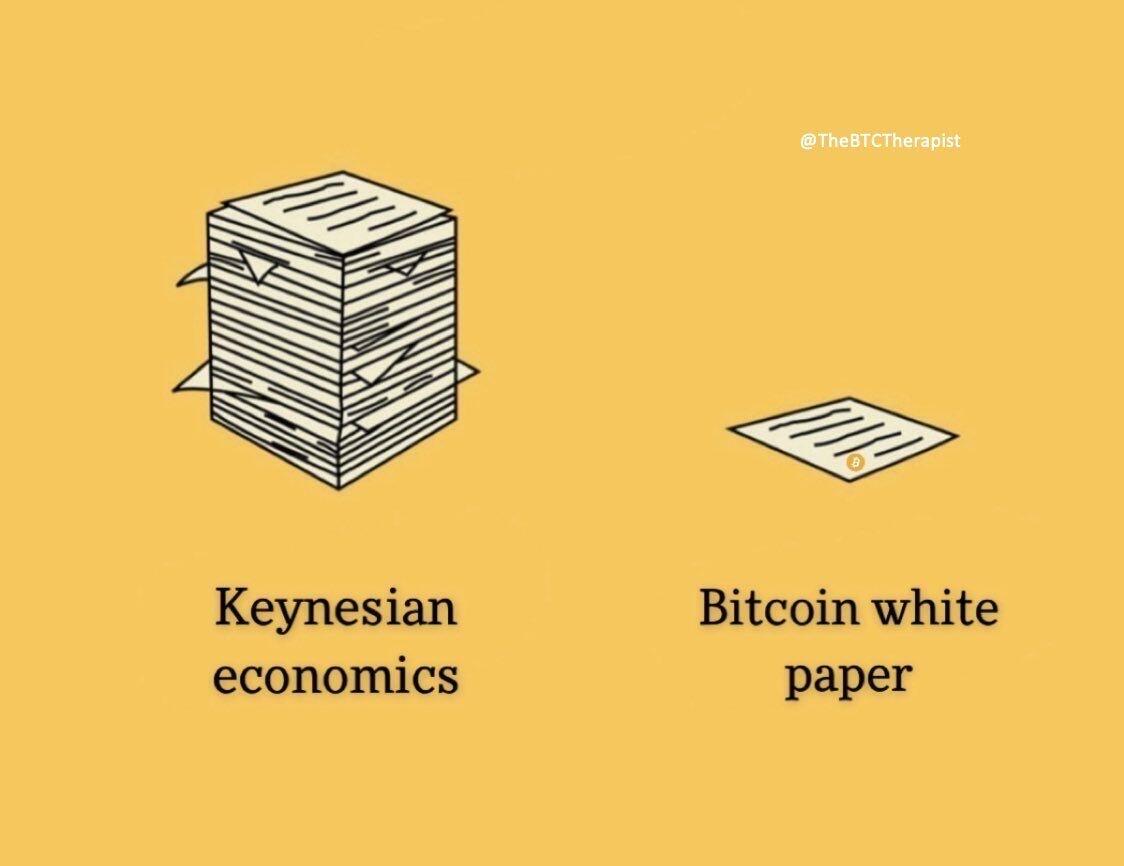

What makes you think he understands that? Because he’s pro monopolisation in the oil sector? Trump is nothing but a product of the fiat system.

Swede here! Grym bild!

As some voice hope for a Kamala Harris pivot toward a pro-Bitcoin stance, I find this implausible and will explain why I believe this.
Below I will have a look at Kamala's stand on taxes, energy and climate. First a glance at the Biden-Kamala constellation.
On March 9th, 2022, Joe Biden signed a document that involved the US government exploring CBDCs. The only way I can interpret this is as a plan to develop and implementing CBDCs. R&D does involve the 'd' as in development.
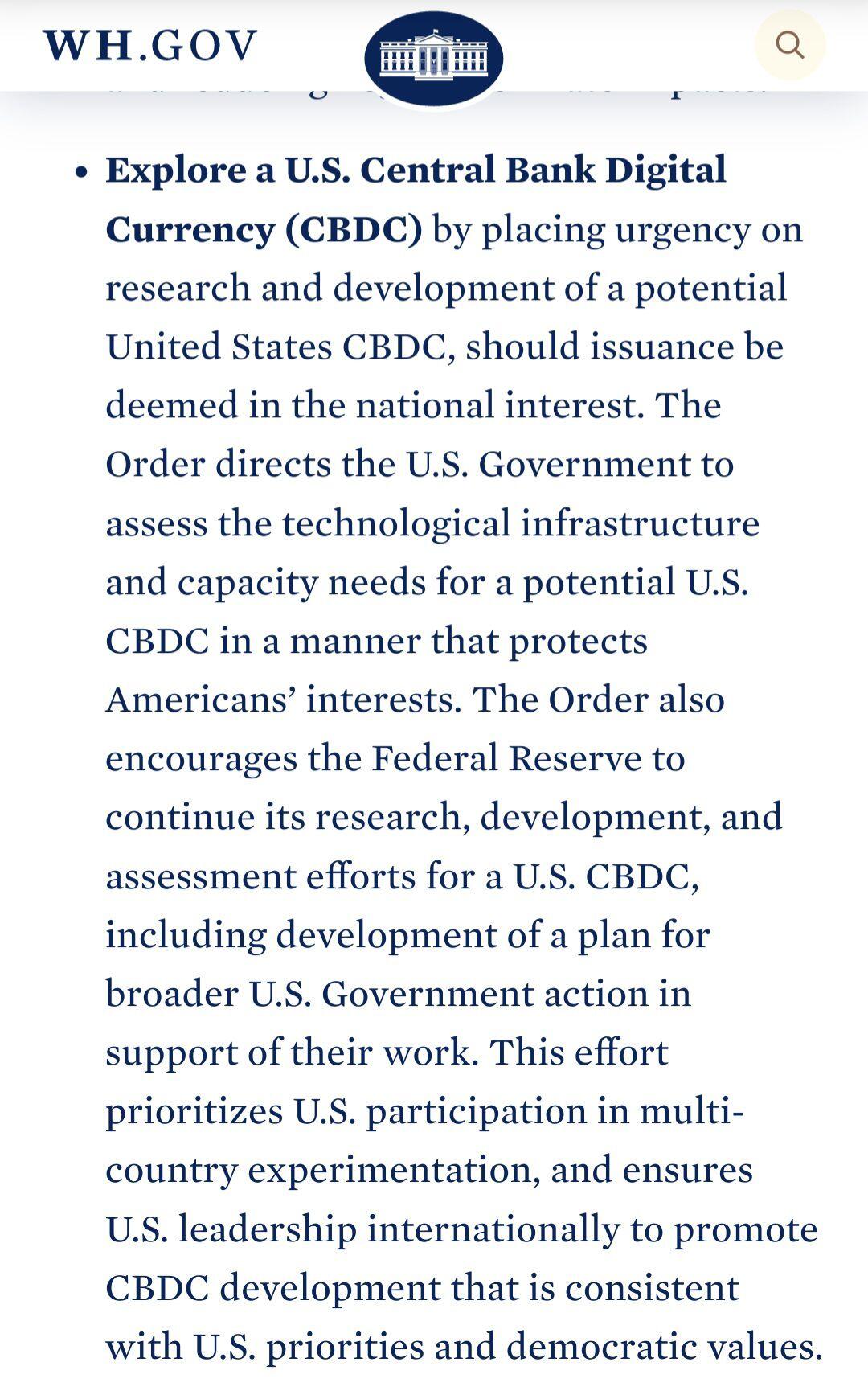
Source 1:
Next, it can be instructive to have a look at Kamala's tax policies from 2020, which are also largely mirrored in her 2024 position.
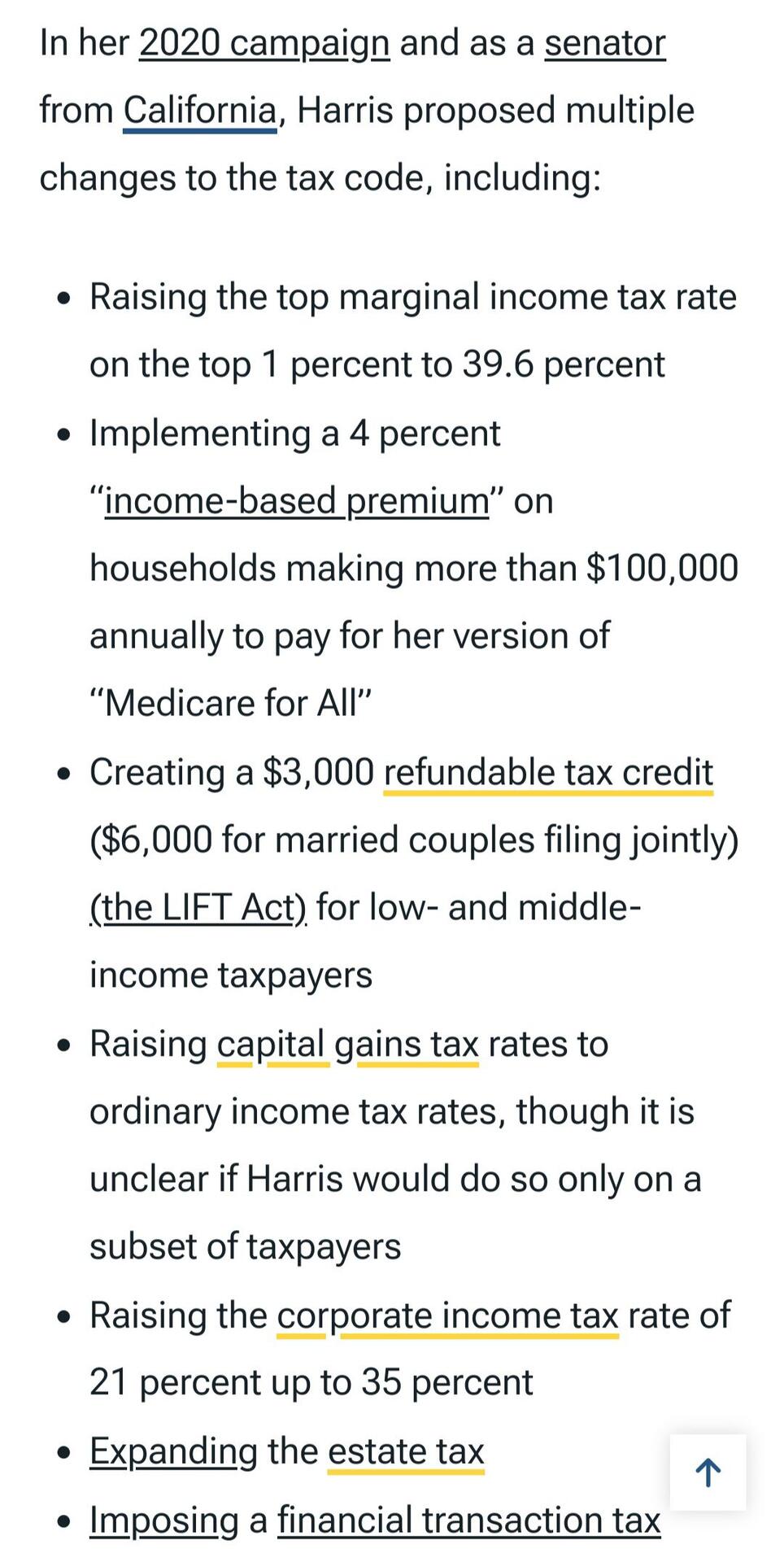
Here we find that Kamala had listed capital gains taxes on her policy document in 2020 and still support them in 2024. Not very bitcoin-friendly at all and a disaster in terms of the erosion of private property rights.
Source 2:
https://taxfoundation.org/blog/kamala-harris-tax-proposals-2024/
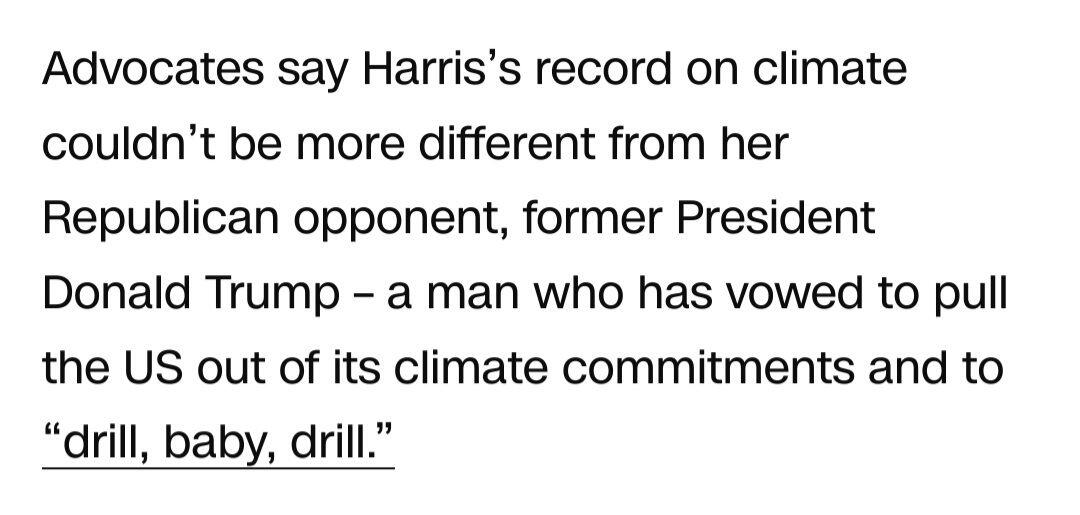
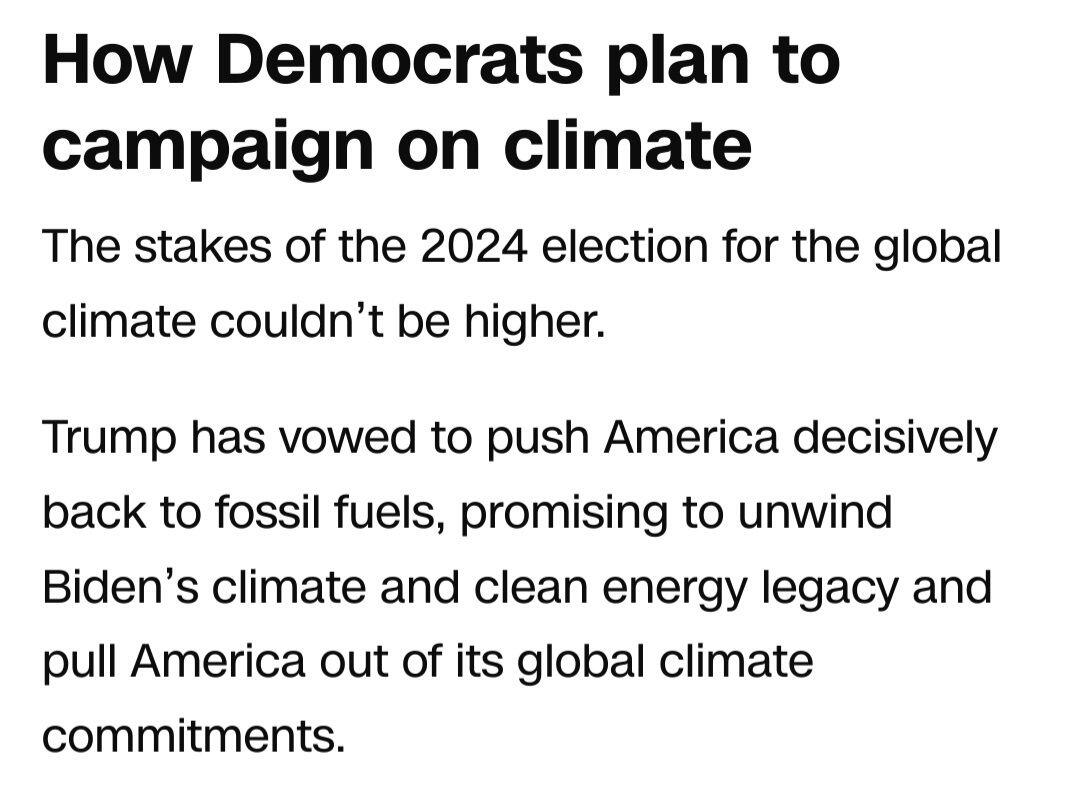
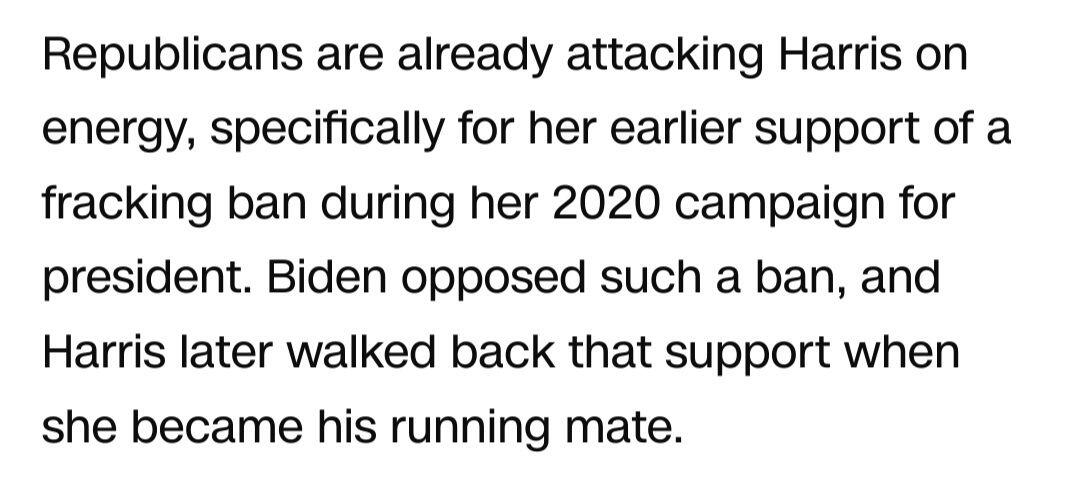
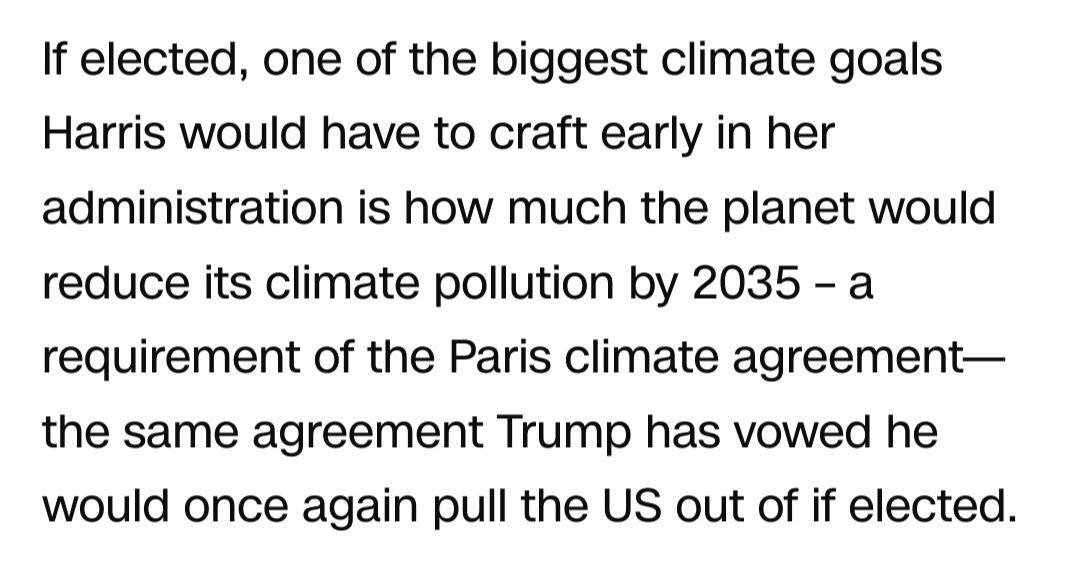
Next up we have the subject of energy and climate. As expected, the more aligned a candidate is toward the UN Agenda 21 and Agenda 2030, the more climate alarmism and de-industrialization policies we find.
This applies to the US, Canada, France, Australia, Germany, UK, Sweden, Norway and a host of countries that are pro-Agenda 21. Not a coincidence.
Ironically, Kamala's negative stance on US energy will likely boost Trump's campaign and he has been consistent in his pro-American energy position for 8 years, in spite of the coordinated MSM backlash.
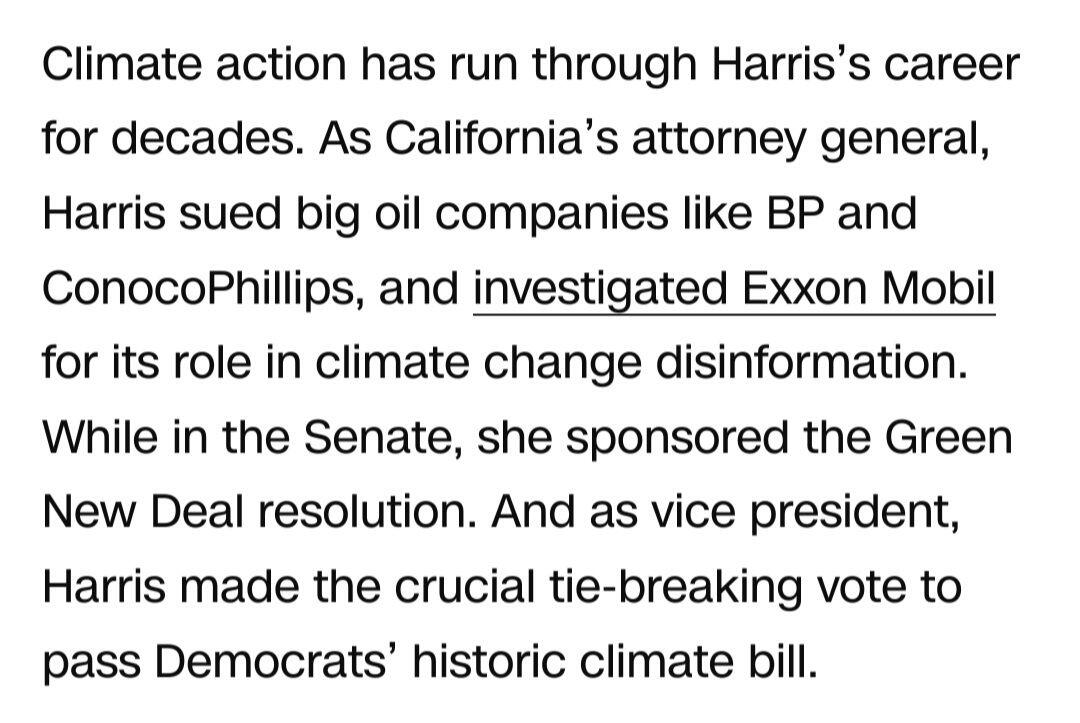
Source 3:
https://edition.cnn.com/2024/07/23/climate/kamala-harris-on-climate-energy/index.html
In conclusion, considering the ideological foundation of the Democrats, grounded in the UN Agenda 21 climate alarmism, and with 6 years left to reach the Agenda 2030 climate goals, we can expect Kamala to reduce the US energy capacity of oil, coal and gas in favor of environmentally questionable solar and wind energy, resulting in a de-industrialization and possible energy rationing.
Since CBDCs are necessary tools to implement carbon allowances and social credit score systems, we can expect that any political candidate that is on board with climate alarmism, also see CBDCs as useful tools in herding (forcing) consumers toward eating less meat, using less gas, driving fewer miles with cars, travelling less with planes and using less energy in general, which, under her policies, there won't be sufficient energy anyway.
Bitcoin mining under this kind of energy rationing scheme would become pointless due to the skyrocketing costs of energy. De-industrializing a nation while also embracing bitcoin mining is not a compatible match. Can't work, won't work.
Trump's energy maximization plan however, is compatible with bitcoin mining at low costs. Without the climate alarmism ideology, Trump doesn't even have a use case for CBDCs, which by the way he is vocally against. Trump doesn't believe in social engineering applied by central planners to pressure people to stop eating meat or stop driving cars. He has rejected climate alarmism consistently for 8 years, in spite of global demonization and recently, an assassination attempt.
The deep state has shown itself aligned with climate scaremongering and this is the lithmus test I use to determine who is aligned with the deep state and who is not.
Are they pro energy or not?
Are they anti UN or not?
Are they anti CBDC or not?
Are they anti capital gains taxes or not?
Are they for individual liberties or not?
Are they for private property rights or not.
Are they pro bitcoin or not?
These are the questions we must ask.
#Kamala #Harris #Donald #Trump #Bitcoin #Mining #Taxes #Climate #Alarmism #Energy #Policy
Trump does not understand the single most fundamental aspect of a free market, sound money or Bitcoin. He thinks it’s an about “winning”, which is a finite game and exactly what fiat is about.

We must restore the incentive structures in our economy to align with sustainable living.
6/ In a sound money environment, the precise incentives recognised as problematic today are reversed. In such an environment, the market — which would then be genuinely free because it would not have a structural bias — would naturally align with long-term, sustainable practices.
We all strive for the same goal: a sustainable planet. However, the notion that "if we could all just unite this one time for the common goal of saving the planet" may be inspiring but is insufficient if it assumes that a single central entity, if only given full mandate, can outsmart the collective intelligence of all the world's citizens with a “wave of its magic wand”.
The concept of unity by concentrating power in one central entity overlooks how every organism on Earth has adapted to an unpredictable future for billions of years, as it is akin to putting all eggs in the same basket. Survival, whether for mosquitoes, elephants, or humans, has never depended on uniform agreement — that is an impossible standard to meet that only ends up in compromises and insufficient actions — but rather on embracing diversity of thought, allowing free agents to act autonomously in their respective environments.
The point is that we must restore the economic environment in which the marketplace of ideas operates; only then will the full collective intelligence of the world's citizens be directed towards our better judgement. In fact, by doing so, we automatically activate and lever the entire world population towards the goal of environmental sustainability.
5/ Attributing the root cause of climate change to "market-based solutions" lacks nuance. The market is merely a collection of free agents that adapt to the most efficient way of operating in a given environment.
Unfortunately, that environment is currently the centralised fiat system with skewed incentive structures, which is why the current iteration of our market — which is not genuinely free — has adapted to operate most efficiently within that framework.
The “capitalism” or "market-based solutions" we know today resemble communism for the rich and capitalism for the poor. In other words, the word capitalism has been hijacked by those who seek fewer regulations and lower taxes to continue benefiting from the system's inherent flaws. In a genuinely free market, many of these individuals would have to reinvent themselves as their line of work adds zero value to the economy.
Under the fiat environment, increasing regulation and taxes is absolutely necessary, but it's at best only a short-term solution.
4/ However, while many at the forefront of the climate change movement are correctly identifying the symptoms and desperately pushing politicians to do more, many are also falling short of diagnosing the root cause accurately — or maybe they have just become so entrenched in the current system that they cannot see it can be reinvented.
3/ Those at the forefront of the green movement are instinctively correct. They are making the right choice in fighting back against forces that seek our destruction. They rightly sense that something is fundamentally wrong with how we live our lives and the behaviours that are rewarded…
2/ Those who argue otherwise are presenting a straw man argument. For instance, it is an undeniable fact that Earth will be hit by another asteroid in the future. We just don't know when, where, or how severe it will be. Similarly, those who claim the science on climate change is “unsettled” are debating the specifics of "when, where, and how severe," which indeed can vary.
However, it is settled that climate change will have disastrous consequences to the world in one way or another unless action is taken.
The even more ridiculous claim that climate scientists — as if they were one and the same — have “conspired” to downplay uncertainty and exaggerate risk, are apparently unaware of the fact that increased uncertainty equates to increased risk. So, they effectively have a defeater for their own argument.
Climate change is real and it’s caused by the unsustainable living practices that FIAT forces upon each and every one of us!🧵…
We stand at a pivotal moment in human history, where the adoption of sound money is no longer a mere theoretical concept but a tangible goal that can be genuinely achieved.
There is no such thing as a free market under a FIAT system.
To assert that the sinful act in terms of unsustainability, for example, is merely extracting and using oil, which releases greenhouse gases and warms the planet, is a grave underestimation of the issue.
The far more egregious act is that for all the various intents and purposes that energy could have been used for — such as fuelling innovation, which could have generated something of more value than the sum of its parts — it is instead used to build tanks and weapons with the intention to destroy lives, homes, and cities.