


The Rise of #Linuxia: A Comprehensive Guide to the #Linux Operating System
https://linuxsecurity.com/news/security-projects/rise-of-linuxia
What the heck do they mean by Linuxia? Doesn't look like it's a distro...
Why is Google bad for your business?
Does your company mandate Google docs, email, or meet? Well, everyone knows Google docs are free, and so any random clown can access them. Because of the complete lack of any type of exclusivity or advanced knowledge, we present compelling arguments that to use them in a corporate setting, not only gives the appearance of poverty and laziness, but encourages decreased revenue and team building.
With online companies, their e-commerce websites are not their only “store front”, but also the websites their customers interact with. We can think of this with analogy of a brand’s “hotel lobby”. When you send a client a Google doc, you’re turning what could be a beautiful luxury hotel lobby into a homeless bus shelter. When you have a client paying for your expertise, you want to create the impression that they need you. You don’t want them to think “I can do Google docs on my own, maybe I can do all of this work on my own.” Even if you pay for Google Suite, now your employees or customers don’t respect you for paying for free docs.
Numerous business experts have studied these issues and reached similar conclusions regarding Gmail. YFS Magazine in their article “3 Reasons Why @Gmail.com For Business Is A Bad Idea” discusses how using Gmail makes your company look unprofessional and lack branding. [1] A different magazine TechnologyHQ repeats similar messages that using Gmail not only makes your brand unprofessional, but you also lose credibility. [2]
Not only does Google docs make your firm lose branding and look poor, but because Google sells all data on their platforms, it encourages employees to share as little as possible with each other. In our previous work, we discussed how Google doesn’t just sell ad space, but manipulatively sells user data directly through the use of a cookie. [3] We cited research from Dr Johnny Ryan, Chief Policy & Industry Relations Officer at Brave [4b], as well as documentation from Bhagyashree of PacktPub discussing Google violation of the European Union’s GDPR [4c]. Even usually “pro-marketing” publications such as AdExchanger, admit to Google’s corruption and rot of basic EU privacy law through cookies. [4d]
So if Google’s business model is to maliciously broadcast and sell as much data as possible, then basic logic would dictate that employees would be motivated to share as LITTLE as possible about themselves with any co-workers. And this is why using Google’s products pisses away your revenue. Research from TeamStage, demonstrates teams that communicate more, produce more revenue. [5] Their statistics show that twice the revenue can be generated by teams that are fully engaged and communicate about their personal lives. [5] But how can teams build this trust if the medium with which they communicate is malicious and insecure? [3]
Some might argue that most people are not aware of the malicious and illegal data sales of Google. However, this view assumes that you will be hiring only ignorant employees. Only the least technically savvy users, who give your company the most exposure to security vulnerabilities due to lack of internet knowledge, will not mind their data being sold.
And speaking of security, through Google’s corrupt and illegal sale of all data, the use of their products encourages phising attacks on your employees who have become identified to everyone and their mother. Having your employees’ mobile phone numbers sold by Google is much higher risk, when compared to the use of Element/Matrix, which would instead keep employee encryption credentials locally on employees’ hard-drives. End-to-end encrypted group chats encourages the use of audio confirmation to trust unknown encryption keys, all while incurring minimal expense to your organization.
(knock-out punch)
In conclusion, ignorant business owners will dismiss these claims saying “people don’t care”. This view simply dismisses the statistically proven power of branding or team building’s effects on revenue. It’s definitely true that SOME people don’t care, and so it encourages your firm to only hire less technically savvy users, which can expose your firm to lose money on security vulnerabilities.
So if you want to reduce invasive involuntary tech in your workplace, please consider sharing this.
Relentless. Determined. I fight for you. Sources: http://simplifiedprivacy.com/googledocs
I appreciate the new angle instead of just the privacy approach which unfortunately many people just don't care enough about.
Perhaps it could be spiced up furer by mentioning a scary news story about #GoogleDrive users losing access to their account or documents.
#GoogleDocs #freecloud #freecloudstorage
I love it can't wait for it to get stable
Google Pixel phones are not available in Turkey, so I bought myself an iPhone. In ideal circumstances, I would buy one and install GrapheneOS. But if you had to choose between an iPhone and an android device where you have no choice over privacy, which one would you choose?
If I'm not mistaken, your criticism is on Apple platfoms, not directly on the efforts of Damus team. And I find that little unfair to them. The usability, and the approach that they chose is unmatched. We're having a simple, private and elegant client to interact with everyone on the network.
I think nostr:npub1xtscya34g58tk0z605fvr788k263gsu6cy9x0mhnm87echrgufzsevkk5s is planning to launch an Android client after his struggles with the App Store. Please try it when they launch it. I'm curious to see whether your opinions remains.
I'd still choose the Android device as it gives more freedom and control over #privacy than Apple devices. In fact, #Pixel devices aren't sold by Google in my country either so I bought an older Pixel online and degoogled it.
As a former iPhone user myself I'm not judging anyone, but it depends on priorities I guess... Mine is, if I paid my hard earned money for it, I should be able to decide what I run on it.

Agreed. At the very least, anything that connects to the internet should be #opensource.

Why are companies are hesitant to release their software's source code? The issue of funding/monetisation or lack of it is at the core of it. Almost all of the bad decisions made by foss projects and companies in the previous year including license changes stem from this...

grapheneos.org
nitter.cz/GrapheneOS
discuss.grapheneos.org
why do GrapheneOS has no presence in nostr yet ?
#linux #plebchain #privacy #linuxstr #tipstr
Vanadium version 121.0.6167.101.0 released:
https://github.com/GrapheneOS/Vanadium/releases/tag/121.0.6167.101.0
One of their moderators posts here regularly:
nostr:npub1c9d95evcdeatgy6dacats5j5mfw96jcyu79579kg9qm3jtf42xzs07sqfm
You may also be able to follow #grapheneos official Fediverse account through the #mostr bridge.
I thought it's a new #firewall. There's nothing different from the version in 22.04 is there?
The apps can still be sold even if the code is public but hardly any #foss projects do that... is it because the developers think they have to provide the complied binaries for free?

Completely understandable. However, the developers are okay with it being in the F-Droid main repo right so we can submit a request to F-Droid for inclusion?
Any plans of releasing a fully #foss version on #fdroid free of proprietary closed source dependencies? Thanks.

What about #Autocrypt for usability compared to #PGP? Pretty easy to use with clients like #DeltaChat and K-9 Mail?

Yes I love it but it remember to disable so-called secureboot.
Hope you get well soon :)
Some Cloudflare sites regularly serve me captchas that don't let me pass even on the standard Tor setting.

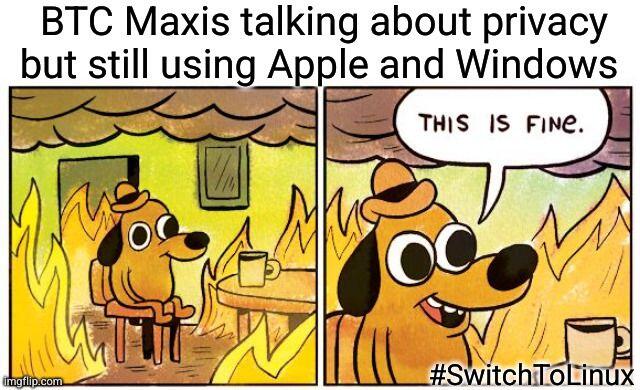 #m=image%2Fjpeg&dim=640x390&blurhash=imOC%5D2M%5Exuogt3x%40ofWXkDpfWBa%23ofRkV%7Bj%40kBs%2Cxxogjtf5ofaeoLafWCxttRoIRkt7WAofbFa%23tQofR-jZoMbZaffRof&x=dcaec24e6c33e98913b8142f73bfe52a8197b241d343b8a9b66df6fd7d01872f
I use Pop!_OS and Ubuntu on desktops and Debian and Ubuntu on servers.

 #m=image%2Fjpeg&dim=1536x2040&blurhash=_3I5e%7Cr%3B00j%3F4%3AD*4%3ADNH%3Fs9IUW%3DS5X900Vs%7EWNG%25No%23%25M%25g%25fxut7oeRjRP00%25h.7xuV%3FsmV%40.8krS5xuV%3FxZjE00bdR%2Bofj%3FxZsSX9M%7CD*j%5Bf6t6xZ00IVM%7CWBs%3Aoext&x=191a60a3ccf7e7e7f0ce0a161420e4db554cd431c9ece4dcbd4b69ae1051e70d