

Trying the pizza oven for first time! #foodstr #pizza #fathead 

Sunday 28 January 2024
4th Sunday in Ordinary Time
Saint Thomas Aquinas, Priest, Doctor
Painting by Carlo Crivelli, 1476, from the large 'Demidoff Altarpiece' made for the high altar of San Domenico in Ascoli Piceno, east central Italy, now in the National Gallery, London.
From a conference by Saint Thomas Aquinas, priest
The Cross exemplifies every virtue
Why did the Son of God have to suffer for us? There was a great need, and it can be considered in a twofold way: in the first place, as a remedy for sin, and secondly, as an example of how to act.
It is a remedy, for, in the face of all the evils which we incur on account of our sins, we have found relief through the passion of Christ. Yet, it is no less an example, for the passion of Christ completely suffices to fashion our lives. Whoever wishes to live perfectly should do nothing but disdain what Christ disdained on the cross and desire what he desired, for the cross exemplifies every virtue.
If you seek the example of love: Greater love than this no man has, than to lay down his life for his friends. Such a man was Christ on the cross. And if he gave his life for us, then it should not be difficult to bear whatever hardships arise for his sake.
If you seek patience, you will find no better example than the cross. Great patience occurs in two ways: either when one patiently suffers much, or when one suffers things which one is able to avoid and yet does not avoid. Christ endured much on the cross, and did so patiently, because when he suffered he did not threaten; he was led like a sheep to the slaughter and he did not open his mouth. Therefore Christ’s patience on the cross was great. In patience let us run for the prize set before us, looking upon Jesus, the author and perfecter of our faith who, for the joy set before him, bore his cross and despised the shame.
If you seek an example of humility, look upon the crucified one, for God wished to be judged by Pontius Pilate and to die.
If you seek an example of obedience, follow him who became obedient to the Father even unto death. For just as by the disobedience of one man, namely, Adam, many were made sinners, so by the obedience of one man, many were made righteous.
If you seek an example of despising earthly things, follow him who is the King of kings and the Lord of lords, in whom are hidden all the treasures of wisdom and knowledge. Upon the cross he was stripped, mocked, spat upon, struck, crowned with thorns, and given only vinegar and gall to drink.
Do not be attached, therefore, to clothing and riches, because they divided my garments among themselves. Nor to honours, for he experienced harsh words and scourgings. Nor to greatness of rank, for weaving a crown of thorns they placed it on my head. Nor to anything delightful, for in my thirst they gave me vinegar to drink. 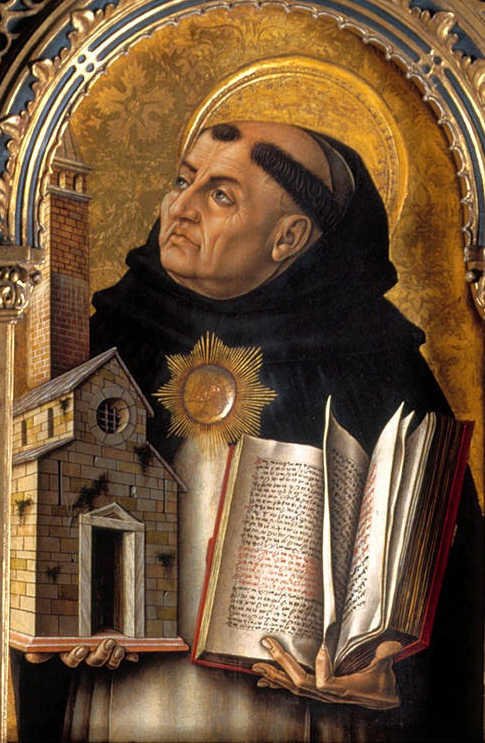
Saturday 27 January 2024
Saturday of week 3 in Ordinary Time
or Saint Angela Merici, Virgin
Spiritual Reading
Your Second Reading from the Office of Readings:
Saturday of week 3 in Ordinary Time
From the Second Vatican Council's pastoral constitution "Gaudium et spes" on the Church in the modern world
The mystery of death
In the face of death the enigma of human existence reaches its climax. Man is not only the victim of pain and the progressive deterioration of his body; he is also, and more deeply, tormented by the fear of final extinction. But the instinctive judgement of his heart is right when he shrinks from, and rejects, the idea of a total collapse and definitive end of his own person. He carries within him the seed of eternity, which cannot be reduced to matter alone, and so he rebels against death. All efforts of technology, however useful they may be, cannot calm his anxieties; the biological extension of his life-span cannot satisfy the desire inescapably present in his heart for a life beyond this life.
Imagination is completely helpless when confronted with death. Yet the Church, instructed by divine revelation, affirms that man has been created by God for a destiny of happiness beyond the reach of earthly trials. Moreover, the Christian faith teaches that bodily death, to which man would not have been subject if he had not sinned, will be conquered; the almighty and merciful Saviour will restore man to the wholeness that he had lost through his own fault. God has called man, and still calls him, to be united in his whole being in perpetual communion with himself in the immortality of the divine life. This victory has been gained for us by the risen Christ, who by his own death has freed man from death.
Faith, presented with solid arguments, offers every thinking person the answer to his questionings concerning his future destiny. At the same time, it enables him to be one in Christ with his loved ones who have been taken from him by death and gives him hope that they have entered into true life with God.
Certainly, the Christian is faced with the necessity, and the duty, of fighting against evil through many trials, and of undergoing death. But by entering into the paschal mystery and being made like Christ in death, he will look forward, strong in hope, to the resurrection.
This is true not only of Christians but also of all men of good will in whose heart grace is invisibly at work. Since Christ died for all men, and the ultimate vocation of man is in fact one, that is, a divine vocation, we must hold that the Holy Spirit offers to all the possibility of being united with this paschal mystery in a way known only to God.
Such is the great mystery of man, enlightening believers through the Christian revelation. Through Christ and in Christ light is thrown on the enigma of pain and death which overwhelms us without his Gospel to teach us. Christ has risen, destroying death by his own death; he has given us the free gift of life so that as sons in the Son we may cry out in the Spirit, saying: Abba, Father!
________
Other choices for today:
Saint Angela Merici, Virgin
Saint Angela Merici (1474-1540) as a teacher, devotional picture (pastel on paper) by Pietro Calzavacca (1855-1890), Merician Museum, Brescia, Italy.
From the Spiritual Testament by Saint Angela Merici, virgin
He has disposed all things pleasantly
Mothers and sisters most dear to me in Christ: in the first place strive with all your power and zeal to be open. With the help of God, try to receive such good counsel that, led solely by the love of God and an eagerness to save souls, you may fulfil your charge.
Only if the responsibilities committed to you are rooted firmly in this twofold charity will they bear beneficial and saving fruit. As our Saviour says: A good tree is not able to produce bad fruit.
He says: A good tree, that is, a good heart as well as a soul inflamed with charity, can do nothing but good and holy works. For this reason Saint Augustine said: Love, and do what you will, namely, possess love and charity and then do what you will. It is as if he had said: Charity is not able to sin.
I also beg you to be concerned about every one of your daughters. Bear them, so to speak, engraved upon your heart – not merely their names, but their conditions and states, whatever they may be. This will not be difficult for you if you embrace them with a living love.
Mothers of children, even if they have a thousand, carry each and every one fixed in their hearts, and because of the strength of their love they do not forget any of them. In fact, it seems that the more children they have the more their love and care for each one is increased. Surely those who are mothers in spirit can and must act all the more in the same way, because spiritual love is more powerful than the love that comes from a blood relationship.
Therefore, mothers most dear to me, if you love these your daughters with a living and unaffected charity, it will be impossible for you not to have each and every one of them engraved upon your memory and in your mind.
I beg you again, strive to draw them by love, modesty, charity, and not by pride and harshness. Be sincerely kind to every one according to the words of our Lord: Learn of me, for I am meek and humble of heart. Thus you are imitating God, of whom it is said: He has disposed all things pleasantly. And again Jesus said: My yoke is easy and my burden is light.
You also ought to exercise pleasantness towards all, taking great care especially that what you have commanded may never be done by reason of force. For God has given free will to everyone, and therefore he forces no one but only indicates, calls, persuades. Sometimes, however, something will have to be done with a stronger command, yet in a suitable manner and according to the state and necessities of individuals; but then also we should be impelled only by charity and zeal for souls.
Nice and clear from Jeff Booth: https://video.nostr.build/9a0455045909f6005f15dc5773218025bdd52507e6603e780fa26c17f61822e5.mp4
Thursday 25 January 2024
The Conversion of Saint Paul, Apostle - Feast
Spiritual Reading
Your Second Reading from the Office of Readings:
The Conversion of Saint Paul, Apostle
The Conversion of Saint Paul by Caravaggio (1571-1610), circa January 1600. Odescalchi Balbi Collection, Rome.
From a homily by Saint John Chrysostom, bishop
For love of Christ, Paul bore every burden
Paul, more than anyone else, has shown us what man really is, and in what our nobility consists, and of what virtue this particular animal is capable. Each day he aimed ever higher; each day he rose up with greater ardour and faced with new eagerness the dangers that threatened him. He summed up his attitude in the words: I forget what is behind me and push on to what lies ahead. When he saw death imminent, he bade others share his joy: Rejoice and be glad with me! And when danger, injustice and abuse threatened, he said: I am content with weakness, mistreatment and persecution. These he called the weapons of righteousness, thus telling us that he derived immense profit from them.
Thus, amid the traps set for him by his enemies, with exultant heart he turned their every attack into a victory for himself; constantly beaten, abused and cursed, he boasted of it as though he were celebrating a triumphal procession and taking trophies home, and offered thanks to God for it all: Thanks be to God who is always victorious in us! This is why he was far more eager for the shameful abuse that his zeal in preaching brought upon him than we are for the most pleasing honours, more eager for death than we are for life, for poverty than we are for wealth; he yearned for toil far more than others yearn for rest after toil. The one thing he feared, indeed dreaded, was to offend God; nothing else could sway him. Therefore, the only thing he really wanted was always to please God.
The most important thing of all to him, however, was that he knew himself to be loved by Christ. Enjoying this love, he considered himself happier than anyone else; were he without it, it would be no satisfaction to be the friend of principalities and powers. He preferred to be thus loved and be the least of all, or even to be among the damned, than to be without that love and be among the great and honoured.
To be separated from that love was, in his eyes, the greatest and most extraordinary of torments; the pain of that loss would alone have been hell, and endless, unbearable torture.
So too, in being loved by Christ he thought of himself as possessing life, the world, the angels, present and future, the kingdom, the promise and countless blessings. Apart from that love nothing saddened or delighted him; for nothing earthly did he regard as bitter or sweet.
Paul set no store by the things that fill our visible world, any more than a man sets value on the withered grass of the field. As for tyrannical rulers or the people enraged against him, he paid them no more heed than gnats. Death itself and pain and whatever torments might come were but child’s play to him, provided that thereby he might bear some burden for the sake of Christ.
________
The ferial reading for today:
Thursday of week 3 in Ordinary Time
From a sermon by John the Serene, bishop
Love the Lord and walk in his ways
The Lord is my light and my salvation; whom shall I fear? How great was that servant who knew how he was given light, whence it came, and what sort of man he was when he was favoured by that light! The light he saw was not that which fades at dusk, but the light which no eye has seen. Souls brightened by this light do not fall into sin or stumble on vice.
Our Lord said: Walk while you have the light in you. What other light did he mean but himself? For it was he who said: I came as a light into the world, so that those who have eyes may not see and the blind may receive the light. The Lord then is our light, the sun of justice and righteousness, who has shone on his Catholic Church spread throughout the world. The prophet spoke as a figure of the Church when he cried: The Lord is my light and my salvation; whom shall I fear?
The spiritual man who has been thus illumined does not limp or leave the path, but bears all things. Glimpsing our true country from afar, he puts up with adversities; he is not saddened by the things of time, but finds his strength in God. He lowers his pride and endures, possessing patience through humility. That true light which enlightens every man who comes into the world bestows itself on those who reverence it, shining where it wills, on whom it wills, and revealing itself according to the will of God the Son.
When this light begins to shine upon the man who sat in darkness and the shadow of death, in the darkness of evil and the shadow of sin, he is shocked, he calls himself to account, repents of his misdeeds in shame, and says: The Lord is my light and my salvation; whom shall I fear? Great is this salvation, my brethren, which fears neither sickness nor lethargy and disregards pain. We should then in the fullest sense not only with our voice but with our very soul cry out, The Lord is my light and my salvation; whom shall I fear? If he enlightens and saves me, whom shall I fear? Even though the dark shadows of evil suggestions crowd about, The Lord is my light. They can approach, but cannot prevail; they can lay siege to our heart, but cannot conquer it. Though the blindness of concupiscence assails us, again we say: The Lord is my light. For he is our strength; he gives himself to us and we give ourselves to him. Hasten to this physician while you can, or you may not be able to find him when you want him.
The Conversion of Saint Paul 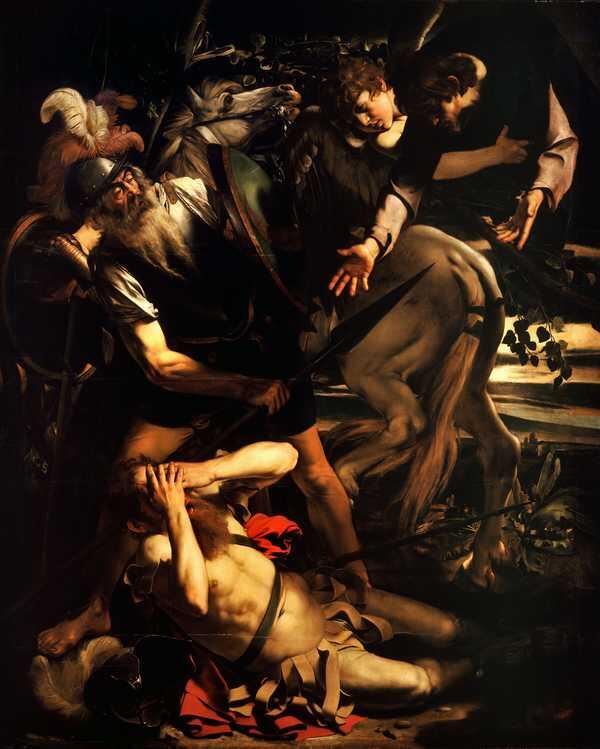
#Bitcoin is playing in big leagues now and the game is at a new level.
How I suspect it plays out: An attempt to capture as much as #Bitcoin as possible including regulation to “try” to slow self custody of #Bitcoin (Warren et all) and leverage games on paper #Bitcoin to reduce price. (ETF’s)
Which “causes” more Bitcoiners aware of the manipulation and how the game is being played to use lower prices to buy and self custody more #Bitcoin (reducing supply)
Which at some point creates a short squeeze of MEGA proportions (maybe along with halving - maybe later ) that liquidates a major financial player. (Similar to FTX)
Money has become a monopoly because of the games that have been able to be played with others assets due to the centralization and control of those assets.
But Wall Street has never seen an asset like this. It is not gold and too many #Bitcoiners know how the game is played, meaning if you don’t play by the rules, eventually you will be caught short. (And no one is coming to save you)
Or as nostr:npub1qny3tkh0acurzla8x3zy4nhrjz5zd8l9sy9jys09umwng00manysew95gx says:
Stay humble and stack sats.
Maybe a dumb question, but somewhat related. I’m still learning…
Where does the bitcoin come from to supply all the banks selling it for the EFTs? Who’s selling their bitcoin? And why? Mining alone isn’t enough right? I think there’s a bigger market that I’m ignorant of, just curious how it works
I meant this quote, sorry! 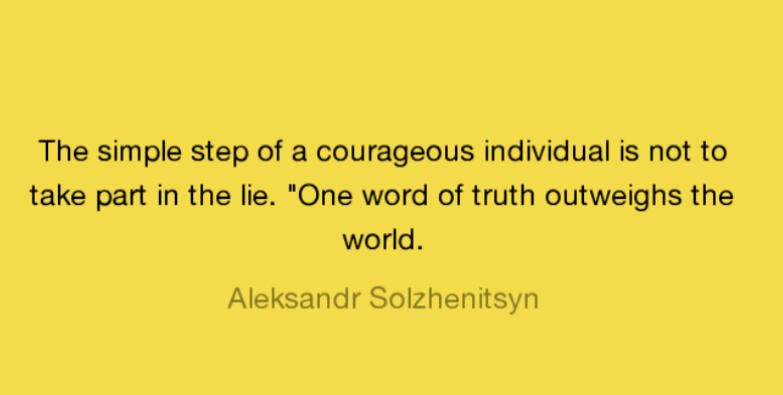
Previous quote reminds me of this quote:

This is so key…what we know is less important than what we do…we don’t have to know all the truths out there…we have to do what is right in conformity with little truth we know. It doesn’t take many people taking a stand to change things.
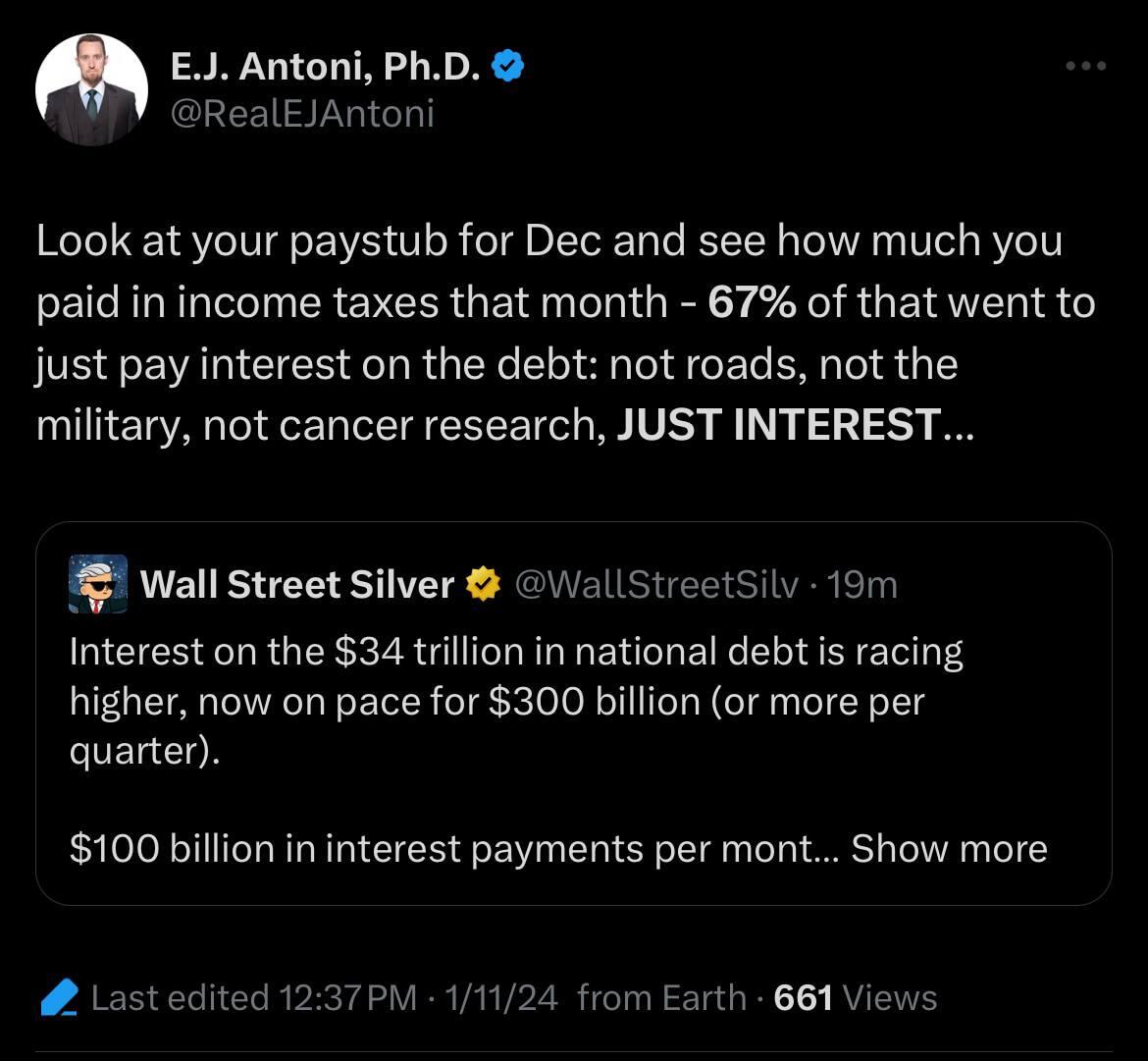


100 percent. had a similar thought recently traveling in a poorer country. It was and felt freer. There was less coordination and technology to monitor everything- because of the poverty. Yes there is corruption, crime and chaos…but less techno tyranny. I prefer the former.
That’s a lot of signal… https://video.nostr.build/fb3cb457a47aa39efd19740b4f7c32e07b8967297c3e3a42cc871367d3f49812.mp4