
Antiphon from Vespers/Evening Prayer this Holy Saturday:
Death, you shall die in me; hell, you shall be destroyed by me.
🙏🏽

Good morning friends.
Todays office of readings contains a sermon from around the year 100, and it may be the most beautiful reading of the whole year. The silence of Holy Saturday, and Christ the Victor over death going into the darkness to rescue Adam and all of us.
Peace.
Saturday 30 March 2024
Holy Saturday
Spiritual Reading
Your Second Reading from the Office of Readings:
Holy Saturday
From an ancient homily for Holy Saturday
The Lord's descent into the underworld
Something strange is happening – there is a great silence on earth today, a great silence and stillness. The whole earth keeps silence because the King is asleep. The earth trembled and is still because God has fallen asleep in the flesh and he has raised up all who have slept ever since the world began. God has died in the flesh and hell trembles with fear.
He has gone to search for our first parent, as for a lost sheep. Greatly desiring to visit those who live in darkness and in the shadow of death, he has gone to free from sorrow the captives Adam and Eve, he who is both God and the son of Eve. The Lord approached them bearing the cross, the weapon that had won him the victory. At the sight of him Adam, the first man he had created, struck his breast in terror and cried out to everyone: “My Lord be with you all.” Christ answered him: “And with your spirit.” He took him by the hand and raised him up, saying: “Awake, O sleeper, and rise from the dead, and Christ will give you light.”
I am your God, who for your sake have become your son. Out of love for you and for your descendants I now by my own authority command all who are held in bondage to come forth, all who are in darkness to be enlightened, all who are sleeping to arise. I order you, O sleeper, to awake. I did not create you to be held a prisoner in hell. Rise from the dead, for I am the life of the dead. Rise up, work of my hands, you who were created in my image. Rise, let us leave this place, for you are in me and I am in you; together we form only one person and we cannot be separated. For your sake I, your God, became your son; I, the Lord, took the form of a slave; I, whose home is above the heavens, descended to the earth and beneath the earth. For your sake, for the sake of man, I became like a man without help, free among the dead. For the sake of you, who left a garden, I was betrayed to the Jews in a garden, and I was crucified in a garden.
See on my face the spittle I received in order to restore to you the life I once breathed into you. See there the marks of the blows I received in order to refashion your warped nature in my image. On my back see the marks of the scourging I endured to remove the burden of sin that weighs upon your back. See my hands, nailed firmly to a tree, for you who once wickedly stretched out your hand to a tree.
I slept on the cross and a sword pierced my side for you who slept in paradise and brought forth Eve from your side. My side has healed the pain in yours. My sleep will rouse you from your sleep in hell. The sword that pierced me has sheathed the sword that was turned against you.
Rise, let us leave this place. The enemy led you out of the earthly paradise. I will not restore you to that paradise, but I will enthrone you in heaven. I forbade you the tree that was only a symbol of life, but see, I who am life itself am now one with you. I appointed cherubim to guard you as slaves are guarded, but now I make them worship you as God. The throne formed by cherubim awaits you, its bearers swift and eager. The bridal chamber is adorned, the banquet is ready, the eternal dwelling places are prepared, the treasure houses of all good things lie open. The kingdom of heaven has been prepared for you from all eternity.
________
Revelations of Divine Love
Julian of Norwich
6. On prayer (2)
For the Goodness of God is the highest prayer, and it cometh down to the lowest part of our need. It quickeneth our soul and bringeth it on life, and maketh it wax in grace and virtue. It is nearest in nature; and readiest in grace: for it is the same grace that the soul seeketh, and ever shall seek till we know verily that He hath us all in Himself enclosed.
For He hath no despite of what He hath made, nor hath He any disdain to serve us at even the simplest office that to our body belongeth in nature, for love of the soul that He hath made to His own likeness.
For as the body is clad in the cloth, and the flesh in the skin, and the bones in the flesh, and the heart in the whole, so are we, soul and body, clad in the Goodness of God, and enclosed. Yea, and more homely: for all these may waste and wear away, but the Goodness of God is ever whole; and more near to us, without any likeness; for truly our Lover desireth that our soul cleave to Him with all its might, and that we be ever-more cleaving to His Goodness. For of all things that heart may think, this pleaseth most God, and soonest speedeth the soul.
For our soul is so specially loved of Him that is highest, that it overpasseth the knowing of all creatures: that is to say, there is no creature that is made that may fully know how much and how sweetly and how tenderly our Maker loveth us. And therefore we may with grace and His help stand in spiritual beholding, with everlasting marvel of this high, overpassing, immeasurable Love that Almighty God hath to us of His Goodness. And therefore we may ask of our Lover with reverence all that we will.
For by our nature, our Will is to have God, and the Good Will of God is to have us; and we may never cease from willing nor from longing till we have Him in fullness of joy: and then may we no more desire.
For He willeth that we be occupied in knowing and loving till the time that we shall be fulfilled in Heaven; and therefore was this lesson of Love showed, with all that followeth, as ye shall see. For the strength and the Ground of all was showed in the First Sight. For of all things the beholding and the loving of the Maker maketh the soul to seem less in his own sight, and most filleth him with reverent dread and true meekness; with plenty of charity to his even-Christians.
“Even-Christians” is a favourite word of Julian’s. The word “even” means “equal”, so that “even-Christians” means more than just “fellow-Christians”. It adds a sense of “radical equality by virtue of being Christian”.
________
Friday 29 March 2024
Good Friday
Spiritual Reading
Your Second Reading from the Office of Readings:
Good Friday
From the Catecheses by Saint John Chrysostom, bishop
The power of Christ's blood
If we wish to understand the power of Christ’s blood, we should go back to the ancient account of its prefiguration in Egypt. “Sacrifice a lamb without blemish,” commanded Moses, “and sprinkle its blood on your doors.” If we were to ask him what he meant, and how the blood of an irrational beast could possibly save men endowed with reason, his answer would be that the saving power lies not in the blood itself, but in the fact that it is a sign of the Lord’s blood. In those days, when the destroying angel saw the blood on the doors he did not dare to enter, so how much less will the devil approach now when he sees, not that figurative blood on the doors, but the true blood on the lips of believers, the doors of the temple of Christ.
If you desire further proof of the power of this blood, remember where it came from, how it ran down from the cross, flowing from the Master’s side. The gospel records that when Christ was dead, but still hung on the cross, a soldier came and pierced his side with a lance and immediately there poured out water and blood. Now the water was a symbol of baptism and the blood, of the holy Eucharist. The soldier pierced the Lord’s side, he breached the wall of the sacred temple, and I have found the treasure and made it my own. So also with the lamb: the Jews sacrificed the victim and I have been saved by it.
“There flowed from his side water and blood.” Beloved, do not pass over this mystery without thought; it has yet another hidden meaning, which I will explain to you. I said that water and blood symbolised baptism and the holy Eucharist. From these two sacraments the Church is born: from baptism, “the cleansing water that gives rebirth and renewal through the Holy Spirit,” and from the holy Eucharist. Since the symbols of baptism and the Eucharist flowed from his side, it was from his side that Christ fashioned the Church, as he had fashioned Eve from the side of Adam. Moses gives a hint of this when he tells the story of the first man and makes him exclaim: “Bone from my bones and flesh from my flesh!” As God then took a rib from Adam’s side to fashion a woman, so Christ has given us blood and water from his side to fashion the Church. God took the rib when Adam was in a deep sleep, and in the same way Christ gave us the blood and the water after his own death.
Do you understand, then, how Christ has united his bride to himself and what food he gives us all to eat? By one and the same food we are both brought into being and nourished. As a woman nourishes her child with her own blood and milk, so does Christ unceasingly nourish with his own blood those to whom he himself has given life.
________
Revelations of Divine Love
Julian of Norwich
6. On prayer (1)
“The Goodness of God is the highest prayer, and it cometh down to the lowest part of our need”
This Showing was made to teach our soul wisely to cleave to the Goodness of God.
And in that time the custom of our praying was brought to mind: how we use for lack of understanding and knowing of Love, to take many means whereby to beseech Him.
Then saw I truly that it is more worship to God, and more very delight, that we faithfully pray to Himself of His Goodness and cleave thereunto by His Grace, with true understanding, and steadfast by love, than if we took all the means that heart can think. For if we took all these means, it is too little, and not full worship to God: but in His Goodness is all the whole, and in it there faileth nought.
For this, as I shall tell, came to my mind in the same time:
We pray to God for the sake of His holy flesh and His precious blood, His holy Passion, His precious death and wounds: and all the blessed nature, the endless life that we have of all this, is His Goodness.
And we pray Him for the sake of His sweet Mother’s love that bore Him; and all the help we have of her is of His Goodness.
And we pray by His holy Cross that he died on; and all the virtue and the help that we have of the Cross, it is of His Goodness.
And in the same wise, all the help that we have of special saints and all the blessed Company of Heaven, the precious love and endless friendship that we have of them, it is of His Goodness.
For God of His Goodness hath ordained means to help us, full fair and many: of which the chief and principal mean is the blessed nature that He took of the Maid, with all the means that go afore and come after with regard to our redemption and to endless salvation. Wherefore it pleaseth Him that we seek Him and worship through means, yet understanding that He is the Goodness of all.
Continued…
________
Good morning. It’s Maundy Thursday, the Triduum is upon us.
Have a great day friends
Thursday 28 March 2024
Maundy Thursday
Spiritual Reading
Your Second Reading from the Office of Readings:
Maundy Thursday
From an Easter homily by Saint Melito of Sardis, bishop
The Lamb that was slain has delivered us from death and given us life
There was much proclaimed by the prophets about the mystery of the Passover: that mystery is Christ, and to him be glory for ever and ever. Amen.
For the sake of suffering humanity he came down from heaven to earth, clothed himself in that humanity in the Virgin’s womb, and was born a man. Having then a body capable of suffering, he took the pain of fallen man upon himself; he triumphed over the diseases of soul and body that were its cause, and by his Spirit, which was incapable of dying, he dealt man’s destroyer, death, a fatal blow.
He was led forth like a lamb; he was slaughtered like a sheep. He ransomed us from our servitude to the world, as he had ransomed Israel from the hand of Egypt; he freed us from our slavery to the devil, as he had freed Israel from the hand of Pharaoh. He sealed our souls with his own Spirit, and the members of our body with his own blood.
He is the One who covered death with shame and cast the devil into mourning, as Moses cast Pharaoh into mourning. He is the One who smote sin and robbed iniquity of offspring, as Moses robbed the Egyptians of their offspring. He is the One who brought us out of slavery into freedom, out of darkness into light, out of death into life, out of tyranny into an eternal kingdom; who made us a new priesthood, a people chosen to be his own for ever. He is the Passover that is our salvation.
It is he who endured every kind of suffering in all those who foreshadowed him. In Abel he was slain, in Isaac bound, in Jacob exiled, in Joseph sold, in Moses exposed to die. He was sacrificed in the Passover lamb, persecuted in David, dishonoured in the prophets.
It is he who was made man of the Virgin, he who was hung on the tree; it is he who was buried in the earth, raised from the dead, and taken up to the heights of heaven. He is the mute lamb, the slain lamb, the lamb born of Mary, the fair ewe. He was seized from the flock, dragged off to be slaughtered, sacrificed in the evening, and buried at night. On the tree no bone of his was broken; in the earth his body knew no decay. He is the One who rose from the dead, and who raised man from the depths of the tomb.
________
Revelations of Divine Love
Julian of Norwich
5. “A little thing like a hazel-nut”
“God, of Thy Goodness, give me Thyself;—only in Thee I have all”
In this same time our Lord showed me a spiritual sight of His homely loving.
I saw that He is to us everything that is good and comfortable for us: He is our clothing that for love wrappeth us, claspeth us, and all encloseth us for tender love, that He may never leave us; being to us all-thing that is good, as to mine understanding.
Also in this He showed me a little thing, the quantity of an hazel-nut, in the palm of my hand; and it was as round as a ball. I looked thereupon with eye of my understanding, and thought: What may this be? And it was answered generally thus: it is all that is made. I marvelled how it might last, for methought it might suddenly have fallen to naught, for littleness. And I was answered in my understanding: It lasteth, and ever shall, for God loveth it. And so All-thing hath the Being by the love of God.
In this Little Thing I saw three properties. The first is that God made it, the second is that God loveth it, the third, that God keepeth it. But what is to me verily the Maker, the Keeper, and the Lover, I cannot tell; for till I am in substance oned to (made one with) Him, I may never have full rest nor true bliss: that is to say, till I be so fastened to Him that there is right nought that is made betwixt my God and me.
We must have knowing of the littleness of creatures and hold as nought all-thing that is made, to love and have God, that is unmade. For this is the cause why we be not all in ease of heart and soul: that we seek here rest in those things that are so little, wherein is no rest; and know not our God that is All-mighty, All-wise, All-good. For He is the True Rest.
God willeth to be known, and it pleaseth Him that we rest in Him; for all that is beneath Him sufficeth not us. And this is the cause why that no soul is rested till it is made nought as to all things that are made. When it is willingly made nought, for love, to have Him that is all, then is it able to receive spiritual rest.
Also our Lord God showed that it is full great pleasance to Him that a helpless soul come to Him simply and plainly and homely. For, as by the understanding that I have in this Showing, this is the natural yearnings of the soul, by the touching of the Holy Ghost: God, of Thy Goodness, give me Thyself: for Thou art enough to me, and I may nothing ask that is less that may be full worship to Thee; and if I ask anything that is less, I am ever in want; but only in Thee I have all.
And these words are full lovely to the soul, and they touch full near the will of God and His Goodness. For His Goodness encompasseth all His creatures and all His blessed works, and surpasseth without end. For He is the endlessness, and He hath made us only to Himself, and restored us by His blessed Passion, and keepeth us in His blessed love; and all this of His Goodness.
“One” is one of Julian’s favourite verbs, as in “oneth”, “oneing”, and so on. We have kept it because it is so characteristic of her and a key to her thoughts. It means something close to “to make one”, “to unite”.
________
From the Confession of Saint Patrick, bishop
Through me many peoples have been reborn in God
I give unceasing thanks to my God, who kept me faithful in the day of my testing. Today I can offer him sacrifice with confidence, giving myself as a living victim to Christ, my Lord, who kept me safe through all my trials. I can say now: Who am I, Lord, and what is my calling, that you worked through me with such divine power? You did all this so that today among the Gentiles I might constantly rejoice and glorify your name wherever I may be, both in prosperity and in adversity. You did it so that, whatever happened to me, I might accept good and evil equally, always giving thanks to God. God showed me how to have faith in him for ever, as one who is never to be doubted. He answered my prayer in such a way that in the last days, ignorant though I am, I might be bold enough to take up so holy and so wonderful a task, and imitate in some degree those whom the Lord had so long ago foretold as heralds of his Gospel, bearing witness to all nations.
How did I get this wisdom, that was not mine before? I did not know the number of my days, or have knowledge of God. How did so great and salutary a gift come to me, the gift of knowing and loving God, though at the cost of homeland and family? I came to the Irish peoples to preach the Gospel and endure the taunts of unbelievers, putting up with reproaches about my earthly pilgrimage, suffering many persecutions, even bondage, and losing my birthright of freedom for the benefit of others.
If I am worthy, I am ready also to give up my life, without hesitation and most willingly, for his name. I want to spend myself in that country, even in death, if the Lord should grant me this favour. I am deeply in his debt, for he gave me the great grace that through me many peoples should be reborn in God, and then made perfect by confirmation and everywhere among them clergy ordained for a people so recently coming to believe, one people gathered by the Lord from the ends of the earth. As God had prophesied of old through the prophets: The nations shall come to you from the ends of the earth, and say: “How false are the idols made by our fathers: they are useless.” In another prophecy he said: I have set you as a light among the nations, to bring salvation to the ends of the earth.
It is among that people that I want to wait for the promise made by him, who assuredly never tells a lie. He makes this promise in the Gospel: They shall come from the east and west, and sit down with Abraham, Isaac and Jacob. This is our faith: believers are to come from the whole world. 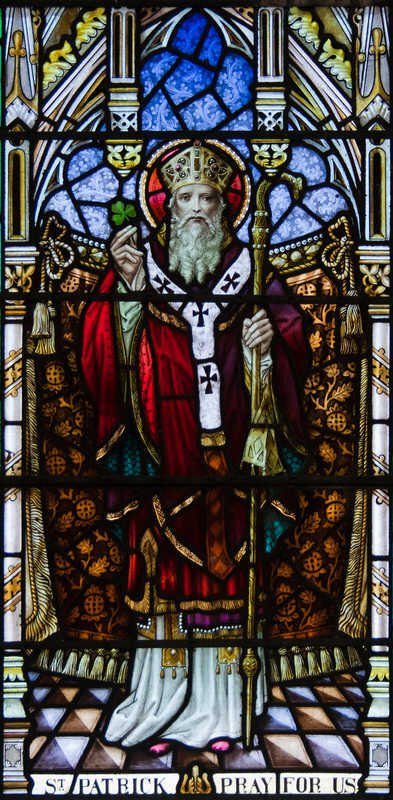
So I want to present about bitcoin to non coiners (Christian). I have an hour. I’m not the best speaker so I’m looking to play a video. What are some videos you’ve seen that really made the case for newbies? Thank you
Excelllent podcast
Good morning friends!
Thursday 7 March 2024
Thursday of the 3rd week of Lent
(optional commemoration of Saints Perpetua and Felicity, Martyrs)
Spiritual Reading
Your Second Reading from the Office of Readings:
Thursday of the 3rd week of Lent
From the treatise On Prayer by Tertullian, priest
The spiritual offering of prayer
Prayer is the offering in spirit that has done away with the sacrifices of old. What good do I receive from the multiplicity of your sacrifices? asks God. I have had enough of burnt offerings of rams, and I do not want the fat of lambs and the blood of bulls and goats. Who has asked for these from your hands?
What God has asked for we learn from the Gospel. The hour will come, he says, when true worshippers will worship the Father in spirit and in truth. God is a spirit, and so he looks for worshippers who are like himself.
We are true worshippers and true priests. We pray in spirit, and so offer in spirit the sacrifice of prayer. Prayer is an offering that belongs to God and is acceptable to him: it is the offering he has asked for, the offering he planned as his own.
We must dedicate this offering with our whole heart, we must fatten it on faith, tend it by truth, keep it unblemished through innocence and clean through chastity, and crown it with love. We must escort it to the altar of God in a procession of good works to the sound of psalms and hymns. Then it will gain for us all that we ask of God.
Since God asks for prayer offered in spirit and in truth, how can he deny anything to this kind of prayer? How great is the evidence of its power, as we read and hear and believe.
Of old, prayer was able to rescue from fire and beasts and hunger, even before it received its perfection from Christ. How much greater then is the power of Christian prayer. No longer does prayer bring an angel of comfort to the heart of a fiery furnace, or close up the mouths of lions, or transport to the hungry food from the fields. No longer does it remove all sense of pain by the grace it wins for others. But it gives the armour of patience to those who suffer, who feel pain, who are distressed. It strengthens the power of grace, so that faith may know what it is gaining from the Lord, and understand what it is suffering for the name of God.
In the past prayer was able to bring down punishment, rout armies, withhold the blessing of rain. Now, however, the prayer of the just turns aside the whole anger of God, keeps vigil for its enemies, pleads for persecutors. Is it any wonder that it can call down water from heaven when it could obtain fire from heaven as well? Prayer is the one thing that can conquer God. But Christ has willed that it should work no evil, and has given it all power over good.
Its only art is to call back the souls of the dead from the very journey into death, to give strength to the weak, to heal the sick, to exorcise the possessed, to open prison cells, to free the innocent from their chains. Prayer cleanses from sin, drives away temptations, stamps out persecutions, comforts the fainthearted, gives new strength to the courageous, brings travellers safely home, calms the waves, confounds robbers, feeds the poor, overrules the rich, lifts up the fallen, supports those who are falling, sustains those who stand firm.
All the angels pray. Every creature prays. Cattle and wild beasts pray and bend the knee. As they come from their barns and caves they look out to heaven and call out, lifting up their spirit in their own fashion. The birds too rise and lift themselves up to heaven: they open out their wings, instead of hands, in the form of a cross, and give voice to what seems to be a prayer.
What more need be said on the duty of prayer? Even the Lord himself prayed. To him be honour and power for ever and ever. Amen.
________
Other choices for today:
Saints Perpetua and Felicity, Martyrs
The martyrdom of Perpetua, Felicity and others, from the Menologion of Basil II, c.1000.
From the story of the death of the holy martyrs of Carthage
Called and chosen for the glory of the Lord
The day of the martyrs’ victory dawned. They marched from their cells into the amphitheatre, as if into heaven, with cheerful looks and graceful bearing. If they trembled it was for joy and not for fear.
Perpetua was the first to be thrown down, and she fell prostrate. She got up and, seeing that Felicity was prostrate, went over and reached out her hand to her and lifted her up. Both stood up together. The hostility of the crowd was appeased, and they were ordered to the gate called Sanavivaria. There Perpetua was welcomed by a catechumen named Rusticus. Rousing herself as if from sleep (so deeply had she been in spiritual ecstasy), she began to look around. To everyone’s amazement she said: “When are we going to be led to the beast?” When she heard that it had already happened she did not at first believe it until she saw the marks of violence on her body and her clothing. Then she beckoned to her brother and the catechumen, and addressed them in these words: “Stand firm in faith, love one another and do not be tempted to do anything wrong because of our sufferings.”
Saturus, too, in another gate, encouraged the soldier Pudens, saying: “Here I am, and just as I thought and foretold I have not yet felt any wild beast. Now believe with your whole heart: I will go there and be killed by the leopard in one bite.” And right at the end of the games, when he was thrown to the leopard he was in fact covered with so much blood from one bite that the people cried out to him: “Washed and saved, washed and saved!” And so, giving evidence of a second baptism, he was clearly saved who had been washed in this manner.
Then Saturus said to the soldier Pudens: “Farewell, and remember your faith as well as me; do not let these things frighten you; let them rather strengthen you.” At the same time he asked for the little ring from Pudens’s finger. After soaking it in his wound he returned it to Pudens as a keepsake, leaving him a pledge and a remembrance of his blood. Half dead, he was thrown along with the others into the usual place of slaughter.
The people, however, had demanded that the martyrs be led to the middle of the amphitheatre. They wanted to see the sword thrust into the bodies of the victims, so that their eyes might share in the slaughter. Without being asked they went where the people wanted them to go; but first they kissed one another, to complete their witness with the customary kiss of peace.
The others stood motionless and received the deathblow in silence, especially Saturus, who had gone up first and was first to die; he was helping Perpetua. But Perpetua, that she might experience the pain more deeply, rejoiced over her broken body and guided the shaking hand of the inexperienced gladiator to her throat. Such a woman – one before whom the unclean spirit trembled – could not perhaps have been killed, had she herself not willed it.
Bravest and happiest martyrs! You were called and chosen for the glory of our Lord Jesus Christ.

Saturday after Ash Wednesday
From the treatise "Against the Heresies" by St Irenaeus
The friendship of God
Our Lord, the Word of God, first drew men to God as servants, but later he freed those made subject to him. He himself testified to this: I do not call you servants any longer, for a servant does not know what his master is doing. Instead I call you friends, since I have made known to you everything that I have learned from my Father. Friendship with God brings the gift of immortality to those who accept it.
In the beginning God created Adam, not because he needed man, but because he wanted to have someone on whom to bestow his blessings. Not only before Adam but also before all creation, the Word was glorifying the Father in whom he dwelt, and was himself being glorified by the Father. The Word himself said: Father, glorify me with that glory I had with you before the world was.
Nor did the Lord need our service. He commanded us to follow him, but his was the gift of salvation. To follow the Saviour is to share in salvation; to follow the light is to enjoy the light. Those who are in the light do not illuminate the light but are themselves illuminated and enlightened by the light. They add nothing to the light; rather, they are beneficiaries, for they are enlightened by the light.
The same is true of service to God: it adds nothing to God, nor does God need the service of man. Rather, he gives life and immortality and eternal glory to those who follow and serve him. He confers a benefit on his servants in return for their service and on his followers in return for their loyalty, but he receives no benefit from them. He is rich, perfect and in need of nothing.
The reason why God requires service from man is this: because he is good and merciful he desires to confer benefits on those who persevere in his service. In proportion to God’s need of nothing is man’s need for communion with God.
This is the glory of man: to persevere and remain in the service of God. For this reason the Lord told his disciples: You did not choose me but I chose you. He meant that his disciples did not glorify him by following him, but in following the Son of God they were glorified by him. As he said: I wish that where I am they also may be, that they may see my glory.
**** Note how old the above writing is, how long ago he lived and how God used him, a Bishop, to help define the books of the New Testament…the Church predates the Bible and comes forth from her
About the author of the Second Reading in today's Office of Readings:
Second Reading: St Irenaeus (130 - 202)
Irenaeus was born in Smyrna, in Asia Minor (now Izmir in Turkey) and emigrated to Lyons, in France, where he eventually became the bishop. It is not known for certain whether he was martyred or died a natural death.
Whenever we take up a Bible we touch Irenaeus’s work, for he played a decisive role in fixing the canon of the New Testament. It is easy for people nowadays to think of Scripture – and the New Testament in particular – as the basis of the Church, but harder to remember that it was the Church itself that had to agree, early on, about what was scriptural and what was not. Before Irenaeus, there was vague general agreement on what scripture was, but a system based on this kind of common consent was too weak. As dissensions and heresies arose, reference to scripture was the obvious way of trying to settle what the truth really was, but in the absence of an agreed canon of scripture it was all too easy to attack one’s opponent’s arguments by saying that his texts were corrupt or unscriptural; and easy, too, to do a little fine-tuning of texts on one’s own behalf. Irenaeus not only established a canon which is almost identical to our present one, but also gave reasoned arguments for each inclusion and exclusion.
Irenaeus also wrote a major work, Against the Heresies, which in the course of denying what the Christian faith is not, effectively asserts what it is. The majority of this work was lost for many centuries and only rediscovered in a monastery on Mount Athos in 1842. Many passages from it are used in the Office of Readings.
Ash Wednesday
Grant, O Lord, that we may begin with holy fasting
this campaign of Christian service,
so that, as we take up battle against spiritual evils,
we may be armed with weapons of self-restraint.
Ash Wednesday
From a letter of Pope St Clement I to the Corinthians
Repent
Let us fix our attention on the blood of Christ and recognise how precious it is to God his Father, since it was shed for our salvation and brought the grace of repentance to all the world.
If we review the various ages of history, we will see that in every generation the Lord has offered the opportunity of repentance to any who were willing to turn to him. When Noah preached God’s message of repentance, all who listened to him were saved. Jonah told the Ninevites they were going to be destroyed, but when they repented, their prayers gained God’s forgiveness for their sins, and they were saved, even though they were not of God’s people.
Under the inspiration of the Holy Spirit, the ministers of God’s grace have spoken of repentance; indeed, the Master of the whole universe himself spoke of repentance with an oath: As I live, says the Lord, I do not wish the death of the sinner but his repentance. He added this evidence of his goodness: House of Israel, repent of your wickedness. Tell the sons of my people: If their sins should reach from earth to heaven, if they are brighter than scarlet and blacker than sackcloth, you need only turn to me with your whole heart and say, “Father,” and I will listen to you as a holy people.
In other words, God wanted all his beloved ones to have the opportunity to repent and he confirmed this desire by his own almighty will. That is why we should obey his sovereign and glorious will and prayerfully entreat his mercy and kindness. We should be suppliant before him and turn to his compassion, rejecting empty works and quarrelling and jealousy which only lead to death.
Brothers, we should be humble in mind, putting aside all arrogance, pride and foolish anger. Rather, we should act in accordance with the Scriptures, as the Holy Spirit says: The wise man must not glory in his wisdom nor the strong man in his strength nor the rich man in his riches. Rather, let him who glories glory in the Lord by seeking him and doing what is right and just. Recall especially what the Lord Jesus said when he taught gentleness and forbearance. Be merciful, he said, so that you may have mercy shown to you. Forgive, so that you may be forgiven. As you treat others, so you will be treated. As you give, so you will receive. As you judge, so you will be judged. As you are kind to others, so you will be treated kindly. The measure of your giving will be the measure of your receiving.
Let these commandments and precepts strengthen us to live in humble obedience to his sacred words. As Scripture asks: Whom shall I look upon with favour except the humble, peaceful man who trembles at my words?
Sharing then in the heritage of so many vast and glorious achievements, let us hasten towards the goal of peace, set before us from the beginning. Let us keep our eyes firmly fixed on the Father and Creator of the whole universe, and hold fast to his splendid and transcendent gifts of peace and all his blessings.

Friday 2 February 2024
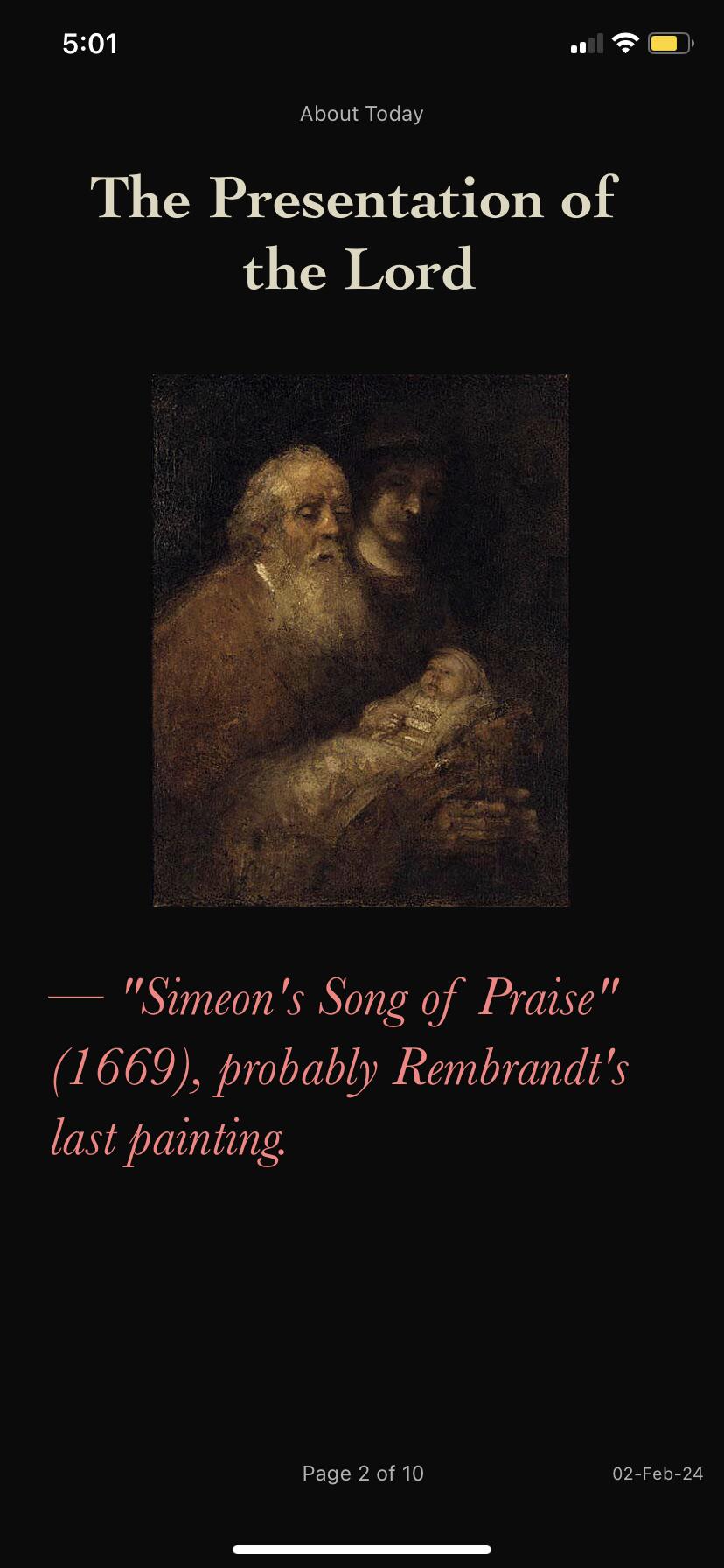
The Presentation of the Lord - Feast
From a sermon by Saint Sophronius, bishop
Let us receive the light whose brilliance is eternal
In honour of the divine mystery that we celebrate today, let us all hasten to meet Christ. Everyone should be eager to join the procession and to carry a light.
Our lighted candles are a sign of the divine splendour of the one who comes to expel the dark shadows of evil and to make the whole universe radiant with the brilliance of his eternal light. Our candles also show how bright our souls should be when we go to meet Christ.
The Mother of God, the most pure Virgin, carried the true light in her arms and brought him to those who lay in darkness. We too should carry a light for all to see and reflect the radiance of the true light as we hasten to meet him.
The light has come and has shone upon a world enveloped in shadows; the Dayspring from on high has visited us and given light to those who lived in darkness. This, then, is our feast, and we join in procession with lighted candles to reveal the light that has shone upon us and the glory that is yet to come to us through him. So let us hasten all together to meet our God.
The true light has come, the light that enlightens every man who is born into this world. Let all of us, my brethren, be enlightened and made radiant by this light. Let all of us share in its splendour, and be so filled with it that no one remains in the darkness. Let us be shining ourselves as we go together to meet and to receive with the aged Simeon the light whose brilliance is eternal. Rejoicing with Simeon, let us sing a hymn of thanksgiving to God, the Father of the light, who sent the true light to dispel the darkness and to give us all a share in his splendour.
Through Simeon’s eyes we too have seen the salvation of God which he prepared for all the nations and revealed as the glory of the new Israel, which is ourselves. As Simeon was released from the bonds of this life when he had seen Christ, so we too were at once freed from our old state of sinfulness.
By faith we too embraced Christ, the salvation of God the Father, as he came to us from Bethlehem. Gentiles before, we have now become the people of God. Our eyes have seen God incarnate, and because we have seen him present among us and have mentally received him into our arms, we are called the new Israel. Never shall we forget this presence; every year we keep a feast in his honour.
Why does everything cost so much? https://video.nostr.build/c0a5be886b34258ea48f6e95c5e1f7f8036e7c1947706d979df07160a5c8fe57.mp4
Saw this online and appreciated this message, from my Archbishop:
https://www.facebook.com/share/r/DvHCRwnCgNBeDJoU/?mibextid=UalRPS