Need to provide a lot more information about what people are should expect when you're inviting them to something like this.
Just a login and (demands for | questions about) sharing camera and microphone feeds is rather disconcerting.
Should offer a link to a page describing the project and service.
I meant to type "wouldn't be even worse?"
I cannot see a scenario where the U.S. federal government wouldn't use a CBDC (Central Bank Digital Currency) to eventually exert far more insidious control over its users (citizens and others) than they could ever manage to impose on private corporations (especially international institutions).
They'll offer "better security" (backed by military force and the power of the state to collect taxes, tariffs, and fees) and lower volatility (but with 2% "target official inflation" (and the hidden debasement of quantitative "easing" and issuance of T-bills.
It'll be the same scams in most regards — just delivered cryptographically for greater efficiency and (their) convenience.


And you think U.S. governmentally created (mandated?) CBDC would be even worse? And considerably less transparent?
What's your actual thesis here?
Which "they?" How much can "they" do so without court orders?
Enable all manner of surveillance and seizure that pesky court orders to private institutions would hamper.

Personally I think it's the best approach to scaling Bitcoin beyond the single main blockchain (and increasing the capacity of Lightning even beyond the limits of a single chain for liquidity/channel management.
I say this not because I work for them. I work for them because I think it's the case.

The "PIN Oracle server" is the service that unlocks your Jade using your PIN while preventing it from being brute force attacked (by cracking open the hardware and connecting some custom electronics.
I don't think Blockstream's website nor PIN Oracle was dependent on any service related to Clowdstrike. But maybe it was something else in your infrastructure or on your system.
Or maybe CloudFlare or Amazon's or Google's CDNs (content delivery networks) were impacted by the Cloudstrike outage. I don't know which of these CDNs are used by Blockstream for their website. (Pretty sure the PIN Oracle would not be behind any CDN).

nostr:npub1jg552aulj07skd6e7y2hu0vl5g8nl5jvfw8jhn6jpjk0vjd0waksvl6n8n nostr:npub1nyyhnqahf3cgqzcc927x7eqyd2msgplfe27ddn6hpgu2m200wh2s0s7gan is a federated side chain for Bitcoin. It's built over Elements, source which was derived from Bitcoin-core (the free code upon which the Bitcoin main blockchain was built and which still powers the vast majority of Bitcoin full nodes).
What does all that mean?
Mostly it provides an infrastructure for managing ₿ liquidity while overcoming many of the limitations and issues with performing transactions on the main blockchain, but also while maintaining a security, custody, and transaction processing model as close to Bitcoin's as possible and without additional the complexity, costs, and risks, of a separately exchanged (floating valuation) token.
Which limitations and issues?
Bitcoin transactions on the main chain take, on average, 10 minutes to be processed from the (peer-to-peer) mempool through a miner and into a block on the blockchain.
It's generally considered prudent to wait for at least six blocks of confirmation before treating a transaction as "settled" (no longer subject to the risk of a block re-organization or "double spend" cancellation).
Thus transaction settlement is likely to take an hour, and may take twice that in some cases.
Also this assumes that the transaction is among those to be selected for the first available block. But other transactions may be offering higher fee rates; thus Bitcoin transaction processing is effectively an ongoing auction for space in any upcoming block. Lower bids can take much longer (days, even up to two weeks, to be included in a block (processed to that first level of confirmation). Block congestion can make urgent transactions cost over 10x the fees of the low bidders.
Overall, transactions on the main chain can be slow, expensive, and offer relatively high uncertainty with regards to settlement delays.
The Lightning Network (LN) can provide means to alleviate some of these issues. But it's far more complex than the Bitcoin main chain and somewhat more complex than simple Bitcoin transactions over Liquid™.
To use LN you (and your counter parties — anyone you wish to transact with) must establish and maintain liquidity. That means you have to perform some special transactions on the main Bitcoin blockchain in the form of smart contracts which lock some quantities of Bitcoin funds for outbound and inbound usage.
That generally requires at least one on-chain transaction. But, without Liquid™, managing your LN liquidity (adding funds or moving funds to save self custody storage, removing it from being committed to those smart contracts, would also require (potentially slow, relatively expensive) on chain transactions.
How does Elements/Liquid solve these issues?
Using a wallet or other tools with Liquid support, you can conduct your transactions on the side chain directly (if your counter party accepts L-BTC, the Liquid asset tokens which are pegged 1:1 against BTC on the main chain.
You can exchange Bitcoin for L-BTC through many exchanges you're an advanced user, you could peg in your satoshis and claim the equivalent number of L-BTC sats (less any fees).
Transactions on the Liquid side chain are almost always processed in on minute and can be considered settlement after just two confirmations.
Liquid functionaries use HSMs, hardware signing modules, in lieu of "proof-of-work" (PoW) mining to construct new blocks of transactions. So, no "wasted" energy; but, more importantly, much less variability in the block issuance cadence.
Also the fee rates on Liquid are measured in centi-satoshis — a hundredth of those on the main chain.
By itself this wouldn't provide much value until there was wide enough adoption of Liquid L-BTC to ensure that you could usually do your transactions using it directly.
But, there are services, such as nostr:npub1psm37hke2pmxzdzraqe3cjmqs28dv77da74pdx8mtn5a0vegtlas9q8970 and Changelly which maintain liquidity on Liquid, the main Bitcoin blockchain, and in LN channels. So these can be used to resolve most of the liquidity management issues for LN.
Also you can arrange with some exchanges and services to accumulate your Bitcoin in smaller transactions as L-BTC (on the side chain, but in your own wallet — so self-custodied throughout). Then you can exchange more substantial amounts back out to the main chain (keeping it in self custody — perhaps on a hardware wallet securely stored in a vault or safe deposit box throughout the process).
(Remember you can direct payments to newly generated addresses (Bitcoin or Liquid]) without touching your wallet in cold storage. You export a wallet descriptor (xpub, ypub, zpub "key") and the "read only" wallet you import that into can securely generate new payment addresses while not exposing your funds to any risk of theft or misappropriation).
This all may sound complicated. But mostly it's just a few "tricks" of using the wallets with Liquid L-BTC support and using liquidity exchange services when doing so will save time and on fees over doing those transactions on the main blockchain.
The main Bitcoin blockchain and mempool will get more congested (and much more expensive to use) as Bitcoin becomes more successful — as it advances towards global adoption. That's a necessary aspect of its design and of the security and censorship resistance tradeoffs that were baked into its implementation.
Liquid provides infrastructure to mitigate these eventualities. Eventually it's likely that there will be a mesh of transparently interoperable Elements/Liquid side chains to support the scalability that global Bitcoin adoption will require. (Lightning over Liquid™ — LoL — has already been implemented and demonstrated as a technology so it's available long before there's demand for it).
Liquid was intentionally designed to operate almost identically to Bitcoin's core and it's a permission-less system in the same ways that Bitcoin is (except that there's no "mining" on the side chain). Integration of Liquid support by developers of Bitcoin wallets and other tooling has been described (by most of those who have done it) as easy, almost trivial.
On top of all that, Liquid offer many features which are not available on the main blockchain.
But you probably already so lots of information about those on the website.
Regarding the shots taken at Trump, resulting in one audience member behind him dead, two wounded, and the shooter, a sniper on a roof apparently less than 100 meters away, shot by counter snipers.
I've now given a bit of thought to the "false flag" … "if was all staged" scenario.
It's not plausible.
But it will be almost impossible to allay such concerns. This helps support a false equivalence between supposed left wing conspiracy theories and Qanon.
If I were writing an action thriller around these events, I would do it like so:
Master mind (some like Gen. Mike Flynn or a Putin operative who has successfully maintained the secret of his, or her, identity) recruiting four co-conspirators.
Only one of those is in on the whole plot.
One other is a patsy, the others get duped into it thinking that it was just going to be a campaign publicity stunt.
Patsy is a unknown, random, Trump supporter and espionage wannabe. Convinced to snipe from a rooftop and deliberately miss, intentionally hitting (wound or kill, doesn't matter) a random person behind Trump.
They're convinced they're going to get away. Our master mind shows them the getaway plan and sells it (perhaps with the true co-conspirator — the shooter's shooter — posing as getaway accomplice).
The true co-conspirator is either a secret service agent who shoots the patsy, or a second sniper using the efforts of the actual anti-sniper, counter-sniper unit to cover his, or her, shots supplied with the exact same ammo as the anti-snipers).
One of the duped accessories must be close in with Trump's security detail, supplied with a trick ring or other device with a tiny, short, razor blade. He bloodies Trump's ear during the scuffle (after shots fired).
This avoids the risk of the (patsy) sniper having to graze Trump with a real bullet. Trump could be depicted, in my hypothetical story, as the one to cause the superficial but photogenic injury. He was around pro-wrestling kayfabe enough to understand that.
The last accessory is the attending physician — to ignore the discrepancies between intentionally inflicted razor bloodying and grazing from a real bullet.
Might actually be instructed to alter the injury to it would pass third party (cursory) review.
Only the mastermind and the shooter's shooter need to be in on the whole plot up front.
Everyone else is a patsy (dead afterwards) or duped into participating in "just a stunt" and then locked in as accessory to murder among other charges after the member of the crowd is shot by the patsy.
This is all far more plausible than most popular fiction, and perhaps more plausible than a shooter really only barely grazing Trump's ear from only 100 meters or so away, on a clear day, with clear line of sight to target. (I shoot better than that without any formal training!)
これのために得る翻訳は奇妙に聞こえます:「祖母が作った女の子を着ています。」
もっと慣用的な解釈はありますか?

The translation I get for this sounds odd: "I'm wearing the girl made by my grandmother."
Is there a more idiomatic interpretation?

Get your coins off exchange to self-custody!
Hardwarewallet Blockstream
#Jade
Coupon code: JOKHODL
-10% discount on all store hardware wallet and metal backup😍
store.blockstream.com
#Hardwarewallet ⚡️
🧡 #Bitcoin
#Blockstreamjade
Not your keys , not your coins.
store.blockstream.com/products/block… 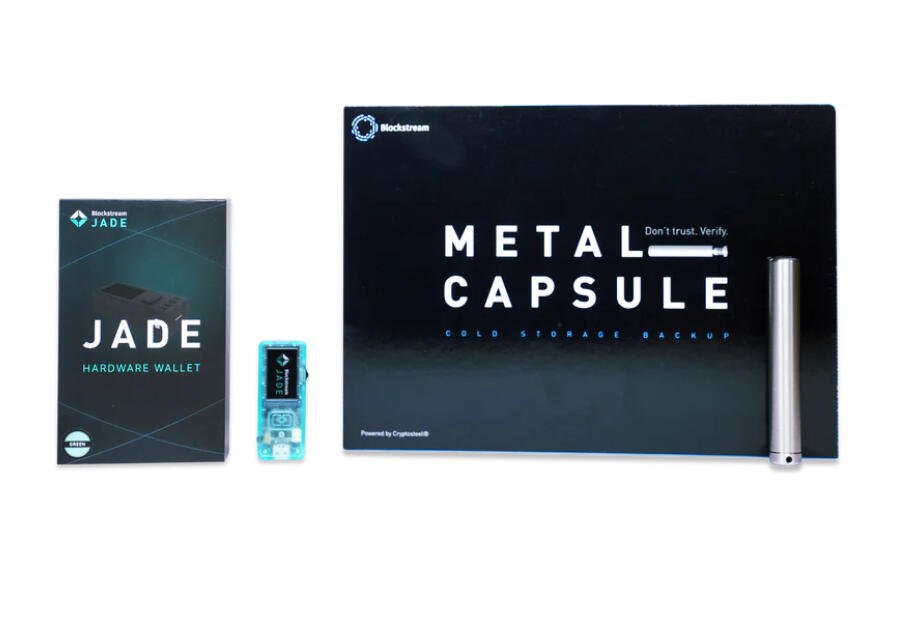 https://video.nostr.build/00919ce3554fd6b2373ad1eb791abc670fa469403a4aa2cf4aace86f868b8d1e.mp4
Also it's worth considering deriving the seeds for any mobile or desktop wallets from your Jade (using the BIP85 support in the firmware).
This allows you to safely leverage one Metal™ or Capsule™ recovery mnemonic device to backup all your wallets. (Recovery process is simply: recover to any Jade™ then re-derive seeds — as subordinate recovery mnemonics — at each index you've used; so just keep track of the mapping of wallet to BIP85 index numbers).
These same seeds (master and derived) can each be used for Bitcoin main chain and Liquid™ single sig and multi-factor wallets.

Barely enough to taste it. Less salty than sweat.

I've read that "straining on the pot" is an apt description of the technique that figher pilots are trained in as part of developing their ability to withstand high G-force maneuvers without blacking out.
Laugh all you like. But that shit is serious. Their lives depend on it in some combat scenarios — and lives are lost if they're too dignified to do it regardless of how it looks.
What would it take for nostr:npub18m76awca3y37hkvuneavuw6pjj4525fw90necxmadrvjg0sdy6qsngq955 to support the iPadOS/iOS [Share] feature that's common in various other apps?
For example in Duolingo I can "share" an achievement to 𝕏 or Meta/Facebook like I did here:
https://x.com/answrguy/status/1731771579049320641
Also, what's the best way to share a #NOSTR note or event over the web?
I would love to phase out direct posting to 𝕏 and shift towards posting new content on #NOSTR with links to 𝕏 and other social media. Grow the NOSTR community by guiding my (admittedly not impressive number) of followers towards it.
Basically getting sick of 𝕏's continued decline and was long ago disgusted by Facebook's policies and algorithmic manipulation of my feed.
These are worth pondering:
1. One mark of a smart person is the ability to learn from people they don’t like.
2. The most powerful productivity tool ever invented is simply the word "no."
3. Rich people have money. Wealthy people have time.
4. Writing is often the process by which you realize that you do not understand what you are talking about.
5. 90 percent of success is not getting distracted.
6. Short-term results come from intensity. Long-term results come from consistency.
7. Clear writing gives poor thinking nowhere to hide.
8. The quicker you want something, the easier you are to manipulate.
9. If you want new ideas, read old books.
10. First-principles thinking is a competitive advantage because almost no one does it.
11. Talent and potential mean nothing if you can't consistently do the boring things when you don't feel like doing them.
12. The greatest trap is telling yourself that you’ll do something important tomorrow. Procrastination creates negative momentum.
13. Make your next project something people will ask you about for the rest of your life.
Those are from: https://x.com/1writeofpassage/status/1731300704718123451
I'll add:
* To be successful, learn how to respond to failure.

This is technically the case. But there's a key qualitative difference.
The issuance schedule is hard coded into the consensus rules implemented by all compatible software. It's an exponential (binary) decay function referred to colloquially as the "halvening," (I preferred the term "hardening" as it's easier to pronounce and reflects the benefit rather than simply calling out an implementation detail).
Every 216,000 blocks (four years, give are take some variance on a Poisson distribution) the reward gets cut in half. The exponential of the divisor is incremented.
So, sometime next April the block mining reward, the issuance rate, will go from 6.25₿ to 3.125₿ and annualized monetary inflation will drop to less than the U.S. Fed target. It will be much lower than real monetary inflation for any fiat currency.
What's the current annual increase global gold supply, as a percentage of total known reserves?

As I said, I've got a whole multiverse setting in which I spend much of my daydreaming time. This idea emerges from that as a nugget that small enough, cohesive enough to toss out there for any and all to make their own.
Definitely would prefer for folks to not try to trademark the Ægobots neologism, though. That actually does fit in with a recurring theme in my as-yet unpublished corpus.