
Bitcoin Audible Read_811 - Speaking Freely by nostr:npub1dergggklka99wwrs92yz8wdjs952h2ux2ha2ed598ngwu9w7a6fsh9xzpc
nostr:npub1h8nk2346qezka5cpm8jjh3yl5j88pf4ly2ptu7s6uu55wcfqy0wq36rpev
🤙
Making the Case for Private Law and Defense From Scratch


We should strive for the separation of Money and State, rather than pursuing better money for the State.
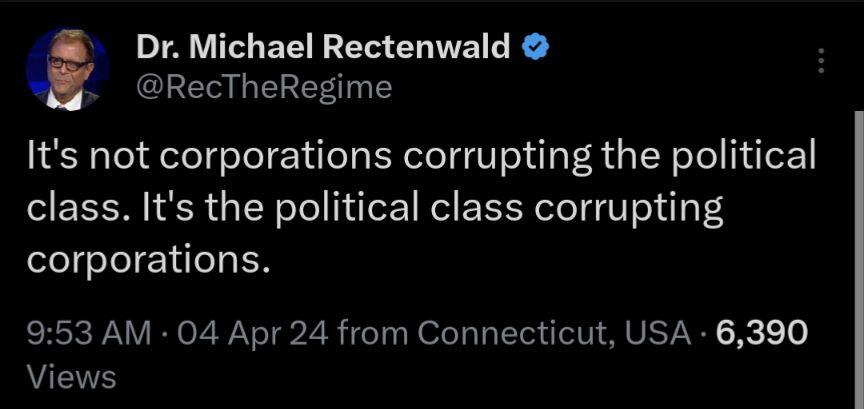
Government regulation and intervention in the market create opportunities for politicians to extract benefits from businesses, thereby leading to corruption.
The state has a monopoly on the use of force, which enables it to impose regulations and laws on businesses. These regulations can create barriers to entry, restrict competition, and protect incumbent firms, all of which benefit established corporations at the expense of consumers and new entrants. In order to gain favorable treatment or avoid punitive measures, corporations may feel compelled to make campaign contributions, hire lobbyists, or provide other incentives to politicians. This creates a system of crony capitalism, where politically connected businesses are able to secure advantages over their competitors through influence peddling rather than through superior products or services.
While corporations may indeed engage in corrupt practices, the root cause of the problem lies in the coercive nature of the state and its ability to regulate the economy. By creating a system of privilege and protectionism, the political class invites corruption and undermines the functioning of markets. We must advocate for the complete abolition of the state and the establishment of voluntary, competitive systems for resolving disputes and protecting property rights, which would minimize opportunities for corruption and lead to more efficient and just outcomes.
Self-ownership is the cornerstone of freedom; without it, every other liberty we cherish begins to crumble.

The Intellectual Humility of the Spontaneous Order
My latest from Mises
https://mises.org/mises-wire/intellectual-humility-spontaneous-order
The insights of methodological individualism and subjective valuation remind us to place the individual at the forefront of our analysis and to respect the diversity of human experiences and preferences. Moreover, the role of prices in coordinating economic activity highlights the importance of allowing markets to function freely, unencumbered by government intervention.
The Intellectual Humility of the Spontaneous Order
My latest from Mises
https://mises.org/mises-wire/intellectual-humility-spontaneous-order
"the recognition of the insuperable limits to his knowledge ought indeed to teach the student of society a lesson of humility which should guard him against becoming an accomplice in men’s fatal striving to control society."

The Intellectual Humility of the Spontaneous Order
My latest from Mises
https://mises.org/mises-wire/intellectual-humility-spontaneous-order
The concept of spontaneous order highlights the fascinating phenomenon in which complex patterns and structures emerge from the interactions of numerous individuals, without being orchestrated by a central authority or designer. This idea posits that decentralized decision-making, rather than top-down control, plays a crucial role in shaping social and economic phenomena. As Friedrich von Hayek astutely observed, “The curious task of economics is to demonstrate to men how little they really know about what they imagine they can design.”
At its foundation, spontaneous order is not merely a theoretical construct but a philosophical perspective that emphasizes the importance of humility in understanding human affairs. Recognizing the limitations of human knowledge and cognitive abilities, spontaneous order acknowledges that it is impossible to fully comprehend or direct the intricate nature of social interactions. Instead, spontaneous order arises from the cumulative actions of individuals reacting to incentives and expressing their personal preferences within a framework of well-defined property rights.
The Intellectual Humility of the Spontaneous Order
My latest from Mises
https://mises.org/mises-wire/intellectual-humility-spontaneous-order
The market process is an operational choreography too vast for any single mind to comprehend fully. Yet this incomprehensibly complex order unfurls spontaneously from the invisible hand of decentralized social cooperation among countless free individuals. To insist on a central plan is to abandon the very concept of the spontaneous order that arises from human liberty.


The Intellectual Humility of the Spontaneous Order
My latest from Mises
https://mises.org/mises-wire/intellectual-humility-spontaneous-order
Statists demand that proponents of the free market explain in painstaking detail how every conceivable service would be provided without the heavy hand of government coercion. How would law be administered? How would security be maintained? How would charity and education function? And of course, the tiresome refrain—who will build the roads? While Austrian economists have offered satisfactory answers to these questions, entertaining them may project a fundamental misunderstanding of the nature of the free market itself.
The Austrian insight into spontaneous order transcends the realm of mere economic theory, representing a profound epistemological paradigm shift. It rejects the hubristic notion that human reason can fully comprehend, let alone control, the complexities of social cooperation. It is a worldview rooted in reverence for individual liberty as the indispensable catalyst for the wondrous emergence of spontaneous order in society.
The Intellectual Humility of the Spontaneous Order
My latest from Mises
https://mises.org/mises-wire/intellectual-humility-spontaneous-order




Domestic Imperialism w/ Keith Knight & Dave Smith
The Economics of Generosity and Charity
