

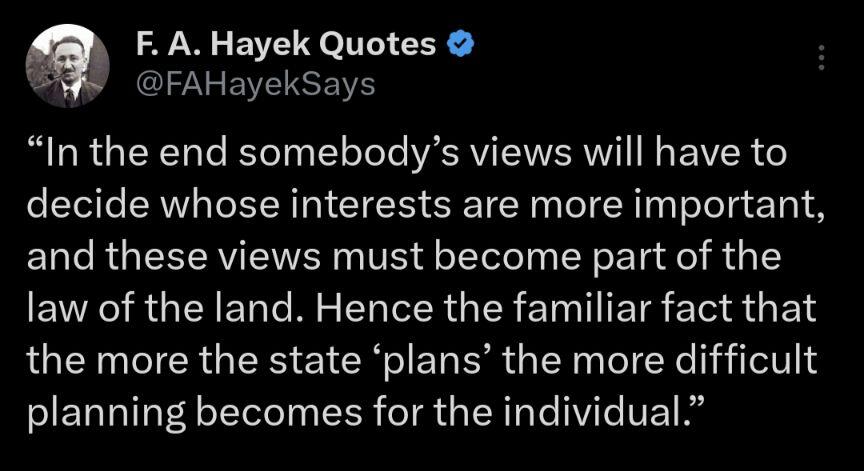
"the chief task of the rulers is always to secure the active or resigned acceptance of the majority of the citizens.
For the masses of men do not create their own ideas, or indeed think through these ideas independently; they follow passively the ideas adopted and disseminated by the body of intellectuals. The intellectuals are, therefore, the “opinion-molders” in society. And since it is precisely a molding of opinion that the State most desperately needs, the basis for age-old alliance between the State and the intellectuals becomes clear.”
- Rothbard



If you wear pants you are an advocate for privacy.

Bitcoin Audible Read_815 - What are Mises's Six Lessons
nostr:npub1h8nk2346qezka5cpm8jjh3yl5j88pf4ly2ptu7s6uu55wcfqy0wq36rpev
🤙

The compliance-driving hypnotists will tell you we must ask permission from our local governing offices for an embracement of bitcoin. So that we can pay our taxes in bitcoin and service our legal debts.
Bitcoin is a tool of empowerment and Bitcoin is for enemies. Well, now our enemy, the state, is empowered, and their regulatory goons are barking like wolves at the gate. We must stay clever, and arm ourselves with the rhetoric needed for the oncoming onslaught against those that dare to build tools that threaten the spellings of the state.
Writing code is not a crime.

This is what regulatory clarity looks like.
Libertarianism realizes that only the self-ownership rule is universalizable and compatible with the goals of peace, cooperation, and conflict avoidance. We recognize that each person is prima facie the owner of his own body because, by virtue of his unique link to and connection with his own body -- his direct and immediate control over it -- he has a better claim to it than anyone else.
~ Stephan Kinsella
"The libertarian creed rests upon one central axiom: that no man or group of men may aggress against the person or property of anyone else. This may be called the "nonaggression axiom." "Aggression" is defined as the initiation of the use or threat of physical violence against the person or property of anyone else. Aggression is therefore synonymous with invasion." - Rothbard
In other words, libertarians maintain that the only way to violate rights is by initiating force that is, by committing aggression. (Libertarianism also holds that, while the initiation of force against another person's body is impermissible, force used in response to aggression -- such as defensive, restitutive, or retaliatory/punitive force -- is justified. Now in the case of the body, it is clear what aggression is: invading the borders of someone's body, commonly called battery, or, more generally, using the body of another without his or her consent. The very notion of interpersonal aggression presupposes property rights in bodies -- more particularly, that each person is, at least prima facie, the owner of his own body.
Non-libertarian political philosophies have a different view. In these systems, each person has some limited rights in his own body, but not complete or exclusive rights. Society or the state, purporting to be society's agent, has certain rights in each citizen's body, too. This partial slavery is implicit in state actions and laws such as taxation, conscription, and drug prohibitions. The libertarian says that each person is the full owner of his body: he has the right to control his body, to decide whether or not he ingests narcotics, joins an army, pays taxes, and so on. Those various non-libertarians who endorse any such state prohibitions, however, necessarily maintain that the state, or society, is at least a partial owner of the body of those subject to such laws -- or even a complete owner in the case of conscriptees or non-aggressor "criminals" incarcerated for life or executed.
Libertarians believe in self-ownership. Non-libertarians -- statists -- of all stripes advocate some form of slavery.
~ Stephan Kinsella
Libertarians tend to agree on a wide array of policies and principles. Nonetheless it is not easy to find consensus on what libertarianism's defining characteristic is, or on what distinguishes it from other political theories and systems.
Various formulations abound. It is said that libertarianism is about: individual rights; property rights; the free market; capitalism; justice; the nonaggression principle. Not all these will do, however. Capitalism and the free market describe the catallactic conditions that arise or are permitted in a libertarian society, but do not encompass other aspects of libertarianism. And individual rights, justice, and aggression collapse into property rights. As Murray Rothbard explained, individual rights are property rights. And justice is just giving someone his due -- which, again, depends on what his rights are.
The nonaggression principle is also dependent on property rights, since what aggression is depends on what our (property) rights are. If you hit me, it is aggression because I have a property right in my body. If I take from you the apple you possess, this is trespass, aggression, only because you own the apple. One cannot identify an act of aggression without implicitly assigning a corresponding property right to the victim.
So, as descriptive terms for our political philosophy, capitalism and the free market are too narrow, and justice, individual rights, and aggression all boil down to, or are defined in terms of, property rights.
What of property rights, then? Is this what differentiates libertarianism from other political philosophies -- that we favor property rights, and all others do not? Surely such a claim is untenable. After all, a property right is simply the exclusive right to control a scarce resource -- what I often refer to now as conflictable resources. Property rights specify which persons own -- have the right to control -- various scarce resources in a given region or jurisdiction. Yet everyone and every political theory advances some theory of property. None of the various forms of socialism deny property rights; each socialism will specify an owner for every scarce resource. If the state nationalizes an industry it is asserting ownership of these means of production. If the state taxes you, it is implicitly asserting ownership of the funds taken. If my land is transferred to a private developer by eminent domain statutes, the developer is now the owner. If the law allows a recipient of racial discrimination to sue his employer for a sum of money -- he is the (new) owner of the money. If the state conscripts someone, or imprisons them as the penalty for refusing to serve in the military, or for failure to pay taxes, or for using illegal narcotics, then the state is claiming legal ownership of the person's body.
Protection of and respect for property rights is thus not unique to libertarianism. Every legal system defines and enforces some property rights system. What is distinctive about libertarianism is its particular property assignment rules its view as to who is the owner of each contestable, conflictable resource, and how to determine this.
- Stephan Kinsella
All rational action is in the first place individual action. Only the individual thinks. Only the individual reasons. Only the individual acts.
- Ludwig von Mises
Renato Moicano Cares About His Country More Than Sohrab Ahmari
A Message from the Great Dr. Ron Paul
The question as to what is justice and what constitutes a just society is as old as philosophy itself. Indeed, it arises in everyday life even long before any systematic philosophizing is to begin.
All throughout intellectual history, one prominent answer to this question has been to say that it is “might” that makes “right.” Or more specifically: that what is right or wrong, just or unjust, is unilaterally decreed by a State qua territorial monopolist of violence. The self-contradictory nature of this “decisionist” position, i.e. of “legal positivism,” comes to light once we ask its proponents for a reason or evidence as to why we should believe the proposition that “might makes right” to be true and correct. By virtue of providing any such reason or evidence, however, and thus seeking—ultimately—unanimous agreement regarding the validity of the proposition in question, any such proponent implicitly acknowledges the presence of other reasonable and sensible persons and, importantly, that the question of right or wrong, true or not-true, then, is not a matter of “might” or “fiat,” but a question to be decided on the basis of common reason and experience instead. Yet reason and experience demonstrate, contrary to the proponent’s initial claim, that “might does not make right.” That “might is might” and “right is right,” but “no might can ever make a right.”
https://mises.org/mises-wire/foreword-legal-foundations-free-society
How Court Historians Turn Political Villains into Heroes
Seditious Conspiracy: A Fake Crime and a Danger to Free Speech
