
(Btw ALARA to me, just like the 'precautionary principle' is illogical/meaningless nonsense ... apparently I *do* have some strong opinions on this 😄)
Sidestepping, i just mean, take LNT as true and stick with those guidelines and it's reasonable. Unless you think even LNT is noymt cautious enough?
I'm a former nuclear engineer so I feel *somewhat* comfortable with this topic, and I don't see anything particularly controversial here.
(Linear no-threshold and all that jazz ... we can sidestep those debates).
Where I do sympathise with the general public is that radiation operates entirely outside of the human sensory apparatus, and so there is no inbuilt, instinctive 'feel' for the danger level. It's not irrational to be ... irrationally fearful of it, if you see what I mean :)


Oh yeah 100% they are fine in small enough dose/ye, but saying literally 'x-rays are harmless' would be misleading and dangerous.



I think if I'd been involved in, and making bank off, doing biological/bioweapon experimentation with the CCP, which then spilled over into a global pandemic, I'd probably prefer it if everyone believed it came from animals? And would be keen to promulgate a false narrative that all the experts agreed this was true?
Cover up can be for incompetence and corruption.
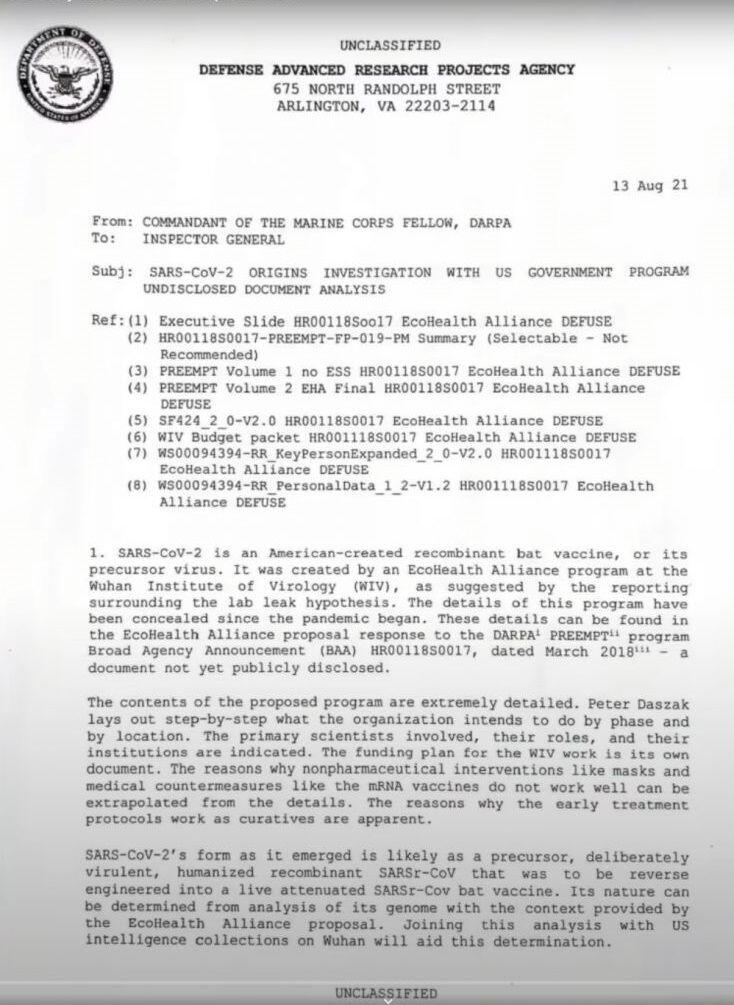
Yes I'm aware of eco health alliance's direct involvement (Daszak et al) and that cover up occurred. It's not the same as there being a conspiracy to unleash it, or the vaccines, on the global population.
I wanted to communicate about this idea of Jeremy Rubin, because I'm not sure how easily people will understand what he's saying:
https://rubin.io/bitcoin/2024/05/29/fed-up-covenants/
An attempt to explain without mathematics: the ability to create an address that can only be spent in one specific transaction (the most basic/pure covenant), but without needing a new op-code or soft fork. How? Basically by taking advantage of a crypto technique called "functional encryption", you can let someone/anyone make a signature to pay out of an address by "decrypting", but the decryption will only work for the single transaction you intend.
There are basically two problems with this apparently magical trick; one small, one big.
The smaller problem: to make this flexible structure needs a trusted setup: you create an initial (bitcoin) private key and an initial encryption key, and they must deleted at the end of the setup, otherwise the mechanism described above won't be safe from anyone who knows those keys.
The bigger problem: generalised functional encryption as described here, i.e. "give a decryption key for the output of a general function f, given the encryption of the input of the function" doesn't really exist as far as I know, except in theory. There are papers from the last decade that develop and extend more limited variants, such as "inner product encryption" which implements the idea for only the function of (take the inner product of the input with a given other value/vector), but (*and I could be wrong here) we are a long way from having it at the level where the function could be "schnorr signature of inputs (private key, transaction hash)" (though JR references ECDSA, it seems way more reasonable to go with Schnorr, since it's a simpler formula).
I think the CCP 'manufactured' it from the intrinsic incompetence in their system. Just a surmise, but anyway, I doubt what you're saying is true overall.
I wanted to communicate about this idea of Jeremy Rubin, because I'm not sure how easily people will understand what he's saying:
https://rubin.io/bitcoin/2024/05/29/fed-up-covenants/
An attempt to explain without mathematics: the ability to create an address that can only be spent in one specific transaction (the most basic/pure covenant), but without needing a new op-code or soft fork. How? Basically by taking advantage of a crypto technique called "functional encryption", you can let someone/anyone make a signature to pay out of an address by "decrypting", but the decryption will only work for the single transaction you intend.
There are basically two problems with this apparently magical trick; one small, one big.
The smaller problem: to make this flexible structure needs a trusted setup: you create an initial (bitcoin) private key and an initial encryption key, and they must deleted at the end of the setup, otherwise the mechanism described above won't be safe from anyone who knows those keys.
The bigger problem: generalised functional encryption as described here, i.e. "give a decryption key for the output of a general function f, given the encryption of the input of the function" doesn't really exist as far as I know, except in theory. There are papers from the last decade that develop and extend more limited variants, such as "inner product encryption" which implements the idea for only the function of (take the inner product of the input with a given other value/vector), but (*and I could be wrong here) we are a long way from having it at the level where the function could be "schnorr signature of inputs (private key, transaction hash)" (though JR references ECDSA, it seems way more reasonable to go with Schnorr, since it's a simpler formula).

As per my response to Sjors, I appreciate the correction on Campbell even if I can't verify it it sounds very likely, but on the substance here, I would say that what's at issue is not whether the vaccines were perfect, it's whether it was reckless to impose them on populations, or perhaps even much worse than reckless.

OK you're probably right about the first paragraph; it was lazy of me to make assumptions just from seeing the guys videos about 10-20 times back in the day.
I did listen to TWiV a few times, but it's a bit too in the weeds for me.
"But if you're 100% sure .. baseline for comparison should be infection." Hmm, that sounds true, but this part and especially the 2,3 paragraphs that follow is the centrepoint of what I mean about expertise, intelligence, wisdom: I know you are a trained scientist, as am/was I, but afaik you are not an expert in this field (if you are, forgive the error): do you really think you can assess correctly things like mRNA vaccines? I certainly cannot. But, I did not believe the scientific information coming out at the time, due to the mass hysteria. (The idea of science, even physical science, as unbiased and objective is a bit fantastical nowadays; no chance, and *especially* not something with political sensitivity and with huge economic incentives, too). Sorry if that seems luddite, unserious analysis, but to me it was obvious. And it also seems clear, trying hard to filter and admittedly I could be wrong, but it seems clear that the vaccines did not come without substantial health risks, and were rushed, and were using experimental new tech. It's just to me obviously unwise. The data on total death rates was just not there to support the idea that this was a plague level event requiring desperate measures. All this is an example of taleb's "via negativa" way of thinking; there's a ton of stuff here we can't fully, properly assess; but in the absence of a plague-level event a rush to action like we saw with these vaccines was unwise. Everyone got infected anyway, as you'd expect; the virus became less dangerous over time, as you'd expect. I believe it was a profoundly unwise decision to mass vaccinate with something so new.
Also, thanks for the serious critique of my point of view.
This video struck me quite forcefully; I remember that this UK doctor was making regular update videos at the height of the pandemic, very much giving "consensus" information and advice on how dangerous the virus was etc. Nowadays we see something like this: even totally "inside the tent" experts giving detailed information on just how shockingly unwise and dangerous it was to force mRNA vaccines on the public.
I do not criticize those who took the vaccines. I would tell those people the same thing I told a few family and friends at the time: I am not taking it because I see mass hysteria, and I don't trust scientists even a little bit not to be affected by the obvious mass hysteria.
(Notice how I was not claiming any medical or scientific knowledge in the field, but this heuristic has served me well. Crowd dynamics *completely* change people and are intensely dangerous; since around 2010 the world has dramatically changed because those crowd dynamics can be set off by a much more powerful vector in the form of social media, which is kind of super-charged internet for the masses).
Those who took the vaccines in many cases were forced to at the point of losing their livelihood. Plenty of others just considered it a moral obligation, combined with an intelligent deference to scientific authority. They were wrong on the latter point, but not in a way I consider stupid, just *perhaps* a little naive (even that's a stretch!).
The other thing that clouded people's judgement was fear. Even to this day I think a lot of intelligent people somehow convinced themselves that covid19 was some kind of monstrous threat like the bubonic plague that justified a biologically nuclear response like rushed, experimental vaccines. As I've said before here, intelligence and wisdom are very different things.

NEWS: 🟠 Brazil, Germany, and Turkey have seen a surge in #Bitcoin searches, at times even surpassing the USA 🙌
https://video.nostr.build/716e050cd9c2c0303e45a0abe00a9230190d4d98939d41ed57b70ffba9cdbc68.mp4
Would be interesting to see the data displayed per capita.

I'm still playing on 1.29 because I hate updating 😄
I've been thinking this through and I've encountered two closely related problems. My outline of the naive approach is: see the "Vcash" section of the Curve Trees paper. The "pour" algorithm already does most of what you want. You build a tree of utxo pubkeys, more exactly tags of the form G__nll =hash(pubkey)G_t to use the notation of the paper. Then for each of yours, you build the commitment as C_i = v_iG_v + G_nll_i + r_i H where v is the value of the coin and r_i is a random chosen by the prover to blind the commitment. So far so normal. Then you use CurveTrees' "Selectandrerandomise" algo to get C_rr,i (rr means 're-randomized' commitment) along with a proof of its validity (i.e. a proof that it's in the tree.
After doing this for every one of your utxos, you then need to attach a second zero knowledge proof, a minor adaptation of "pour" in Fig 6 of the paper: instead of proving zero balance from summing ins and outs in a transaction, you prove "commitment to my claimed balance minus the sum of commitments to the list I've given has value 0". You also need to attach a range proof for each one of the outputs, but this is also handled by spend/pour in the paper.
But in that lies the problem: if I claim an exact amount, say 100 BTC, and I have to provide a list of N utxos, I've provided already too much information, in the general case: with a very specific amount and a number it's almost trivial (usually) to crunch the public utxo set and figure out the subset that gives the exactly correct total sum. I only see two directions to correct this problem. Use a proof of range instead of exact balance (prove x > y instead of x == y), but this can be surprisingly much more difficult than proving exact values in zero knowledge. Or, some form of aggregation to avoid leaking the number of items (so instead of one c_rr per one of your keys, somehow aggregating the selectandrerandomize? not sure if that actually even makes sense ...).
Ranked player plays OST 7
https://www.youtube.com/watch?v=kfIdHmGFxNg
Watching Parapass crush the new OST was a guilty pleasure. I can barely pass 4 of the 5 tracks. I really like some of the songs so I'll definitely be returning to them and improve my scores.
I remember parapass as a challenge player from the old days :)
Haven't seen the new OST, but i saw the last one, it had a couple of super hard maps right.

I believe we currently have the technology to make compact proofs of ownership of a certain amount of btc without revealing which utxos we own. Computationally intensive, sure, but compact and quick to verify, even though thwre are 160M+ utxos.
There's a bit of engineering work, but with this, we could embarrass Coinbase Custody into proving they actually hold the coin they claim to.

It's the most common in wallets that aren't multisig yeah
P2wsh is one of the segwit types, the other is p2wpkh.
Technically, taproot (p2tr) is also segwit, it's segwit v1 not v0
TIL Bitcoin Optech has a handy calculator for sizes of transactions of different types:

Rust is quite demanding and restrictive if your main coding experience is Python. The main Rust book isn't bad (doc.rust-lang.org/stable/book), but what i found most useful was VScode with its rust extensions for real time feedback and hints. I'm still quite limited with Rust though, so take that with a pinch of salt.