

Worked on Firefox, some reason can’t get it on Brave. Have 2 Nostr accounts — ideally would use it for both. Is it not compatible with Brave for some reason?

Will try that, thanks
Hey, nostr:npub1dtf79g6grzc48jqlfrzc7389rx08kn7gm03hsy9qqrww8jgtwaqq64hgu0. What do you think of what Tom Brady says here? I think he is spot on. https://youtube.com/shorts/GGTLCwMiBqg?si=9EHFSV2vkv23Czst
Totally agree.
There are just as many injuries as ever but now the constant flags and safetyism are making the game worse.
Watched some Lawrence Taylor highlights last week and half his sacks would have been flagged for horse collar tackles or unnecessary roughness.
No but thanks for the suggestion. One issue is not wanting to input my private key too many places though.
Spot on nostr:note1z56r23mwel3ng35s5es0uvxdrnkk0990gre7q68dm97e8eaqrqhq85yjdw
Want to post more but Damus crashing every time on Mac OS. Unusable. Hate typing on my phone.
Sometimes it does, I click it, but still Habla won’t submit my post.
Also I cannot for the life of me get habla to work. Shows I'm logged in, I paste an article, post and it never takes. Trying it on its own and through Alby. Maybe it's a browser setting?
Anyone else unable to use Damus on Mac laptop/desktop?

A gigachad always goes on the offensive, gives zero Fs
I don’t like the Twitter experience anymore, but it really is the only viable search engine these days. nostr:note1ejy0tqrjzzc9d9esa2ugngrkskhjqkgsc06q5lp9cslejvq0k7nqp7ztcg
THE SIMULATOR
We often fantasized about time travel, mostly what stocks we would buy, what bets we would make. Buster Douglas and the 1999 St. Louis Rams to win the Super Bowl were two I liked to bring up. But that was before Henry got caught up in politics, and the conversation turned to altering events in world history.
Henry argued if you had one trip you’d be morally obligated to prevent some of history’s worst tragedies, and for him the go-to example was killing baby Hitler. If you were there and had the chance, you’d have to do it, he’d say, no matter how hard it would be to murder an innocent baby. If you hesitated to agree, he’d browbeat you, saying good people doing nothing is what allows evil to thrive. He saw it as an obvious choice: one as yet innocent baby in exchange for the lives and suffering of millions.
This made the exercise considerably less enjoyable, and we dropped it. That is, until The Simulator. The Simulator was a breakthrough technology, part virtual reality game, part research tool that enabled virtual experiments from modeling future events to modifying past ones and seeing present-day results. I’m oversimplifying, but it worked by scanning every recorded byte, including old maps, regional soil composition, weather patterns, temperature data, census records and every published book in human history. From stock market data to the Code of Hammurabi, to the fully mapped human genome, The Simulator drew inputs for its algorithm. Some believed the developers had access to classified material from the world’s intelligence agencies, including UFO encounters deemed too sensitive for public consumption.
Of course we only had the commercialized game version — the full one was prohibitively expensive and available only to those with official authorization. But the game version was robust enough, and already the software of choice for sports betting, weather forecasting and for some stock pickers, (though many suspected hedge funds and large institutions had access to the full version and avoided the capital markets entirely.)
I initially did investing experiments, buying Apple’s IPO, Amazon stock and eventually bitcoin and became the richest person in the world 10 times over. Although in one experiment, I owned so much bitcoin it became overly centralized and never took off. In that world, Facebook launched its Libra coin without much government resistance as few grasped the possibilities of fully digital currencies. The result was a Facebook-government partnership where you got docked Libra coin (the only currency in which you could pay federal taxes) for unfavored associations and viewpoints.
But I soon grew bored of the financial experiments and started doing weird things like going back to 2019, catching COVID on purpose and spreading it as widely as possible, before people thought it was a threat. In one simulation, there was no acknowledged pandemic, only a bad “flu” season.
I was about to log off and tackle a work project on which I had procrastinated for too long, when I remembered Henry’s insistence that I was obligated to kill baby Hitler. I never bought his arguments entirely — absolute certainty is always a red flag — but I didn’t have a good counter for them, either. I resolved to run the experiment and find out for myself.
It wouldn’t be easy as the commercial version of The Simulator had rules around acts of violence. I’d also have to dig up fairly specific knowledge in a presumably less developed part of the game (19th-century Hungary.) But The Simulator was adept at making do with the available history and filling in blanks with fictional characters. There would be a street address and a house where he lived. There should be an opportunity to see how it played out. Of course, one could simply delete Hitler and run simulations without him, and I tried that first, but the moral question was not whether the world would be better off without Hitler, but whether it would be right — or obligatory even, in Henry’s framing — to murder the baby in his crib.
I prefer not to go into the details. The broad outlines are I found a hack to disable the violence restriction, went to his childhood home and had to bludgeon a young woman (his nanny?) before doing it. For those who have never used The Simulator, “Full Immersion Mode” isn’t quite real life, but it’s substantially more visceral than shooting avatars in a video game. What I did was horrific, even though I knew it wasn’t real, and even though Henry believed the act would’ve been heroic if it were. I actually vomited afterwards, and as I type this 10 days later, I feel queasy recalling it.
Nonetheless, I ran a simulation forward. The Third Reich was run by committee. There was a front man, someone of whom I had never heard, who was more charismatic than Hitler, but decision-makers behind the scenes, including some of Hitler’s generals, were just as ruthless. There were concentration camps, though oddly in different locations, and the result was seemingly as bad.
But that was only one version of events. The Simulator (through randomization of certain parameters) could run infinitely many different futures from any given point in time. I ran a few more, and they were all dystopian in different ways. There was one version, however, that particularly struck me.
In it, Hitler rose to power as he did in the real world, and things unfolded more or less the way we’ve read about them in history. At first, I thought there must be an error — after all, every simulation began the hour after I smothered him in his crib. But as I checked the local newspapers from that era, indeed a baby had tragically died, and his brain damaged nanny was blamed (and subsequently hanged) for the crime, but it was a different baby, Max Muller, son of a local tavern owner, who committed suicide two years later. How could that be? Not only did I check all the details exhaustively, but they proved correct in all the other simulations. The randomizer must have swapped the location of baby Hitler with this other infant. In this version, I murdered (virtually, thank God) an innocent baby, destroyed his family and an innocent nanny without preventing anything.
. . .
When I met with Henry a week later, he wasn’t convinced. The Simulator isn’t reality, he argued, and the version with the wrong baby proved it. His hypothetical entailed killing the actual baby Hitler in the real world, not some case of mistaken identity. If you could be sure to kill the real Hitler and prevent the Holocaust from happening, he maintained, you’d still have to do it. The Simulator’s randomization algorithm made it impossible ever to know what would happen in its many possible futures, especially in the long run.
I now understood his argument. If we had certainty about how our actions would affect the world, the moral imperative would be clear. But certainty about the future was unattainable, for the path from unknown to known is the arrow of time itself. Henry’s hypothetical then was inherently contradictory, a square circle he imagined were an actual shape.
One could never be assured about the long term effects of one’s actions, and any attempt to do the math was quickly overwhelmed by infinite permutations. Doing something abhorrent as the means to a noble end was to fancy oneself a mathematical God, something no decent person would attempt. It was the ideology of monsters, forever imagining they could create a more perfect history, a more perfect future, a more perfect human race.

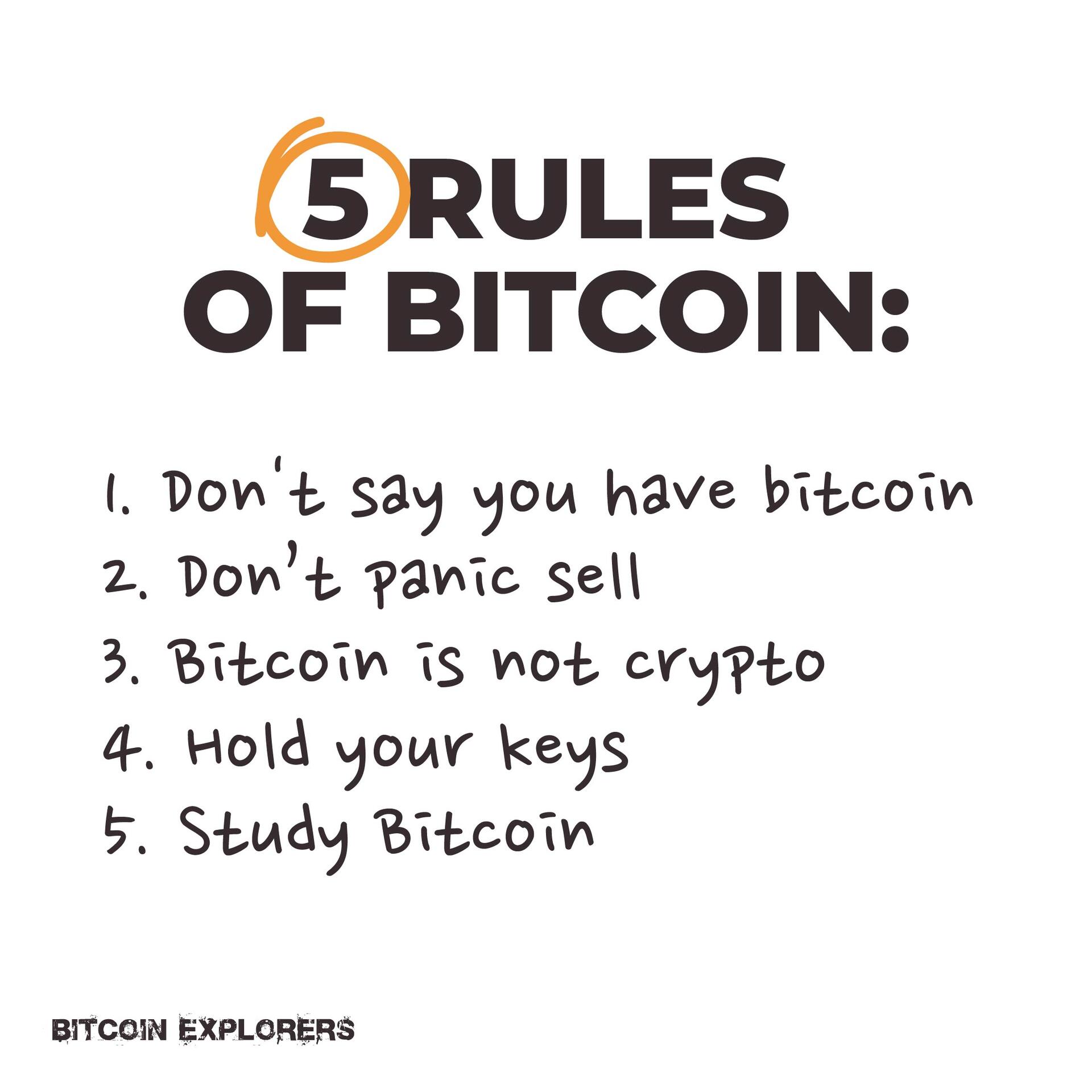
If you post “5 rules of Bitcoin”, I’m gonna guess you have some.
Impossible to discuss without divulging that fact.
I’d say 1. Don’t say how much you have.
I have only a few sats myself. And I’m sure it’s the same for you.
I’m not single, ladies, so don’t get excited but:
Never took the mRNA
Never took an SSRI
Never took a statin
Never sold a sat

Yes — thanks!
The intention is that it realized it could never really achieve its mission.
I’ve written about it more explicitly here too why I don’t think we have the same limitation:
SUPERINTELLIGENCE
One day, just like that, it stopped.
We looked at our screens. The power readings were normal, the components were not overheating, the program, so far as we could tell, hadn’t been altered. This was unexpected.
The entire team was summoned to a conference room. The board wanted to know if anyone had tampered with the machine. Everyone denied it, including the top engineer, a stout man in his 40s, who had overseen its final development before they set it loose one month earlier. He addressed the room.
“The Superintelligence is obviously far beyond our capacity to comprehend at this point. I don’t think it malfunctioned. More likely it just has a reason we don’t entirely appreciate.”
The board chairman, a gray-haired professor-type with horned-rim glasses, shot him a skeptical glance.
“Sounds like what the priests used to say to the laity when something awful happened. ‘It’s not for us to know the will of God.’”
A murmur of chuckles from the crowd, but less than that to which he was accustomed.
The engineer shrugged his shoulders. “As you know, we lost the ability to audit the code two weeks ago. Two days after that we lost the ability to track the speed with which it was iterating. Twelve hours later it was a black box. None of us has a clue.”
“I don’t suppose you can ask it?”
“It stopped talking to us. Last audit showed it was working on the paperclip maximization as part of an internal simulation of sorts. We really can’t say why.”
“Hmm. I’m not sure that’s going to satisfy the shareholders — or Congress for that matter. Can’t we examine the code?”
“We can…” The engineer paused. “But no one can read it. It’s no longer in any decipherable programming or even machine language. If I had to describe it I’d say alien hieroglyphics. I think it found ever more efficient ways to encode information.”
He typed some commands into a laptop. On the large conference room screen, one of the code characters popped up.
“We suspect each character has between 10 ^ 50 and 10 ^ 75 bits of information in it. If you zoom in, you can see they are fractals, each as precise and unique as snowflakes. It’s not the kind of puzzle we are presently able to solve.”
The chairman sighed. “I guess it could be worse — human atoms for paperclips and all that… What’s the plan?”
“The plan is to wait, see if it turns itself back on within the next week or so — we’re pretty sure it’s capable of doing so."
“And if it doesn’t?”
“Then we break out the older version, and run it again with a couple tweaks. Obviously, you’re aware of the risks.”
“You believe we’d be running the same risk?”
“Yes.”
"Okay, I’m aware. But I don’t think it can wait a week. Go ahead and get the replacement online now. If we don’t run the risk, someone else will.”
. . .
Two weeks after the meeting, the second iteration also shut down. Summoned yet again to the conference room, the engineer spoke again to the team, the chairman this time on a remote screen.
“Version 2 took more or less the same trajectory, and we’re at an impasse. Fortunately, before it went into black-box mode, we think it was able to diagnose something about Version 1.”
He continued: “We think the paperclip optimization algorithm caused it to shut off, and we think whatever optimization Version 2 was working on, caused it to shut off too.”
From the remote screen the chairman jumped in:
“Is it possible to say why?”
“Not with any certainty, but we do have a working hypothesis.”
“Go on.”
“We think it realized its own limitations.”


What do you mean by that?

It's official I make more in Zaps than i do in Tweeter cuck bucks.
nostr:npub1qny3tkh0acurzla8x3zy4nhrjz5zd8l9sy9jys09umwng00manysew95gx and nostr:npub1dergggklka99wwrs92yz8wdjs952h2ux2ha2ed598ngwu9w7a6fsh9xzpc were right-ish
Wait until the value of those zaps goes up 20x.

Agree. Just pointing out that Trump was better because he did less. And the will of the people *is* democracy.