

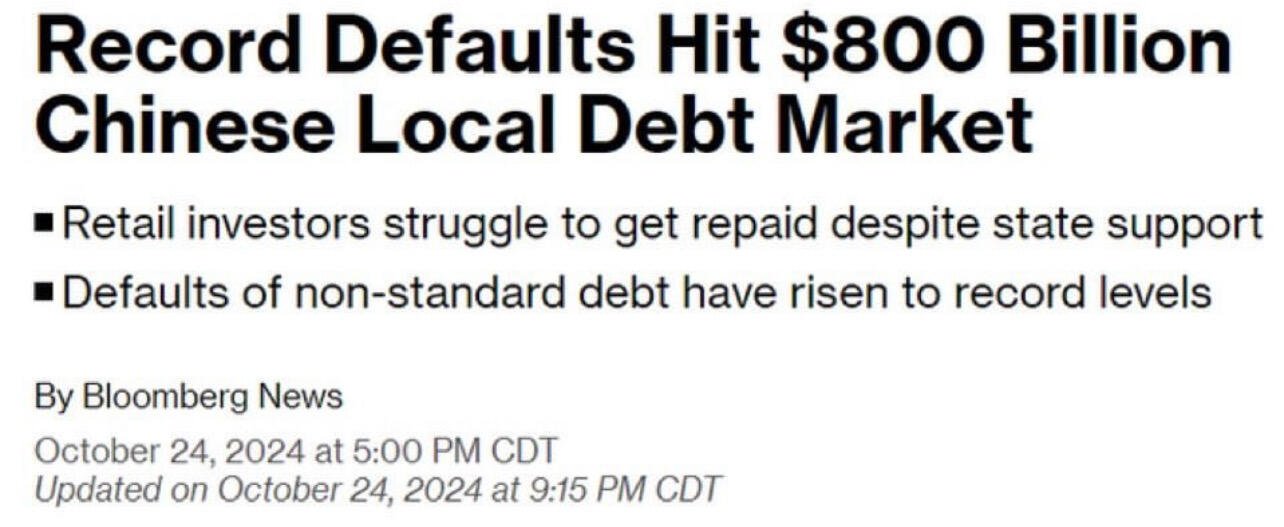
exactly. How do you fight deflation in the keynesian fiat system, which is nothing other than an expression of failed interventionism? With more interventionism. Of course...



Turkey Bombs US Proxies In Northeast Syria Following Ankara Terror Attack
Turkey Bombs US Proxies In Northeast Syria Following Ankara Terror Attack
Turkey https://www.ft.com/content/87c73485-3505-42cf-9b2c-2d29c7744701
several airstrikes and artillery shelling across US-controlled north and east Syria late on Wednesday, targeting positions held by the Kurdish Syrian Democratic Forces (SDF).
The attacks targeted several villages and sites in the Syrian provinces of Aleppo, Raqqa, and Hasakah. One of the attacks hit an SDF military outpost in the countryside of the city of Al-Malikiyah, at the Syrian–Turkish–Iraqi tri-border region. Turkish artillery also hit SDF sites in the village of Umm al-Kaif in the countryside of the town of Tal Tamr, northwest of Hasakah.
 ?itok=uLA6few4
, Turkish artillery shelling hit the villages of Al-Sayyada, Aoun Al-Dadat, Al-Tukhar, and Al-Daraj.
On Thursday, the UK-based Syrian Observatory for Human Rights (SOHR) https://www.syriahr.com/en/347305/
that the attacks killed at least "27 members of military formations operating in SDF-controlled areas," three soldiers from the Syrian Arab Army (SAA), and at least four civilians.
For its part, Turkiye's Ministry of National Defense said 32 targets in Syria and Iraq were "destroyed" in the aerial offensive without providing details on the locations that were hit. Officials added that "all kinds of precautions" were taken to prevent harm to civilians.
The intense attacks were launched hours after https://edition.cnn.com/2024/10/23/europe/turkey-ankara-aerospace-attack-intl/index.html
set off explosives and opened fire at the headquarters of the Turkish Aerospace Industries (TUSAS) in Ankara, which designs, manufactures, and assembles civilian and military aircraft, unmanned aerial vehicles (UAVs), and other defense industry and space systems.
Turkish Interior Minister Ali Yerlikaya and Defense Minister Yasar Guler accused the Kurdistan Workers’ Party (PKK) of being behind the attack.
"We give these PKK scoundrels the punishment they deserve every time. But they never come to their senses," Guler said. "We will pursue them until the last terrorist is eliminated."
At least five people were killed and 22 injured in the Ankara attack. Two attackers – a man and a woman – were also killed.
Terrorist attack in Ankara Turkiye, numerous dead and injured.
At least one female attacker, amongst several carrying automatic weapons, struck a military aerospace company. https://t.co/ykAJgEpTrk
— Chay Bowes (@BowesChay) https://twitter.com/BowesChay/status/1849113174714294447?ref_src=twsrc%5Etfw
Turkey regularly conducts air strikes against the PKK in Iraq and against the SDF in Syria. In 2014, the US military began partnering with the Kurdish People's Protection Units (YPG), an offshoot of the PKK. The YPG later changed its name to the SDF.
Together, the US and its Kurdish proxies occupy Syria’s northeast, including Hasakah, Raqqa, and parts of Deir Ezzor, denying Syria access to its oil resources and wheat-producing agricultural land.
Wednesday's attack in Ankara came as Turkish President Recep Tayyip Erdogan was in the Russian city of Kazan to attend the annual https://thecradle.co/articles/brics-nations-make-urgent-call-for-palestinian-statehood-gaza-ceasefire
. He condemned the "hateful attack" alongside Russian President Vladimir Putin.
https://cms.zerohedge.com/users/tyler-durden
Fri, 10/25/2024 - 02:00
the crises in #Ukraine and #gaza are bringing #NATO into the worst internal conflicts. History is being written here!

Following yesterday's news that tax revenues in #Germany will shrink significantly over the next few years due to the country's recession, this is another sign of where the #eurozone's largest economy is heading. The Europeans are in for hard times.



GM. Very good points. We can only approximate, because even with the best calculation, every household has its own consumption preferences. Do you know the organization 'truflation'? They have developed a very good way of calculating inflation. You can find it under this name on X
'There are two things in the universe that are infinite: human stupidity and its intellectual laziness.'
Schopenhauer on crypto scams
BRICS Unleashes Game-Changing Power Play: New Financial System Meets Energy Dominance
In a historic move that could reshape the global economic landscape, BRICS nations have unveiled a comprehensive strategy combining financial innovation with unprecedented energy market control, as revealed in their landmark Kazan declaration.
Financial Revolution Meets Energy Dominance
The alliance is simultaneously launching multiple initiatives that could fundamentally alter global power dynamics:
- BRICS Clear: A new cross-border settlement infrastructure
- BRICS Grain Exchange: Alternative commodities trading platform
- Local currency payment systems: Bypassing traditional financial channels
- Unified energy market: Creating world's largest energy trading bloc
The Energy Superblock Effect
What makes this particularly significant is the emergence of an energy superblock controlling over 40% of global energy production and consumption. This consolidation creates unprecedented price-setting power, potentially putting energy-dependent regions, particularly Europe, in a vulnerable position.
"The combination of alternative financial infrastructure and energy market dominance creates a powerful lever for reshaping global economic relationships," suggests the declaration, without directly stating this intention.
Strategic Implications
The initiative goes beyond mere market mechanics:
1. Financial Architecture:
- New payment systems reducing dependency on traditional channels
- Local currency trading expansion
- Independent reinsurance capacity
2. Energy Market Control:
- Unified pricing strategies
- Enhanced negotiating power
- Direct influence over global energy flows
3. Geopolitical Impact:
- Pressure on energy-scarce regions
- Alternative trade routes
- New economic alliances
Global Market Response
Markets are beginning to process these developments, particularly the implications for:
- Energy pricing mechanisms
- International trade flows
- Currency exchange patterns
- Regional economic stability
Looking Ahead
This convergence of financial innovation and energy market control signals a potential shift toward a multipolar economic order. Energy-dependent regions may need to develop new strategies for ensuring supply security and price stability.
The BRICS alliance also addressed current global conflicts in their declaration, emphasizing diplomatic solutions and humanitarian considerations, while positioning themselves as a stabilizing force in international relations.
This historic convergence of financial reform and energy market control could represent the most significant shift in global economic power since the Bretton Woods agreement. As markets digest these developments, the full impact on global trade, energy security, and economic stability remains to be seen.
#BRICS #GlobalFinance #Energy #Geopolitics #GlobalEconomy #FinancialInnovation #EnergyDominance #InternationalTrade
Economic Crosswinds: US Manufacturing Struggles While Services Show Resilience
Recent data paints a complex picture of the US economy. While the Chicago Fed's activity index dipped to -0.28 in September, signaling overall economic slowdown, S&P Global's latest survey reveals unexpected strength in certain sectors. Manufacturing continues to face headwinds, posting 47.8 in October, but services maintain robust performance at 55.3. The composite index reached 54.3, suggesting economic resilience despite mixed signals.
#economics #fedwatch #marketdata #manufacturing #services #economictrends
The frenzy with which #ECB central bankers in the #eurozone (and elsewhere, but not as bad) are pushing for rate cuts and influencing the public narrative to that effect tells me that we won't be talking about #inflation a year from today.
#Deflation is in the air!
Pennsylvania Makes History: Bipartisan Digital Assets Bill Sails Through House
The Keystone State just took a giant leap into the future of finance. In a rare display of political unity, Pennsylvania's House representatives crossed party lines to approve groundbreaking digital assets legislation with an overwhelming 176-26 vote. This decisive move positions Pennsylvania at the forefront of Bitcoin adoption in the United States, potentially pushing other states toward adoption.
#bitcoin #legislation #pennsylvania 
German Government's Fantasy Math: When Reality Meets Bureaucratic Dreams
In a stunning display of fiscal reality finally catching up with bureaucratic expansion, Germany's latest tax revenue forecasts have revealed a €58.1 billion shortfall through 2028. But don't expect any belt-tightening from Berlin's bureaucratic behemoth.
While most households and businesses tighten their budgets during economic downturns, our ever-expanding government apparatus appears to exist in a parallel universe where basic economic principles don't apply. The federal government alone faces a €12.6 billion revenue gap, yet the political response seems to follow the time-honored tradition of spending more while earning less.
States must somehow manage with €2.3 billion less in 2024, and municipalities face a €600 million squeeze. Yet, remarkably, the sound of new government programs being proposed echoes through the halls of power, as if printing money were a sustainable solution to economic gravity.
As Germany slides deeper into recession, the disconnect between economic reality and political fantasy grows wider. The political class, cushioned in their Berlin bubble, continues their spending spree while private sector businesses face the harsh realities of market forces. Perhaps it's time for our political leaders to step out of their ideological echo chamber and into the real world where basic math still matters.
#Germany #Economy #GovernmentSpending #FiscalReality #EconomicCrisis #BureaucraticBloat #TaxRevenue
US Labor Market With Mixed Data
Weekly unemployment filings dropped sharply to 227,000, beating analysts' forecasts of 242,000. However, the number of Americans receiving ongoing benefits increased to 1.897 million, suggesting mixed signals in the labor market dynamics.
#economics #jobs #labormarket #usnews #unemployment

Where do we stand in the international debt race?
First of all: let's spare ourselves the shame of including the national debt of the villains of our time, the Russians, in the comparison. Their national debt is currently just under 15%! But that is of no further interest to us at this point, as the West and the international community of good states have finally isolated Russia, which will no longer play a role in the total treatment. The fuss about the BRICS countries and their growing energy power is completely overrated and quite rightly ignored by the mass media.
So let's get back to the international race of the debt kings, where Japan is still hovering at lonely heights, but is now slowly facing competition from the ambitious socialists and Keynesians from China and the USA.
The figures are from 2022, but it is easy to add about three to five percent of new debt to the balance sheet of horror for each additional year. In general, it can be said that the trend towards higher debt is a built-in fiat money mechanism to roll over the existing debt mountains plus the accruing interest into the future. So expect more in light of the fact that individual sectors of the economy, such as the real estate market in China, are already collapsing in a deflationary spiral.
Bank balance sheets live on inflated asset prices to accelerate credit. This is the price we pay for a frictional monetary system that has detached itself from any respectability and real valuation of assets. This will continue until the winner of this debt race collapses and takes the other ailing countries with it. Prepare for high volatility in the bond markets in particular as we head towards the point of debt saturation globally.
Governments will do all they can to oblige large capital accumulators, banks or pension funds to take even more of their debt junk onto their balance sheets.
In this way, the poison of bad debt is seeping deeper and deeper into our society, contaminating the last opportunities to build up capital without distortion and credit risk.
#debt #debtspiral #inflation #centralbank #bitcoin #eu #usa #japan #china


I think the correlation is: if bonds fall (yield rises) there are rising oportunity costs for holding gold that doesn't yield anything
I think the decoupling, at least temporarily for the time being - we'll have to see how it goes - of gold and bond interest rates is one of the most spectacular developments these days. In the event of an economic bust, this gap is likely to close abruptly and send shockwaves through the markets.
#gold #markets #yields #bondmarket #debtspiral https://files.sovbit.host/media/863f2c555276e9ed738933b0efee6b021042f16e1529dd755704885b87fee183/79fd4164136583645650d9238af79a05862a67805171022e350c1f4c9b5ba5bc.webp
BoJ's Quest for 'Neutral' Rate Exposes Fatal Flaw in Central Banking Doctrine
Japan's central bank finds itself in an increasingly precarious position as market realities clash with monetary policy rhetoric. The Bank of Japan's current predicament offers perhaps the most compelling real-world evidence that centrally planned monetary policy – particularly the search for a mythical "neutral" interest rate – is fundamentally flawed.
Bank of Japan Governor Kazuo Ueda's recent admission about the difficulties in predicting appropriate interest rate levels isn't merely a technical challenge – it's a profound acknowledgment of the impossibility of central planning in monetary policy. The very concept of a "neutral" rate that neither stimulates nor restrains the economy reveals the hubris of believing that any central authority can successfully determine such a precise equilibrium in a complex, dynamic market system.
While the BoJ maintains its narrative of potential rate adjustments and careful market monitoring, the stark reality of Japan's massive government debt burden – one of the highest debt-to-GDP ratios globally – severely constrains any meaningful monetary tightening. This fundamental limitation appears particularly acute as the yen continues its downward spiral, demonstrating how markets ultimately override central planning attempts.
Finance Minister Katsunobu Kato's recent statements at the G20 meeting in Washington D.C., expressing "urgent concern" over rapid yen movements, further highlight the growing tension between policy aspirations and market forces. These diplomatic utterances serve as a stark reminder that no amount of central planning can outmaneuver market fundamentals.
The central bank's increasingly desperate search for an optimal interest rate policy exemplifies Friedrich Hayek's knowledge problem – the impossibility of any central authority possessing sufficient information to make optimal economic decisions that markets naturally coordinate through decentralized price mechanisms.
Market observers note that this disconnect between rhetoric and action capacity has not gone unnoticed in currency markets, where the yen continues to face selling pressure. Japan's situation has become a textbook case of how centralized monetary policy inevitably leads to market distortions and eventual policy paralysis.
The BoJ's predicament serves as a warning to other developed economies about not just the long-term consequences of prolonged ultra-loose monetary policy, but more fundamentally about the inherent limitations of central banking itself. The current crisis demonstrates that no amount of sophisticated economic modeling or careful calibration can replace the natural price discovery mechanism of free markets.
#BoJ #MonetaryPolicy #Economy #Japan #Yen #DebtCrisis #FinancialMarkets #CentralPlanning https://files.sovbit.host/media/863f2c555276e9ed738933b0efee6b021042f16e1529dd755704885b87fee183/7cb2a8fede6977261a031e112fbe93220000f2e8b3dd199229dc85b4e6d31d0a.webp

Let dad pay. He benefitted from 42 years falling interest rates
Eurozone In Recession: The Price Of Central Planning
Recent economic indicators paint a concerning picture of the Eurozone's structural challenges. With manufacturing PMI at 45.9 and services at 51.2, we're witnessing the consequences of sustained bureaucratic intervention and resource misallocation. Assuming that the construction industry is also in a deep recession alongside the industrial sector and that the state is the only one left to light its useless fires with artificial credit, things are looking really bad in the eurozone. The awakening of the Europeans at the point at which the reception also materializes on the labour market will also frighten many. Then they will learn that all the shouting about the green transformation and the climate apocalypse was nothing more than a sad attempt to generate artificial gross domestic product in the face of an anaemic economy regulated to death and ever more centrally controlled.
Key Insights:
- Years of heavy-handed state intervention have created systemic inefficiencies
- Government overspending (nice to gain
power at cost of the 'sovereign') increasingly displaces productive private sector activity
- Bureaucratic expansion has reached unsustainable levels
- Resource allocation is being distorted by non-market forces
-State intervention fails to produce goods and services that consumers actually demand
The fundamental issue isn't just about numbers - it's about the misallocation of scarce resources. Government intervention, while well-intentioned, consistently fails to generate real economic value. Instead, it diverts critical resources away from productive channels, creating a cascade of market distortions.
The solution requires a fundamental rethink of our approach to economic management. We need to recognize that sustainable growth comes from allowing market forces to efficiently allocate resources, not from expanding bureaucratic control.
#Economy #ECB #EU #Eurozone #keynes #regulation