
This flag is the symbol of clumsy bureaucracy, paternalism, corruption, and anti-republican spirit. 
The consequence of Brussels' degeneration into a vulgar socialist power clique: a civilizational rupture, warmongering as a last resort to cover up the debt collapse, the collapse of the economy—and as revenge, the hated population is forced into a digital censorship gulag, while European traditions and national dignity are hammered down with the most terrible invasion policy.
Brussels is the nucleus of the European cancer.
#EU #Brussels #WEF #Trump #Globalists #Migration #Merz #Ukraine
Back in Málaga, thank God. Climate change has pushed temperatures down to one or two degrees in Germany. 
Advertising to build up the #wareconomy is in full swing. Found at Weeze Airport. I'm curious to see how they plan to fill the empty capacity in industry, which currently employs around 8,000 people in #Germany. 

Just a reminder: this is exactly what debt spirals look like, illustrated here using the example of the crisis-stricken city of Munich. It is a symbol of what is currently happening across the country. Germany will no longer be able to escape the debt spiral. 
#Germany #Merz #debtcrisis #EU #socialism #Klingbeil #Munich
These statistics do not take into account the fact that in Germany, half of the entire social welfare system is also financed through labor. In net terms, this leaves much less. 
But in Germany, the state does a lot for its huge raid in terms of internal security, education, and the cityscape. This enormous achievement by Germany's huge bureaucracy should be worth something to the people there, shouldn't it? #germany #socialism #eu #taxes #taxesaretheft #freedom
Hi. Yes, I was restarting my work as free journalist. I am writing now for two german news media and some in the US. It was and is a wild ride.
Hope You're fine

...and so they created the holy church of #co2! 
This is fuel looking for its rocket. #btc 
Collapse of the Social Machine
Social insurance is the crown jewel of Germany’s welfare-state engineers and statists. With its hypertrophic bureaucracy, it forms the power base of the party-state. It’s also the recruitment machine for ever more citizens bound into dependency—citizens who, much like the tens of thousands of Green Deal subsidy entrepreneurs, quietly submit to the country’s cartel of silence. Incentives rule...
And now, this gigantic bureaucratic power apparatus is crumbling before our eyes. Aging demographics, social migration, and the deindustrialization forced by aggressive ecological ideology are all eroding the levers of redistribution built into this dull, unreformable machine. The number of people making a productive contribution to Germany’s economy is shrinking, while the ranks of those living parasitically continue to swell.
A quick look at the numbers: this year, the pension system alone will require at least €123 billion in tax subsidies. Health insurance needs roughly €14 billion, and long-term care insurance another €1.7 billion. The collective deficit of Germany’s social funds will explode exponentially once the prolonged recession starts depressing tax revenues—something that’s all but inevitable.
Germany today is no longer the country I knew as a child in the 1980s. We’re witnessing a society coming apart at the seams—internally fractured, drifting away from bourgeois-meritocratic values, abandoning Western traditions and the cultural heritage of its forebears. And it no longer seems capable of repairing the damage it has inflicted upon itself.
Germany has been harvested to the bone, scarred by wind turbines, intellectually dumbed down, and turned wild in its urban spaces. The circus of the globalists moves on—and few even notice.
#Germany #EU #WesternCivilization #Socialism #WEF
A nice democratic simulation of the #EU Commission. Here, citizens can have their say on the speed at which their jobs are being destroyed by the CO2 mania. #climatescam 
Battle for Free Speech: EU-Europe Deploys Its Artillery
In the struggle for narrative dominance and interpretive control, EU-Europe is pursuing a hard and consistent line. Dissenting voices and a growing opposition are met with narrowing discursive spaces. The new German government is also aligning with the Brussels chorus.
One thing cannot be said about Brussels and its national subsidiaries: inconsistency. Once a shared agenda is agreed upon and a procedural consensus is found, institutional and media-based defense mechanisms are built in parallel. These serve to immunize and narratively shield the actors, institutions, and beneficiaries involved in the machinery that transforms political will into reality.
SLAPP Lawsuits as Smokescreen
This is the context in which the German government is now operating. Chancellor Merz’s administration is preparing the national implementation of a largely underreported EU directive. It concerns so-called SLAPP lawsuits — Strategic Lawsuits Against Public Participation — legal intimidation tools used by powerful actors to silence critics, journalists, or whistleblowers through financially exhausting court proceedings. These lawsuits aim not at legal victory, but at creating pressure, fear, and ultimately bankrupting the opposing side.
The EU directive, officially framed as a protection mechanism for critical voices, gives national legislators wide leeway in interpretation and application. While Brussels speaks of “protection against intimidation,” Berlin is using the blueprint to expand judicial intervention rights and grant courts the power to determine what constitutes an “obviously unfounded” case.
The real target isn’t mainstream disinformation, but rather effective disciplining of critics of the government and the EU.
As a wave of substantive opposition to Brussels’ centralism mounts, a legal early-warning system is being formed, disguised as a protection for press freedom.
The legislative process is currently in inter-ministerial coordination. After cabinet approval, it will move to the parliamentary stage. If the federal government has its way, the law will come into effect this year — a striking example of how efficiently politics can work when it curtails individual freedom.
Climate of Suppression
Let us condense the Brussels agenda into its core elements: centralized capital allocation in sectors like energy; the introduction of digital control currency; the erosion of national cultures through mass migration; and the suppression of secessionist tendencies. In short, further power is to be funneled quietly and systematically from the regions into the Brussels center.
The symptoms of this centralism — economic and cultural decline, uncontrolled migration, and a looming debt crisis — are drawing public attention to foundational questions about the EU’s future.
Dissatisfaction with climate ideology and government overreach is also showing at the ballot box. A rising conservative right, embodied by figures like Hungary’s Viktor Orbán and Italy’s Giorgia Meloni, is finding common ground in opposition to EU centralism. A consolidation of this movement is likely, and it’s triggering defensive reflexes in Brussels and national capitals.
This awakening opposition has exposed the various immune systems protecting the regime: NGOs, state-funded media, subsidized business leaders, and a captured academic class dominate public discourse. Together, they set the narrative, isolate dissenters, and — where these defenses fail — seek to sterilize political opposition through media mechanisms. Firewalls in party politics, climate hysteria, and the borderless migration policy are the most visible front lines in this battle for narrative control.
Vectors of Centralized Attack
A visible rupture appeared with Elon Musk’s takeover of X. His multi-billion-dollar investment could mark a turning point in the history of postmodern democracy. With around 600 million users and the spread of sovereignty-enabling technologies like VPNs, the decentralized author ecosystem of X has stabilized and expanded.
That success has triggered fierce retaliation. Brussels is now pushing measures like criminal liability reversal, mandatory identity verification, and invasive surveillance software — classic tools of a control regime blind to the growing public backlash it now faces. Free media have made the problem of centralized power visible, and people are quietly withdrawing their consent.
Yet the EU persists, levying grotesque multimillion-euro fines on U.S. media companies. The battle lines are drawn: the EU versus a rising domestic liberty movement, increasingly backed by America’s renewed push for sovereignty.
Mounting Costs, Dwindling Control
Alongside these attacks, EU member governments are scrambling to subsidize their collapsing media ecosystems with taxpayer money. But this is a doomed effort: once dissenters find safe harbor, they rarely return to the island of curated, state-managed thought. The exponential cost spiral of this asymmetric fight remains misunderstood by its protagonists.
In trying to keep a failing eco-socialist narrative alive, governments are burning public money — and revealing the political-media cartel defending it. This paternalistic overreach is backfiring, fueling public rejection.
Greta Thunberg’s endless moral performances — from climate marches to Palestinian solidarity rallies — have become a symbol of a system that proclaims its moral superiority more desperately the more it loses its grip on the public narrative.
That the EU and its national arms are now rolling out their heavy guns in the information war — like the SLAPP directive — is deeply concerning. We learned from the COVID protests in Europe and Canada that the state is willing to use police force and underhanded methods to protect its power.
But this escalation reveals a deeper truth: the media consensus between rulers and ruled has broken down. Political messaging and its execution increasingly diverge from the people’s will, and manifest in polarized parliaments and a more unified opposition.
The debate space is heating up. And the battle lines are now crystal clear.
#eu #socialism #freedom
That's the marxist attack vector no. 1.
France's Fiscal Reckoning: Is The Eurozone's Second Giant Next In Line?
France is caught in a debt spiral. Now the president of the French Court of Auditors is warning of the consequences of political inaction.
Pierre Moscovici has served as president of the French Court of Auditors for five years, overseeing regular audits of the nation's public finances. From 2012 to 2014, he was France’s finance minister and then spent five years as EU Commissioner for Economic and Financial Affairs, Taxation and Customs. The man knows his way around empty coffers.
On Wednesday, Moscovici called on Prime Minister François Bayrou to take urgent steps to consolidate public finances. France’s budgetary situation, he said, has spun out of control, especially in 2023 and 2024. If a turnaround is not achieved soon, the capital markets will force one. “We can still act voluntarily,” he warned the government, “but tomorrow, the markets may impose austerity.”
For Now, Calm in the Bond Markets
Once the dominoes start falling, it goes fast. Investors dump French government bonds en masse. Yields spike, prices plummet, and refinancing the country’s massive debt becomes even more costly. Already, interest payments consume 10.6% of France’s state budget—roughly the same as education spending. As debt levels rise, fiscal maneuvering space shrinks.
With sovereign debt at 114% of GDP, the trap could snap shut unexpectedly. For now, European officials still point fingers at the U.S., whose debt ratios are similar. But no one can say how long that deflection tactic will work. Credit risk materializes suddenly—usually without warning.
Point of No Return
What we do know is this: historically, a debt ratio above 100% of GDP is already considered critical. At that point, even ambitious reform efforts are rarely enough to grow out of the mess. And unless the indebted country happens to issue the world’s reserve currency, capital markets will deliver their verdict—as we saw during the Eurozone debt crisis fifteen years ago.
What follows is familiar: central bank intervention to keep government finances liquid by running the printing presses—transferring the bill to citizens through inflation.
France has never been known for fiscal conservatism. Years of political stalemate, shifting majorities, and unstable coalitions have pushed annual deficits far beyond the Maastricht 3% threshold. In 2024, the deficit reached 5.8% of GDP. Even with early consolidation steps, it is expected to remain at 5.5% this year—far above the target.
No Economic Comeback in Sight
If French policymakers are banking on a comeback in economic growth, they may be disappointed. In May, the Purchasing Managers' Index (PMI) for manufacturing came in at 48.1 and for services at 49.6—both in contraction territory. PMIs reflect business sentiment, with readings above 50 indicating growth and below 50 signaling decline. They are considered early indicators of economic and industrial trends.
In other words: despite—or perhaps because of—massive government spending, the French economy is stuck in recession.
Contagion Risk
France’s brewing fiscal crisis is more than a national tragedy. Alongside Germany and Italy, France is under close scrutiny from analysts and investors worldwide. Can Paris pull off fiscal consolidation? Confidence in France’s creditworthiness has been shaky for years. In 2023, Moody’s was the last major rating agency to downgrade France’s AAA status, assigning a negative outlook.
If capital markets further downgrade French debt, the consequences would spill across the Eurozone. Here, the old rule applies: hang together, or hang separately. Bond markets tend to move from one weak link to the next, rigorously reassessing creditworthiness in crisis situations. Those who falter pay higher interest—or lose market access altogether. Moscovici knows this.
The pressure is mounting on national governments: either push through tough budget reforms or increase the tax burden on citizens.
The French Exception
France is a special case. With a government spending ratio of 57.3% of GDP, it ranks among the top welfare states in the world. Accordingly, the overall tax burden has risen to 45.6%—well above the EU average of around 40%. Citizens are already surrendering nearly half their income to maintain Paris’s welfare illusions.
Social peace is being purchased with money that no longer exists—financed by debt and propped up by the illusion of fiscal sovereignty. When even the nation’s top auditor demands consolidation, one thing is clear: it’s about to get serious. The social budget—the bedrock of the political quiet pact keeping unrest in the banlieues at bay—is at stake.
History teaches us: when governments cut social programs in France, social peace crumbles. Then the suburbs—from Paris to Marseille to Lyon—go up in flames.

When I'll go there the next time I'll do my part: I'll drink the old town of Düsseldorf dry! That's growth
Germany’s Pension Ponzi on the Brink
If you’ve ever wanted to witness the slow-motion collapse of a Ponzi scheme, you might want to keep an eye on Germany’s public pension system.
Rhetorically and politically sugar-coated as a “pay-as-you-go” system — where today’s workers finance the retirement of yesterday’s — this bureaucratic redistribution leviathan is utterly dependent on an ever-growing pool of contributors. Problem is: Germany is aging, shrinking, and losing its industrial base.
Just in time for this demographic crunch — declining birth rates, increasing life expectancy, and longer pension payout durations — policymakers have decided to torch what’s left of the country’s industrial foundation in a green frenzy. Year after year, around €70 billion in value creation is being sent up the chimney, while more than half a million jobs have disappeared in recent years. That’s half a million fewer contributors to the pension Ponzi.
Tax Payer´s Money To Maintain The Illusion
To keep the locomotive rolling — even as it barrels in the wrong direction — the federal government now plugs the pension system’s gaping cash hole with roughly €123 billion annually from the general budget. In other words: workers pay a second time, in the form of taxes, to support the same unsustainable system they already fund through record-high payroll deductions.
With a government spending ratio now exceeding 50% of GDP, Germany has erected a full-scale hyperstate. Attached to its bloated bureaucracy are ever-growing administrative tentacles: layers of social insurance agencies and subsidized institutions now serving as the domestic enforcement arm of Brussels’ self-destructive Green Deal.
The coming deep economic depression, which has been foreshadowed by three years of quasi-permanent recession, will test just how resilient — and solvent — the savings and wealth accumulation of past generations truly are. It may be their prudence that softens the blow of the present generation’s green delirium.
Trapped in the Logic of a Ponzi Scheme and Keynesian Voodoo Economics
Entirely captive to the logic of Ponzi finance and Keynesian voodoo economics, Germany’s new federal government now plans its grand escape from all woes. With a debt hammer of one trillion euros over the coming years, it aims to wipe away every problem while putting the economy back on track.
Broadly speaking, the money is supposed to raise the defense budget to 5% of GDP, as demanded by the latest NATO summit, pour into the country’s crumbling infrastructure, and plug countless holes in the overstrained welfare apparatus.
We don’t need to go into detail here to recall that such stimulus-fueled bonfires leave behind nothing but more debt and inflation, misallocating printed capital into sectors with little or no real demand. It would suffice if politicians had even a passing familiarity with recent economic history — they’d realize they are once again slamming their heads against the very same wall as in decades past.
Socialists Debate Higher Contribution
Meanwhile, the SPD — junior coalition partner to Chancellor Friedrich Merz’s CDU-led government — is currently debating raising the pension contribution ceiling by €500 to €8,050 monthly salary. This increase would translate to an additional yearly burden of over €1,116 for anyone earning that amount. In other words, those who already carry the lion’s share of the country’s fiscal load as the last remaining productive pillars of society would be hit with yet another surcharge. The welfare state and social peace, they argue, are worth this sacrifice.
The coalition partner CDU’s reaction was not long in coming. There was unanimous rejection of the SPD proposal to once again burden the country’s top earners. Wolfgang Steiger, Secretary General of the CDU’s Economic Council, stated:
“We strictly oppose the move to raise the contribution ceiling in statutory health insurance. It would further increase the cost of labor.”
That sounds good at first and has its merits. After all, it’s about time fiscal policy wielded the Milei chainsaw instead of continuing with the socialist cornucopia. Yet recent history has shown us that the CDU flips positions faster than expected.
It is, not least, Chancellor Friedrich Merz’s fault that trust in his party has hit rock bottom. After multiple broken campaign promises — like cutting the electricity tax or securing the country’s external borders once and for all — no one believes his party anymore.
After all, the community, acting as a global social welfare office, also needs to provide compensatory payments across other social insurance branches — which, thanks to successful recruitment efforts related to illegal migration, are facing significant special financing needs.
Germany is the Victim of Its Own Success
Two successful postwar generations built the capital and economic foundation on which the neo-socialist aberration could flourish — manifesting itself in an overgrown welfare system.
At the root of the problem lies not only the crushing tax and contribution burden in Germany but also its stagnating productivity, which together make rapid private capital formation nearly impossible for large parts of the population.
Even though politicians occasionally flirt with the idea of introducing elements of a capital-funded pension system, such proposals are a suicide mission in light of the sheer weight of the public pay-as-you-go system. Germans hold almost exclusively cash-based savings, which makes them highly vulnerable whenever the state — in concert with the ECB — fires up the inflation engine. On top of that, they remain deeply risk-averse investors, culturally and historically allergic to equity markets or private pension schemes.
Powerful Voting Block
The pension insurance provides the perfect case study. With over 21 million pension recipients, every reform attempt at the expense of this group faces a homogeneous voting block. Germany could raise the retirement age, which it is attempting to do to 67 years. It could reduce benefits, which it does not. Pensions are tied to inflation and productivity growth in the economy.
Politicians could reject the green-socialist agenda and return to the economic rationality of the free market to expand the contributor base and attract investment. They do not. The bureaucracy — the political front organization — is simply too powerful. Regulation is its product, and additional welfare recipients are its customers.
The path of least resistance will be taken: further increasing contribution rates for the productive pillars. Federal subsidies from the tax pool will supplement this to ease the pressure. But due to demographic development and the destructive economic policies in the EU, especially in Germany, the Ponzi scheme is steering toward an abyss.
#germany #eu #fiatponzi
The US dollar on a dive. The low DXY will facilitate the refinancing of the dollar-indebted world and thus stabilize the dollar. The end of the dollar as a reserve currency is not in sight. #usd 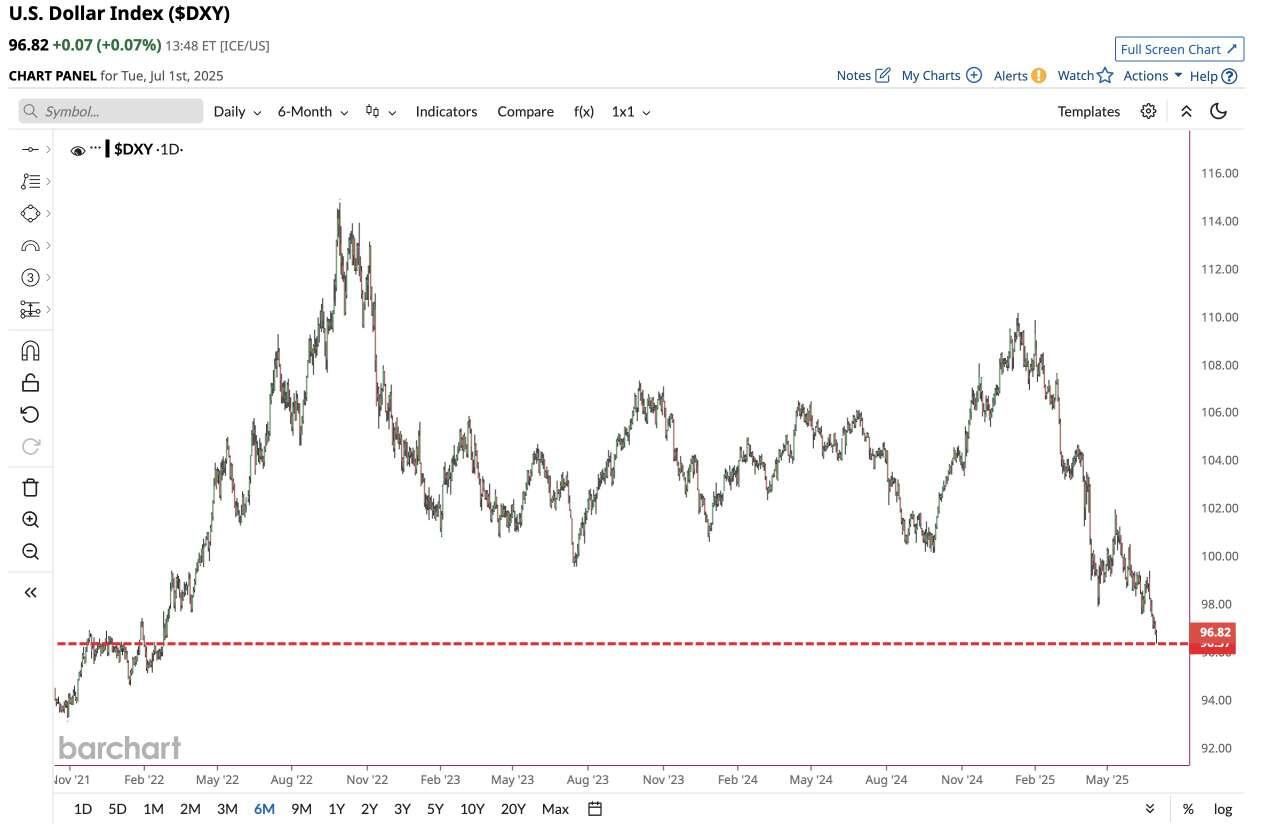
Industrial production in #Germany has fallen by 9% since 2021. This is the backbone of this country's economy. How do the Russia neurotics want to finance a war against the evil empire with this collapsing economy? #eu #russia 
#Trump is right: without massive pressure, the Europeans would never budge from their protectionism. Not a millimeter. It's all just empty talk. #EU
Despite the fact that the euro is a total misconstruction, it has basically held up well. There is still some residual purchasing power left. For us bitcoiners, of course, it's a joke. #bitcoin #gold #euro #fiatponzi 
Germany Faces Potential AfD Ban: A Step Toward Greater Polarization
The debate surrounding a potential ban of the Alternative for Germany (AfD) has intensified in recent days. This follows the classification of the party by the Federal Office for the Protection of the Constitution (BfV) on May 2, 2025, as "securely far-right."
Since Friday, a state of emergency has swept through German media. The AfD, the largest opposition party in the Bundestag, faces the threat of a ban.
The cause is the party's classification as "securely far-right" by the BfV, yet concrete evidence for this assessment has not been publicly presented. Even more conspicuous is the almost simultaneous surge of campaigns by journalists, left-wing political factions, prominent NGOs, and even the churches, which have increasingly embraced a strictly leftist ideological course in recent years. The media and political coordination appears orchestrated, raising questions about the independence and democratic culture in Germany.
The Alternative for Germany, originally born from an intellectual protest movement against the Euro, has evolved over the years into a right-wing conservative force in a political landscape that has drifted leftward under Angela Merkel’s era.
Key issues for the AfD include a controlled immigration policy, independence from the European Union, the abolition of the Euro, and a return to market-driven economic principles. It could be described as a libertarian-conservative party in the German context. Over the years, no overtly nationalist or ethnic tendencies have been manifested in its platform. The current debate surrounding a potential ban thus resembles a moral outcry from the left-green political elite, which is losing traction across Europe. More and more people are turning to right-wing conservative parties that address the central challenges of our time, not least the escalating migration crisis on the continent.
As in Romania, where the European Union pressured the annulment of an election victory for an unwanted party, or in the case of Marine Le Pen in France, Germany now follows a similar pattern: Instead of responding to the will of the people and making political course corrections, the establishment seeks to eliminate its political opposition. In Germany, there is in effect only one true opposition party – the AfD. The other parties, whether CDU, SPD, Greens, or the Left, fundamentally follow the same ideological line: a globalist-leaning statism with socialist tendencies.
Criticism of the AfD from the ranks of the political establishment is nothing new. But since the party surged to 26% in the latest poll, making it the strongest political force, alarm bells have likely been ringing in the corridors of power. What is hoped for from a potential party ban remains unclear. Is there a genuine desire to politically exclude millions of voters, or even "eliminate" them? Does Berlin truly believe that growing discontent will not find another outlet?
The coordinated action from media, NGOs, and political actors points to rising panic within the power structure. Free platforms like X are increasingly coming under the scrutiny of a pan-European censorship campaign, led by Berlin, Paris, London, and Brussels. However, one thing is certain: this cannot continue. Germany is in its third year of recession, and neither Berlin nor Brussels has shown any signs of reform that could lead the country out of its growth and productivity crisis. Public frustration is mounting, fueled by rising unemployment and diminishing economic prospects.
European Union states are responding to growing discontent by implementing larger state expenditure programs, expanding the public sector, and encouraging early retirement.
A self-perpetuating debt spiral is gaining momentum. With an average national debt of around 95% of GDP, fiscal control is increasingly at risk, particularly in Southern Europe, where debt-to-GDP ratios exceed 120%. Germany itself is attempting to mask its internal political tensions and Europe's growth weakness with a new borrowing program amounting to one trillion euros over the next four years.
Simultaneously, the narrative of fear surrounding Vladimir Putin is being deliberately kept alive. The accelerated rearmament of European armies is intended to cloak the population's latent insecurity, suggesting that security can only be guaranteed by the existing power structures in Brussels and national capitals. But can this strategy succeed in the long run? Doubts are mounting. An increasing number of people are looking beyond the official state narratives and perceiving the European Union as an overbureaucratized structure, where too much power has been concentrated within the Brussels bureaucracy. The economic dirigisme of an eco-socialist agenda is driving capital and innovation out of Europe, preventing the much-needed reboot of the European industry.
A potential AfD ban would inevitably draw attention to the real issue: the failure of the established political order and its representatives. Such a move would not resolve any conflicts—it would only deepen them. Europe, and Germany with it, is heading further into societal division and a political crisis of trust.
#afd #ban #germany #eu
The #GfK consumer climate surveyed in #Germany probably correlates highly with real increases in social budgets. The welfare state is the last growing sector in this country. And don't worry: fresh credit is on the way, the party will go on for now thanks to the socialists of the #CDU and top economist #FriedrichMerz.
#HFSP #bitcoin #inflation #fiatponzi 