
This is why I got frustrated with #IoT after many years of enthusiasm.
In an ideal world, all devices should seamlessly talk to each other, with no need for too many bridges, apps and intermediaries.
And, in some sense, some devices do - those that properly implement the Zigbee protocol and (even better) Z-Wave.
Matter was that other thing that everyone used to talk about, too much and for too long, but as I expected a couple of years ago it didn't really happen, or at least not a significative scale. That's because protocols and standards should come together organically, rooted in FOSS and blessed by the ISO/IEEE/IETF. Not scrapped together as an afterthought by a couple of big corporations that just want to solve the "how do I make my certified product talk to your certified product?" problem by proposing yet another competing standard, without even bothering to look at what solutions (like Zigbee/Z-Wave) are already working.
Unfortunately, despite my hopes, that standardization of the IoT landscape, that moment where everybody blesses and embraces the TCP/IP of IoT, hasn't really happened.
And the reason why it hasn't happened, and why most of the smart devices out there in 2025 still talk Wi-Fi over priorietary protocols, and require either a physical bridge or a virtual one in the form of a mobile app, and instead of wide compatibility offered by open standards they still rely on ridicolously outdated "Works with Alexa/SmartThings/Google Assistant" labels (which remind me of the "Works with Internet Explorer 6" GIF that many websites used to sport in the early 2000s), is the most boring one. It's because they want control.
A lightbulb or a switch that talks Zigbee can work with anything that supports Zigbee. You can flash an open firmware on a CC2531 microcontroller, plug it in your RPi, install zigbee2mqtt, and suddenly any open home automation platform (HomeAssistant, OpenHAB, Platypush...) will recognize it and allow you to control it.
This is amazing from a user's perspective, but it sucks from the perspective of a greedy business manager.
Because, if you can use HomeAssistant or Platypush to control your lightbulb, then the vendor can't make extra money by selling you a bridge.
They can't force you to connect another device to your network to sniff all that juicy Intranet traffic and send it back home.
They can't force you to install a mobile app that requires tons of permissions, so they can grab and sell your location data or your bathing habits to any data broker willing to pay for it every time you turn on the lights.
They can't lock you inside subscription plans or other recurring revenue traps.
They can't forcefully push background upgrades to your devices to make them even more effective in their primary task - spying on you.
In other words, giving you devices that work (and will always work) on top of truly open protocols means that these vendors will be akin to the retail shop that sells you a lightbulb because you need one, and doesn't expect to make any extra profits from it after your purchase.
And this idea is a nightmare for the current generation of business manager. WHERE IS MY YEARLY RECURRING REVENUE?? WHERE IS MY OWN ECOSYSTEM?? WHERE IS MY LOCK-IN AND UPSELL STRATEGY??
So that's why we've ended up in a state that is still as fragmented as it was 15 years ago. Because incentives were never aligned to force those vendors to put the user's interests at the center. And, when you don't have those incentives, products will inevitably and predictably enshittify over time.
For putting things in perspective on how big of a tragedy this is: can you imagine a world where some geeks at CERN hadn't decided to put together HTTP and give it away to the world?
A world where the Internet experience consists of a bunch of closed and mutually incompatible apps instead of largely mutually-compatible browsers, each implementing their own protocols, each with their own convention for identifying resources (no URLs), each resource using different markup languages, each app supporting only a limited set of domains, and each of them available only on a subscription plan?
Because that's exactly where we are with the IoT. And things could have been much better than this.
But you know what's another often forgotten problem with this business model?
That when you're locked inside of somebody else's ecosystem, and you have no alternatives but to use their software and hardware to interact with those devices, then all it takes for your expensive smart devices to become trashware is a new business manager who joins the company and says "this product line is not profitable enough, we need to cut it".
And the sad part is that this will inevitably happen to all the smart devices that you purchase and that don't support open protocols - unless you're strongly confident that the company that produces them will still be around in 10, 50 or 100 years.
What happens after that decision is usually a well-rehearsed protocol. An email is sent out to all customers announcing that their products will be discontinued and abandoned, and that the app will be pulled down from all the stores.
And these emails almost try to make you feel guilty - "how come you haven't yet thrown away all the electronic devices in your home that you purchased 10 years ago to buy some new ones? How are we supposed to make money if there are people like you that don't keep buying new smart switches from us every year?"
These emails usually contain a quite dismissive "we're sorry about any inconvenience caused by this decisions, but....BYEEEE!!!"
A deadline is provided for the complete end-of-life of your product, and by then you're expected to just throw a device made of environmentally hazardous plastics, rare earths and heavy metals in a landfill, and go to your local store to buy a new one - all because a clueless greedy guy who just came out of a business school, and to whom it doesn't matter if you produce IoT devices or biscuits made of stone, complained about profitability and recurring revenue.
Luckily, if you are a Belkin user who still has some WeMo devices, you can still rely on Platypush to control them.
I made a plugin a while ago to interact with those devices without the mobile app https://docs.platypush.tech/platypush/plugins/switch.wemo.html (and this was actually one of the first plugins I developed, as I purchased those plugs more than 10 years ago).
It previously leveraged ouimeaux (an open-source project to interact with Belkin products put together through some extensive reverse engineering), but eventually I incorporated most of that implementation in Platypush itself after ouimeaux was discontinued.
I can't make promises about maintaining this long-term because I no longer use those devices (but they're safely stored in a cupboard, not in a landfill), but I still have around if anyone needs supports for debugging stuff.
I wish that my industry was different. I wish that MBAs had kept clear of it. I wish that they had never tried to subjugate and pollute the purity of engineering with their perverse ideas on how to get rich while not giving people what they need. But here we are. So the best we can do is to reverse engineer and pirate the shit out of them, build and spread open and compatible implementations of their software and protocols, avoid all of their lock-in traps, keep your phone free of their crapware, and demand that hardware products that you install in your own home should only get obsolete when they physically break apart after several decades of continuous use - not because of software-enforced planned obsolescence.
There are some electrical sockets in my late grandpa's home that still do their job 80 years after being installed. I'd like my grandsons to also come to my house one day, and find out that the same devices that I use today are still working. Without me having to replace them every couple of years, and without me embracing the same technology used 80 years ago by my grandpa as an alternative. Otherwise we can't really call it progress.
Canadian-born Cynthia Olivera, 45, accompanied by her husband, Francisco Olvera, a US citizen, who waited outside, arrived at her June 13 green card interview in Chatsworth, Calif., only to be detained by ICE.
That’s because America is currently run by a Nazi unaccountable administration that detains people just for the sake of it.
Cynthia Olivera’s family overwhelmingly supported Trump at the last elections.
Her reaction to the detention:
“The only crime I committed is to love this country and to work hard and to provide for my kids. I voted for change, but I didn’t vote for this change”
Of course, it’s not like we didn’t tell them that this was going to happen, right?
It’s not like the whole political spectrum, from socialists, to liberals, to moderate conservatives, hadn’t told them that Trump would have turned America into the worst fascist shithole of the 21st century, right?
It’s not like Trump didn’t miss a single chance to make it very clear that he would have harassed anyone that didn’t look like him dismantled democracy piece by piece during his campaign, right?
The problem with the kind of folks who voted for Trump is that they are completely incapable of feeling any kind of empathy towards the whole human race.
They feel entitled to vomit their hate on whatever scapegoats a billionaire puts in front of them, they feel a deep sense of deprived enjoyment when someone proposes to feed all Hispanics in America to alligators, and they only wake up from their irrational slumber when someone comes after them.
And I’m pretty sure that other Trump’s supporters will react to this news with a “good, maybe she deserved it”.
How was that Brecht’s poem about “then they came after me, and nobody was there to stand up for me”…?
https://crooksandliars.com/2025/07/maga-couple-i-voted-change-i-didnt-vote
nostr:nprofile1qy2hwumn8ghj7un9d3shjtnddaehgu3wwp6kyqpqethhqukzyn3cng30wvjr03vl6hr3a34kddpqjhncmcvvhr64lc8szu665q > Cavalli-Sforza did a good job of covering this, but most likely those populations were offshoots from the same original modern human population in Europe.
Are you sure about this?
First, Cavalli-Sforza died in 2018, and, for as much as I admire his pioneering work in biology and antropology, methodologies have progressed quite a lot since the time he was a researcher (most of his findings were based on analyses of blood groups, we’ve got way more things to look at nowadays).
Second, Cavalli-Sforza’s research was actually crucial in DISMANTLING the whole idea of racial diversity driven by genes. There’s a lot to talk about that, but consider this old The Economist article as a summary:
The work of Wilson, and of Luca Cavalli-Sforza, at Stanford University, who began looking at human genetic variation in the 1950s, has touched off a whole new field, and one that has extensive ramifications. It has revealed some surprisingly fine detail about human history. It challenges the assumption that there are significant genetic differences between human races and, indeed, the idea that “race” has any useful biological meaning at all. And it holds out the promise of identifying just what it is that makes humans human in the first place.
AND YET Palestinians and Jews remain distinct genetic groups.
Those groups share way more DNA than you think. Because both those groups share the same genetic and linguistic roots - the Semitic Arabian peninsula of the Bronze Age. They’ve been apart for 2000-3000 years at most, which is just yesterday in biological terms.
But we’re still missing the point here. The point is not that they should belong to the same land because they’re genetically or linguistically similar. The point is that Palestinians belong to that land because they have continuously inhabited that land at least since the time of the Ottoman Empire, while Jews have been away from it since at least the time of Tito’s diaspora in 71 AD. You wanna put Jews back in that land? Sure, as long as they behave as good neighbours moving back into a neighbourhood that may have changed a lot since they moved out as kids, and since the times of Solomon’s temple. Otherwise, there should be no place on this planet for arrogant bad neighbours.
AND YET we have a clear historical origin for Jews in Israel.
That is also wrong. Even according to their own sacred books, Jews moved to that land under Abraham. And Abraham was a settler of Ur, in today’s Iraq. According to the myth, he moved there because his imaginary friend told him to do so. The same imaginary friend who also ordered early Jews to slaughter Philistines and Canaanites - populations that are clearly mentioned in the Old Testament as being there before the Jews moved in.
Since in the past few years there’s also been a lot of genetic and cultural research into those mysterious Philistines, we’ve also managed to pinpoint when those folks lived and where they were from - they were most likely members of the “Sea People” mentioned around the time of the Late Bronze Age collapse (~1200 BC), and they most likely came from Greece or Crete. So it’s likely that they settled in Palestine around that time. Since the Bible mentions them as populations that already lived there when the Jews moved in, we also have an earliest possible date for the settlment of Jews in Palestine - ~1100/1000 BC. That’s about 3000 years - which, again, on the scales of human evolution is like yesterday. There were no such thing as Jews there before that date. So the whole “clear historic origin” argument is literally out of the window.
And they also settled those lands until 71 AD, when Titus displaced them, and they didn’t go back there until the 1920s (so almost 2000 years).
So basically you’ve had continuous Jewish settlment in Palestine for little more than 1000 years.
For comparison, my Roman ancestors ruled over Greece from 146 BC until ~1000 AD (or until 1453 if you consider the final fall of Constantinople as the fall of the Byzantine empire). That’s comparable to the time that Palestine has been settled mainly by Jews. Does it mean that I can just walk into the house of someone in Athens tomorrow and kick him out, and bomb his neighbourhood or starve him to death if he refuses to move?
AND YET Palestinians genetically resemble Arab Semitic groups from Syria, Jordan, and Egypt the most.
Ok, this confirms that your idea of “resemblence” much more to do with a “are they brown enough, do they speak the same language and do they pray the same God?” rather than rigorous genetics.
nostr:nprofile1qy2hwumn8ghj7un9d3shjtnddaehgu3wwp6kyqpqnu6g36k6g8898s2k2jz26r35m7e0zw7cz7unqpsvl37x26yp99ms7smeqv as the native speaker of a Latin language I’ve always found the construction of English sentences quite primitive - a couple of words per sentence at most and not much punctuation. And I feel like it’s getting even simpler over time, to the point where each sentence is a subject-verb-object unit ending with a period. I feel like the more back in time you go, the more you’ll find articulate sentences with all of their nuances and punctuation (until you get to Cicero and his 2-3 lines long sentences with plenty of commas and semicolons).
If you work a software developer in a corporate environment, how do you approach the use of #AI tools in your day-to-day job?
For a while I have tried to struck a pragmatic balance and use it in moderation. If I have an enum with 10 values and I have to fill up a switch-case boilerplate scaffolding for each of them, I'm happy to let Copilot do it for me. Same if I have a class with a bunch of attributes and I have to set up getters and setters for them. I mean, performing these tasks fast doesn't add a lot of value, just like performing quick multiplications of numbers with 5 digits may be a nice party trick but not exactly the kind of thing that you'd put on your CV. I'm trying not to get AI to erode my problem solving skills, but writing boilerplate code isn't something that contributes to those skills. Let machines do what they're best at (repetitive tasks) and let me do what I'm best at (solving problems) - that's been my guiding principle for a long time.
I'm slightly amused when I see people react in shock to companies that announce that ~25-30% of their code is AI-generated. In my experience a way higher share of code in corporate codebases consists of boilerplate. Managing it by hand is often time consuming and error prone (you're always one copy-paste away from breaking production, and such errors often elude even the most eagle-eyed human reviewer). If that share of code is mostly filled up by AI (which is usually good at spotting repetitive patterns, and boilerplate interface definitions, YAML configurations or mappers/adapters usually have a lot of them) then I'm more than happy to offload those tasks, so I can spend more time thinking of how to fix that nasty memory leak or how to handle 10x traffic on my Kafka consumer.
However, I feel like I'm increasingly finding myself in a position where my own career may be affected if I don't make a more aggressive use of AI tools - and I don't think I'm the only one here.
When I started writing code for a living in the early 2000s, I had a good knowledge of C, C++ and Java, with a sprinkle of PHP and jQuery. That's literally all I needed to land any jobs I wanted in software development. And, in those times, I already had the chance to meet older developers who were grumpy about having to learn so many technologies, as they could get away for all of their professional lives by knowing only C, using only Makefiles to build their projects and using at most SVN to handle versioning. Those folks were skeptical even of object-oriented programming and git.
Nowadays mastering even 4-5 programming languages and a couple of build tools is no longer sufficient to work in an efficient way in a corporate environment.
The proliferation of programming languages and build/deployment tools in the past decade has been an interesting phenomenon. I feel like there have been more programming languages, paradigms and abstractions created in the past 10 years than in the 25 years that preceded them. Sure containerization and public clouds have played a big role in this, as well as the push towards turning all software developers into their own SREs and sysadmins. Earlier, when you wanted to add a new tool to your monolithic codebase deployed on prem, you had to go through the gates of hell to ensure that all the pieces of your infrastructure had the right dependencies with the right configuration to handle your new thing. Nowadays, you just throw a new container in your compose file or Helm chart, deploy it to your cloud through Terraform, and you're done. This has in turn encouraged much more experimentation, but it has also left our industry very fragmented and hyperactive.
It's not uncommon in a job like mine nowadays to work on a Kotlin service today, a Java library tomorrow, a Python script the day after, and then a Groovy or Lua script used by one of your integrations, then some little Go program that somebody made because they just needed a small exe to launch in their CI/CD, then fix some issues in some Rust code that someone has decided to write to replace some legacy C++ service, then on a little TypeScript+Express web service that your former full stack guy made as a proxy for the API calls, then modify some nginx configurations, then work on Gradle build files the week after, then on a Bazel build the next day, and then put together a new Makefile that needs to be run in your Dockerfile that needs to be started by your compose file which needs to be run both in your Gitlab CI/CD and in your cloud, provisioned through Terraform and configured through an Ansible playbook - but hey you also need to deploy some of the changes to a legacy on prem system managed with Puppet and Jenkins.
Oh, and then you need to provision that new Kafka topic - did you hear about those API changes and deprecations in Confluent btw?
Oh, and then you also need to plug those new metrics that pull from ElasticSearch, Postgres, Loki, Prometheus and CloudWatch and use both Grafana and Bosun to handle alerts - did you take a look into that new OpenTelemetry integration btw?
Oh, and then you also need to work on pipelines that replicate your data from Postgres to Snowflake for your data scientists, to Tableau for your business analysts, to Hadoop for long-running queries, to an S3 bucket for cold audits, to ElasticSearch to power your UI, to Redis for API caches (did you hear about those changes in the Valkey fork btw? and how about our PM who wants to switch to that new cloud product, have you looked into it?), to Neptune or Tinkerpop for that knowledge graph project (btw have you chosen between Gremlin and SparQL? How about RDF with Jena?), to Pinecone for your ML team (btw did you check out Chroma and Weaviate and that other couple of new vector databases that the PM talked about yesterday?)
Oh, and you need to pack all those data pipelines into an Airflow workflow that runs both DBT queries (btw did you manage to adapt those SQL queries into both SparQL and Snowflake SQL?) and Spark jobs (btw did you manage to look into that Sagemaker integration for the ML folks?), which needs to be deployed through a Harness, Drone or Gitlab pipeline, as well as some Flink pipelines to do runtime aggregation of raw events.
Oh, btw did you decide between Erlang, Elixir and Haskell as a functional language to write that small service that needs to process a lot of high-volume stuff?
And so far I've only scratched the surface for backend developers. Let's not even get started with the frameworks madness of the frontend world - and the races between competing frameworks in today's languages in general.
It's not uncommon nowadays to hear a colleague say "hey, did you hear about this framework / data storage / transmission / transformation technology?" at the coffee break, and being tasked with deploying a solution to production with that tool the next day.
And programming languages themselves are now also in a position where it's objectively much harder to master them compared to 1-2 decades ago. C had about 40 keywords and a relatively small standard library. Java had a bit more expressive power and came with hundreds of possible frameworks to augment it. Kotlin has probably hundreds of keywords and countless ways of achieving the same results. And let's not even get started with modern C++ - a language that has become so complex and with so many caveats to be basically human unintelligible. Don't get me wrong, I love the expressive power of languages like Rust, Kotlin and modern Python over the rigidity of C, Tcl or early Java. But I'd argue that the learning curve of most of those modern programming languages is now smoother for beginners but steeper for those who need to master them - and if you need to write scalable production-ready software with the least amount of bugs you usually need some level of mastery that goes beyond reading a Medium/HackerNews article.
So not only you're supposed to master more technologies, and master them faster than you were expected before (in the early 2000s it wasn't uncommon to give a new hire, even a senior, a quarter or two just to get familiarized with a new language or tech stack), but those languages themselves have become more complex and harder to master.
This is no longer frameworks fatigue, this is pure technological madness. And I don't think that I'm speaking only of FAANG-level companies here - I've seen similar patterns also in smaller businesses.
No human being in this world can master so many tools and be even remotely competent in 10% of them.
But what happens when you tell your boss that yes, you can look into that new technology or integration, but it will take you 1-2 weeks just to understand how it works, how you're supposed to use it, and then another 1-2 weeks to reliably deploy it to production and fix anything that goes wrong?
Well, that your colleague asks ChatGPT or Claude and comes up within minutes with a solution that may require only a couple of iterations and manual tweaks before being deployed in production. Sure, it may not be perfect and in most of the cases it still requires human scrutiny, but it's definitely more efficient than you trying to figure out the same things through Github pages, Medium articles, StackOverflow questions and trial-and-error.
Then guess who gets a promotion.
I've also noticed that in a quite short time many companies have gone from "please don't use AI tools - you may leak sensitive intellectual property to unauthorized parties or even to competitors" to "please use all AI tools you need if it means that fixing bugs and building stuff in today's hyperactive industry can take minutes/hours instead weeks/months".
Just like you have that moment in school when you realize that there's no point of doing multiplications of long numbers by hand (you can delegate it to your pocket calculator so you can use your brain power to actually solve that differential equation before the exam is over), I feel like we've reached a level of complexity in our industry when there's literally no added value in being able to bootstrap a React project from scratch, knowing the functions of the standard library of your favourite programming language by heart, writing an ElasticSearch query by hand or deploying a cloud resource through Terraform without asking an AI assistant to create a template for you.
All those tools and technologies are subject to constant change anyway, and tomorrow you may even be tasked to work on a different one - or everything they do suddenly becomes deprecated and you have to learn a new way of doing what you do now.
Sure, AI may at some point make our jobs irrelevant. But I feel like, if we engineers don't learn fast how to master it to make ourselves more productive in today's hectic industry, we may become irrelevant sooner anyway.
Good that my son doesn’t have siblings and doesn’t (yet) play Minecraft.
I also wouldn’t know how to handle 80 cows in his house.

nostr:nprofile1qy2hwumn8ghj7un9d3shjtnddaehgu3wwp6kyqpqkj6xq0jl6kav0qsqt3fdt2r35mlahq7nkm7usxwarvts9cq29krqphhak5 it’s ~36h if you keep Wi-Fi+Bluetooth on, keep the brightness high and use some power-hungry/synchronization-hungry apps for hours. Otherwise, if you mostly use it to take notes and read stuff offline, it looks like it can easily last for a week.
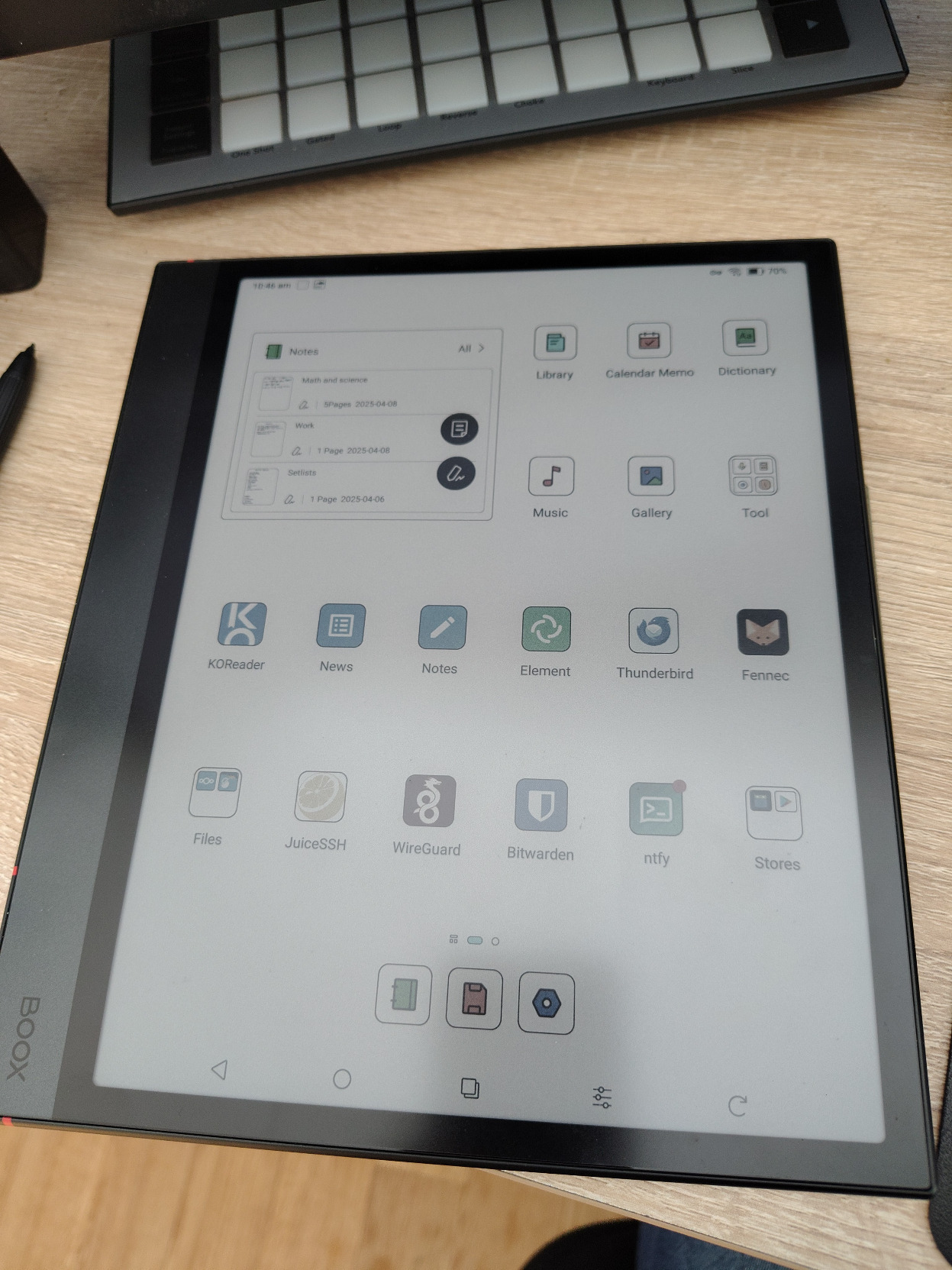
Less than a week into my new #BOOX Note Air4, and I already don’t know how my life was before it.
This device is amazing. After years spent using old B&W notebooks and synchronizing them to SD cards, I have a notebook that runs a modern version of Android, and with a Notes app that actually supports WebDAV synchronization - which means that my notes will be available as PDF files on my Nextcloud instance as soon as I close them.
Since it runs Android pretty much without restrictions, I’ve also proceeded with installing F-Droid on it and Fennec, Element, my RSS app, Nextcloud Notes and ntfy.
Oh, and since it’s basically an Android tablet with a color e-ink screen and 6GB of RAM you could also watch videos on it (but again just because you can it doesn’t mean that you should).
And its AI features are also nice an unintrusive. Wrap some handwritten stuff in a square/rectangle, and it can easily be converted into text.
And this device really shines with the #KOReader app. It turns it into a powerful e-book reader, and with #Wallabag, RSS feeds and OPDS support (synchronized with my personal library running on #Ubooquity) you can’t ask for more.

I have often stated that the bullet on that campaign day should have hit Trump’s head rather than shave his ear.
I firmly stand by it.
I firmly believe that Donald J. Trump deserves to die, and in a very painful and public way in order to discourage any future wannabe dictator - just like the violent deaths of Mussolini and Hitler have discouraged dictators in Western Europe for nearly a century.
I firmly believe that there’ll be no way of getting rid of Trump through democratic means, even if he loses the next election, and that the 6th of January was just a small anticipation of the civil war that will come.
I firmly believe that, if given the choice between the death of thousands or millions in a civil war, or in a military invasion of Canada/Greenland/Panama, or the destruction of other economies (and their own domestic economy) through reckless tariffs, and the death of a single human being, we should choose the death of that single human being without even thinking twice.
I firmly believe that the principles of liberal democracy don’t apply to those who despise them and leverage them just to get into power, that Popper’s paradox of tolerance is valid today more than ever, and that violence is the only language you can speak to those who only understand violence.
I firmly believe that a bully who is used to get his way through threats and extorsion isn’t fit to be a leader, even if he manages to convince half of the population of the contrary.
I firmly believe that being bossy with your moderate allies and being weak with authoritarian bullies is an act of weakness, not of strength.
I invite my fellow American friends to take on the arms now, before Trump’s authoritarian metamorphosis is complete, before America becomes a one-man show with institutions filled up with yes-men, before the damage done to its reputation becomes impossible to fix, and before it permanently loses all of the friends it has made over the course of a century.
Democracy is much more fragile than we, spoiled by 80 years of peace, may think.
What happens when you let prices of services float in a free market fashion?
That those who have interest in prices going up will inevitably push the prices up, until common people can no longer afford those services.
It’s been happening in the Netherlands for housing (median income can’t afford a house in any of the major cities, as most of housing supply in Amsterdam and The Hague is controlled by private businesses that have interest in pushing prices up), it already happened with childcare (the scandal that brought down the previous Rutte government), it’s happening with healthcare (the cartel of insurances increases prices every year in a synchronized way at rates that are much higher than the average salary increase), and it’s now happening for public transport too.
The “americanization” of the Dutch economy is doing permanent damage to the fabric of our society.
When you have people in a supposedly advanced country who can no longer afford housing, nor childcare, nor healthcare, nor transport, all while inflation remains higher than the EU average and many can’t even afford food, all while you get more and more aggressive homeless people on the street who have been kicked out from the economy, you have the perfect recipe for political grudge, polarization, extremism and chaos.
And we know already how it ends up. When you start those races to the bottom, it’s rarely the progressive left that wants to boost equal opportunities for everyone that gets a shot at running things. It’s usually the ugliest identity politics that wins on the promise of giving you the things you need by taking them away from someone else - me-first, me-vs-them, urban-vs-rural, local-vs-migrant etc.
The triumph of a populist imbecile like Wilders at the past elections is probably just the beginning of a long-standing trend.
https://www.dutchnews.nl/2024/10/middle-incomes-also-struggling-to-pay-for-transport/