Avatar
Bert
9020fe7857bd2392d504beeb9e568776f507784fb5b5a94af7b5ef1ae9780289
BitcoinBrabant | BitcoinBloem

3 months ago I paid to upload the first interview I ever did, because I wanted it to last for the future. Paid in bitcoin and streamable since. It’s interesting to pay for hosting your content. You appreciate the physical storage again like the early days when building a website in html in your notepad. Paying to host it and upload it. The version on YouTube is watched more often, but it comes with a cost. A cost that most people don’t see or understand. https://www.flare.pub/w/naddr1qqrk2dzn94kkudgppamhxue69uhkummnw3ezumt0d5pzqqcum72xramg3wxvefua8hlfnws5a090u7wcfp4d6vrv3c79rm3lqvzqqqy9hvqqhxvq

Lets see if we can make it happen on zap.stream today. 16.30 CET. Also we’ll try to broadcast from https://youtube.com/live/PdlsNEmOW0o

nostr:note1lk58pcmktyrhchhyxh3rfmnhqql7zaxtrwt57p6j4elcr3szh7eqmuenrv

The nice thing about the hack0 built is that there is no SD cards involved. I agree it’s one of the weaknesses of the raspi. Also depending on the node software you run, and you use a fan it can be really noisy. If you use passive cooling on the pi that was not put there properly it can overheat. We’ve seen quite some pi failures with different causes. A hack0 is a totally different kind of build which I think many would appreciate.

Later this year we are planning to start offering plug and play nodes and payment servers. We are currently testing nostr:npub1l5pxvjzhw77h86tu0sml2gxg8jpwxch7fsj6d05n7vuqpq75v34syk4q0n beauties. The ronindojo bokuto and btcpayserver enclosure. Hack0 hardware with 2TB for the node and 1TB for the nostr:npub155m2k8ml8sqn8w4dhh689vdv0t2twa8dgvkpnzfggxf4wfughjsq2cdcvg. This hardware should last longer (~decade) than our raspis (1-3 years they only lasted).

We’ve been testing quite some setups but these are real beauties, proper proof of work which i can really appreciate.

The node took ~5 days to sync the bitcoin timechain. There were some issues with starting the plug and play btcpayserver, which we’ll solve soon.

It’s great going through these testing cycles and be in toch with fellow pleb builders in Europe. I’m really happy to see the free open market is so decentralized. Can’t wait we start supplying more plug and play sovereign devices soon. We are most likely going to need them in the future.

Several important additions to our bitcoin network could be in there. Either a node or a miner or both… I’m finalizing a full node sync again today… soon you’ll want that one too 😉

You have to assume nothing you speak near an online device with a microphone is private. Just like the messages you send.

Replying to Avatar Rune Østgård

Why I hate 1991

A story about two doctrines, the US neocon hegemony and the Norwegian battery, and a tough personal awakening.

32 long years

On Monday 24 July 2023, 32 years after the Soviet Union broke up, the whole thing about what has happened on the geopolitical scene and with my beloved Norway, begins to make sense to me. And therefore, I wrote this note, as a preliminary conclusion.

The braindead conscript

I was 19 years old when the Soviet Union collapsed. At the time I was serving my obligatory year as a conscript in the army in Skjold, up north in a region called Inner Troms.

When the news about the chaos in the Baltic countries broke out, the Norwegian defence system was put on high alert, and I remember that permissions to visit our families were withdrawn.

I wish I knew more about the world of politics back then. I wish that the 12 years of public schooling had taught me about the three pillars of politics:

. Monetary policy

- Security policy

- Energy policy

I had been one of the best in our class all the way. But in hindsight I hadn't learned anything about how society and politics really works. In this sense I was a braindead boy, a pawn and a conscript freezing my ass off somewhere deep in the Norwegian woods.

And of course, I understood zero of what was going on around me, except that we knew that we might have to defend ourselves against some crazy soldiers from Soviet Union.

The awakening

My awakening to what was going on at that time comes after having:

- written a book about inflation last year,

- been part of the public debate on monetary policy in the last few months, and

- reflected upon a recent interview with Jeffrey Sachs on The Duran Podcast.

The interview was the final piece in the puzzle. Sachs talked about how he had been part of a team that tried to facilitate cooperation between Russia and some of the East bloc states. He had thought that saving them from a hyperinflation scenario was everybody’s immediate concern. Something which turned out not to be correct, and which he at that time didn’t understand why.

The hosts, Alex Christoforou and Alexander Mercouris, who both are experts on geopolitical issues, were perplexed. This was the first time they had heard about it.

And so, it was for me. But, finally after all these years, I now begin to get a glimpse of what was going on in the world at that time, why it happened, and what it caused.

When I understood this today, I first became excited. Then I felt anger. And I also felt sorry about the boy from 1991, who had been kept so solidly in the dark.

But after having written this piece, I’ve managed to calm down, and to start looking forward again.

Let’s now have a look at what was going on back in those days.

The Americans’ dilemma in 1991

Sometime in the late 1980s/early 1990s, it likely dawned upon the US government and its major constituents that the real question was:

“How can we assure that we get the financial benefits of printing of US dollars in a rapidly changing world with a collapsing Soviet Union?”

The situation involved great risks and even bigger opportunities.

One of the risks was the possibility of monetary deflation in the US.

The Fed and the government had allowed cheap credit to be used as a remedy to the stock market crash in 1987. By doing this, they kept the housing market alive, and the financial markets could then also move forward with the help of some of Fed governor Alan Greenspan uppers and steroids now and then.

In this situation, both debtors and creditors risked huge financial problems if things got out of hand internationally and many new countries begun to demand more and more USD.

If the domestic US economy became drained of USD, that meant monetary deflation and a spike in real interest rates domestically. This could cause havoc to an economy built on cheap credit and dollar hegemony.

How could the Fed and Wall Street be able to print enough USD in such a situation, without creating unmanageable bubbles in the markets, nationally and globally?

Another risk was that if the global reserve currency couldn’t meet the increasing demand for a functioning means of exchange, Russia would look for alternatives.

One alternative for them could be to default on the public debt and reintroduce gold as money.

Another more potent alternative could be to join the European countries, who were planning to create a common European currency, which later became the euro. The combination of the combined energy resources of Russia and Norway, a large common market and a common currency could easily become problematic for the US government.

In both scenarios, the USD could lose its reserve currency status.

If that happened, the US government would also lose its military supremacy as well as its No. 1 export commodity – the dollar.

The neocon solution

Today the following US policy measures, which were carved out by the neocons, and which begun in 1991, stand out:

- Saving Poland and other key East Bloc countries from hyperinflation by guaranteeing for their public debt, combined with bringing them into the EU and NATO fold.

- Turning down Jeffrey Sachs' plan to stabilize the Russian ruble with the same measures as were used to save the economy in Poland, thereby causing hyperinflation in Russia and many years of political instability inside the former superpower in the east.

- Convincing China to speed up economic reforms with the help of dollar loans from US investors and buying up US treasuries, in exchange for producing cheap goods that could be imported by the US, paid in USD.

- Relaxing house lending standards in the US, at the same time as obliging publicly funded Fannie Mae and Freddie Mac to lend handsomely to the poor, thereby creating a vehicle that made it possible to funnel newly created USD into the national and global economy.

All of this happened extremely quickly – in 1991 to 1992.

These measures created a financial policy framework for the US that made it possible for them to manage the monitory policy in a relatively controlled manner.

At least in the short term…

Happy

The neocon’s policy could please all the major stakeholders, thereby creating some sort of an equilibrium, domestically, as well as internationally:

- Wall Street, who has possessed the most power at least since the creation of the Federal Reserve in 1914, would benefit handsomely.

- The US government would keep its position as rulers of the world.

- The military -industrial complex would profit greatly if things got out of hand and brute force had to be used.

- The EU could prepare onboarding of many new member states with the likely blessing of the US

- China’s political elite could show the Chinese and the rest of the world how quicly and successfully they could lift its country out of poverty and become a real international contender.

Everybody would be happy.

That is – except for Russia.

Short-term success, long-term turmoil

Although these measures could be seen as successful in the short term, they caused a high number of unintended consequences in the longer term.

We all know about the many wars and the financial instability we've had globally in the 32 years since 1991.

However, I will in the following turn your attention to Norway and have a look at the role that my country got to play when the shit started to hit the fan during the financial crisis in 2008.

The legacy of Jens Stoltenberg

Smack in the midst of the Great Financial Crisis, the Norwegian Prime Minister Jens Stoltenberg and his government launched the idea in March 2008 that "Norway can become Europe's battery".

The concept was that Norwegian wind and hydro power could solve the coal- and nuclear dependent Europe’s need for access to safe, climate friendly, and renewable energy.

This year also marked the beginning of 15 years of more or less systematic debasement of our currency, the Norwegian krone (NOK). It has since then lost roughly 50% of its value against the USD and 25% against the EUR. The last year the NOK has become a veritable shitcoin.

As we shall see the "battery for Europe" doctrine has also been put into place in the exact same timeframe.

In 2013 the government made the decision to build two new high-capacity power cables, one to the UK and one to Germany. This was a large and costly project that would take many years to complete.

In 2014 Stoltenberg switched roles and became Secretary General of NATO. This was the same year as the coupe in Ukraine, when the neocons in the US government started their big push for Ukraine membership in NATO.

Recent Norwegian energy policy

The power cables to Germany and the UK were put into operation in 2020/2021. In exchange of export of electricity to the Germans and Brits, we immediately imported their electricity prices, which were significantly higher.

As a result, electricity prices spiked at once in the southern and middle part of Norway, causing an uproar among the voters.

Our country has been built on cheap energy, but the cables marked an end to this era. People and companies had to adjust to a reality with sky high electricity prices compared to what we used to have, and many small and medium businesses have folded as a direct result of the cables.

This sudden electricity tax, which it became in reality, has been complimented with an insane use of subsidies from the Norwegian government to various renewable energy projects in the form of land and ocean wind farms, battery projects and much more.

Foreign large corporations have been the main recipients of the subsidies, which are financed over electricity bills to Norwegian consumers and corporations, as well as in the form of taxation.

Devaluation and energy export

The relationship between the Norwegian monetary policy and our energy policy is straight forward: Devaluation of the NOK makes it cheaper for European countries to buy energy exported from Norway.

The political motive for the battery doctrine

It might be that you believe that this is something that Norway has done as some part of a European project. Our current PM, Jonas Gahr Støre, who IMO best can be described as a climate fanatic and Europe romantic, might hope so. If you instead “torture” Jens Stoltenberg for answers, you would probably come closer to the truth.

The last few decades Germany has become increasingly skeptical to US foreign policies. Germany saw the possibility of becoming more independent from the US, by making closer ties to Russia. Gas pipes were built from Russia to Germany, and they made long term contracts for supply of gas.

The only problem was that the Germans were stupid enough to shut down the country’s own nuclear plants, making them even more dependent on gas supplies from Russia. It’s beyond any doubt that this caused panic and outrage among the neocons in the US government.

Washington, not Oslo

Norway has been a vassal state under the US since the end of WWII, and it’s highly likely that both ideas, the currency devaluation as well as the battery doctrine, came directly out of Washington. The Norwegian citizens were supposed to be the ones who would have to pay the price for keeping European countries from trading with Russia, and thereby prolong American hegemony.

In this way the Norwegian taxpayers and our hydropower dams became financial batteries in the US government’s fight for protection of the status of the USD as the global reserve currency.

We can create our own future

As what seems to be a proxy war between the US and Russia in Ukraine slowly seems to come to an embarrassing conclusion for Biden, Nuland, Blinken and the other neocons, the Norwegian citizens continue to pay a high price. Electricity bills still put companies out of business, and cause hardship to the people. And the madness related to battery and ocean wind projects seem to have no limit.

In this situation I cannot but help myself from hating 1991. For me it will forever stand as a symbol of my ignorance and a public education system that had created a brainwashed kid who knew nothing about what was going on around him.

On the other hand, I cannot let this hate burn me up from inside. It’s no use. I’m wasting my energy. Instead, I must focus on the future. The question I have to ask is the following:

“How can I make sure that today’s kids don’t end up in the same situation as I was in?”

Because I am firmly of the opinion that we can shape our own future. The neocons’ hegemony is probably about to end, and with that the, we – the Norwegian people – suddenly have options:

Should we just shut our mouths and glue ourselves to the mast of a sinking ship?

Or do we want to start discussing our future openly, and try to find out what the best way forward for Norway is?

I know for sure what the brainwashed conscript from 1991 wants. He’s done with being kept in the dark. And he wants the public debate to begin as fast as possible.

How about yourself?

Is it true that ignorance is bliss when we are talking about your kids’ future?

Do you want them to be the next to stand in the cold somewhere up north on the border to Russia, or as soldiers being dispatched to a faraway country, not knowing anything about why they are going?

I think not.

We cannot leave this discussion to the experts and the politicians. It’s far too important for that. If they get the opportunity, they probably won’t think twice about continuing to use you and your offspring as their batteries.

Choose wisely.

What a post! Norway is a land of abundance sacrificed for geopolitical gains.

We’re the official reseller in EU for foundation passport and blockstream jade.

Replying to Avatar Greeny

I’ve only ever used a ledger nano x

And a blockstream Jade.

As far as signing devices go …

Had the nano for like a year, enjoyed using it. It worked. It was easy af to use.

I was a lil annoyed every time I was forced to see shitcoin bull shit.

But other than that I liked it….

Then when all the drama went down and it was like all anyone could talk about… ditching ledger etc…

So I was on the fence

I was like damn I payed for this thing. So I don’t wanna be wasteful and just throw it away.

But then I was tuned into some bitcoin conference… can’t remember which one… and I think it was the ceo of ledger speaking on stage. In a panel or something

They took questions from the audience at the end and someone asked the ledger dude…

They said something like “when bitcoin only?? “… accusing them of being shit coiners basically…

And the guy responded

Very arrogantly

And just with this whole shitcoin/ rug pull persona that he had going on 😂

Said something like “ if u don’t like it, then use a different hww”

I was like ok bet MF

That very second I grabbed all my ledger shit and chunked in the trash…

Obvi wiped my funds clean first…

But yeah that was the straw that broke the camel’s back when I was debating on keeping that signing device.

That smug shitcoiner dick was suck a cuk

I was like fuck that company…

Well everyone was pretty much saying that. But when that door closed the open source door opened

I love jade

Not only do I not have to see all the shitcoin trash. I feel better about the open source- ness of the situation

And more secure imo

And it was way cheaper too

We shipped hundreds of jades. With over 8 million pieces of ledgers distributed, a lot are still to change device in the future. Once people understand, they’ll move.

First of all I have a personal problem with them as they leaked my data in the ledger breach.

There are multiple risks with ledger:

- data harvesting, most people use their software and their node. This means ledger links every transaction to your IP address.

- Recover, once ledger recover was launched you could give access to your seed. But because it’s closed source software you have no clue if they already have access…

- the active shitcoin promotions on their application makes it painful for the ones you directed to ledger, many people end up shitcoining which is a loss of life energy and creating a gambling addiction for many

Therefore after years of discussions we decided to become a reseller for signers with the following properties:

- bitcoin only

- air gapped

- open source

We delete your data directly after shipment. Almost every day we ship signers, and every time I pack a Jade, Passport or Seedsigner I believe someone will secure and store their bitcoin safely. With every shipment the network becomes stronger. And we all are a step closer to a sovereign, hard monetary base layer society.

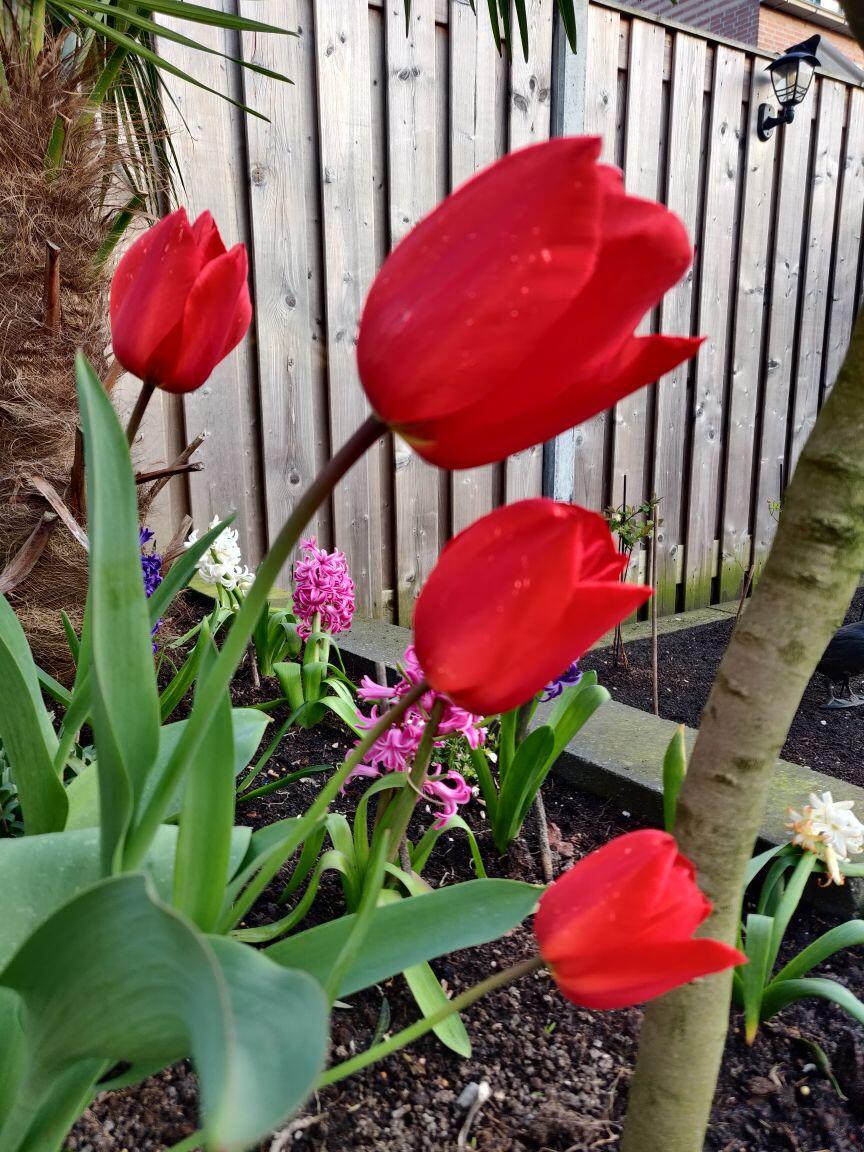
Gm, PV, happy Easter fellow plebs. These bitcoin dried tulipbulbs came out beautifully. Cut them from the garden 3 days ago and put them in water they open up really nicely for this Easter morning breakfast with the family.

I know you all don’t have the yellow ones, but enjoy the ones in your garden! We’ve sent out a lot across the planet and I believe they are all in full bloom now.

If that’s the case please post a picture of them below 👇

Enjoy your time with the fam!

I love how bitcoin history is quite well documented. At some point you run out of government influencers, they either fail or join the revolution. The ones that failed can easily be found. The ones that join understand they are on the right side of history.
How were they? Vaclav is rather lengthy with some parts I miss. Eric’s book you’ll read multiple times and not be bored… there’s so much to think about and come back to.

Replying to Avatar zhenya

Cryptoeconomics by Eric Voskuil is the most challenging Bitcoin book I’ve ever read.

It challenges my naivety, comprehension, and belief.

One such challenge is it’s not Bitcoin if it’s not able to exist on the black market - where the white market is the one that is allowed to exist and the black market is the one that exists outside of control/interference/approval.

I believe this can be extended to our all having our own self defined white and black markets that exist in our little heads. This creates some very inconvenient truths like our enemies can use bitcoin to do harm to us or those we love, and we can’t stop it.

Eric points out that if it’s not censorship resistant it’s not Bitcoin, full stop. Any censorship makes it something other than Bitcoin. And I agree.

With that, while recognizing there are dimensions to this I am far from understanding, I’m not in favor of nostr:npub1qtvl2em0llpnnllffhat8zltugwwz97x79gfmxfz4qk52n6zpk3qq87dze censoring ordinal transactions.

Perhaps ordinal transactions lead to a future node problem. Indeed the block space could be utilized for other purposes today and prospective quality bitcoiners in need of freedom money are sadly being priced out of the market earlier than they should be.

But as for me I see these as insufficient justifications for violating a core tenant such as censorship resistance. It’s like breaking free from a fraudulent/corrupt environment only to bring your preferences and systems to corrupt the new. What is the point in getting the aspiring bitcoiner that needs Bitcoin a coin that was only gained by means of censorship? In the long run is anything changing?

There has to be other ways to solve the problems that the ocean fella is worried about without breaking the constitution of Bitcoin.

I will be watching nostr:npub1qtvl2em0llpnnllffhat8zltugwwz97x79gfmxfz4qk52n6zpk3qq87dze sponsored Unconfiscatable conference this weekend so maybe I’ll feel different Monday.

I don’t know the answers but I’m looking for them. If you’ve got em please share. ✌️

#Bitcoin

#Ocean

Just zapped you for a coffee. Will you be joining the adopting bitcoin Arnhem conference? You lay out the things that we need to discuss.

Is there any way to do a livestream on Nostr? We’re having our bitcoin Eindhoven meetup interview and are planning to livestream it. Where would you prefer to watch the livestream?

There’s quite some pleb hash heaters… Sometimes they are shown to the public:

nostr:note1zsnjjp2p0js6sya55ssxmr8ddtztxgh9ngh8j82u2umtsd83ujzsmf3d3v