

It is a way for two relays to know which events one has and the other doesn’t, so that you can sync them.
You can use a local relay / cache and keep it in sync with your actual relays easily. And it’s super fast!
If using JS, take a look at @welshman/net for a good implementation.

Makes sense that Google built a whole frontend framework on top of it.

To analyze and annotate a conversation, if you often say the wrong thing 😄

Have any relays (and clients) implemented it already?

For me the “old reliable” is react/redux in part due to familiarity, in part cause it solves the problem I value the most - decoupling logic and making it easy to locate where some state update is going wrong.
Something I learned was to not try new tech when building a product I don’t understand yet - and since I spend more time prototyping, I go for the boring stack I’m most productive in.
I think it’s all a question of which kind of problems you want to have…
A complex app will have lots of state to manage no matter what. With vanilla JS you’ll have to find a structure for it yourself. Frameworks bring you a structure and a bunch of tradeoffs.

Hadn’t heard about rimmeljs 👀
Used stencil a bit and it was quite enjoyable. In rust I played with yew and a bit of leptos, but you end up having to write a lot more stuff yourself.
What are you looking into, post svelte?
Ah! I was taking a look at Coracle’s code some time ago and thinking “maybe I should learn this Svelte thing” 😅
Call me old fashioned, but my go to is still react + redux + redux-saga. Yes it’s boilerplaty, but isolates UI code from state management, from side effects, which makes debugging much faster (no magic). That said, if I was optimizing for performance I’d maybe have to reconsider.
I’m experimenting with building a simple wealth tracker, where you save encrypted records of your assets’ value to a local relay (indexedDB), and sync to a trusted relay.
If your nsec is compromised, the ideal would be for the data to not be revealed without an extra key.
If I’m not mistaken, the scheme you shared allows me to achieve this, since you’d need the device as well to decrypt. And I would add a passphrase, for when the device is compromised.
Am I doing something stupid? 😅
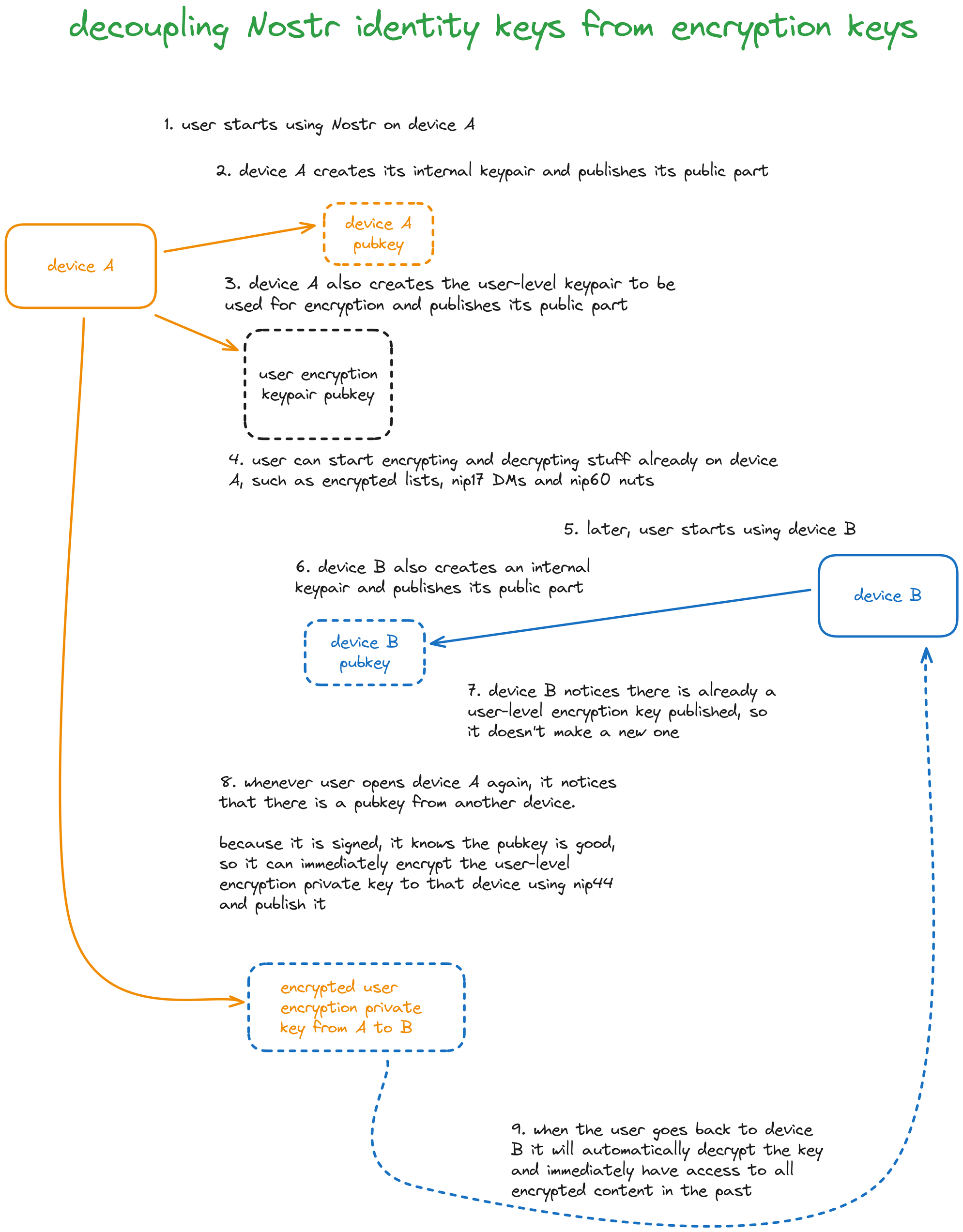
I’m working on a prototype where I was nip44 encrypting the content directly (and not feeling comfortable about it), so this couldn’t have come at a better time 🙌

The way I understand it, these are internal key pairs for the device only. You’d be publishing their pubkeys with your normal nostr keys, so you’d find the other devices pub key cause it would be an event signed by you.
One click wallet
nostr:note1ltdtkg77kgz9r8u98kp9wyqpfusyanvdeqzh9v7gwk3vt2suve7s8s5rxy


God morgen! Do you do that with a stencil or something?

Found this one very insightful:
naddr1qq25gnzpveay5jns29z9xdrkdgehw5mvv46k6q3qarkn0xxxll4llgy9qxkrncn3vc4l69s0dz8ef3zadykcwe7ax3dqxpqqqp65wuucp8v
nostr:npub1hee433872q2gen90cqh2ypwcq9z7y5ugn23etrd2l2rrwpruss8qwmrsv6 was posting about building a gifs SDK today

Ycombinator might select for people who actively misunderstand it.
I once tried to convince the CEO of Sketch that all design tools should have command lines, like AutoCAD. He was not convinced 😅
nostr:note1drma7856dtp5x6e048k790797atph2hdwrk52w66qs5lmyawmq3qaz0v6m