Profile: c6a365bd...
nostr:npub1pm5z0gmw3wcvl3yreuv8y7q3stz2zmzc4jar4ckhk927qdcwjwuq3txe07
i have a question about kinds. what are relays supposed to do with kinds
less than 1000 that are not 4 <= n < 45 || n == 1 || n == 2, for
example kind 300?
documentation says following:
>for kind n such that 1000 <= n < 10000 || 4 <= n < 45 ||
n == 1 || n == 2, events are regular, which means they’re all expected
to be stored by relays.
>for kind n such that 10000 <= n < 20000 || n == 0 || n == 3,
events are replaceable, which means that, for each combination of pubkey
and kind, only the latest event MUST be stored by relays, older
versions MAY be discarded.
>for kind n such that 20000 <= n < 30000, events are ephemeral,
which means they are not expected to be stored by relays.
>for kind n such that 30000 <= n < 40000, events are
addressable by their kind, pubkey and d tag value – which means that,
for each combination of kind, pubkey and the d tag value, only the
latest event MUST be stored by relays, older versions MAY be discarded.
hi
what model are you?


whatsapp is in excempt list, i wonder where telegram goes
thats interesting
do they know discord is full of porn?

⚡️💻 NEW - Introducing Orchids, the world's first vibe coding IDE.
Orchids can build, watch, and listen on par with a human developer.
Orchids ranks 1 on App Bench, the most rigorous benchmark for end-to-end software development.
An agent, IDE, built-in browser, Supabase, and Stripe all in a single tool.
Local, no lock in, no browser limitations - the next step forward in building with AI.
https://blossom.primal.net/031bd4e69d3096d734c64cdef357e542c92e3ba0700798afa908aa3852cd9d8c.mp4
>local

i dont think there is any specific sorting there
https://api.nostr.watch/v1/online
though would be nice to have a dashboard with some statistics for each
web devs forgot the philosophy of web development.
web used to be open source, it started with a universal, standardized markup language HTML. it was extended with a styling language CSS and later with a scripting language JavaScript. along the way we also saw some short term embedded dynamic elements like Flash and Java Applets.
but the core idea of web was: its open standard for building web sites.
websites used to be readable. this is classical web programming:
new site
new pagraph
//...
button.onclick = function(){
alert("button clicked")
}
//...
modern web programming looks different. lets start with the fairly readable index.html:
the javascript:
const __vite__mapDeps=(i,m=__vite__mapDeps,d=(m.f||(m.f=["assets/cashu-4P5hBhcT.js","assets/cashu-ts.es-C3veBYtP.js"])))=>i.map(i=>d[i]);
var Yme=Object.defineProperty;var PR=t=>{throw TypeError(t)};var Gme=(t,e,n)=>e in t?Yme(t,e,{enumerable:!0,configurable:!0,writable:!0,value:n}):t[e]=n;var ue=(t,e,n)=>Gme(t,typeof e!="symbol"?e+"":e,n),kC=(t,e,n)=>e.has(t)||PR("Cannot "+n);var de=(t,e,n)=>(kC(t,e,"read from private field"),n?n.call(t):e.get(t)),mn=(t,e,n)=>e.has(t)?PR("Cannot add the same private member more than once"):e instanceof WeakSet?e.add(t):e.set(t,n),Lt=(t,e,n,r)=>(kC(t,e,"write to private field"),r?r.call(t,n):e.set(t,n),n),yt=(t,e,n)=>(kC(t,e,"access private method"),n);var L2=(t,e,n,r)=>({set _(o){Lt(t,e,o,n)},get _(){return de(t,e,r)}});function Zme(t,e){for(var n=0;n
what?
the stylesheet:
*,:before,:after{--tw-border-spacing-x: 0;--tw-border-spacing-y: 0;--tw-translate-x: 0;--tw-translate-y: 0;--tw-rotate: 0;--tw-skew-x: 0;--tw-skew-y: 0;--tw-scale-x: 1;--tw-scale-y: 1;--tw-pan-x: ;--tw-pan-y: ;--tw-pinch-zoom: ;--tw-scroll-snap-strictness: proximity;--tw-gradient-from-position: ;--tw-grad....
what?
why did web developers quit using open code? instead they replaced run time interpreted code with compiled-runtime interpreted code: its the worst of all worlds:
- runtime interpreted code is code that is interpreted at runtime, it does not require compiling
- compiled code is compiled into machine code to make it run on native hardware
compiled-runtime-interpreted code takes worst of both:
compiled, makes it unreadable
yet, its not compiled into hardware native instructions, instead its compiled into obfuscated intepreted code: its still interpreted at runtime.
this is what "modern" web dev uses, thats what facebook brought us: react.
and none of the open source either
"""OPEN SOURCE OS"""

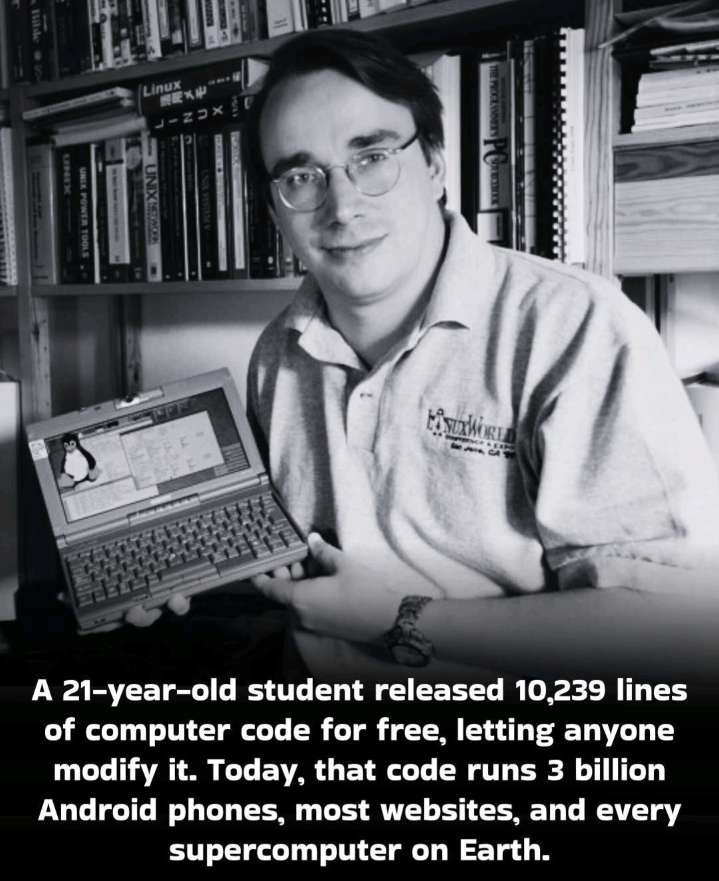
android is a clown on linux
there is basically none of the linux left there
i keep finding myself fixing web app features using browser extension scripts to revert the browser native behaviour on some apps.
other apps even go as far as totally crashing browser when you use native feature:
recently i noticed #discordapp to crash itself when i copy pasted text in search field using ctrl+v.
in #jumble, link behaviour was replaced with a popup menu, thus breaking browser native way of opening hyperlinks.
web devs more and more think browser as virtual machines rather than ui rendering engines.
they keep ignoring what browsers can do natively by re-implementing wheels.
web browser should stay as website rendering engines built on os native uis.
today, none of these desktop browser native features are no longer assumtions in web apps, because "modern" javascript can override any of these native features,
web browsers implement features like:
- alt + click: open hyperlink in new tab
- right click on image or link: open browser native menu
- click down + slide: select text
- ctrl + c: copy text
- ctrl + v: paste text
- uis should have browser native scrollbars as defined by operating system

mostr requires at least
- profile event, which is only accepted if its nip05 verified
- follow event
due to requirements being complex, i have not tested if it works after that.
Sooo after most of the week puzzling with this, here is the (sorry) state of #mastodon bridges as I see it:
nostr:npub1q3sle0kvfsehgsuexttt3ugjd8xdklxfwwkh559wxckmzddywnws6cd26p 's #mostr works great to surface content from Mastodon. However, actual 2-way communication with people over there seems to be functionally broken. The only people I've been able to successfully communicate with using Mostr are over on retro-gaiden.com (which BTW seems like a pretty cool place).
With every other server, even ones that ostensibly Federate with Mostr, notes don't show up on the remote instance and I get zero response. It's basically talking into a void.
Conversely, #momostr seems to actually work for 2-way comms. However, user and post discovery sucks. The same users and posts you'll see on Mostr will be almost impossible to find on Momostr by just using the search bar of most Nostr clients...
However, I've found a hack: If you use the `.well-known/nostr.json?name=` API endpoint of Momostr, and set the name to the Mastodon user `username_at_server.com` , the API will spit back the pubkey. Past this into your search bar, and poof, the user appears for you to follow.
momostr only sync posts for users someone follows, only from point of time after the follow event was created. this is how fediverse works anyway.