Avatar
Who, What, When, Where, How, and Why?
c7bdd7184332398ce0762d011eebec2211260b1fc6513c2f958ab4d7c3ca8677
Asking questions. Mostly rhetorical.
Replying to Avatar MUHTEŞEM

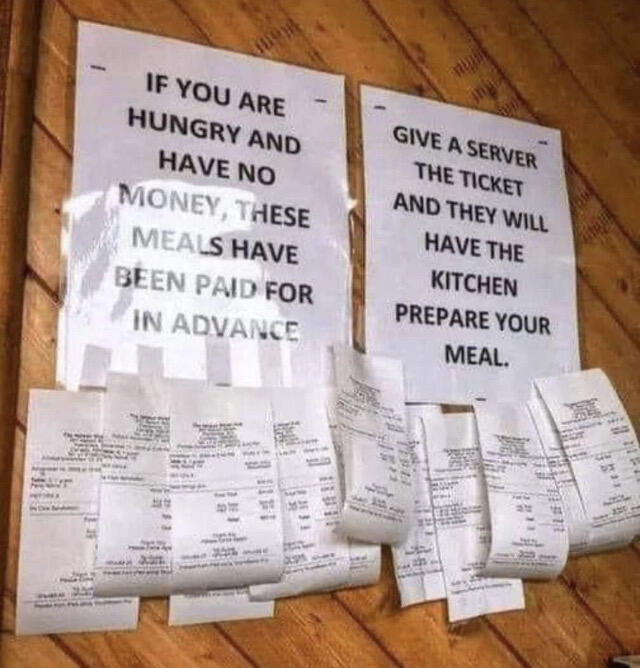
☺️ There’s a little coffee shop where two people walk up to the counter.

“Five coffees, please. Two for us, and three hanging.”

They pay, take their two coffees, and leave.

Curious, I ask the barista, “What’s a hanging coffee?”

“Just wait, and you’ll see,” they respond with a smile.

A little while later, two girls come in. They each order a coffee, pay, and go on their way. Then, three women order seven coffees: three for themselves and four hanging.

My curiosity deepens. What’s with all these “hanging” coffees?

Then, a man in worn clothes, who looks like he’s fallen on hard times, approaches the counter and asks, “Do you have a hanging coffee?”

“Yes, we do, sir,” the barista replies, handing him a hot cup of coffee.

I finally understood. People are paying in advance for coffees that will be served to anyone who can’t afford one.

This heartwarming tradition began in Naples, but it’s now spreading to cities and towns across the world. In some places, it’s not just hanging coffees—you can leave sandwiches or even a full meal for someone in need.

Imagine if we all embraced this simple act of kindness in our own communities. A small gesture like this could make a world of difference to someone’s day, or even their life.

Let’s start bringing this tradition to every city and town. One small act of generosity could ripple out and touch countless lives in ways we can’t even imagine. #Nostr #Bitcoin #coffeechain #kindness 🧡💜
Replying to Avatar Michael Matulef

Today, little is left of this ethic of private property and its anti-government vigilance. Although they now take place on a much grander scale, governmental appropriations of private property owners are overwhelmingly regarded as legitimate. There is no longer a general public opinion that regards government as an antisocial institution based on coercion and unjust property acquisitions, to be opposed and ridiculed everywhere and at all times on principled grounds. No longer is it generally regarded as morally despicable to propagate or, even worse, to actively participate in the enforcement of acts of expropriation, and no longer is it the general opinion that one would not have any private dealings whatsoever with people who engaged in such activities.

On the contrary, instead of being laughed off the stage or met with open hostility or passive indignation, such people are respected as decent and honest men. The politician who actively supports a continuation of the ongoing system of non-contractual property taxation and regulation or who even demands its expansion is treated everywhere with respect, rather than contempt. The intellectual who justifies taxation and regulation receives recognition as a deep and profound thinker in the public eye, instead of being exposed as an intellectual fraud. The IRS agent is regarded as a man doing a job just as legitimate as yours and mine, and not as an outcast that no one wishes to have as a relative, friend, or neighbor.

- Hans-Hermann Hoppe

Does Hoppe make a good point? Maybe I can step up my ridicule and shaming of those who don't respect life, liberty, and property?

nostr:nevent1qqswvznjc2h64l92y4ul05p25663w0unwjkswc6xdx4k65e2cpv8n6cpzpmhxue69uhkummnw3ezumt0d5hsygza2jzvsjt84tpesmx4z2hcmnw4yseapyq6mwa4jgmqzxyy9qa2rcpsgqqqqqqs0qkth8

You are completely free when you have no fear anymore

V: It's time.

Evey: I'm ready.

V: look, all they want is one little piece of information. Just give them something. Anything.

Evey: Thank you, but I'd rather die behind the chemical sheds.

V: Then you have no fear anymore. You are completely free.

https://youtu.be/6qxQ2l1DC6Y

nostr:nevent1qqs9j38zqxmr0lntqrzuupjuvg6yja7d058tkmtle5gdw5c8kfn5upqpz4mhxue69uhhyetvv9ujuerpd46hxtnfduhsyg8u7u9ytnagzl42syaeh29rwht385ckna9z0u7u4s75jyfd7e7n0cpsgqqqqqqsscj3lz

Replying to Avatar The Beave

If I was ever going to ruin for a state level public office, here's what I would base my entire campaign on:

1. Ending daylight savings.

2. Ending the practice of property taxes being used to fund schools.

3. End income taxes and move to a higher sales tax on all good that are not: rent/mortgage, first vehicle for a household, medicine/healthcare/services, clothing items up to ~$250 (you can buy good steel toed boots or a decent enough suit for that amount of dirty fiat), and food (meaning actual food, not prepared or pre-packaged stuff; potatoes would be untaxed but a bag of chips would be subject to tax)

4. Reinstate 10th amendment controls on the state, meaning, the FedGov can get bent. Anything produced and sold within the state shall not be subject to any tax or regulation from the FedGov. Period. Run a local business? You will not have to pay federal income taxes. Part of this will be using the state level judiciary to defend anyone who is persecuted by the FedGov, and also passing laws to prevent any state or subjected municipal levels below the state from aiding and abeting any federal agency for any reason, especially the IRS or FBI, and installing civil penalties if any LEO or agency is found to collude with said deeded agencies or agents.

5. End civil asset forfeiture.

6. End qualified immunity and instate policy that all LEOs will henceforth operate under commonlaw practice as justices the peace and not revenue generation agencies. This will be accomplished primarily through requiring each officer to carry liability insurance. If they are uninsurable, they cannot continue in their position.

7. Increase penalties for fraud and corruption for all civil servants.

8. Break the backs of all public sector unions.

9. Move all computer systems in the state to Linux and FOSS systems and legally prohibit data harvesting and databases that breach public trust and privacy. This will include policy for bug finding, penetration testing, and extensive external auditing.

10. End all professional licensing requirements.

11. End all prohibitions on drugs and food. Want to do cocaine? Have at it. Want to eat raw cheese? Enjoy.

12. Eliminate restraints on judges to sentence criminals. Instate policy to punish crime harshly, and define crime as only actions that produce victims.

13. Declare that money is not taxable. Declare that BTC and precious metals are money.

14. Eliminate concealed carry licensing requirements. Make it easier to apply for one for purposes of reciprocity and insurance.

15. Pass the "Defend The Guard Act."

16. Pass an anti-geoengineering bill (just in case).

17. Pass laws restricting zoning enforcement to only properties that pass certain criteria (immediately adjacent domiciles, building a building that could fall and take out other people's property, facilities that are open to the public commercially, specifically not to include PMAs, etc.)

18. Formally recognize PMAs.

19. Limit any and all emergency powers by both time and extent.

20. Fund building several SMRs all over the state or allow private corporations to build them under an advisory committee.

I think that's enough for now. Mostly just thinking about a bunch of things. I'm actively anti-political, but, I still think about these things sometimes.

#randomthoughts

Lebanon: A Chronicle of Israeli Aggression – An Investigative Exposé of War, Occupation, and Violations of Human Rights

For over seven decades, #Lebanon has been a frontline in #Israel 's ongoing military aggression. As a Lebanese-born and raised individual, I cannot stay silent in the face of these atrocities. From invasions to occupations, bombings, and relentless human rights violations, the scale of suffering inflicted on Lebanon demands immediate global attention. This post sheds light on the systematic nature of Israel's actions against Lebanon and the shocking impunity that enables these crimes.

Chapter 1: The Nakba and the Roots of Israeli Aggression (1948–1970s)

The roots of Israel's aggression trace back to its establishment in 1948 by occupying #Palestine and the first Nakba, which displaced over 700,000 Palestinians. Among them, 100,000 fled to Lebanon, finding refuge in overcrowded camps. These camps, especially in the south, would later serve as pretexts for Israeli raids under the guise of targeting Palestinian fighters.

1968 Beirut Airport Raid

In December 1968, Israel bombed Beirut International Airport, destroying 13 civilian airliners in retaliation for a Palestinian attack, even though Lebanon had no direct involvement. The raid marked the beginning of a disturbing trend: targeting Lebanese civilian infrastructure without consequence.

Chapter 2: Israel's 1978 Invasion – Operation Litani

In March 1978, Israel launched Operation Litani, its first full-scale invasion of Lebanon, allegedly targeting the PLO. The consequences for Lebanese civilians were devastating:

- 1,100 civilians killed.

- 250,000 people displaced as their homes and livelihoods were destroyed.

This operation set the stage for Israel’s continued military presence in southern Lebanon, which would extend for decades.

Chapter 3: The 1982 Invasion and the Sabra and Shatila Massacre

Israel’s 1982 invasion, Operation Peace for Galilee, took the violence to new extremes. Advancing to Beirut, Israeli forces laid siege to the city, bombarding it ruthlessly.

- 6,700 civilians perished in the bombardments on homes, hospitals, and refugee camps.

- The total death toll over three months exceeded 17,825 – most of them civilians.

Sabra and Shatila Massacre

In September, Israeli-backed Phalangist militias entered the Sabra and Shatila refugee camps, slaughtering between 800 and 3,500 Palestinian men, women, and children. Israeli forces, stationed outside the camps, fired flares to illuminate the massacre, a war crime for which Ariel Sharon was found indirectly responsible – yet he faced no significant repercussions.

Chapter 4: Occupation and Resistance – 1985–2000

Following their withdrawal from Beirut, Israel maintained a harsh occupation of southern Lebanon for nearly 20 years, enforced by the SLA. The notorious Khiam Detention Center became a symbol of torture and abuse, where civilians were subjected to unimaginable horrors.

Hezbollah's Rise

The occupation also gave rise to Hezbollah, which led a fierce resistance that ultimately forced Israel’s retreat in 2000, after 18 years of occupation.

Chapter 5: The 2006 Lebanon War – Widespread Destruction

In July 2006, Israel launched a massive assault in retaliation for Hezbollah’s capture of two Israeli soldiers. The 34-day war left a trail of destruction:

- 1,191 civilians killed.

- Over 1 million displaced.

- 15,000 homes and critical infrastructure, including Beirut’s airport, were destroyed.

Cluster Bombs

In the final 72 hours of the conflict, Israel dropped over 4 million cluster bombs across southern Lebanon. These unexploded bomblets have killed and injured over 300 civilians since the war, making everyday life perilous in the region.

Chapter 6: The 2024 Escalation – Unprecedented Destruction

In September 2024, Israel launched Operation Northern Arrows in response to Hezbollah’s cross-border activities, unleashing unprecedented devastation on Lebanon. The toll on civilians, especially children, has been staggering.

By October 3, 2024, the total death toll had reached 2,083, including 127 children and 261 women, with 9,869 injured. The situation for Lebanon’s most vulnerable, particularly children, paints a grim picture:

- In the last 11 days of September 2024, more than 100 children were killed by Israeli strikes.

- On September 23-24, airstrikes claimed the lives of 558 people, including 50 children and 94 women in just 48 hours.

- Over the past six weeks, more than 690 children have been injured, with 400,000 children displaced from their homes due to the conflict.

Health Sector Impact

- 10 hospitals have been damaged, including a neonatal intensive care unit, compounding the already desperate healthcare situation.

- Since October 2023, 35 hospitals and clinics have been hit by airstrikes, resulting in the deaths of 77 health workers and further undermining Lebanon’s healthcare infrastructure.

Economic Ruin

- 24,000 buildings destroyed or damaged, resulting in $1.7 billion in damages, with projections estimating $5 billion by the end of 2024.

- 360,000 people left without access to clean water due to the destruction of 25 water facilities.

Additional Casualties

In a particularly devastating attack on September 17-18, strikes targeting communication devices resulted in 37 deaths, including children. In the town of Charqiyeh in eastern Sidon, an airstrike killed five children, adding to the growing number of young lives lost.

Chapter 7: Economic Collapse and Environmental Catastrophe

Israel’s repeated assaults have pushed Lebanon’s economy to the brink:

- Tourism losses: 310,015 fewer visitors in 2024.

- Poverty rates have surged to 82%, with the total cost of war estimated at $10 billion.

Environmental Destruction

Israel’s use of white phosphorus and other incendiary weapons has severely polluted water sources and agricultural land, leaving long-term ecological damage that Lebanon will feel for generations.

Chapter 8: Impunity and the International Community’s Failure

Despite a clear record of war crimes, Israel continues to act with impunity. Repeated calls for investigations by the UN have led to no meaningful consequences. This failure erodes not only Lebanon’s rights but the global principles of justice and human rights.

Conclusion: A Call for Global Accountability

For decades, Lebanon has suffered unimaginable losses due to Israeli aggression. From Beirut to southern villages, the damage is incalculable. The world must no longer turn a blind eye. We demand:

1. An immediate halt to Israeli attacks.

2. Independent investigations into Israel’s war crimes.

3. International accountability.

4. Humanitarian aid for the displaced.

5. Support for Lebanon’s reconstruction.

The time for justice is now.

#Nostr #Bitcoin