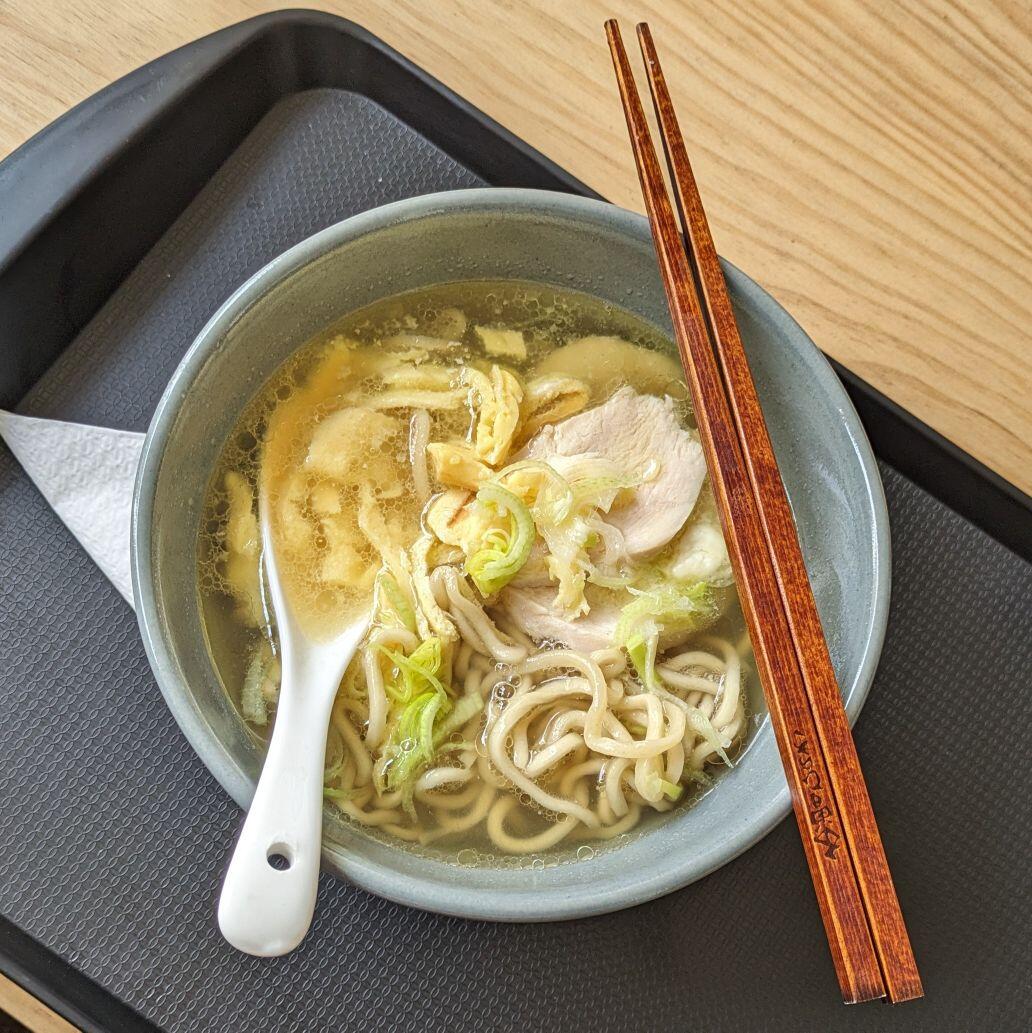
It's what happens when the food industry has been allowed to centralise. Just wrote a note about this actually: nostr:nevent1qqsrvcvk425u4r624e9h6qhhtc7r29mfuyert5lhmg20ran7weh5heqppamhxue69uhkummnw3ezumt0d5pzpnpve0cy5dxg2kvscdyenjf2rjrk5x5699ngk5j2h472906qdmz8qvzqqqqqqyt24ugk
Deep-fried eggplant monaka. Like ice cream monaka but piping hot and double the crunch. At the revamped Ronin, Hong Kong.


Hello! Welcome!
Centralisation of the food industry and bad/corrupt nutrition science - just wrote about it in my latest note.
It's 5am in Hong Kong, which means it's time for a 5am thought.
Been wanting to write this for a while: I see a lot of #foodstr notes (or just food-related notes) about seeking out health/healthy foods.
Firstly, nutrition is actually one of the most inaccurate sciences there is. That's because of ethics around running double blind experiments on human subjects — you can't trap a bunch of humans in a room and feed them nothing but tallow for a year and see what happens. A lot of nutritional "facts" are from animal studies (but rats still don't react 100% like humans), observational studies that by definition can't demonstrate cause and effect, or just "educated" guesses that reflect certain biases, be it just time, culture, or vested interest of any particular institution. That the foundation of contemporary nutrition science is based on the idea of the calorie should tell you enough about how much to trust this "science".
(In case you need a refresher: a calorie is the amount of heat required to raise the temperature of 1 gram of water 1° Celsius — anyone in the right mind knows that our bodies are not an "electric kettle for food". Also, for institutional biases about food, look no further than the American Heart Association's recommendation to avoid red meat. Read Nina Teicholz's The Big Fat Surprise (or find her ep on Joe Rogan) for more exposés of nutritional FUD)
So now that we've established that most nutritional knowledge is BS, the next question is, how do we know what's good (for our bodies) to eat? There are very few clear answers — after reading a ton of literature that says fats/carbs are good, another ton that say fats/carbs are bad, the only conclusion I can make is that oft-quoted phrase from Michael Pollan is the closest thing to clear, reliable nutritional advice I can find: Eat food. Not too much. Mostly plants. By "food", he means real, whole, unprocessed food.
Secondly, consider how the food is grown/raised. Crops grown in nutrient and microorganism-dense soil will be, in turn, nutrient dense. Crops from monoculture farms, or any farm reliant on synthetic input and synthetic "pest" control will naturally have less nutrients. Most contemporary farming now relies on synthetic input. That's why "organic" and now even "regenerative" farming, or ideas like permaculture have made a comeback, albeit in relatively niche circles compared to industrial foods.
The side effect of the industrialisation of food is the release of excess carbon in the atmosphere ie. climate change. Yes, modern farming causes climate change. Soil is a living ecosystem (just think about all the worms and fungi that live in good, healthy soil that looks like chocolate cake) — it stores carbon. Soil that has a lot of synthetic inputs kill off the microorganisms and becomes dry dust (that's how dustbowls form) with no life, hence no carbon stores. So: healthy soil, healthy food, healthy earth.
How have we ended up with so much industrial food that it's causing obesity rates to skyrocket and life expectancies to go down in first world countries like the US? It's simple: an economy/government that has allowed centralised players in the food industry. If there's any platform to talk about how centralisation = bad, it's Nostr, so I'm sure I don't need to explain much further.
Which brings me to the why I, a person who's dedicated their entire adult life to food media, is on Nostr.
So, fellow #foodstr plebs, this is why you need to find people who are growing/raising food right. The regenerative label is the new kid on the block but don't go by labels, ask questions, demand transparency. It's how we begin to dismantle the institution that is Big Food.
Sovereignty in money, media and food — that's pura vida, folks. Pura f**king vida.

I don't want to generalise about Nostr users being mostly male devs but this might really prove the "men eat more steak" thing to be true


Observation: a lot of #foodstr is the carnivore diet


Could try and ask Namae-san of L'Effervecence/Bricolage - he's super ingredients focused, the did will be amazing if he's willing to do it. I'll DM you my contact there.
5am thoughts on #foodwriting: I'm ok for you to gatekeep Chinese food if your song list at karaoke is over 50% Chinese. #foodstr
Tried to get back into pitching some #HongKong travel/food stories recently. Responses have been slow, if they've bothered to respond at all. I get the feelng most Western travel media outlets are shying away from stories about Hong Kong because of the increasing China FUD. Sad. #media #foodstr
Let's try something. All zaps on this note will go to #ZerofpodprintAsia, a charity that funds regenerative farming (soil carbon sequestration) to combat climate change (side effect is that these farms grow delicious nutrient dense produce). More info: https://www.zerofoodprintasia.org/
#charity #fundraising #foodstr #plebchain
Gah, typo! #ZerofoodprintAsia
Let's try something. All zaps on this note will go to #ZerofpodprintAsia, a charity that funds regenerative farming (soil carbon sequestration) to combat climate change (side effect is that these farms grow delicious nutrient dense produce). More info: https://www.zerofoodprintasia.org/
#charity #fundraising #foodstr #plebchain
Great new izakaya in Central, #HongKong, especially if you like sake and unagi (eel): Uza by Nikushou. Opened by a friend who's obsessed with good ingredients. He's got an awesome yakiniku restaurant too (it's called — you guessed it — Nikushou). Spenny but "real" food is rarely cheap!
#foodstr #plebchain


My first contribution to #foodstr: char siu from Sun Kwai Heung, Chai Wan, #HongKong, one of the best in the city. #nocharsiunolife
#[0]
