


These lists are a bit silly.
If we are gonna put Gold and Google on the same list, why not NYC Real Estate or Crude Oil or US Treasury Issuance?

Bisq is for BTC to everything else.
Haveno is for XMR to everything else.
The only overlap and competition is BTC/XMR and XMR/BTC.

Privacy is necessary for an open society in the electronic age. Privacy is not secrecy. A private matter is something one doesn't want the whole world to know, but a secret matter is something one doesn't want anybody to know. Privacy is the power to selectively reveal oneself to the world.
If two parties have some sort of dealings, then each has a memory of their interaction. Each party can speak about their own memory of this; how could anyone prevent it? One could pass laws against it, but the freedom of speech, even more than privacy, is fundamental to an open society; we seek not to restrict any speech at all. If many parties speak together in the same forum, each can speak to all the others and aggregate together knowledge about individuals and other parties. The power of electronic communications has enabled such group speech, and it will not go away merely because we might want it to.
Since we desire privacy, we must ensure that each party to a transaction have knowledge only of that which is directly necessary for that transaction. Since any information can be spoken of, we must ensure that we reveal as little as possible. In most cases personal identity is not salient. When I purchase a magazine at a store and hand cash to the clerk, there is no need to know who I am. When I ask my electronic mail provider to send and receive messages, my provider need not know to whom I am speaking or what I am saying or what others are saying to me; my provider only need know how to get the message there and how much I owe them in fees. When my identity is revealed by the underlying mechanism of the transaction, I have no privacy. I cannot here selectively reveal myself; I must always reveal myself.
Therefore, privacy in an open society requires anonymous transaction systems. Until now, cash has been the primary such system. An anonymous transaction system is not a secret transaction system. An anonymous system empowers individuals to reveal their identity when desired and only when desired; this is the essence of privacy.
Privacy in an open society also requires cryptography. If I say something, I want it heard only by those for whom I intend it. If the content of my speech is available to the world, I have no privacy. To encrypt is to indicate the desire for privacy, and to encrypt with weak cryptography is to indicate not too much desire for privacy. Furthermore, to reveal one's identity with assurance when the default is anonymity requires the cryptographic signature.
We cannot expect governments, corporations, or other large, faceless organizations to grant us privacy out of their beneficence. It is to their advantage to speak of us, and we should expect that they will speak. To try to prevent their speech is to fight against the realities of information. Information does not just want to be free, it longs to be free. Information expands to fill the available storage space. Information is Rumor's younger, stronger cousin; Information is fleeter of foot, has more eyes, knows more, and understands less than Rumor.
We must defend our own privacy if we expect to have any. We must come together and create systems which allow anonymous transactions to take place. People have been defending their own privacy for centuries with whispers, darkness, envelopes, closed doors, secret handshakes, and couriers. The technologies of the past did not allow for strong privacy, but electronic technologies do.
We the Cypherpunks are dedicated to building anonymous systems. We are defending our privacy with cryptography, with anonymous mail forwarding systems, with digital signatures, and with electronic money.
Cypherpunks write code. We know that someone has to write software to defend privacy, and since we can't get privacy unless we all do, we're going to write it. We publish our code so that our fellow Cypherpunks may practice and play with it. Our code is free for all to use, worldwide. We don't much care if you don't approve of the software we write. We know that software can't be destroyed and that a widely dispersed system can't be shut down.
Cypherpunks deplore regulations on cryptography, for encryption is fundamentally a private act. The act of encryption, in fact, removes information from the public realm. Even laws against cryptography reach only so far as a nation's border and the arm of its violence. Cryptography will ineluctably spread over the whole globe, and with it the anonymous transactions systems that it makes possible.
For privacy to be widespread it must be part of a social contract. People must come and together deploy these systems for the common good. Privacy only extends so far as the cooperation of one's fellows in society. We the Cypherpunks seek your questions and your concerns and hope we may engage you so that we do not deceive ourselves. We will not, however, be moved out of our course because some may disagree with our goals.
The Cypherpunks are actively engaged in making the networks safer for privacy. Let us proceed together apace.
Onward.
You had me at KYC
#DontRiskItBisqIt
#KYCNotMe
Debt is servitude. Anyone encouraging you to take on debt is encouraging your slavery.



In 1909 Congress proposed the Sixteenth Amendment. This amendment reads as follows:
*The Congress shall have power to lay and collect taxes on incomes, from whatever source derived, without apportionment among the several States, and without regard to any census or enumeration.*
By February 1913, the required three-fourths of the states ratified the Sixteenth Amendment, thus adding the amendment to the constitution.
Later that year, Congress enacted the Revenue Act of 1913. The tax ranged from 1% on income exceeding $3,000 ($97k in 2025 dollars) to 7% on incomes exceeding $500,000 ($16.2m in 2025 dollars).

Can't buy BTC with fiat on Haveno

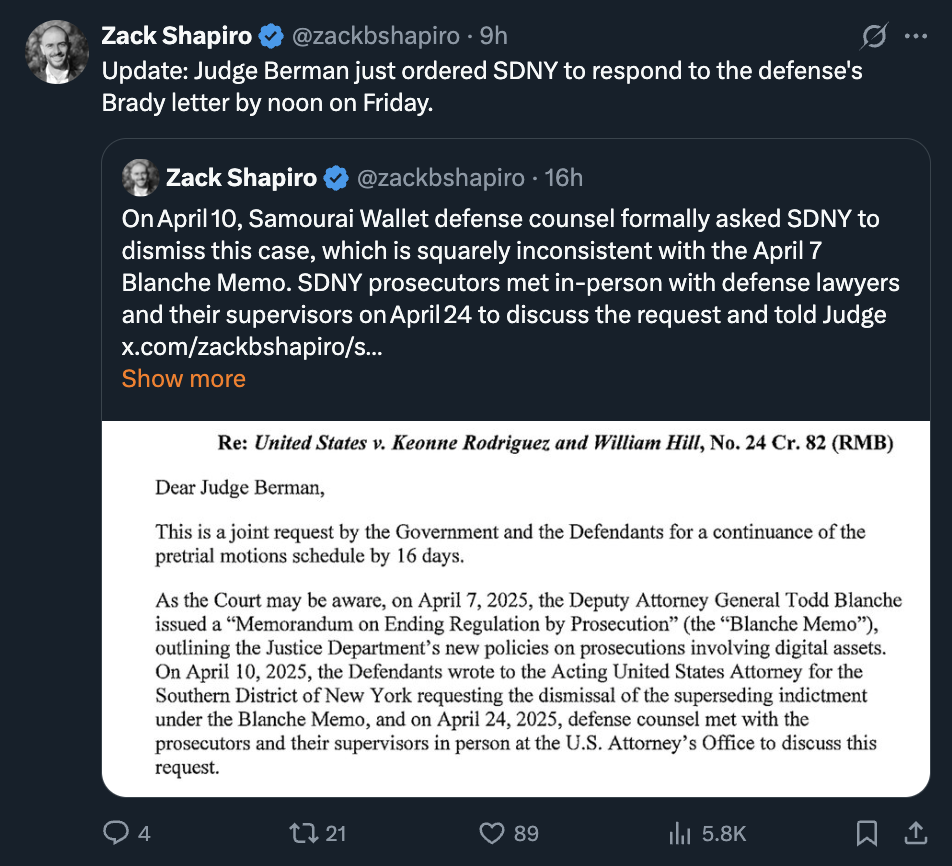
TLDR Fuck the SDNY
Held out for that math at the end 💪
The quadratic "-b" solution is easily derived. The cubic solution I memorized in middle school and is a bit or work but manageable.
The quartic solution is a nightmare and involves a lot of refactoring into various different other forms until you reduce it to solving quadratics and cubics. The complexity is such that if a high school text book ever asks you to solve a quartic, you'd be better off guessing than applying the full algorithm by hand.
https://fountain.fm/episode/BaB9yVMkrOh0nmbLV23R
nostr:nevent1qvzqqqpxquqzqyg9tuaff8wg7h59hzszzuwfz28v3vwqdqr08t2l79x2vm3zeq7qaskxz7

Gonna do a video on nostr:nprofile1qy88wumn8ghj7mn0wvhxcmmv9uq3qamnwvaz7tmwdaehgu3wd4hk6tcqyz4fq3ej2cpa4n20s9pqjdt8ju6kdh3mrcs2392hku5v80jvd2zyk8p4hdy . What are the features you'd like to see covered? I'll try to make it as thorough as I can.
Double tap the zap to do custom amounts and messages.

I've booted it up but the premium for buying is higher than Bisq 1 and the reputation requirements for selling are a bit onerous for me (bonding BSQ). Once it gets Musig protocol it will be worth trying for me.



A confab which Americans can actually understand!
https://fountain.fm/episode/0kvSF2cwxcV31qwgKpp3
nostr:nevent1qvzqqqpxquqzqer2c6nqtdqqhqd5ywyhcnxc0p6renth5s66vg5les32l4mcfwunjwqmdn

You could have just had 401(k)s and other savings vehicles. The oension benefits funded from current year tax revenues are all scams and will bankrupt all nations facing demographic problems from low birth rates.


You can enable oniononly in the config file and it will protect your IP address. You could also use router level VPN tied to the Mac address of your node.