


You'll own nothing and be happy!

They work. They reduce population...as intended.

The earth is the Lord's and the people it contains.
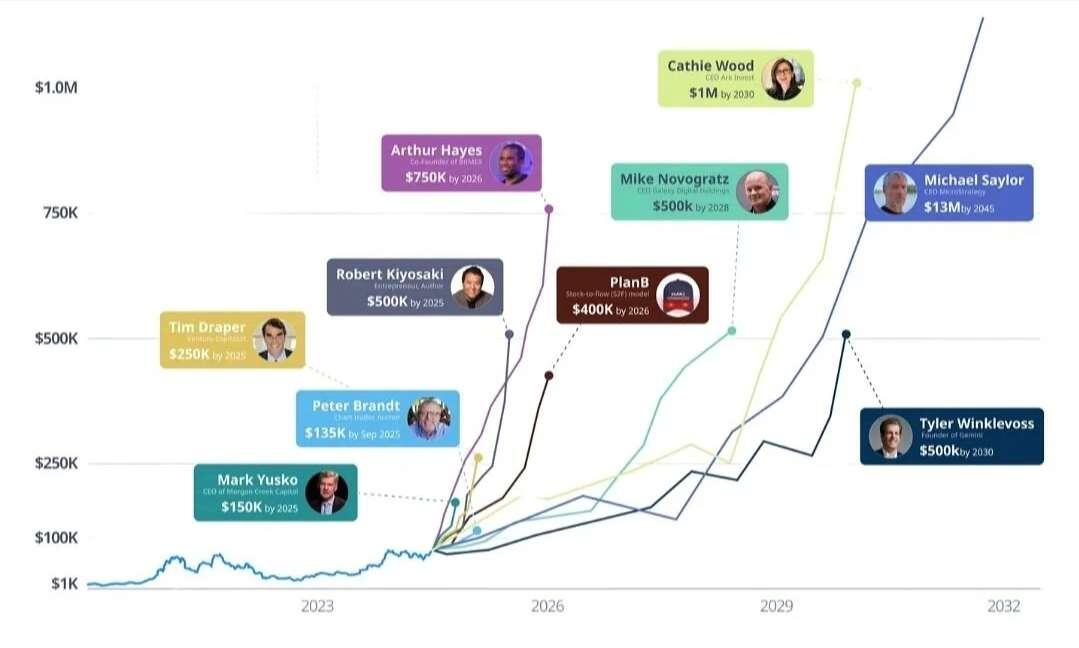
Uh, what about "value for value" instead of "here's a plan to buy influence."
Go back to TikTok, bro.
good one

Also, Forbes picture shows their natural antibitcoin bias...

This article honestly explained nothing. It sounds like the cosmology gurus attempting to explain origins with maybe, possibly, will,...weasel words to replace "we haven't the slightest idea". Anyway, Forbes is like the Rolling Stone of economics...fake!

*Cities on return are often strange\
Yeah, and now\
Every time you blink, you feel it change\
And it's been\
A long, a long, a long, a long, long-long\
You've been my\
Favourite for a while*
So sings Grian Chatten, lead singer of the Irish punk band Fontaines D.C (look them up and thank me later), in the fourth verse of their song Favourite– my favourite track released in 2024. As a world traveller who has called quite a few places home during the past 10 years I can relate to these lyrics on so many levels.
It just so happens that I recently came back to La Paz, Bolivia– a city I used to call home. But so many things about the city has changed. Most notably with old friends of mine.
Some old friends have turned out to reveal themselves as crooks, and you guessed it, some of the people who had been painted, in my mind, as crooks– well it just so turns out that they have revealed themselves as the good guys. I’m reminded of Warren Buffet’s line: Only when the **tide goes out do you** discover who's been **swimming naked**. The time away from La Paz has given me time to reflect on my two and a half years living here. The time component acts as the tide in Buffet’s great quote– Allowing me to filter through all the noise and focus on what is real. Or should I say who of my old friends were the real friends and who were the crooks– swimming naked all the time.
## My Story with La Paz
I first arrived in La Paz in 2018 as a 22 year old boy looking for a place in South America to live. La Paz was where I met my wife. La Paz is where I bought my first business– a pub in the tourist area. La Paz is where I learned to deal with corrupt city council workers. La Paz is in many ways where I grew from a boy to a man.
 )A Young 22 Year old naive version of me in La Paz
Fast forward to December 2024 as I’m back in the city for the first time in two years. Walking the colourful and chaotic streets of La Paz, brings back all the memories. The street corner where a young naive Sebastian bought his first gram of pure Bolivian Marching Powder– That shit will pick you right up by the bootstraps, but do to proceed with care, I don’t have enough available fingers to count the amount of people who I’ve seen lose their lives to the Marching Powder of Bolivia. If you aren’t careful it will become the only thing you live for.
I jump on a cable car– La Paz’s metro system which flies across the city, up and down the mountains, connecting all neighbourhoods with the city centre. I head to what used to be my local park and viewpoint. This is where I would always come to read a book or listen to podcasts whilst enjoying the stunning view of Illimani– the mountain guarding La Paz. Most importantly this is the park where I made my first move to kiss my wife.
 )The view of Illimani Mountain from the Pub I used to own
## The former community leader who vanished
The main thing I think about as I re-explore my old neighbourhoods is; what happened to my old friends and acquaintances? Together with the other restaurants in the tourist area we used to have a football team organised by a true community leader, let’s call him George in this story, the team was called Chocos Locos– The Crazy Blondes, we were a mix of European expats, exchanges students, NGO employees and some local Bolivian friends of ours. George was the guy who tied us all together. He knew everyone– their birthday, what football team they supported, what drink they preferred etc. George would look out for everyone, he would make sure to organize birthday parties, even for the quiet ones in our group. George had his values set in the right place, he demanded a high standard from everyone on and off the pitch. In exchange we would look out for each other, cover for one another if we were in trouble. You know like the Marines, we would leave no man behind.
As I’m now back in La Paz most of my former friends and teammates are no longer around, George included. Their restaurants are closed and new ones have emerged. Some have left due to the recent years of political instability in Bolivia, others have mysteriously disappeared. What happened to them?
In May 2024 I received a message from George saying our friend and teammate, let’s call him Juan, was in intensive care in a hospital in La Paz, after suffering a near death accident. Juan’s family needed help to cover the treatment costs. Like the true community leader George is, he took it upon himself to reach out to all present and former teammates and friends of Juan, asking us all to pitch in, with whatever we could to support Juan’s treatment. I didn’t think much else of it and sent across €100 to support Juan. As I later came to learn, the story was something else. The real story revealed George’s true identity.
This is the story of a real captain, a true community leader, who turned out to be a scammer. But how did George turn into a scammer who used the near death accident of a friend and teammate, to scam just about everyone who had ever met Juan into donating money to help Juan’s family pay for the intensive care in hospital, only to run off with all the money donated– approximately $4000 USD?
Perhaps the answer was there in front of our faces all along? I recently listened to a podcast with Andrew Bustamente (a former CIA spy, known as Everyday Spy on YouTube) in the podcast Andrew mentioned that most people who come off as highly empathetic, people like George, aren’t actually as highly empathetic as they seem, in fact such people despise almost everybody else.
I now ask myself did George actually use the community and our football team the whole time. Were we funding his life in La Paz all the time? George told us he was working online as an English teacher. Now I ask myself who George really was.
## See you all in 2025
It’s mind blowing to me, how time removed from a former favourite city helps us see our time living in said city with such clarity… What really happened? Who were the good guys? Who were the bad guys?
As I look to settle into a new hometown in 2025 (more on that in future newsletters) I will keep in mind my lessons learned from revisiting La Paz. I will be able to spot who are the charlatan’s and who are the genuine good guys– or at least so I hope.
As I warm up to a Holiday season with family from both Denmark and Bolivia I wish you all a great Holidays, remember to be grateful for your family and those who are your real friends. Show them love. Cherish your time with them. Let me leave you with the lyrics to the final verse of the fantastic Fontaines D.C song Favourite:
*Ah, makes sense when you understand\
The misery made me another marked man\
And I'm always looking over my shoulder\
And each new day\
- I get another year older\
Shoulder bound to the frame of a door\
Tuned into shape like a stone on the shore\
But if there was lightning in me\
Then you know who it was for*
*https://www.youtube.com/watch?v=1UG31mpUnOg*
I will see you all in 2025. God bless you all.
Sebastian
hey I lived in cochabamba for a while

I’ll admit that I was wrong about Bitcoin. Perhaps in 2013. Definitely 2017. Probably in 2018-2019. And maybe even today.
Being wrong about Bitcoin is part of finally understanding it. It will test you, make you question everything, and in the words of BTC educator and privacy advocate [Matt Odell](https://twitter.com/ODELL), “Bitcoin will humble you”.
I’ve had my own stumbles on the way.
In a very public fashion in 2017, after years of using Bitcoin, trying to start a company with it, using it as my primary exchange vehicle between currencies, and generally being annoying about it at parties, I let out the bear.
In an article published in my own literary magazine *Devolution Review* in September 2017, I had a breaking point. The article was titled “[Going Bearish on Bitcoin: Cryptocurrencies are the tulip mania of the 21st century](https://www.devolutionreview.com/bearish-on-bitcoin/)”.
It was later republished in *Huffington Post* and across dozens of financial and crypto blogs at the time with another, more appropriate title: “[Bitcoin Has Become About The Payday, Not Its Potential](https://www.huffpost.com/archive/ca/entry/bitcoin-has-become-about-the-payday-not-its-potential_ca_5cd5025de4b07bc72973ec2d)”.
As I laid out, my newfound bearishness had little to do with the technology itself or the promise of Bitcoin, and more to do with the cynical industry forming around it:
> In the beginning, Bitcoin was something of a revolution to me. The digital currency represented everything from my rebellious youth.
>
> It was a decentralized, denationalized, and digital currency operating outside the traditional banking and governmental system. It used tools of cryptography and connected buyers and sellers across national borders at minimal transaction costs.
>
> …
>
> The 21st-century version (of Tulip mania) has welcomed a plethora of slick consultants, hazy schemes dressed up as investor possibilities, and too much wishy-washy language for anything to really make sense to anyone who wants to use a digital currency to make purchases.
While I called out Bitcoin by name at the time, on reflection, I was really talking about the ICO craze, the wishy-washy consultants, and the altcoin ponzis.
What I was articulating — without knowing it — was the frame of NgU, or “numbers go up”. Rather than advocating for Bitcoin because of its uncensorability, proof-of-work, or immutability, the common mentality among newbies and the dollar-obsessed was that Bitcoin mattered because its price was a rocket ship.
And because Bitcoin was gaining in price, affinity tokens and projects that were imperfect forks of Bitcoin took off as well.
The price alone — rather than its qualities — were the reasons why you’d hear Uber drivers, finance bros, or your gym buddy mention Bitcoin. As someone who came to Bitcoin for philosophical reasons, that just sat wrong with me.
Maybe I had too many projects thrown in my face, or maybe I was too frustrated with the UX of Bitcoin apps and sites at the time. No matter what, I’ve since learned something.
**I was at least somewhat wrong.**
My own journey began in early 2011. One of my favorite radio programs, Free Talk Live, began interviewing guests and having discussions on the potential of Bitcoin. They tied it directly to a libertarian vision of the world: free markets, free people, and free banking. That was me, and I was in. Bitcoin was at about $5 back then (NgU).
I followed every article I could, talked about it with guests [on my college radio show](https://libertyinexile.wordpress.com/2011/05/09/osamobama_on_the_tubes/), and became a devoted redditor on r/Bitcoin. At that time, at least to my knowledge, there was no possible way to buy Bitcoin where I was living. Very weak.
**I was probably wrong. And very wrong for not trying to acquire by mining or otherwise.**
The next year, after moving to Florida, Bitcoin was a heavy topic with a friend of mine who shared the same vision (and still does, according to the Celsius bankruptcy documents). We talked about it with passionate leftists at **Occupy Tampa** in 2012, all the while trying to explain the ills of Keynesian central banking, and figuring out how to use Coinbase.
I began writing more about Bitcoin in 2013, writing a guide on “[How to Avoid Bank Fees Using Bitcoin](http://thestatelessman.com/2013/06/03/using-bitcoin/),” discussing its [potential legalization in Germany](https://yael.ca/2013/10/01/lagefi-alternative-monetaire-et-legislation-de/), and interviewing Jeremy Hansen, [one of the first political candidates in the U.S. to accept Bitcoin donations](https://yael.ca/2013/12/09/bitcoin-politician-wants-to-upgrade-democracy-in/).
Even up until that point, I thought Bitcoin was an interesting protocol for sending and receiving money quickly, and converting it into fiat. The global connectedness of it, plus this cypherpunk mentality divorced from government control was both useful and attractive. I thought it was the perfect go-between.
**But I was wrong.**
When I gave my [first public speech](https://www.youtube.com/watch?v=CtVypq2f0G4) on Bitcoin in Vienna, Austria in December 2013, I had grown obsessed with Bitcoin’s adoption on dark net markets like Silk Road.
My theory, at the time, was the number and price were irrelevant. The tech was interesting, and a novel attempt. It was unlike anything before. But what was happening on the dark net markets, which I viewed as the true free market powered by Bitcoin, was even more interesting. I thought these markets would grow exponentially and anonymous commerce via BTC would become the norm.
While the price was irrelevant, it was all about buying and selling goods without permission or license.
**Now I understand I was wrong.**
Just because Bitcoin was this revolutionary technology that embraced pseudonymity did not mean that all commerce would decentralize as well. It did not mean that anonymous markets were intended to be the most powerful layer in the Bitcoin stack.
What I did not even anticipate is something articulated very well by noted Bitcoin OG [Pierre Rochard](https://twitter.com/BitcoinPierre): [Bitcoin as a *savings technology*](https://www.youtube.com/watch?v=BavRqEoaxjI)*.*
The ability to maintain long-term savings, practice self-discipline while stacking stats, and embrace a low-time preference was just not something on the mind of the Bitcoiners I knew at the time.
Perhaps I was reading into the hype while outwardly opposing it. Or perhaps I wasn’t humble enough to understand the true value proposition that many of us have learned years later.
In the years that followed, I bought and sold more times than I can count, and I did everything to integrate it into passion projects. I tried to set up a company using Bitcoin while at my university in Prague.
My business model depended on university students being technologically advanced enough to have a mobile wallet, own their keys, and be able to make transactions on a consistent basis. Even though I was surrounded by philosophically aligned people, those who would advance that to actually put Bitcoin into practice were sparse.
This is what led me to proclaim that “[Technological Literacy is Doomed](https://www.huffpost.com/archive/ca/entry/technological-literacy-is-doomed_b_12669440)” in 2016.
**And I was wrong again.**
Indeed, since that time, the UX of Bitcoin-only applications, wallets, and supporting tech has vastly improved and onboarded millions more people than anyone thought possible. The entrepreneurship, coding excellence, and vision offered by Bitcoiners of all stripes have renewed a sense in me that this project is something built for us all — friends and enemies alike.
While many of us were likely distracted by flashy and pumpy altcoins over the years (me too, champs), most of us have returned to the Bitcoin stable.
Fast forward to today, there are entire ecosystems of creators, activists, and developers who are wholly reliant on the magic of Bitcoin’s protocol for their life and livelihood. The options are endless. The FUD is still present, but real proof of work stands powerfully against those forces.
In addition, there are now [dozens of ways to use Bitcoin privately](https://fixthemoney.substack.com/p/not-your-keys-not-your-coins-claiming) — still without custodians or intermediaries — that make it one of the most important assets for global humanity, especially in dictatorships.
This is all toward a positive arc of innovation, freedom, and pure independence. Did I see that coming? Absolutely not.
Of course, there are probably other shots you’ve missed on Bitcoin. Price predictions (ouch), the short-term inflation hedge, or the amount of institutional investment. While all of these may be erroneous predictions in the short term, we have to realize that Bitcoin is a long arc. It will outlive all of us on the planet, and it will continue in its present form for the next generation.
**Being wrong about the evolution of Bitcoin is no fault, and is indeed part of the learning curve to finally understanding it all.**
When your family or friends ask you about Bitcoin after your endless sessions explaining market dynamics, nodes, how mining works, and the genius of cryptographic signatures, try to accept that there is still so much we have to learn about this decentralized digital cash.
There are still some things you’ve gotten wrong about Bitcoin, and plenty more you’ll underestimate or get wrong in the future. That’s what makes it a beautiful journey. It’s a long road, but one that remains worth it.
wonderful article

https://fountain.fm/episode/Nyt3vIj8NJ2y8MWDHWdt
"Steve Patterson is an iconoclast who always seeks to puncture the orthodox narrative. In this episode, he defends the book he helped Roger Ver write, in which they lament the alleged "hijacking" of #Bitcoin away from Satoshi's original vision."
I heard him on John Bush. A lot of inaccuracies.
