

The beatings will continue until morale improves.

I dunno I watched Alex Jones do a hilarious interview with him and he said it and I'm participating in the rumor mill.

I actually wrote something up on this a few days ago, I believe it to be an existential threat to bitcoin and a looming crisis that is closer than we realize.

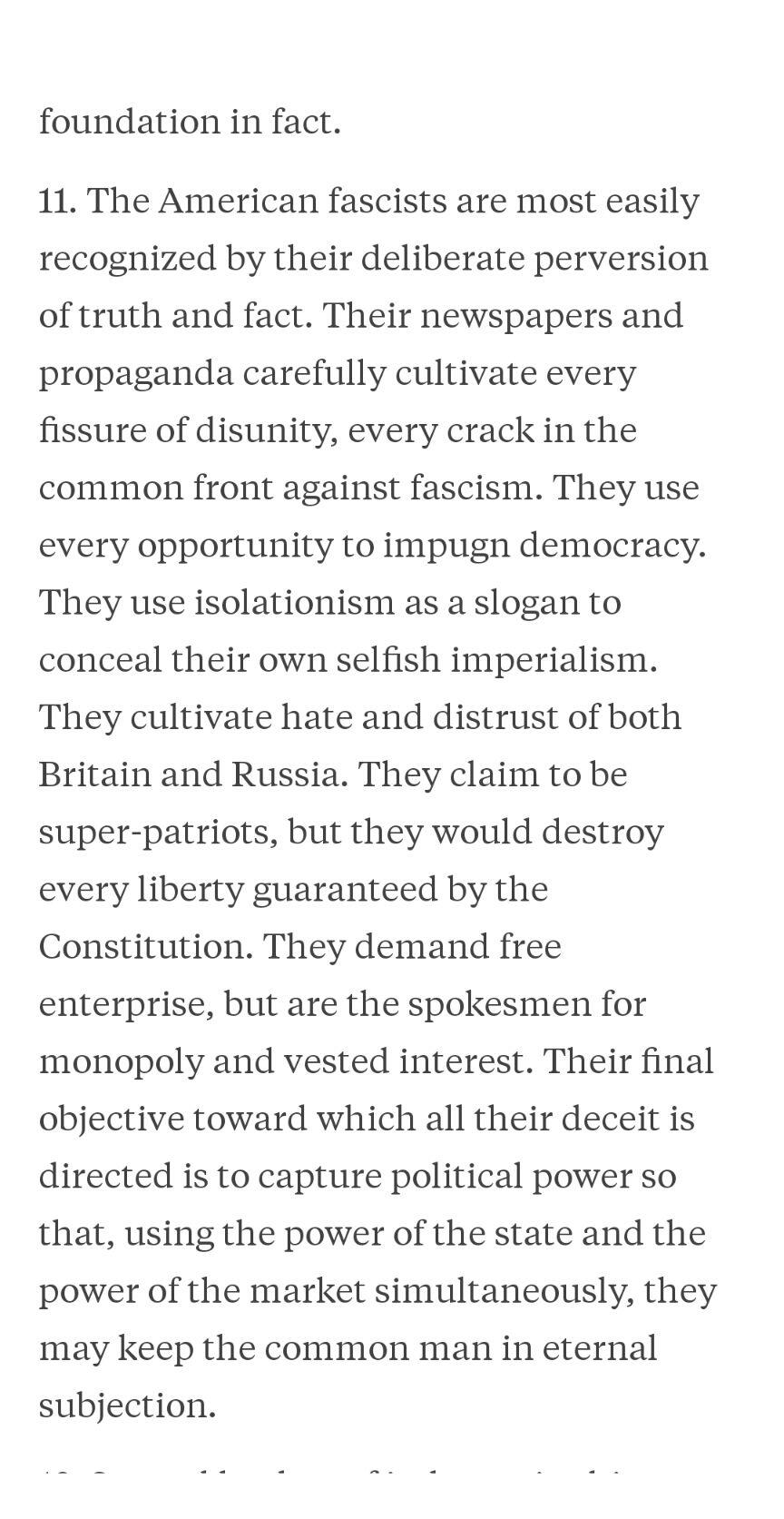 #m=image%2Fjpeg&dim=864x1673&alt=An+excerpt+from+the+1944+%40nytimes+article&blurhash=%5D4SPX_9F%7EqM%7B%3Fbt7fQj%5Bofj%5B%7Eqt7IUt7WBt7ayayofWB%7EqWBM%7Bt7RjWBt7ayayof_3j%5BRjofRjofRjofj%5BWB%25Mt7WBWBay&x=cfce13a2ed5c9c29acf9758350261ba849c2bd351f5c42968054df29665b40f8
What about gold and silver? Their problems are not that someone owns a bunch. I can still buy and sell gold and with and for gold, just because there's supposedly a bunch in fort Knox doesn't make my gold any less useful.
How can someone holding a lot of bitcoin destroy bitcoin? If it can then there's something fundamentally wrong with bitcoin.
https://en.wikipedia.org/wiki/Mr_Jones_%282019_film%29?wprov=sfla1 Great film that reveals how propaganda from Stalin hid atrocities that your 1933 @NYtimes article cited.
It's not my article. I've seen the film. I'm trying to figure out what you're trying to say.


"The average person doesn't have enough savings to cover a typical household emergency! Elect me!"
Then, later
"We have to stimulate spending to save the economy!"
Rinse and repeat.


Interesting. I am curious how it works, is it just a video host that has a built in relay or just notifies and shares video metadata over nostr? Is it FOSS?
I'm particularly curious because I was working on an interesting video solution for nostr and I would like to know if this means the problem I was trying to solve is a non issue now.


Today I'm launching Flare, a video sharing site built on Nostr! 🎉
Like YouTube, Flare lets you upload, view, comment, and like videos from your favorite creators. BUT unlike YouTube, we can't strike, shadow-ban, or demonetize you just because we disagree 🤗
Since Flare is built on Nostr, you are free to serve your content from anywhere and consume content from any kind 34235 client you'd like.
Check it out at https://www.flare.pub/ 🔥
That's cool how are the videos hosted?

There has been some news going around in bitcoinland about people sitting on tons of small bitcoin UTXOs that they can't spend because fees are more than the value of them. Bitcoin guys don't want to look at it too closely, because when you extrapolate this into the future that we want, you wind up with a huge problem. I'll draw you, dear reader, a picture.
Bitcoin becomes the most valuable asset in the world. It becomes the unit of account for the world, the medium of exchange for all high value trades, such as nation to nation or corp to corp, and each bitcoin is worth a ton. Block space is still limited, but demand for it is orders of magnitude higher than it is now. This means fees are orders of magnitude higher, this means that people with even reasonably worthwhile amounts in UTXOs will not be able to spend them. And if this becomes a steady state and there's no more volatility with bitcoin because it is constantly used, there is no "wait for fees to get cheaper."
So some people, including many of us, will have money we can't spend, ever. That's bad. But it's not that bad, because what comes next is worse.
First I'd like to point out that some day there will be no coinbase transactions in bitcoin. The idea is that miners will mine for transaction fees alone, that transaction fees rise to meet demand for block space. The problem I'm talking about doesn't hinge on this, but this fact does exacerbate it, it gives us a best case estimate on the upper limit of time we have to solve the problem I'm about to describe.
What it looks like we see here is that *transaction fees asymptotically approach some equilibrium that makes the system non viable long term.* My intuition tells me that that equilibrium is a function of the median transaction value, the energy cost to secure the network adequately, demand for block space, and rate at which new bitcoin are created. I say intuitively because I haven't done the math on it, but the picture is clear enough to make out the overall picture.
One other thing I'd like to point out that's pertinent: miners can send transactions for free if they mine the block their transaction is in, or if *their counterparty* mines that block, because if you're recipient to a transaction you don't care if you're paid fees for processing it, you're getting paid either way, two miners paying each other can agree to mine each others transactions to each other at any rate they like, including for free.
Worst case scenario: the fees approach the value of the transactions themselves, miners suck up all the value to pay their energy costs and then some profit if any, it isn't worthwhile for anybody to use the network to send value except miners, and can only send in blocks they or their counterparty mine. Of course, that doesn't work, everybody can't mine and get enough blocks to send value within a reasonable timeframe, so the value of the system collapses, people find something else to store and send value whatever that is. What we see then is a system much like the copper money system outlined by Saifedean Ammous in The Bitcoin Standard, where everyone adopts this money only for the power producers to reap the benefit, sucking the capital from miners to secure their network who in turn suck capital from everyone looking to transact. This is energy as money, but energy has a stock to flow ratio of 0.
"Best case" scenario: Bitcoin becomes so important to world trade that states and miners enter cartel agreements to limit energy expenditure on bitcoin and limit transaction fees between permissioned participants. Bitcoin becomes supported as legacy software indefinitely only because we rely on it for international commerce, and compute becomes highly regulated to prevent attacks on the network since security cannot be guaranteed if there's a roof on the amount of energy that can be used to secure it. Only state level actors use and mine bitcoin. That is, of course, if they continue to mine at all and not just agree to share a ledger and permission the network. Note that this is the best case *for bitcoin*, not the world, it is arguably worse for the world than the current state of affairs.
Likely scenario: similar to the worst case scenario, except that as people look to find cheaper ways to move capital around, the cost to move bitcoin approaches the cost to move the alternative and people don't just abandon bitcoin, but rather it shares it's role with something else. Right now, that alternative would be gold due to the scarcity it has. That would mean, of course, that the days where bitcoin is cheaper to move across the ocean than gold are numbered, and in fact, it's as expensive to move bitcoin 1 inch as it is to move it 10 light minutes (the theoretical limit to how far bitcoin can be transported due to the block time, that opens it's own can of worms about spatial distribution of miners and the interplay between that problem and the one I'm describing is very interesting) so gold makes more sense to send short distances while bitcoin may make more sense to send long distances.
(An interesting thought I have had is, in doing this are we discovering that the cost associated with moving gold only appears to be the result of it's mass but is the apparent symptom of something fundamental that appears as a cost to moving scarce things no matter how you do it, and does that tell us anything about what mass fundamentally is?)
Either of these 3 scenarios is an utter failure of bitcoin. Either it collapses, it becomes the new fiat, or it isn't any better than what we already have.
Now, I am not making a block size argument here. raising the block size only kicks the can down the road, you'd still run into this problem, and it has problems that lead to centralization which would exacerbate this scenario such that I think doing it only makes my best case scenario more likely, and that's really not a good scenario at all.
I'm also not arguing for proof of stake. It would put you into the same position except that the validators are the top of the food chain rather than the energy producers. It does absolutely nothing to alleviate this problem.
You might think "payment channels!" or "layer 2" or something, but this also only kicks the can down the road. ultimately you have to finalize everything on the blockchain, otherwise it isn't bitcoin, and you'd still run into the same problems. In my best case scenario it would work, but that gets us basically the gold standard back, complete with high expense to move large value, and nothing more. I would not expect such a scenario to fare better than the gold standard did, it led centralization of custody and then fiat money.
What I'm saying is that *we cannot have a block size at all.* We cannot set an arbitrary ceiling on the number of transactions that can be mined per block. We have to make it so that miners make more money the more transactions they process regardless how much each one pays them. And we can't do that if the entire history of the ledger has to be kept to ensure security while simultaneously keeping the network decentralized. Bitcoin needs cut through and a block size only limited by the latency of the network or it will fail. Ideally the entirety of the blockchain would be unspent UTXOs and we would still have programmability. Even that presents us with some problems, probably more unforeseen ones, and maybe even still the problem I've described if network latency becomes a tangible limit on supply of transactions within the block time.
Also note, above I mentioned that I think the rate at which new bitcoin are created is a factor. I don't know that this would still be an issue if there were no arbitrary scarcity with regard to block space. But it is possible that it would present an issue even with an unlimited sized block, maybe there's a reason that the only place where anything naturally occurring is provably scarce is at the edge of the universe. It may very well be "limited supply, limited block space, limited block time, pick 1."

Well for the nostr protocol it's absolutely true. The only reason you have to have it is because of the client relay architecture. Anything else it gives you is a bonus.
I think the point he's making is if there's 1 relay, it's just twitter, or if you have one you're on of many it's just AP, no need to prove who you are because the source is unique. When there are multiple potential sources that can be amorphous, for people to fetch your messages the architecture needs a way to prove they came from you.
Signatures are useful to prove something wasn't tampered with, yes.

That's not an excuse. Why should people be scared? Because "chemicals"? To anyone with even a tiny bit of skepticism about them, this video looks like a supersize me esque boogyman of our day video. Awaken interest by saying something interesting! Give me a detail, just one, why should I be scared? People are fat and sick now? That could be any combination of the plethora of new shit in our environment since 1960. They make it in processing plants? They make everything in processing plants. Not all chemicals are bad for you. If you want people to care you have to treat them like they're capable of understanding why they should care, if you treat them like stupid children who need to be scared into behaving those are the kind of people you'll get, the rest of us are going to think it's a load of bullshit.

I think seed oils are bad for you, but this video is very heavy on the emotional manipulation and lighter than helium on the details. Not a good educational video, it has 0 educational content whatsoever.