

"This list I compiled myself IS facts"
Money has never, ever come attached with a history of who owned it from the beginning of time. "Privacy" in this sense was so inherent in the medium of exchange that it was taken for granted. Why would you deliberately engrave a coin with it's ownership history? Well in the realm of digital money, we have the opposite problem: we have to deliberately *not* do this. This is a new problem emergent as a result of the properties of a new medium, a problem that was so impossible to have in the physical medium that nobody ever thought about how fundamental memorylessness is to money. And some people, seeing that work must be done to make our digital money work as much like physical money as possible, say it doesn't matter. Do they do it from a position of good faith? No. They do it either from a position of arrogant ignorance, hubris, or they do it with the goal of protecting their financial position.
Memorylessness, historylessness, temporal atomicity, this property absolutely is a fundamental, indispensible property of money. Besides being a necessary trait to ensure the well understood property of fungibility, it is important in it's own right.

Download Youtubes
One of our readers asked if there’s an open source way to download Youtube videos, for music mp3 or the entire video. Yes, there is.
For web browser,
There’s Invidious,
You can use their list of instances or get served up a fresh one from farside.link
For Linux & Windows desktop,
There’s Freetubeapp,
You can download on FreeTube, but as a heads up, it doesn’t tell you the progress which is frustrating for a longer video. As a tip, if you do a lower quality, it will be faster to help with this issue.
For Android,
There’s NewPipe, which is an F-Droid FOSS front end for Youtube. You can download on here, and minimize videos while they play, which Google itself blocks on the real YT client.
For command line,
There’s both Youtube-DL and Youtube-DLP
One of our readers says the fork, Youtube-DLP is way better:
https://github.com/yt-dlp/yt-dlp
Our reader Vidar uses this with Termux on Android.
&
But here’s the older original for comparison Youtube-DL:
https://ytdl-org.github.io/youtube-dl/
For browser extensions,
There’s Firefox “Video Download Helper”
https://addons.mozilla.org/en-US/firefox/addon/video-downloadhelper/
https://www.downloadhelper.net/
Although I personally can’t vouch for this.
Got more ways? Comment below, I’ll add em to our site
https://github.com/deniscerri/ytdlnis
A UI for yt-dlp on android, in the IzzyOnDroid f-droid repo for those who haven't discovered Obtainium yet.


Hey man, you just hop in here every once in a while to see how it's coming along? How do you like it? I personally have entirely abandoned fedi, too many silos and fiefdoms.
Alpha test of a new social network!!
Reddit has cracked down with intense surveillance and censorship. Even worse, Microsoft’s Linked-In broadcasts your sensitive data the world. They demand SMS verification, restrict VPNs, and asks for photo ID to scan your eyeballs. By having all your information public, your haters can try to get you fired.
Instead, join a fun Liberty-Agora community, where people discuss technology, politics, vendors post their sales, and entrepreneurs can post crypto job ads. Meet Linked-Out.
This is a community feedback alpha test. You can be part of the process and give feedback on your experience. Linked-Out.me is a federated message board, like Lemmy. But unlike socialist Lemmy, accounts aren’t tied to government domains or IP addresses. Instead, Linked-Out gives you the following choices:
1) Nostr web client, w/ direct connection to 14 Nostr Relays
You finally have a place to meet Nostr friends with similar interests and discuss topics in groups.
2) Ethereum signer.
Calm down, there are no Eth payments. MetaMask has spyware and Eth is highly centralized. However, we are interested in the anti-censorship of Brave browser’s DNS and push.org notifications to replace Google. Without something like this, IPFS is just static.
Linked-Out.me and vid.simplifiedprivacy.com are two example federated instances. As we expand beyond the alpha test, we will be “linking” with other instances, and Linked-Out will grow into an entire network of unstoppable Crypto-Agorists.
Learn more about the alpha-test,
https://simplifiedprivacy.com/nostr-linked-out/
Please note: USA IP addresses are fully blocked from accessing Linked-Out.me
DM me your whatever Nostr Public Key you want whitelisted
That's weird, why are US IPs blocked?
This is interesting. Its for code too? How does it work?
Id suggest Atlas Shrugged by Ayn Rand and The Diamond Age by Neal Stephenson.
Relative addressing doesn't allow for discovery. Discovery requires an announce or probing, it is interactive. Knowing a router is connected to another router would be a part of the protocol and would be rigid. Bad failure mode there.
Again, if you're on a network where you know who your peers are it would work. Some protocol that allows for a node to determine the likelihood that another node exists, such as a scheme that allows for the identifier to describe something about the node, would help discover nodes faster without having to know it exists. When you're on a network where you don't know anything about the network without asking first, arbitrary identifiers like IP are ideal. It helps with discovery if the address space is limited. But if you want some addressing scheme that is relative, address space is not limited, and the address doesn't describe anything about the node you'll get fragmentation and no better than random discovery, like randomly discovering a bitcoin address. If you don't care what node you connect to that can work for some cases, but usually we care who we are talking to.
Form follows function, what are you trying to do? Form dictates function, a design decision not strictly directed at a problem you're trying to solve will lead to unintended outcomes. If you want to do what IP does, just use IP. If you want some other type of network topology or node behavior then think about how you want the network to work and design based on that. Your idea is cool and would be useful, but it isn't IP and wouldn't work the same as IP.

Yeah, that would work.
Public addresses are only really needed so that the entire network can discover the nodes on the rest of it. If you're only interested in connecting to a subset of nodes, or not interested in the global network at all, you don't really need a protocol like IP. Something like what you're talking about would be cool.
Think about what a protocol is fundamentally: a piece of information known to pertinent parties that enables them to interact in ways defined by the protocol. It's just a set of rules we both know so that we know how to find each other, how to understand each other, how to interpret each others behavior, etc. A handshake, a language, names, interaction can't really exist without protocols, and interaction is defined by protocols. So a protocol has to be thought out for it's uses, what you're describing is a fantastic idea, but it can't replace TCP/IP, primarily because of discovery, nodes must be known to each other already, who someone is is part of the protocol, not part of the information being communicated.

While I do think the cycles overlapp empirically, I did the math on it the other day and the amount of bitcoin mined in a day is something like 0.07% of daily volume. So best case scenario, you have 100% of new coins go on the market the day they're mined, it accounts for less than one thenth of one percent of the volume.
Now I also did the math on liquidity and supply, the 24h volume for bitcoin is around 8% of supply, often lower. So for every dollar that flows into bitcoin net, you get a rise in market cap by about $12, or $0.0000005 per bitcoin. I'm using a naive rough model but it's useful. That means that in a 24 hour period, the mining rewards alone push the price of each bitcoin down by a little under 40 bucks if they're sold. That means that at most 756 million dollars worth of capital needs to pour into the network daily in order to keep the price stable. Again, if miners don't immediately liquidate that number becomes much lower, so any additional inflow raises the price. But when you cut that in half, keeping in mind that only ~8% of bitcoin is for sale in a 24h period, for the dollar value to get back to that number the price must double. So despite being less than .01% of volume, max, it can have a significant impact on the price.
I doubt the actual reduction of emission is what drives these cycles. I think it's pretty obvious that the psychological impact of the halving narrative does the heavy lifting. But it does have it's impact.
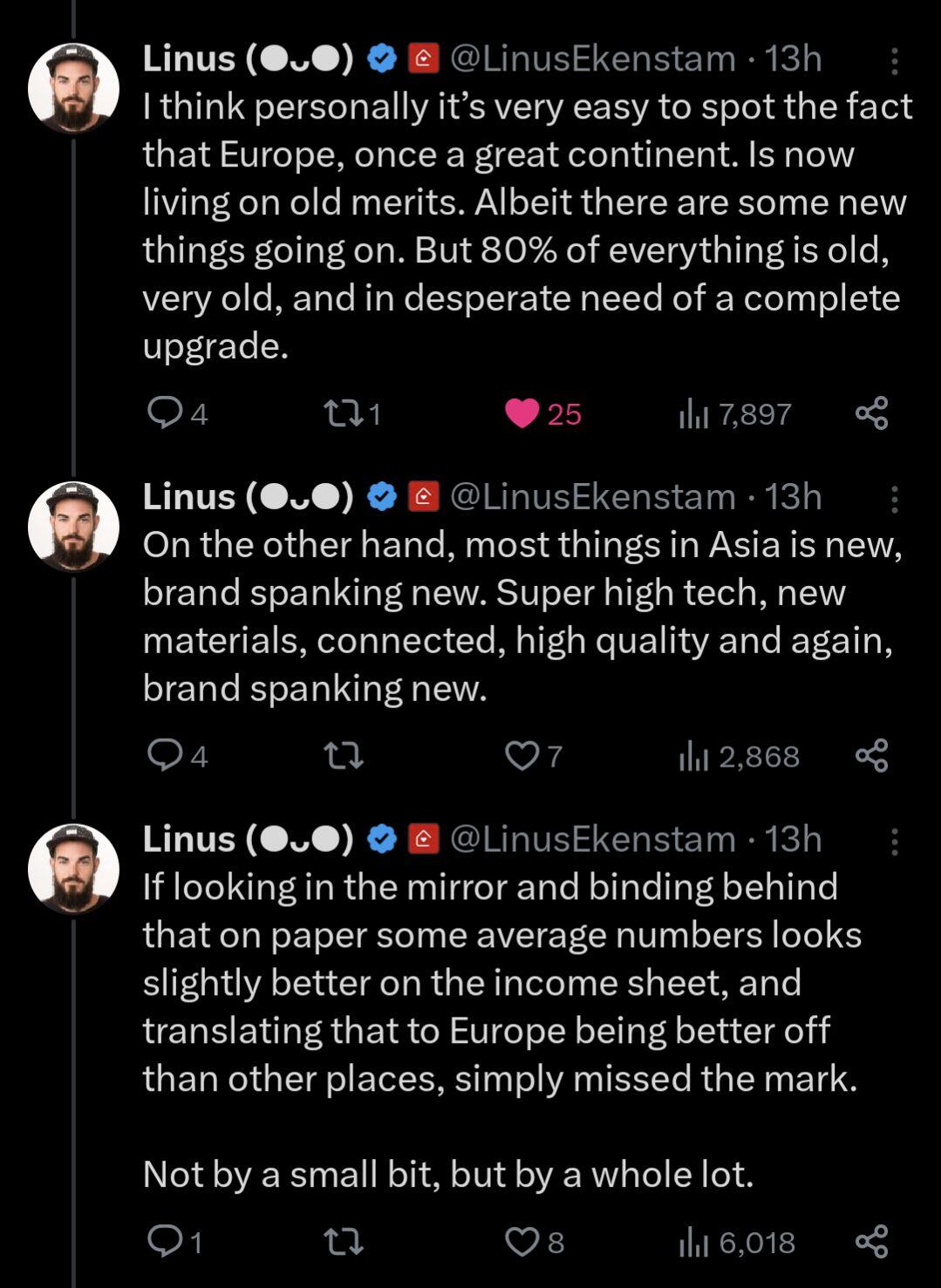
I'm convinced the future developed world will consist of southeast Asia and parts of Latin america. Europe and the north atlantic generally speaking is in fast decline, when I think about places to go visit, words like "Paris" and "London" don't even pop in my head, I'm more interested in Asunción and Jakarta.
Yeah I honestly don't even like likes, they're kind of pointless noise. It's faux engagement, its an antipattern just like read receipts and typing notifications.
I don't think the clients have ways to hide them, but I believe they have a different type in the spec so it should be easy to create this feature.

It doesn't necessarily split anything. All these other networks do it all the time. There's a difference between a project fork and a protocol upgrade.
What's wrong with forking?
Scripting is not going to expand throughput of the blockchain.
Yes, this is a possibility, especially considering that every block must be checked for transactions that have happened since last sync.
But, I'll quote you:
> Yes it cannot scale yet. But its open source, it's a work in progress.
We just need to assure layer 1 survives until we find a solution.
Looks like everyone's in that boat. I'd say that right now we are running into scaling problems with Bitcoin and not the problems you speak of in Monero. Monero as a community has demonstrated itself amenable to implementing improvements, Bitcoin has so far demonstrated the opposite, it's a point of pride among Bitcoiners that they will not accept a hard fork.

Im trying to set up my first mobile monero wallet. The monero website lists two lightweight wallets, mymonero and cake.
Getting mymonero working from source on graphene initially eluded me so i went to try cake.
Then i saw these god awful T&Cs at cake https://changenow.io/terms-of-use
Mind if i ask what are a few well regarded lightweight wallets are? Is mymonero worth the effort to set up or are there reasonable alternatives for a small grapheneos test wallet?
Try Monerujo, stack wallet, or mysu (previously mynero) if you want to dive into using i2p for it, once installed its simple and works. There's also Anonero but that's kind of a DIY hardware wallet sort of solution and it's designed to use 2 devices, definitely not simple. I usually just go with monerujo personally.
It can't scale because of the big blocks? I don't follow the reasoning here, I'd like to understand what you mean.

Well I'm less concerned about being able to fetch a price and more concerned about DEXs being influenced by potential manipulation at CEXs. I think probably DEXs behaving like first class citizens and letting their order books float would be ideal, and letting any mismatches get arbitraged away.


Love bisq.
Is there a plan to decouple exchange rates from Binance and other centralized exchanges? From my current understanding these are fetched from CEXs and so are subject to their manipulation.

Monero people (of which I am one) are framing it like this. Really cringe tbh, but most of us are happy about binance delisting monero, it demonstrates it's utility and besides the silly framing and overly simplistic math, at the core he's right. Monero benefits from the delisting and the ethos is incompatible with access controlled by fiat connected finance corporations.