

NEW SINGLE OUT NOW ON WAVLAKE:
“ALL MY HOMIES FUCK WIT NOSTR”
THIS SHIT IS GAS🔥🔥🔥💯💯💯😤😤😤
https://wavlake.com/track/ba1bddb0-f76f-40c8-862b-690f4a83e6d3
I'm gonna have "there's sun on my bawwws" in my head all day tomorrow

nostr:npub1vwymuey3u7mf860ndrkw3r7dz30s0srg6tqmhtjzg7umtm6rn5eq2qzugd podcast song contender 😂

I've seen a small amount of nazi stuff on global, but idk it was pretty mild. And all were coming from Mastadon bridges too.
Where did he supposedly go to see all these nazis and hate speech? 😂






She was secretly buying XRP wasn't she





🤔We who have Twitter accounts yet, should all go post at least 1 post on Twitter, saying something about Nostr.
🤔Your post could be the tipping point for someone to actually check it out
#toiletthoughts 🤔

Your WiFi Can See You
Your WiFi Can See You
https://bombthrower.com/your-wifi-can-see-you/
When police suspected Danny Kyllo, an Oregon man, of growing cannabis in his home they drove to his house with a https://www.thermal.com/
to scan it. They found hot pockets in the house, which were used to obtain a search warrant and subsequently bust Kyllo.
ruled the scan an unlawful search under the Fourth Amendment, requiring a warrant the police did not obtain.
 ?itok=81BCWN1z
Score one for privacy, but the government is about to have a far more controversial and dangerous tool at its disposal to monitor what’s going on inside your home.
Unlike a thermal imager, this device is already in your home – and you put it there.
How It Works
WiFi is electromagnetic waves in the 2.4 and 5 GHz ranges. It’s the same thing as the light you see, only it can penetrate walls due to its much longer wavelength. Just like light (and echolocation) these waves also reflect off various surfaces and, when reconstructed properly, can be used to create an image.
Development of this technology goes back at least as far as July 2005, where https://ieeexplore.ieee.org/document/1552508
that they had created an ultra-wideband high-resolution short pulse imaging radar system operating around 10 GHz. The applications for which were explicitly for military and police use, providing them with “enhanced situation awareness.”
A few years later, in 2008, https://web.ece.ucsb.edu/mostofi-lab/overview/Imaging.html
.
The Race is On
Sensing the potential of this new surveillance technology, other researchers began piling on. Progress was initially slow but, in 2017, https://physics.aps.org/articles/v10/50
who worked with Friedemann Reinhard of the Technical University of Munich to develop the new method, “The past two years have seen an explosion of methods for passive Wi-Fi imaging.”
At the time, the technology could only https://www.businessinsider.com/wifi-camera-sees-through-walls-2017-5?r=MX&IR=T
. “If there’s a cup of coffee on a table, you may see something is there, but you couldn’t see the shape,” Holl says, “but you could make out the shape of a person, or a dog on a couch. Really any object that’s more than 4 centimeters in size.”
The Controversy Begins
In 2018 the team at UC Santa Barbara published a paper titled “https://arxiv.org/pdf/1810.10109.pdf
” examining the potential threats of this emerging technology. They examined the problem of adversarial WiFi sensing and the risk to privacy resulting from the widespread deployment of wireless devices, which could be used to track your precise physical location, movement, and other physiological properties.
Fortunately, https://syncedreview.com/2018/11/09/seeing-through-walls-with-adversarial-wifi-sensing-attack-and-defence-strategies/
for defending against such attacks to reduce the quantity and quality of the WiFi signals captured by the attacker, such as Geo-fencing and rate-limiting. These methods are not as effective with IoT devices, though, due to the frequency with which they make transmissions.
The Breakthrough
Up until this point it was necessary to use frequencies higher than commercial WiFi (2.4 and 5 GHz) to achieve decent imaging resolutions. That all changed in February 2019 when a team from Michigan State University https://ieeexplore.ieee.org/document/8654605
outlining how they were able to use signals at 5.5 GHz, which matches the 802.11n/ac WiFi protocol, to create a 2-D image of two reflecting spheres and a reflecting X-shaped target, concluding “full 2-D imagery is possible by capturing the WiFi signals present in typical environments.”
Adding AI and Going 3-D
At MobiCom 2020, researchers from the University of Buffalo, https://www.youtube.com/watch?v=WoCMlDM2NiE
, touted as “the first 3-D human pose construction framework using commercial WiFi devices.” This system uses the 2-D imaging technology previously discussed to construct a 3-D avatar of the humans captured by it. The system uses a deep learning model that encodes the prior knowledge of human skeletons in the construction process of the 3-D model.
In 2019, former DARPA contractor Ray Liu launched his first commercial product in the https://www.originwirelessai.com/wifi-sensing/
domain. Pitched as a way of “Making the world safer, healthier, and smarter,” the original military and law enforcement usages mentioned when this technology was born in 2005 were cast aside. The company claims the technology is so accurate that it can sense your breathing using nothing but standard WiFi signals.
In a 2021 company blog, Liu discusses https://www.originwirelessai.com/insights/what-is-the-802-11bf-wifi-sensing-project-a-peek-inside-setting-the-standard/
to this day.
Further refinements to the imaging technology itself have been made. In late 2021 https://arxiv.org/abs/2112.00242
was submitted to IEEE outlining how the researchers were able to achieve high-resolution imaging results with commercial WiFi signals using beamforming on the 802.11n/ac protocol.
Ready for Production
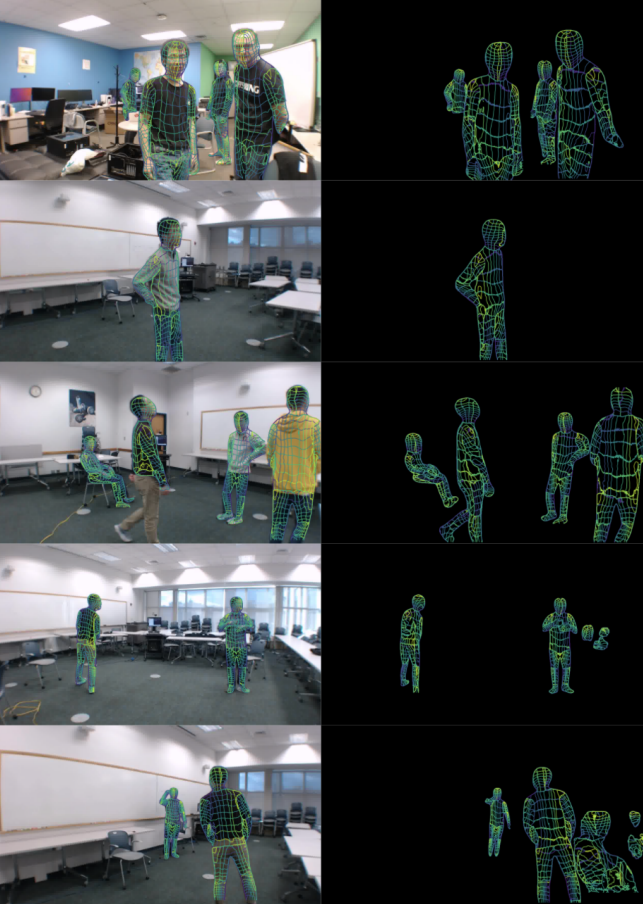
The perfect WiFi imaging system may have just been introduced to the world https://arxiv.org/pdf/2301.00250.pdf
.
 ?itok=FKO_roqe
(Left Column) image-based DensePose (Right Column) WiFi-based DensePose
DensePose is a technology https://github.com/facebookresearch/Densepose
“can detect the pose of humans in a room based solely on the WiFi signals passing through the environment.”
Big Brother’s New Eyes
It’s telling how the pitch for this technology has pivoted from military and police use to keeping people safe in their own homes. The true purpose of this is obviously for law enforcement, the military, and intelligence agencies. We already live with mass digital surveillance and if you don’t believe that this won’t get incorporated into their plans to monitor everything you do, then you haven’t been paying attention.
Apart from putting CCTV cameras in everyone’s living spaces, this technology offers a comprehensive and supremely surreptitious way of putting eyes in every room of your house and place of work. Indeed, this just may become the norm. With https://www.cato.org/blog/nearly-third-gen-z-favors-home-government-surveillance-cameras-1
, this less-intrusive method may just find even broader support from the brainwashed masses. It will be possible to know where you are in the house and exactly what you’re doing, from sitting on the toilet to making love.
We’ve seen how easily intelligence agencies can get secret warrants to surveil anyone of particular interest. We’ve also seen just how easy it is for someone to become a target for surveillance. You very well might, one day, find your WiFi router and access points feeding imagery to an alphabet agency that didn’t like your social media posts, while armed thugs wait for the perfect moment to execute their next no-knock raid.
* * *
Subscribe to https://bombthrower.com/join
https://cms.zerohedge.com/users/tyler-durden
Mon, 09/18/2023 - 17:50