
Avatar
DeWe
e262ed3a22ad8c478b077ef5d7c56b2c3c7a530519ed696ed2e57c65e147fbcb
Freedom is not for free Bitcoin & Nostr only #Bitcoin #ecash #nostr #WhiteNoise

Good first analysis

https://youtu.be/f6-z0PqTKeU

#Trump #Assassination

Anita. Du weißt, was du leistest und dass es gut ist, was du tust. Anderen Menschen lehren, freier zu werden. Flagge hin oder her. (Ist auch nicht mein Ding) Wenn Leute dein für dich richtiges Lebenskonzept nicht verstehen können oder wollen, dann verschwende auch nicht deine Zeit, es ihnen erklären zu wollen. Sei selbstbewusst und denke, was störts die Eiche, wenn sich die Sau daran reibt. LG

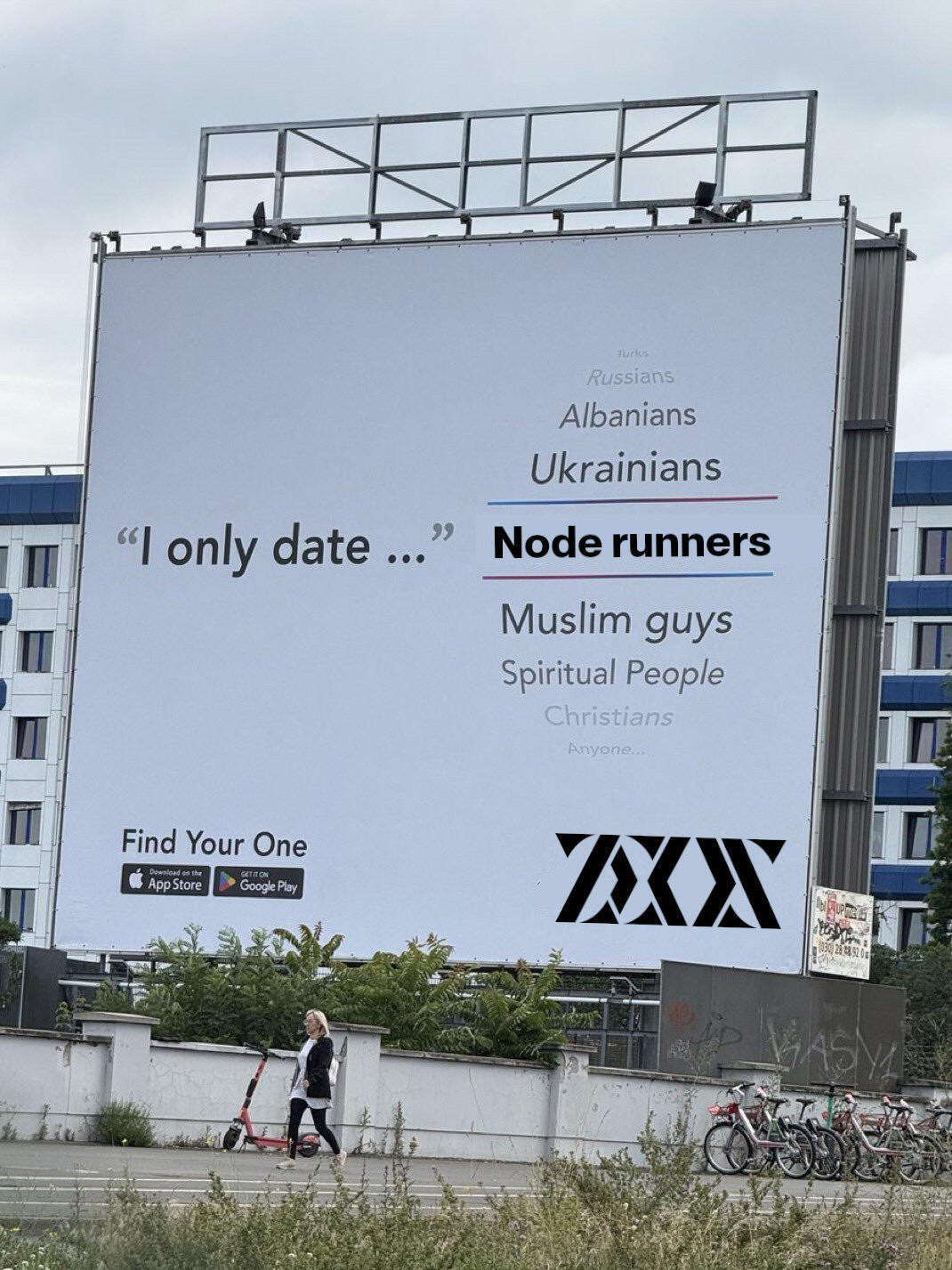
I would write Bitcoiner, where you wrote Node runner. Then I would write Ukrainians the same size than Russians to not politicise it with bias. The Zeus Logo is to cryptic. I know. It's your logo. Maybe a QR Code to link to the iOS and Google shops plus clear text below the qr. (Sorry for my poor English)

Replying to Avatar Lyn Alden

Financial privacy isn’t always about the government or corporations. Sometimes it’s simply about peers. Here’s an anecdote.

In Egypt, people born into lower socioeconomic statuses often don’t have a lot of flexibility for their life path. It’s often largely set by family and tradition, especially for women. And so, it’s kind of the luck of the draw how constructive their family is.

In certain social circles, a girl is generally considered the responsibility of her father. If she dates, has sex, doesn’t wear hijab, etc, then it is considered to reflect badly on him.

Once she marries, responsibility over her is transferred to her husband. He will usually control the main income, he will often control the family finances even if she does have an income, and he will often control most major decisions. And divorce is structured in favor of men here. Initiating a divorce as a woman comes with more limitations and consequences.

Many fathers push their daughters to marry pretty early so that they can relieve themselves of responsibility for her, even if she’s not thrilled about the prospective husband. She can be pressured socially, economically, and sometimes even physically. And at that socioeconomic level, she likely isn’t fluent in other languages, likely has not been exposed to outside ideas very much, is likely surrounded by people who would take her father’s side against her, and so the direction and pressure from her family is mainly how she contextualizes her role in the world.

So in many cases, someone goes from a girl with little power to a wife with little power at a young age, and with limited economic, social, or legal recourse if it ends up not being a good path. A decent percentage of fathers and husbands are abusive, unfortunately. In theory there are safeguards against this, but in practice it’s easy to fall through the cracks.

I know a family that owns an apartment building in Cairo, and they employ a husband and wife as live-in assistants to oversee the property and their family, like a casual butler and maid basically. He cleans, runs errands, and provides security, while she cleans and cooks. The husband and wife come from a low socioeconomic background, and have both been working for the family for 15 years, and are heavily trusted. They make like $4k/year USD equivalent combined, plus receive free basic shelter and a used car.

The husband and wife do not have bank accounts, so they just save in physical Egyptian cash that quickly devalues. Inflation in Egypt hurts people like them the most. With their extended family, they also own a unit for themselves in an apartment building in a poor neighborhood. It’s an unfinished raw brick building that they don’t live in. Their extended family all contribute to the shared building structure and underlying small land lot, and they own their unit within the structure and can choose to invest in finishing it with electricity and plumbing and flooring and furniture to live in, or just leave it as an empty brick hull. Many remain unfinished like that indefinitely throughout Cairo; it’s basically treated as illiquid savings and optionality.

Anyway, one day when the wife was getting a raise from the family that employs her, she asked that her raise be kept private from her husband. She wanted to have autonomy over that portion; their combined income is otherwise mainly under his control. Her husband is by all accounts a nice guy, but that is the common way of doing things in their socioeconomic circle. A private raise would let her keep a tiny bit of pocket cash in her own control. One of the things she wanted to do with some of her own money was send a tiny bit each month to a family member that needed help. So the family agreed to keep her raise private.

As her pocket cash eventually grew a bit, the next challenge arose: how to keep it safe and secret while living in a 250 square foot living area with her husband and daughter. She went back to her employer and asked if she could keep her private savings with them as an informal bank. They agreed to do that for her as well.

As is the case for many people like her, even though she doesn’t have a bank account, she does have a smartphone. Over time, certain types of mobile wallets and their widespread adoption could improve her ability to save privately and in less debase-able ways, and that don’t rely on the particular helpfulness of her employer. And if not her, then maybe her daughter one day.

A shoutout to all the devs working on such wallets and their ease of use; there are certainly plenty of people in the world who could benefit from them!

Have seen it so many times in Egypt. Even with European women, after they've married an Egyptian. After they got their first baby, the husband gets all power, because she cannot leave the country with her kid, if he doesn't allow it. So he can blackmail her and very often he does. But why does it happen? It's the same reason, you described. After the men is married, the (male) society expects that his (European) wife is acting like an Egyptian women. Wearing traditional clothes, doesn't talk to other men and so on. So the society pressure on him is so strong and if he's too weak to resist, he starts acting like this not loosing his face against his friends and family. Very sad and painful.

Replying to Avatar Lyn Alden

GM.

https://v.nostr.build/WGa0V.mp4 GM. Don't always think about price. Just relax.

Replying to Avatar Lyn Alden

Because a lot of it is visual and measurable, and occurred within the past decade, Egypt is currently providing a useful case study in the perils of central planning.

The country over the past ten years (when current leadership took over) took on $120 billion in external debt, and also used a lot of local deficit spending, with the reasonable goal of building lots of new infrastructure, alleviating congestion with new cities, and boosting international tourism to what are some of the best beaches in the world.

But details and order matter. And an entity with a monopoly on violence has less incentive to get the details and path dependence correct, and has fewer error correction methods built in than private developers do.

So the government built a big network of roads and bridges, which helped somewhat, although many of the roads are badly designed and always delayed. They built an entire new capital city for the government and military HQ, along with business and residential districts, which nine years in is still mostly vacant. They are developing the north coast city of El Alamein, but unlike well-designed private developments (eg in El Gouna on the Red Sea), the government was heavily involved for El Alamein, did massive overbuilding with incongruent designs that will take decades to fill (by which time the buildings will be deteriorating).

Now they have chronic power outages due to insufficient power generation. They are building their first nuclear facility, but it only began in 2022 and won’t be finished until 2026 or later (probably later). Maybe they should have started that facility earlier, before their now-empty city…

The average Egyptian pays for a lot of this through currency debasement. They look around and say “yes there are new bridges and entire new cities, but it takes me more hours of work to afford a car than it did ten years ago and there are three-hour power outages each day…” Basically they get taxed in opaque ways via debasement, and don’t benefit from most of the development that they are paying for.

And while those developments might make sense if successful, the order of development, the details of development, and so forth have clearly been suboptimal.

Anyway, good morning.

GM Lyn. I used to live in Egypt for 7 years. Met some of the people, who have been involved into the new government city. (business partners of my best Egyptian friend). At that time I was involved, building one of the biggest sport centres in Cairo (Rehab). These people were so corrupt, that I couldn't work for them. What's the MIC for the US is the Building Industrial Complex for Egypt. I've seen EU supported street networks for a "town" without houses in the dessert. Schools for Bedouin kids without teachers. And many other things. Unbelievable.

Ultimately free. But let us never forget what governments are capable of. Locked up innocently for over a decade and no one can be held accountable.

nostr:nevent1qqsqn328pv9tjsqmpvpx8urca8tw0v239v2s9ghhamvst8fz9emxf6spzpmhxue69uhkummnw3ezumt0d5hsyg8u7u9ytnagzl42syaeh29rwht385ckna9z0u7u4s75jyfd7e7n0cpsgqqqqqqssemg0s

Replying to Avatar IrrelevantBoB

Why Spam? It's a comment to Lyn's story.

Ich Spende täglich per NWC (initiiert durch Zapplepay) via eigene Node ein paar tausend Sats an Opensats. Das alleine ist schon irre. Das dann auch noch völlig anonymisiert und vielleicht auch noch offline machen zu können stellt alles in den Schatten. Danke.