

It’s crazy right? There are jobs which perpetuate only if the person who holds it can successfully convince people they have access to information which a) is only accessible to them and b) only understandable by them.

What irks me is when economists hand wave and try to make you think there are too many variables, and how it’s just too much for you to understand. Meanwhile, I picture this chart of m2 since 2000. 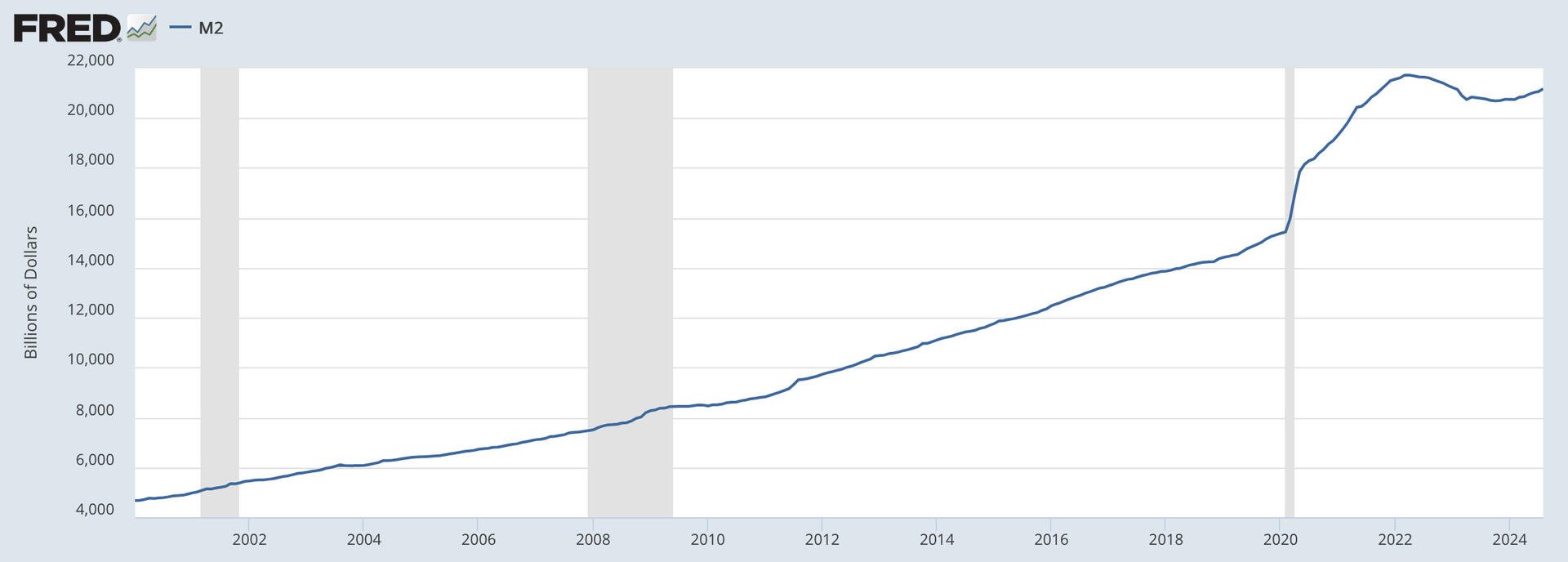

😂 omfg how did I never see the origin of this word?

I can't find the name Oddbean in this repository, how can I find it?
I need it to cite it in my list.
It’s there in that directory. You will see references to oddbean assets. It’s not a standalone repo.

This is a good summary. It’s less noticeable now as people continue to bring their politics and diets to nostr, but the most “real” conversations are typically devs talking about development. Yes nostr is open to everyone, but to your point it just gets noisier the more people that join, then complain it’s too noisy.

Someone will build an asset index. It will get popular. People will complain they’re acting as a central authority. Round and round we go.
While humorous, relay specialization by function should absolutely be a design pattern for nostr. This is awesome. nostr:note14c46r508vlmmwm0me5n5mwp75glsl5vye7qvpc7p4curpjm7krhqmx8h7j

You mean append a bandcamp link for songs that are available there regardless of the source in the event(s)?
nostr:npub1u656f7znujcagfhtgngvtkcflhzptnj38enyzx85da0lh63sfj7qva332p two things I'm thinking for the kind 2002 event that would potentially make it more interoperable / usable.
1) The "i" tag can just be any general information about how to find the song. The MBID schema is great if a user has it, but I don't think it needs to be limited to that. Having `spotify:track:{spotifyId}` or `tidal:track:{tidalId}` would allow clients to more easily link to a spot where the song can be played.
2) I think adding a `source` would be fun, then a client like scrobble.nostr-music.cc can show which player the the scrobble event came from. Cmus, spotify, last.fm, etc...
This would also tie in nicely to building out a more structure graph of how to find music on the web. Something can ingest this data piece together the spotify link, tidal link, mbid link, etc... and turn that into a Song event.
I almost have a little app done that will handle publishing these events directly from your spotify plays, rather than having to go through last.fm, and I think that will open up this event kind to many more users.
Agree allowing for “I” to reference the most relevant unique identifier for the context of that client makes sense. Lowers the friction for users/devs and has a nice side effect of incentivizing the media publishers to support as it’s an organic mechanism for discoverability.
Source would also be useful. As just mentioned, loosening the requirements for clients is the way to go - but it points to a future where post processing to clean up, integrate, and present events is going to be required. It’s not so much a negative trade-off, just the reality of open data. Also, if certain communities want to be more strict, they’re free to do integrity checks on write. Only suggestion would be to call it ‘client’ instead of ‘source’. When I read ‘source’ I think of the publisher.


I'm not sure if you've ever listened to the cognitive scientist John Vervaeke, but I'm always struck by his level-headed and non-judgmental description of how humans can be duplicitous.
“The very things that make you so intelligently adaptive simultaneously make you vulnerable to self-deceptive, self-destructive behavior.”
It’s not an endorsement, or an excuse, it’s a warning.
That quote came from his Awakening From the Meaning Crisis lecture series which nostr:npub1h2sfcqslrmsmrkchapkpmvqj9fr662jdeaftjyuma8kmfmdpcspsgazhwd did a wonderful job summarizing here
Oddly people are also pretty tolerant of someone’s manipulative or exploitative tendencies if they’re wealthy.

Email providers 20 years ago would be judged based on the quality of their spam filters when attracting customers. In a way they still are, if they were bad you wouldn’t use the service.

Total transparency of relay filters helps address this because everyone involved has access to the same information.
Relay operators are not trying to suppress information without others knowing.
nostr:npub1xtscya34g58tk0z605fvr788k263gsu6cy9x0mhnm87echrgufzsevkk5s nostr:npub1zafcms4xya5ap9zr7xxr0jlrtrattwlesytn2s42030lzu0dwlzqpd26k5 heads up, in iOS 18 when you open a media preview panel the app switches to dark mode until you force close. Ahh the joy of new iOS versions 😅
That we can totally agree on. A good indicator of intelligence can be when someone comfortably understands when to say “I don’t know”
Anyone using a Bitkey? Curious if the Server Key means Block has your xpub.
It only knows what it’s trained on. My original point was about poisoning training data. Exhaust their resources, collectively make it economically infeasible to be a data broker.
Is Primal your daily driver or just your wallet provider?

Lightning. Everyone warns you to learn to self custody to reduce your risk of being rugged, but the options for self custody of lightning are not great. So you choose something like Wallet of Satoshi, and things seem ok. But people still tell you to be careful. So you are like wtf. Then WOS bails on the US, and you are like wtf again.
So you try Primal. And you pay a 30% premium for the privilege. Then you realize you are stuck there, then Primal becomes unusable so you come back to Damus.
Damus can’t do zaps unless you install a 3rd party script which nobody knows about. And you still haven’t solved the custody issue.
I’m more bullish on cashu at this point.