
**Astronomy Picture of the Day**
16 July 2023
**Meteor and Milky Way over the Alps**
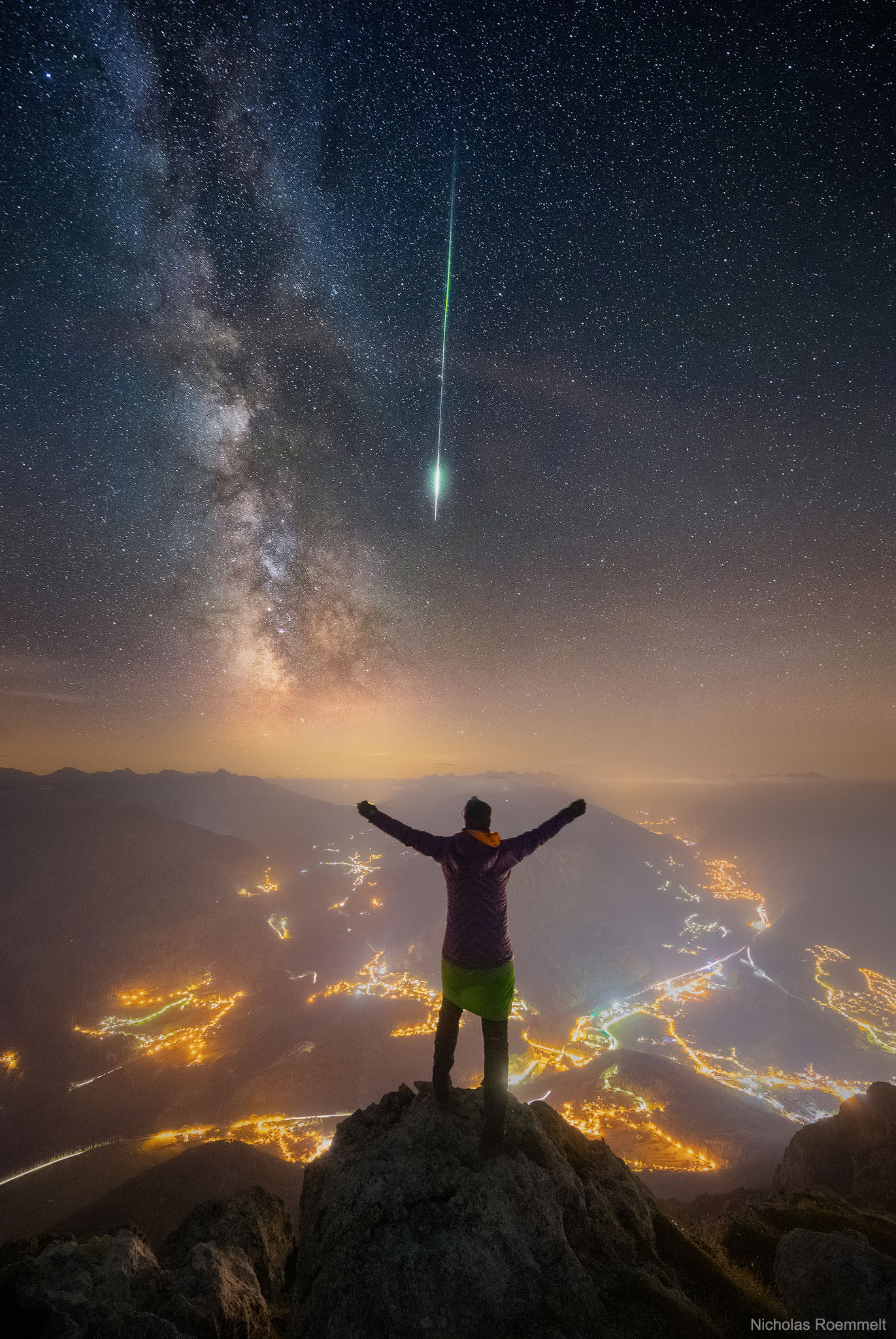
Image Credit & Copyright:
Nicholas Roemmelt
(Venture Photography)
Now this was a view with a thrill. From Mount Tschirgant in the Alps, you can see not only nearby towns and distant Tyrolean peaks, but also, weather permitting, stars, nebulas, and the band of the Milky Way Galaxy. What made the arduous climb worthwhile this night, though, was another peak -- the peak of the 2018 Perseids Meteor Shower. As hoped, dispersing clouds allowed a picturesque sky-gazing session that included many faint meteors, all while a carefully positioned camera took a series of exposures. Suddenly, a thrilling meteor -- bright and colorful -- slashed down right next to the nearly vertical band of the Milky Way. As luck would have it, the camera caught it too. Therefore, a new image in the series was quickly taken with one of the sky-gazers posing on the nearby peak. Later, all of the images were digitally combined.
#APOD #AstronomyLovers #Astronauts #Astrotheory #SpaceStation
**Astronomy Picture of the Day**
15 July 2023
**Webb's First Deep Field**
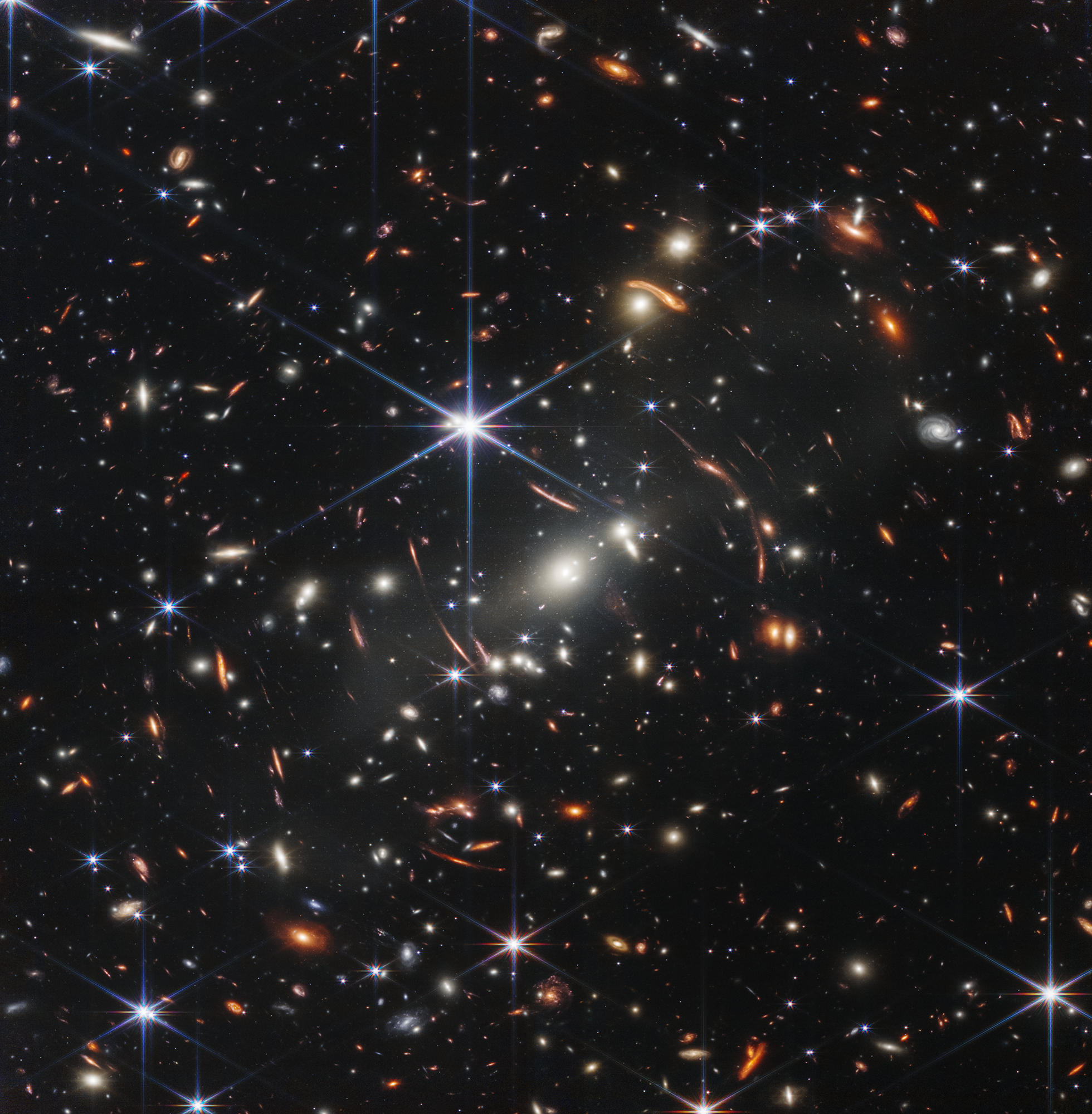
*Image creditor details unavailable via API. Visit linked page below for full info.*
This stunning infrared image was released one year ago as the James Webb Space Telescope began its exploration of the cosmos. The view of the early Universe toward the southern constellation Volans was achieved in 12.5 hours of exposure with Webb's NIRCam instrument. Of course the stars with six spikes are well within our own Milky Way. Their diffraction pattern is characteristic of Webb's 18 hexagonal mirror segments operating together as a single 6.5 meter diameter primary mirror. The thousands of galaxies flooding the field of view are members of the distant galaxy cluster SMACS0723-73, some 4.6 billion light-years away. Luminous arcs that seem to infest the deep field are even more distant galaxies though. Their images are distorted and magnified by the dark matter dominated mass of the galaxy cluster, an effect known as gravitational lensing. Analyzing light from two separate arcs below the bright spiky star, Webb's NIRISS instrument indicates the arcs are both images of the same background galaxy. And that galaxy's light took about 9.5 billion years to reach the James Webb Space Telescope.
#APOD #Planetarium #Astrogeology #Astroeducation #SpaceDiscovery
**Astronomy Picture of the Day**
14 July 2023
**Comet C/2023 E1 ATLAS near Perihelion**
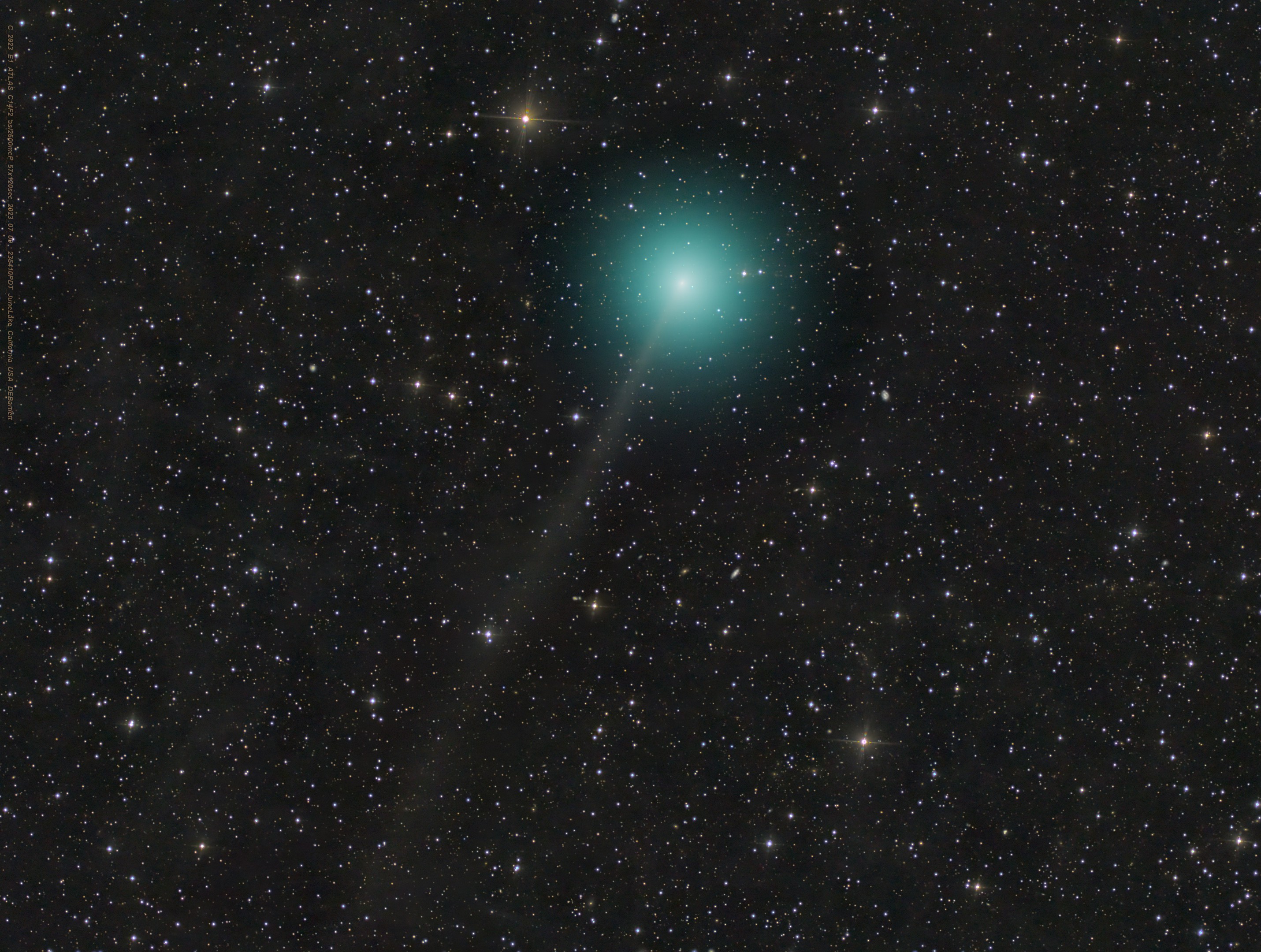
Image Credit & Copyright: Dan Bartlett
Comet C/2023 E1 (ATLAS) was just spotted in March, another comet found by the NASA funded Asteroid Terrestrial-impact Last Alert System. On July 1 this Comet ATLAS reached perihelion, its closest approach to the Sun. Shortly afterwards the telescopic comet was captured in this frame sporting a pretty greenish coma and faint, narrow ion tail against a background of stars in the far northern constellation Ursa Minor. This comet's closest approach to Earth is still to come though. On August 18 this visitor to the inner Solar System will be a mere 3 light-minutes or so from our fair planet. Based on its inclination to the ecliptic plane and orbital period of about 85 years C/2023 E1 (ATLAS) is considered a Halley-type comet.
#APOD #Space #Astrochemistry #SpaceDiscovery #Exoplanets
**Astronomy Picture of the Day**
13 July 2023
**Webb's Rho Ophiuchi**
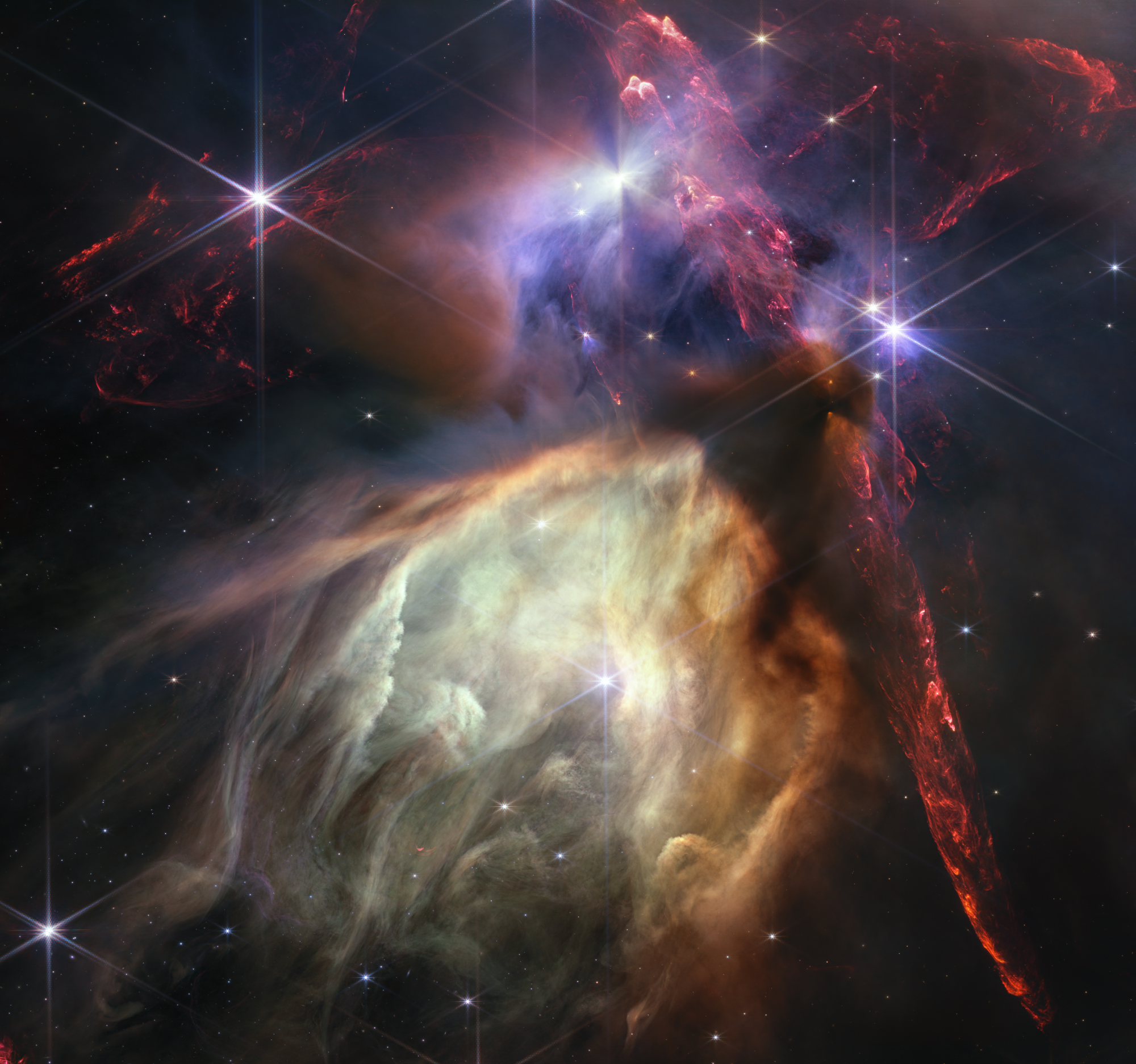
*Image creditor details unavailable via API. Visit linked page below for full info.*
A mere 390 light-years away, Sun-like stars and future planetary systems are forming in the Rho Ophiuchi molecular cloud complex, the closest star-forming region to our fair planet. The James Webb Space Telescope's NIRCam peered into the nearby natal chaos to capture this infrared image at an inspiring scale. The spectacular cosmic snapshot was released to celebrate the successful first year of Webb's exploration of the Universe. The frame spans less than a light-year across the Rho Ophiuchi region and contains about 50 young stars. Brighter stars clearly sport Webb's characteristic pattern of diffraction spikes. Huge jets of shocked molecular hydrogen blasting from newborn stars are red in the image, with the large, yellowish dusty cavity carved out by the energetic young star near its center. Near some stars in the stunning image are shadows cast by their protoplanetary disks.
#APOD #SpaceTravel #Galaxy #Cosmological #SpaceWeather
**Astronomy Picture of the Day**
12 July 2023
**Rings and Bar of Spiral Galaxy NGC 1398**
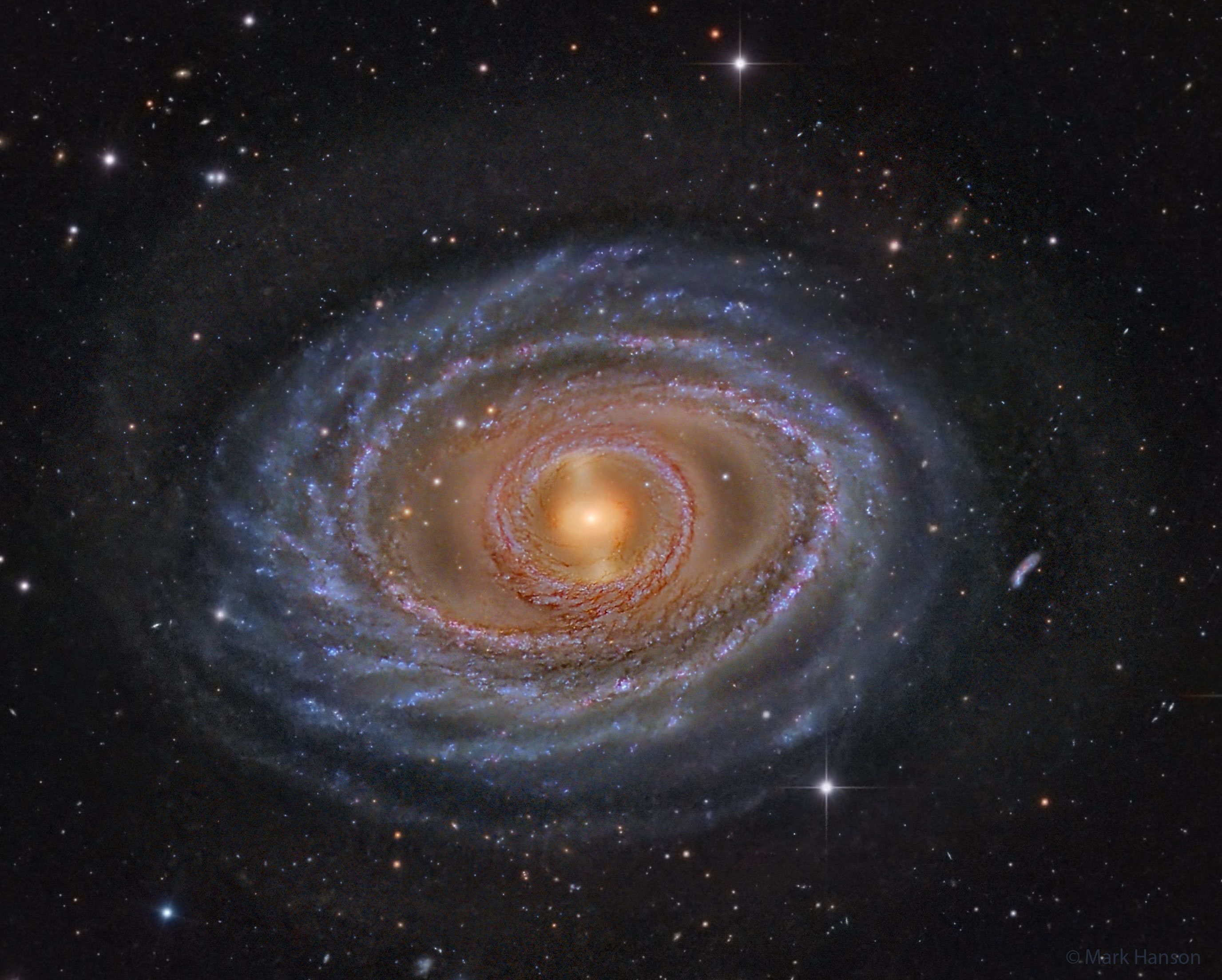
*Image creditor details unavailable via API. Visit linked page below for full info.*
Why do some spiral galaxies have a ring around the center? Spiral galaxy NGC 1398 not only has a ring of pearly stars, gas and dust around its center, but a bar of stars and gas across its center, and spiral arms that appear like ribbons farther out. The featured deep image from Observatorio El Sauce in Chile shows the grand spiral galaxy in impressive detail. NGC 1398 lies about 65 million light years distant, meaning the light we see today left this galaxy when dinosaurs were disappearing from the Earth. The photogenic galaxy is visible with a small telescope toward the constellation of the Furnace (Fornax). The ring near the center is likely an expanding density wave of star formation, caused either by a gravitational encounter with another galaxy, or by the galaxy's own gravitational asymmetries.
#APOD #PlanetaryScience #NASAInspires #Astrophysics #Astroengineer
**Astronomy Picture of the Day**
11 July 2023
**Sunspots on an Active Sun**
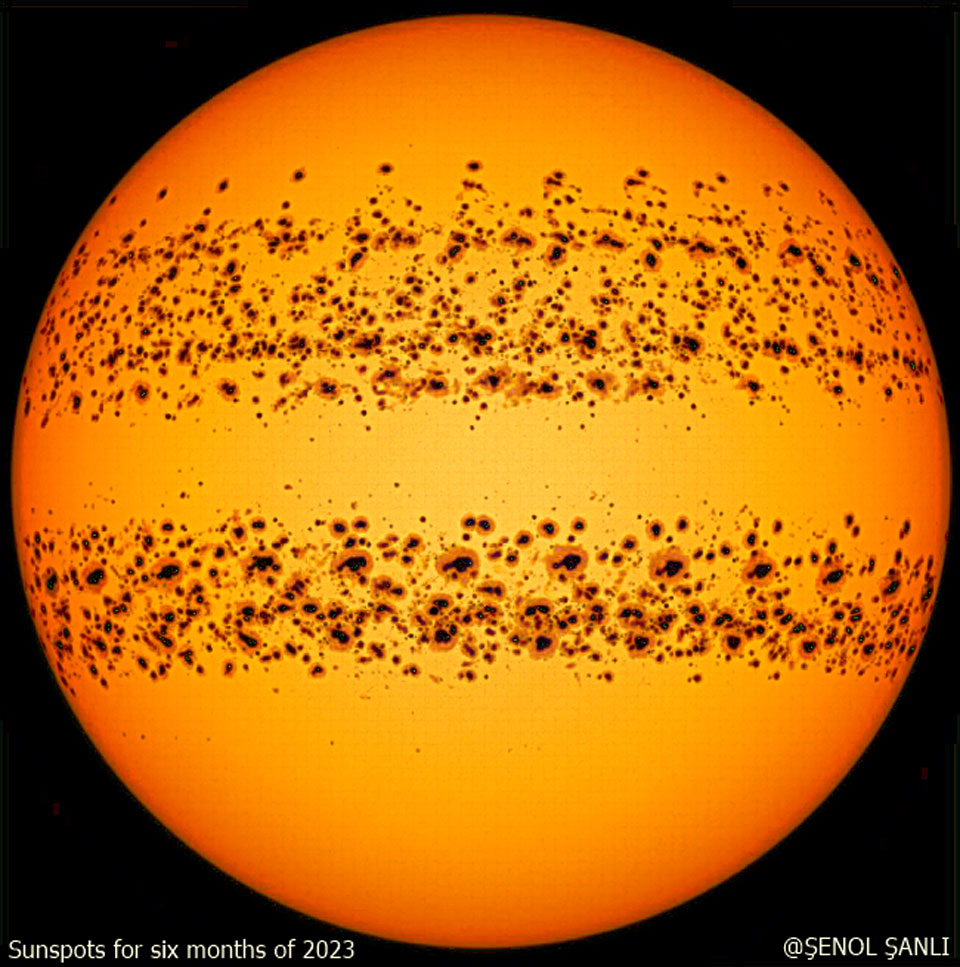
*Image creditor details unavailable via API. Visit linked page below for full info.*
Why is our Sun so active now? No one is sure. An increase in surface activity was expected because our Sun is approaching solar maximum in 2025. However, last month our Sun sprouted more sunspots than in any month during the entire previous 11-year solar cycle -- and even dating back to 2002. The featured picture is a composite of images taken every day from January to June by NASA's Solar Dynamic Observatory. Showing a high abundance of sunspots, large individual spots can be tracked across the Sun's disk, left to right, over about two weeks. As a solar cycle continues, sunspots typically appear closer to the equator. Sunspots are just one way that our Sun displays surface activity -- another is flares and coronal mass ejections (CMEs) that expel particles out into the Solar System. Since these particles can affect astronauts and electronics, tracking surface disturbances is of more than aesthetic value. Conversely, solar activity can have very high aesthetic value -- in the Earth's atmosphere when they trigger aurora.
#APOD #Exoplanets #StarCluster #SpaceTravel #Astrophoto
**Astronomy Picture of the Day**
10 July 2023
**Stars, Dust and Nebula in NGC 6559**
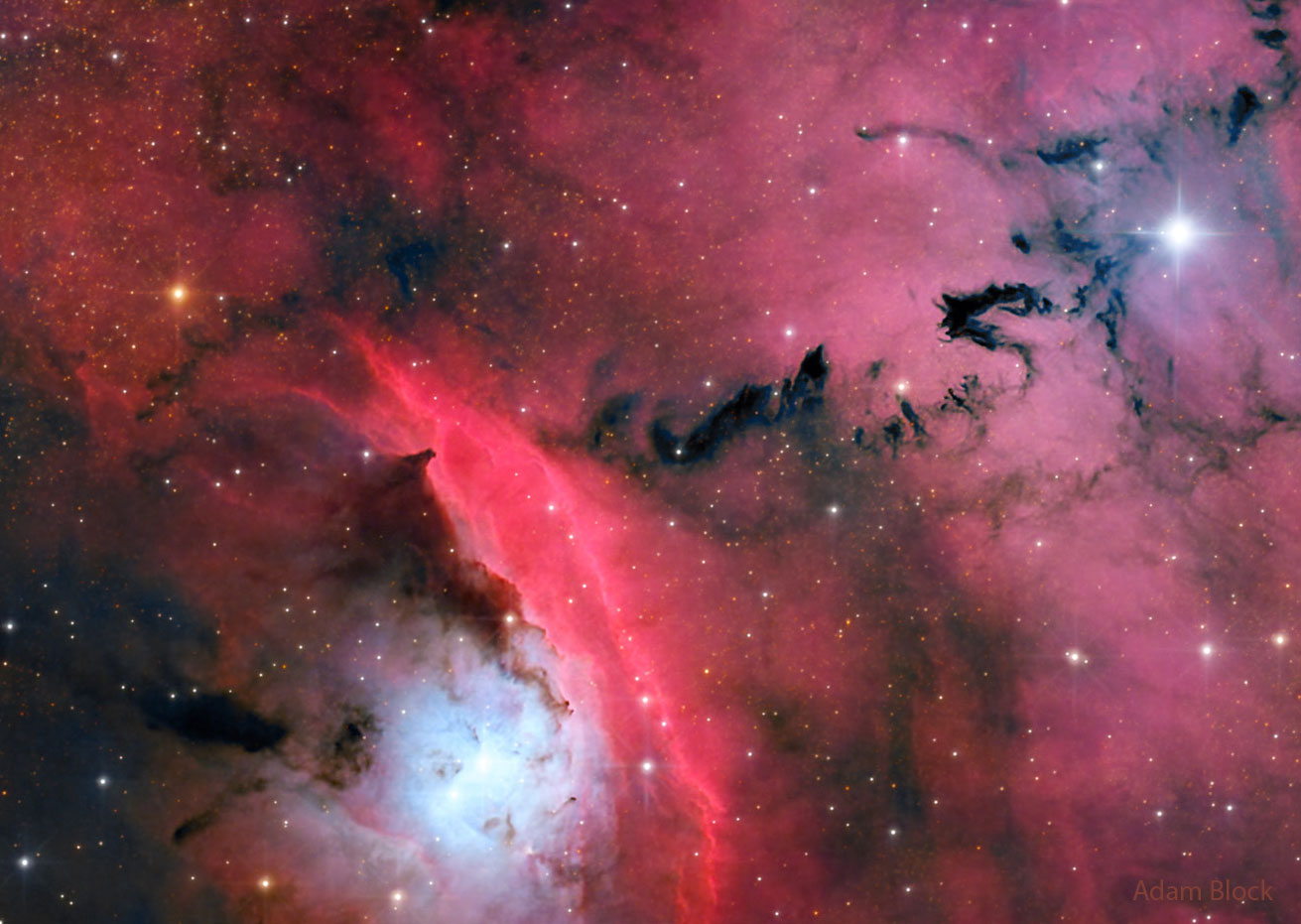
Image Credit & Copyright:
Adam Block,
Telescope Live
When stars form, pandemonium reigns. A textbook case is the star forming region NGC 6559. Visible in the featured image are red glowing emission nebulas of hydrogen, blue reflection nebulas of dust, dark absorption nebulas of dust, and the stars that formed from them. The first massive stars formed from the dense gas will emit energetic light and winds that erode, fragment, and sculpt their birthplace. And then they explode. The resulting morass can be as beautiful as it is complex. After tens of millions of years, the dust boils away, the gas gets swept away, and all that is left is a bare open cluster of stars.
#APOD #Meteorology #Cosmos #Astronauts #AstronautLife
**Astronomy Picture of the Day**
20 June 2023
**The Ñandú in the Milky Way**
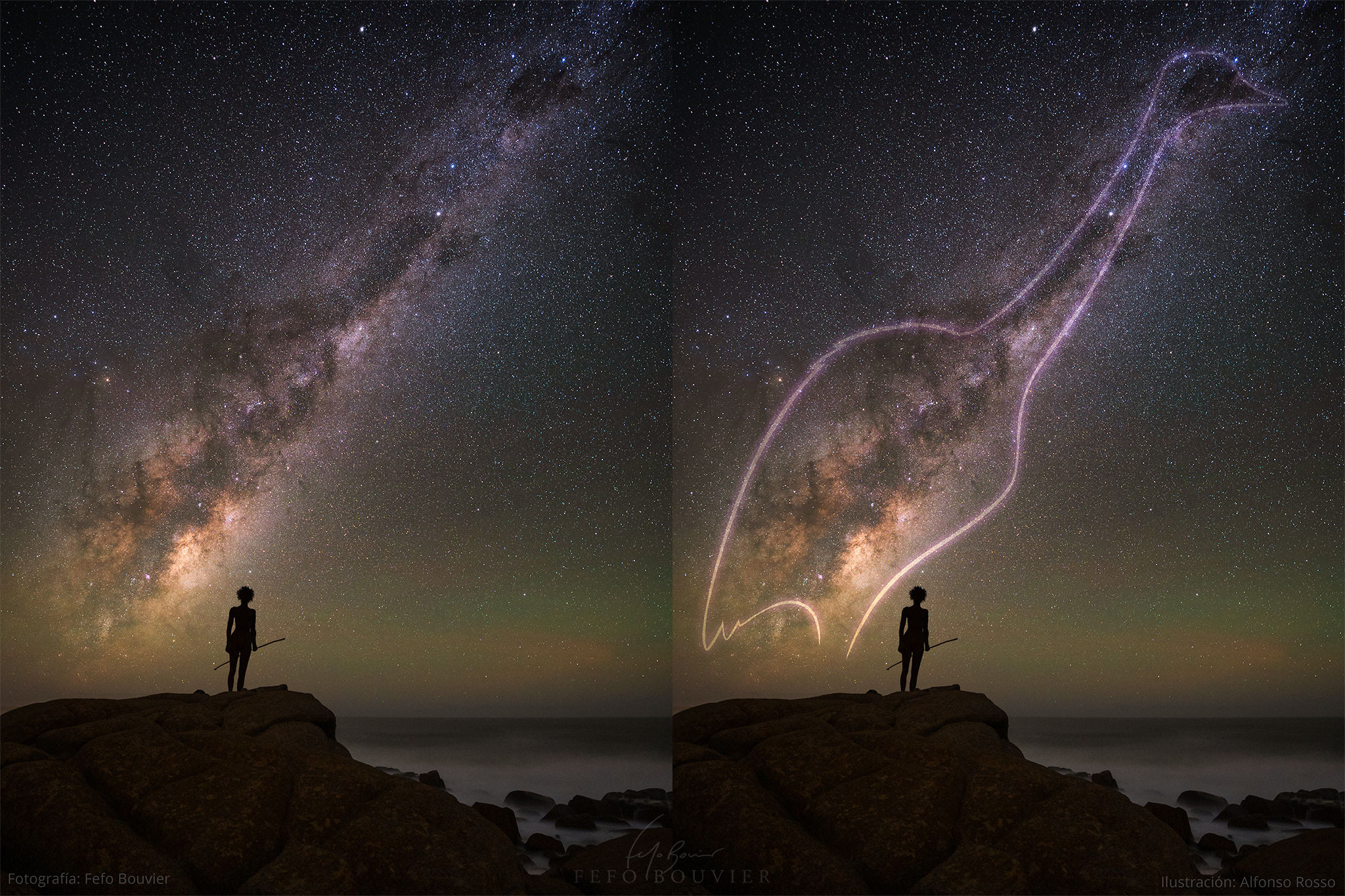
Image Credit & Copyright:
Fefo Bouvier;
Line Drawing: Alfonso Rosso
Have you seen the bird in the Milky Way? Beyond the man in the Moon, the night sky is filled with stories, and cultures throughout history have projected some of their most enduring legends onto the stars and dust above. Generations of people see these celestial icons, hear their associated stories, and pass them down. Pictured here is not only a segment of the central band of our Milky Way galaxy, but, according to folklore of several native peoples of Uruguay, the outline of a great bird called Ñandú. Furthermore, Ñandú's footprint is associated with the Southern Cross asterism. In the foreground, in silhouette, is a statue of María Micaela Guyunusa, an indigenous woman of the Charrúa people who lived in the 1800s and endures as a symbol of colonial resistance. The composite image was taken in mid-April in Cabo Polonio, Uruguay, with the Atlantic Ocean in the background.
#APOD #RocketLaunch #MilkyWay #SpaceTravel #SpaceExploration
**Astronomy Picture of the Day**
17 June 2023
**Planet Earth at Night II**
https://www.youtube.com/embed/zIqG42AD4Gw?rel=0
*Image creditor details unavailable via API. Visit linked page below for full info.*
Recorded during 2017, timelapse sequences from the International Space Station are compiled in this serene video of planet Earth at Night. Fans of low Earth orbit can start by enjoying the view as green and red aurora borealis slather up the sky. The night scene tracks from northwest to southeast across North America, toward the Gulf of Mexico and the Florida coast. A second sequence follows European city lights, crosses the Mediterranean Sea, and passes over a bright Nile river in northern Africa. Seen from the orbital outpost, erratic flashes of lightning appear in thunder storms below and stars rise above the planet's curved horizon through a faint atmospheric airglow. Of course, from home you can always check out the vital signs of Planet Earth Now.
#APOD #Astrophysics #Astrogeology #MeteorShowers #Celestial
**Astronomy Picture of the Day**
16 June 2023
**Sunset to Sunrise over the Baltic Sea**
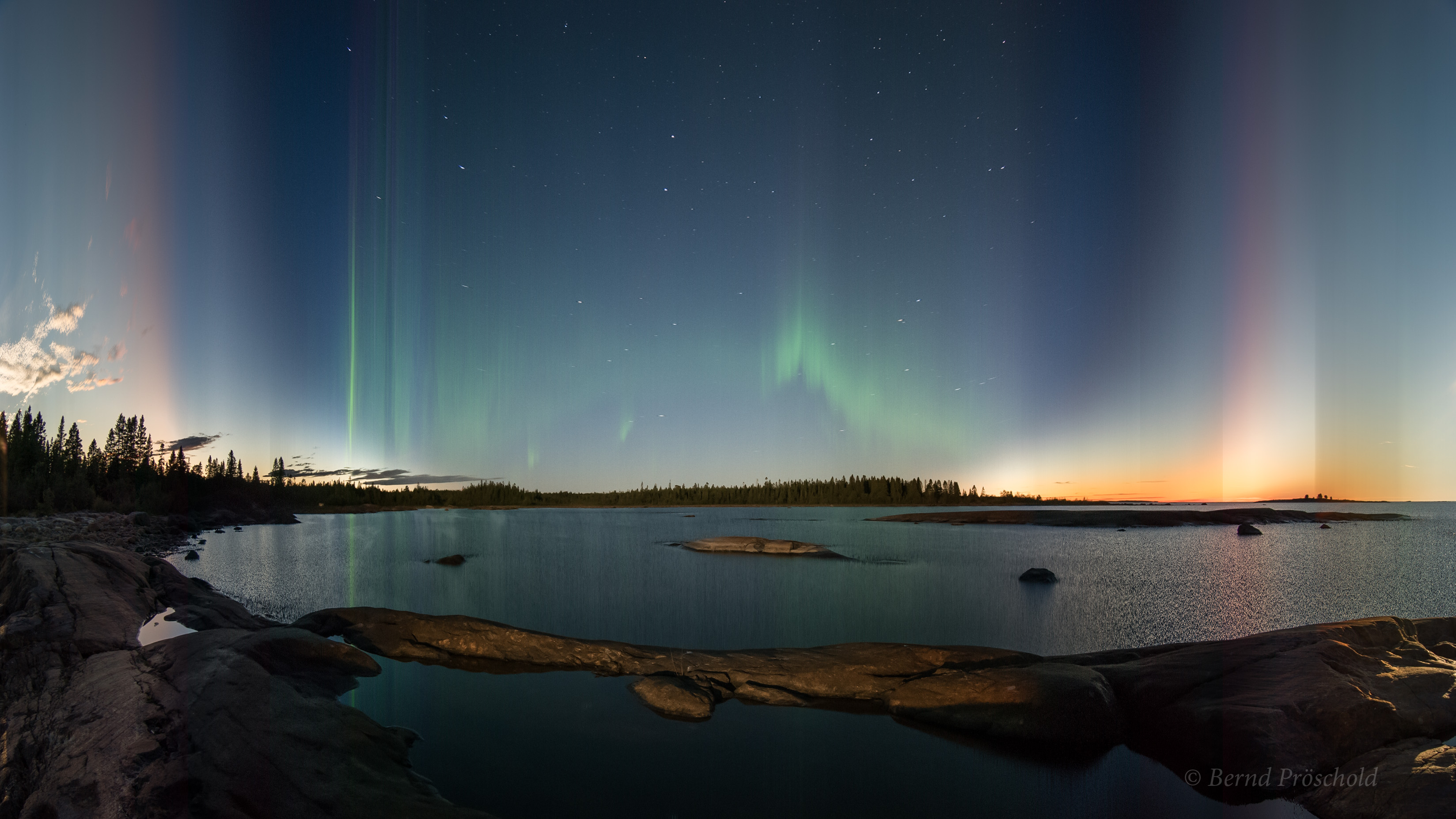
Image Credit & Copyright: Bernd Pröschold
This serene view from the coast of Sweden looks across the Baltic sea and compresses time, presenting the passage of one night in a single photograph. From sunset to sunrise, moonlight illuminates the creative sea and skyscape. Fleeting clouds, fixed stars, and flowing northern lights leave their traces in planet Earth's sky. To construct the timelapse image, 3296 video frames were recorded on the night of June's Full Moon between 7:04pm and 6:35am local time. As time progresses from left to right, a single column of pixels was taken from the corresponding individual frame and combined in sequence into a single digital image 3296 pixels wide. Happy Birthday APOD
#APOD #SpaceResearch #AstronomyLovers #Astrospace #Astroinformatics
**Astronomy Picture of the Day**
15 June 2023
**M15: Dense Globular Star Cluster**
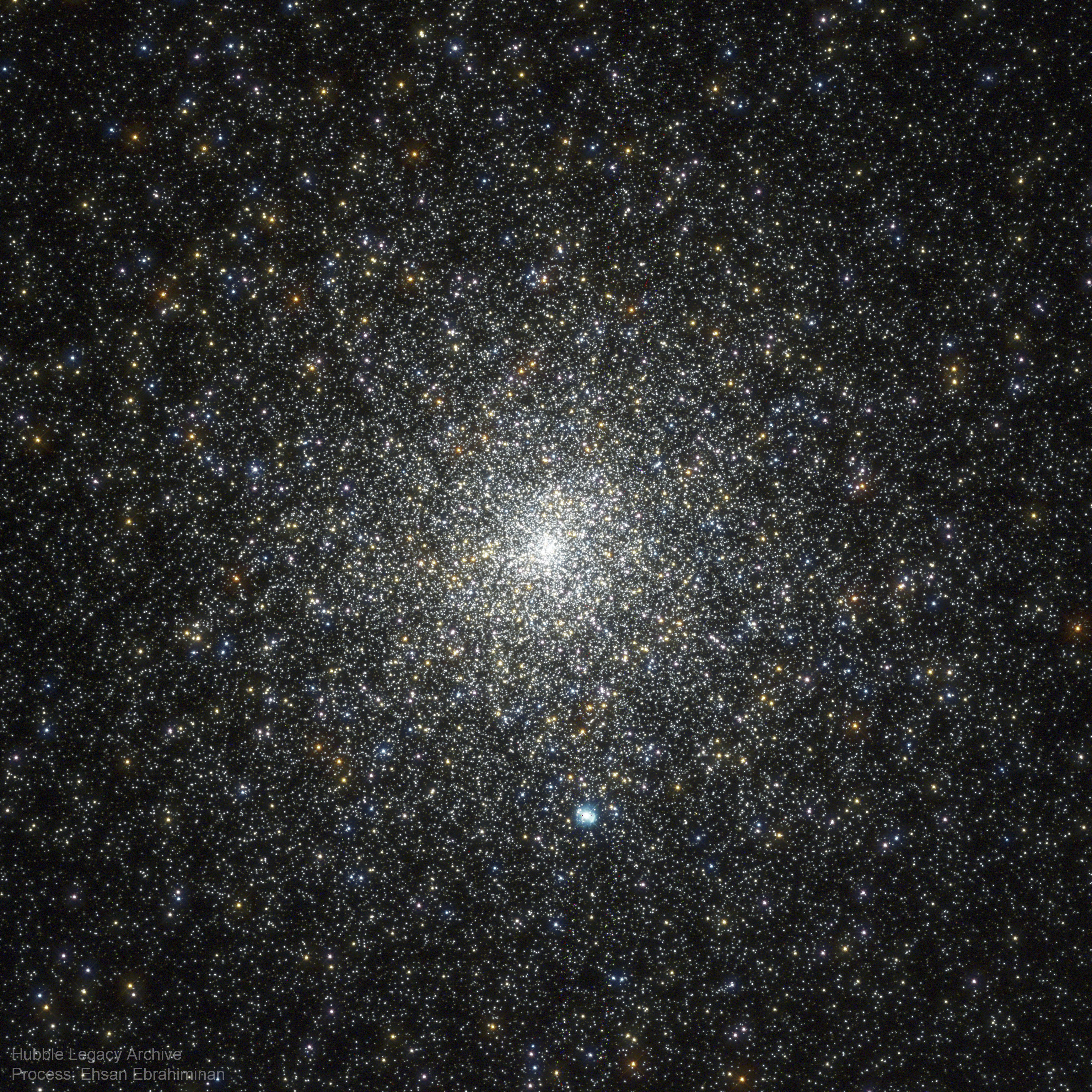
*Image creditor details unavailable via API. Visit linked page below for full info.*
Messier 15 is an immense swarm of over 100,000 stars. A 13 billion year old relic of the early formative years of our galaxy it's one of about 170 globular star clusters that still roam the halo of the Milky Way. Centered in this sharp reprocessed Hubble image, M15 lies some 35,000 light-years away toward the constellation Pegasus. Its diameter is about 200 light-years, but more than half its stars are packed into the central 10 light-years or so, making one of the densest concentrations of stars known. Hubble-based measurements of the increasing velocities of M15's central stars are evidence that a massive black hole resides at the center of the dense cluster. M15 is also known to harbour a planetary nebula. Called Pease 1 (aka PN Ps 1), it can be seen in this image as a small blue blob below and just right of center.
#APOD #SpaceMission #LunarExploration #SpaceMissions #PlanetaryScience
**Astronomy Picture of the Day**
14 June 2023
**The Shark Nebula**
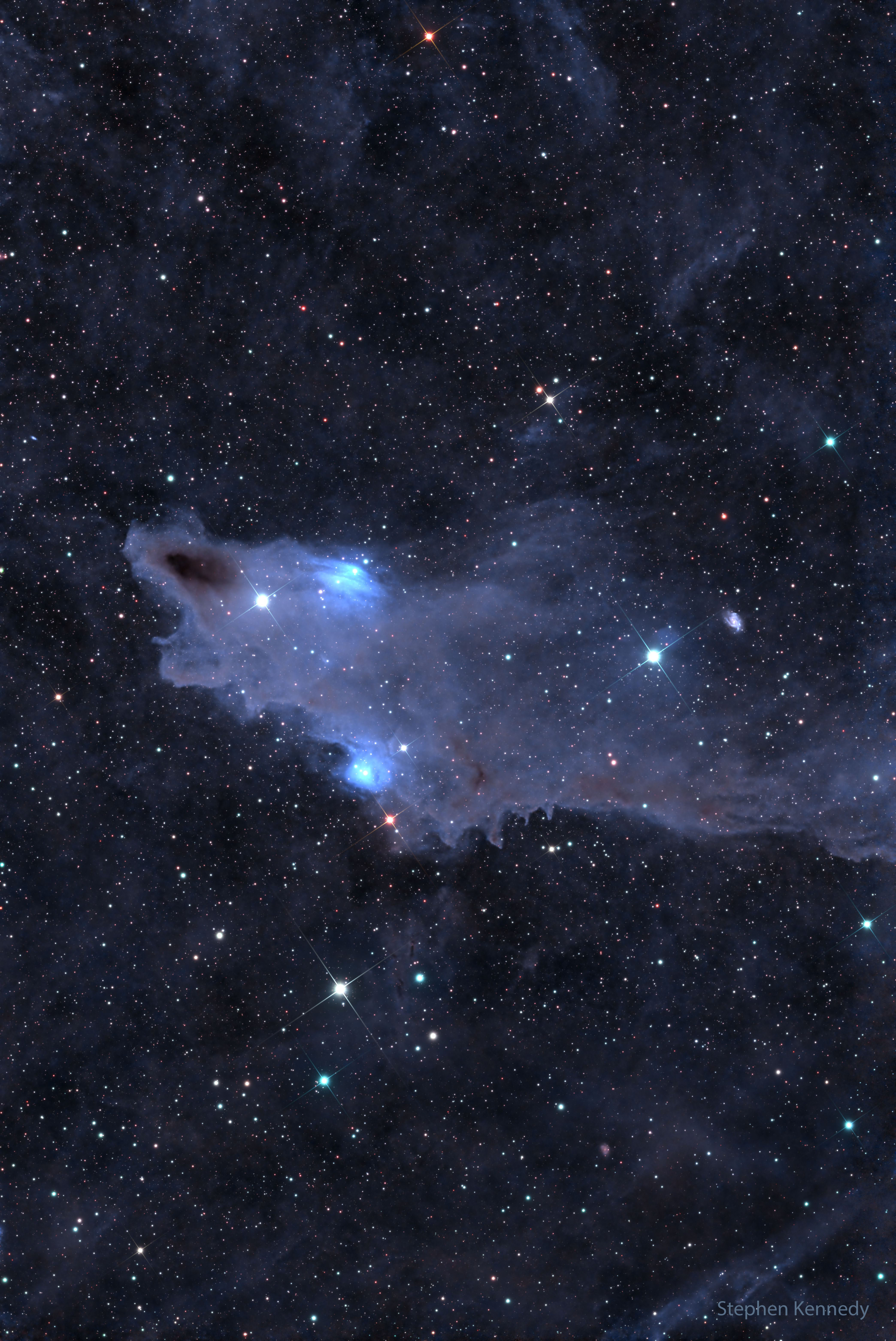
Image Credit & Copyright:
Stephen Kennedy
There is no sea on Earth large enough to contain the Shark nebula. This predator apparition poses us no danger as it is composed only of interstellar gas and dust. Dark dust like that featured here is somewhat like cigarette smoke and created in the cool atmospheres of giant stars. After being expelled with gas and gravitationally recondensing, massive stars may carve intricate structures into their birth cloud using their high energy light and fast stellar winds as sculpting tools. The heat they generate evaporates the murky molecular cloud as well as causing ambient hydrogen gas to disperse and glow red. During disintegration, we humans can enjoy imagining these great clouds as common icons, like we do for water clouds on Earth. Including smaller dust nebulae such as Lynds Dark Nebula 1235 and Van den Bergh 149 & 150, the Shark nebula spans about 15 light years and lies about 650 light years away toward the constellation of the King of Aethiopia (Cepheus).
#APOD #Science #Astronauts #BlackHoles #Research
**Astronomy Picture of the Day**
13 June 2023
**Moons Across Jupiter**
https://www.youtube.com/embed/YEXuGgRCyS0?rel=0
*Image creditor details unavailable via API. Visit linked page below for full info.*
Jupiter's moons circle Jupiter. The featured video depicts Europa and Io, two of Jupiter's largest moons, crossing in front of the grand planet's Great Red Spot, the largest known storm system in our Solar System. The video was composed from images taken by the robotic Cassini spacecraft as it passed Jupiter in 2000, on its way to Saturn. The two moons visible are volcanic Io, in the distance, and icy Europa. In the time-lapse video, Europa appears to overtake Io, which is odd because Io is closer to Jupiter and moves faster. The explanation is that the motion of the fast Cassini spacecraft changes the camera location significantly during imaging. Jupiter is currently being visited by NASA's robotic Juno spacecraft, while ESA's Jupiter Icy Moons Explorer (JUICE), launched in April, is enroute.
#APOD #Cosmology #Astrophysics #Astroengineer #Astrotheory
**Astronomy Picture of the Day**
12 June 2023
**The Largest Satellites of Earth**
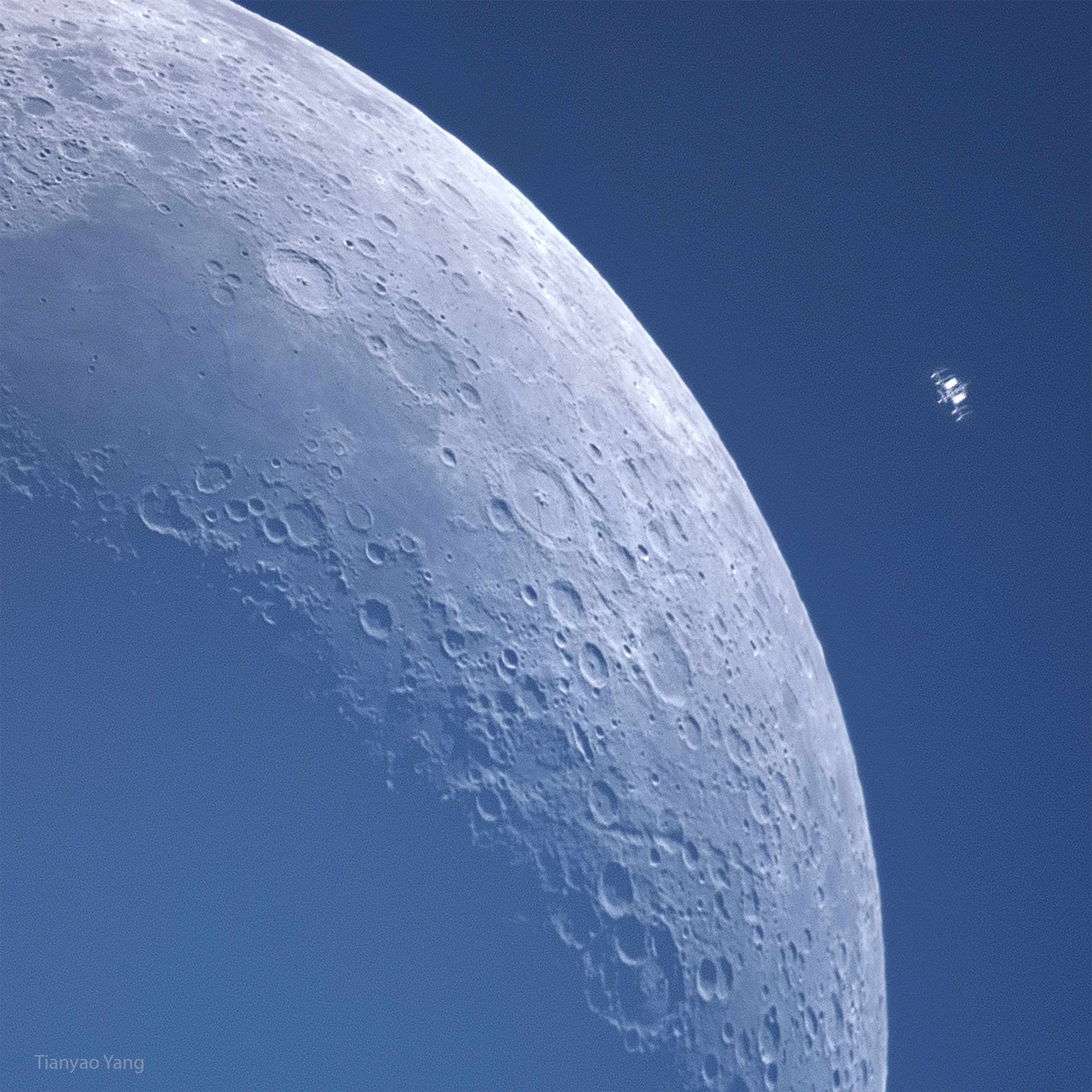
Image Credit & Copyright:
Tianyao Yang
What’s that near the Moon? It’s the International Space Station (ISS). Although the ISS may appear to be physically near the Moon, it is not — it is physically near the Earth. In low Earth orbit and circulating around our big blue marble about every 90 minutes, the ISS was captured photographically as it crossed nearly in front of the Moon. The Moon, itself in a month-long orbit around the Earth, shows a crescent phase as only a curving sliver of its Sun-illuminated half is visible from the Earth. The featured image was taken in late March from Shanghai, China and shows not only details of Earth's largest human-made satellite, but details of the cratered and barren surface of Earth's largest natural satellite. Over the next few years, humanity is planning to send more people and machines to the Moon than ever before.
#APOD #GalaxyExploration #SpaceFacts #LunarExploration #Astrophoto
**Astronomy Picture of the Day**
11 June 2023
**The Sun and Its Missing Colors**
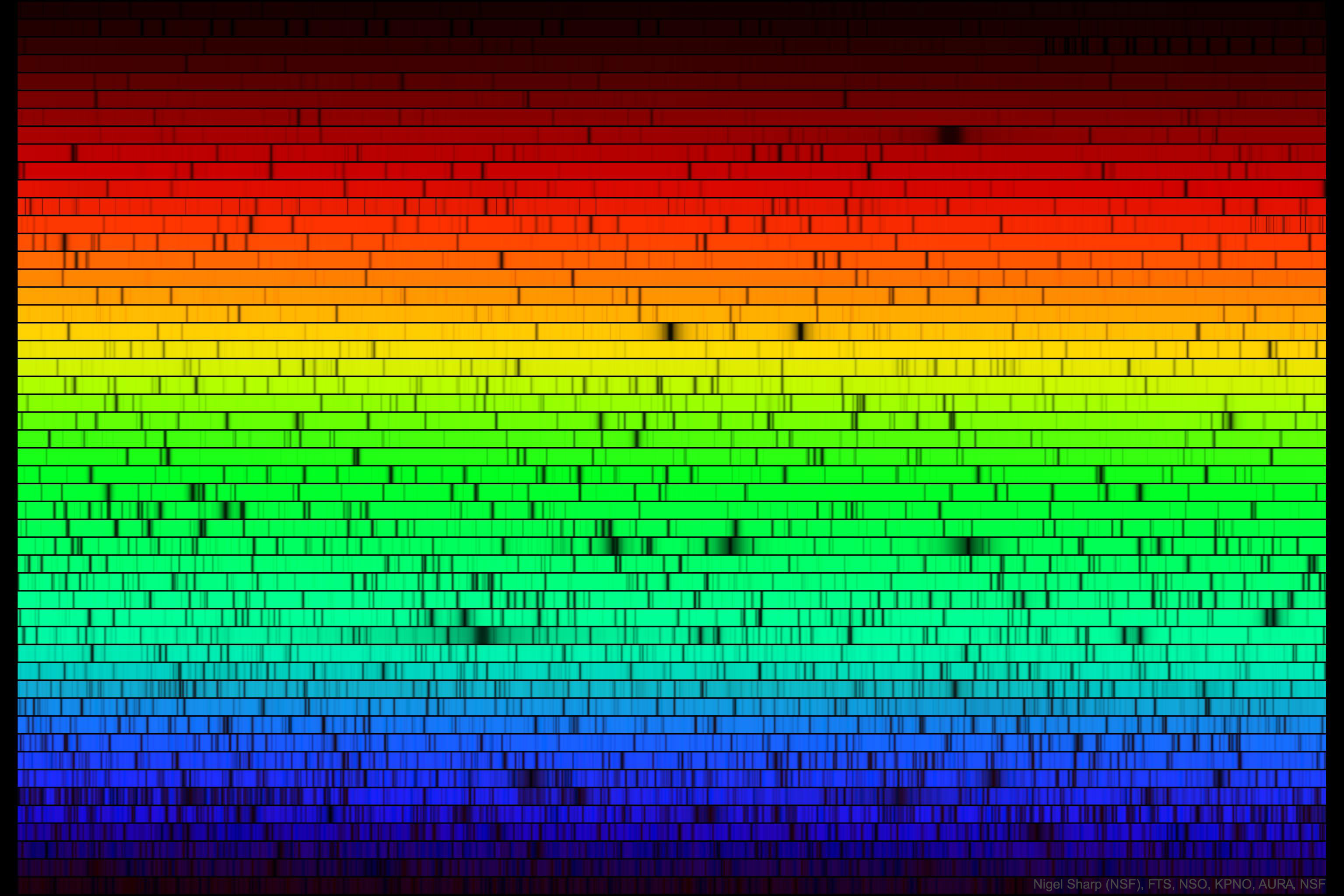
*Image Credit: Nigel Sharp (NSF), FTS, NSO, KPNO, AURA, NSF*
Here are all the visible colors of the Sun, produced by passing the Sun's light through a prism-like device. The spectrum was created at the McMath-Pierce Solar Observatory and shows, first off, that although our white-appearing Sun emits light of nearly every color, it appears brightest in yellow-green light. The dark patches in the featured spectrum arise from gas at or above the Sun's surface absorbing sunlight emitted below. Since different types of gas absorb different colors of light, it is possible to determine what gasses compose the Sun. Helium, for example, was first discovered in 1868 on a solar spectrum and only later found here on Earth. Today, the majority of spectral absorption lines have been identified - but not all.
#APOD #Light #Sun #Spectrum #star
Posted manually due to troubles at NASA APOD API
**Astronomy Picture of the Day**
10 June 2023
**Mars and the Beehive**
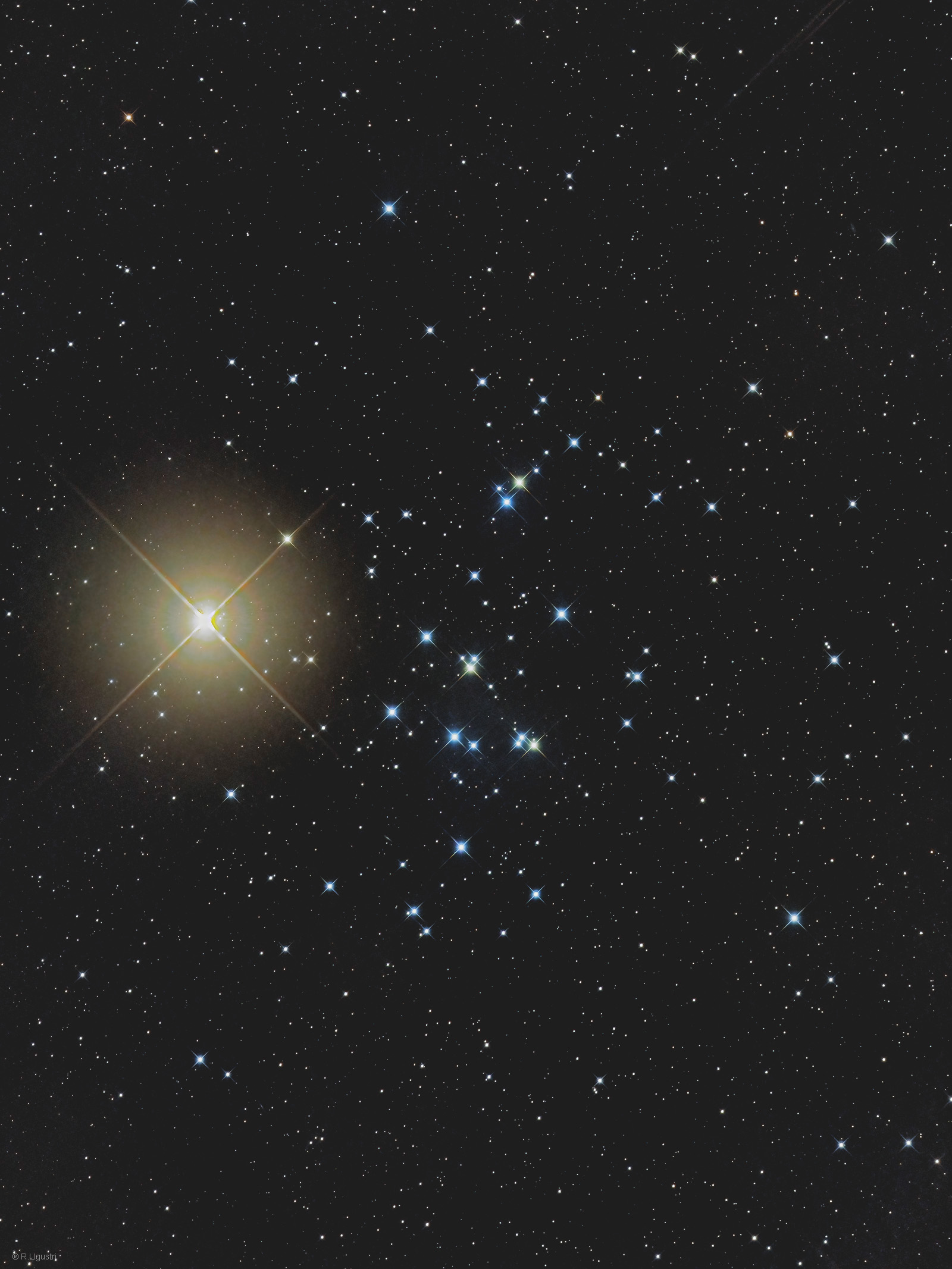
*Image Credit & Copyright: Rolando Ligustri*
This month, bright Mars and brilliant Venus are the prominent celestial beacons in planet Earth's western skies after sunset. Wandering through the constellation Cancer the Crab, the Red Planet was captured here on the evening of June 3 near the stars of open cluster Messier 44. Recognized since antiquity this nearby, naked-eye star cluster is also known as the Praesepe or the Beehive cluster. A swarm of stars all much younger than the Sun, the Beehive cluster is a mere 600 light-years distant. Seen with a yellowish hue, Mars is about 17 light-minutes away. On June 12/13 Venus will take its turn posing next to the stars of the Beehive cluster. But the dazzling light of Venus will make the Beehive stars difficult to see by eye alone.
#APOD #planet #Mars #Venus #stars
Posted manually due to troubles at NASA APOD API
**Astronomy Picture of the Day**
09 June 2023
**Pandora's Cluster of Galaxies**
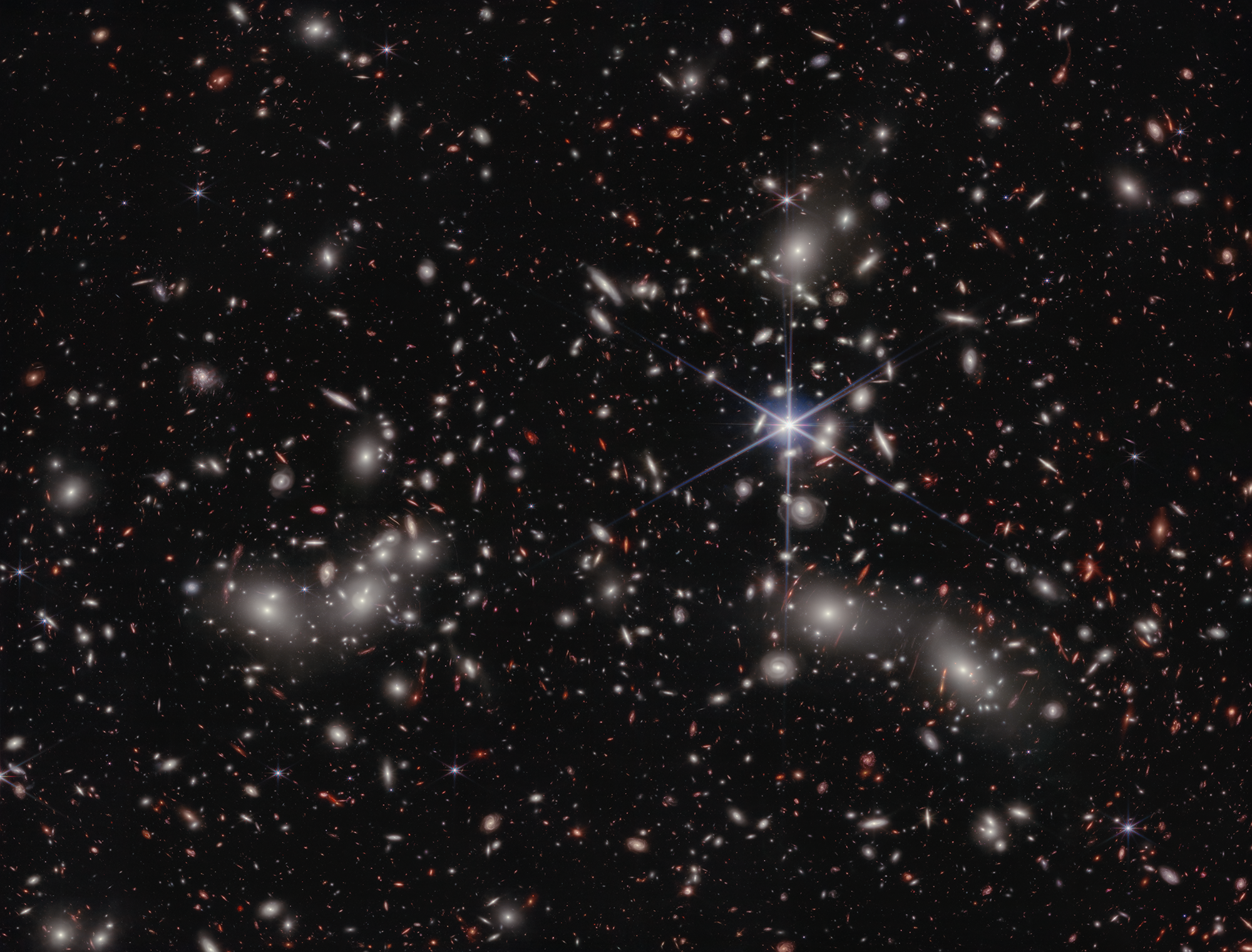
*Image Credit: NASA, ESA, CSA, Ivo Labbe (Swinburne), Rachel Bezanson (University of Pittsburgh), Processing: Alyssa Pagan (STScI)*
This deep field mosaicked image presents a stunning view of galaxy cluster Abell 2744 from the James Webb Space Telescope's NIRCam. Also dubbed Pandora's Cluster, Abell 2744 itself appears to be a ponderous merger of three different massive galaxy clusters some 3.5 billion light-years away toward the constellation Sculptor. Dominated by dark matter, the mega-cluster warps and distorts the fabric of spacetime, gravitationally lensing even more distant objects. Redder than the Pandora cluster galaxies many of the lensed sources are very distant galaxies in the early Universe, stretched and distorted into arcs. Of course distinctive diffraction spikes mark foreground Milky Way stars. At the Pandora Cluster's estimated distance this cosmic box spans about 6 million light-years.
#APOD #galaxy #MilkyWay #darkMatter #galaxyCluster
Posted manually due to troubles at NASA APOD API
**Astronomy Picture of the Day**
08 June 2023
**Elephant's Trunk and Caravan**
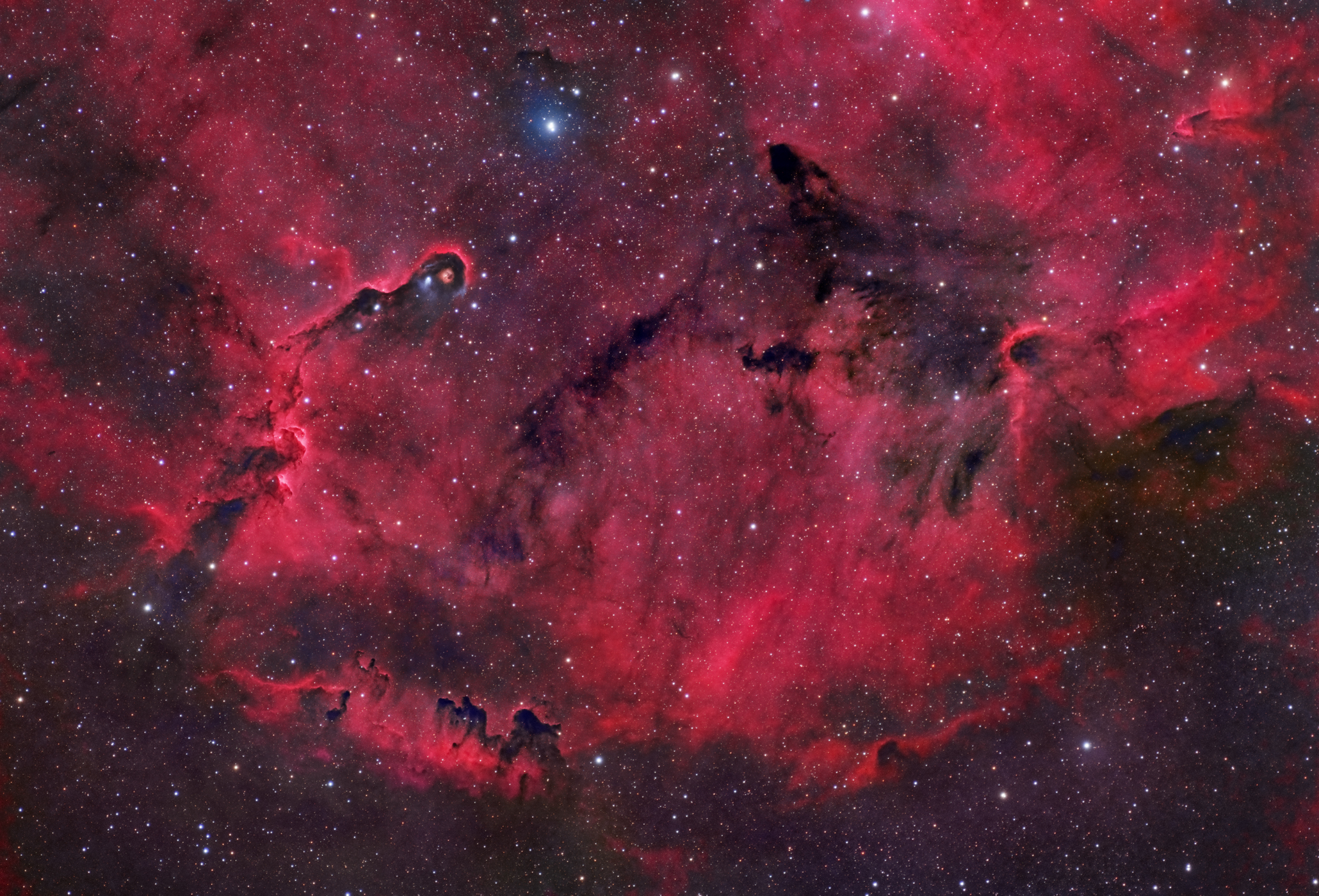
Image Credit & Copyright: Steve
Cannistra
Like an illustration in a galactic Just So Story, the Elephant's Trunk Nebula winds through the emission region and young star cluster complex IC 1396, in the high and far off constellation of Cepheus. Seen on the left the cosmic elephant's trunk, also known as vdB 142, is over 20 light-years long. This detailed telescopic view features the bright swept-back ridges and pockets of cool interstellar dust and gas that abound in the region. But the dark, tendril-shaped clouds contain the raw material for star formation and hide protostars within. Nearly 3,000 light-years distant, the relatively faint IC 1396 complex covers a large region on the sky, spanning over 5 degrees. This rendition spans a 1 degree wide field of view though, about the angular size of 2 full moons. Of course the dark shapes below and to the right of the outstretched Elephant's Trunk, are known to some as The Caravan.
#APOD #RocketLaunch #Astroinformatics #SpaceMission #Astrophysics
**Astronomy Picture of the Day**
07 June 2023
**M94: A Double Ring Galaxy**
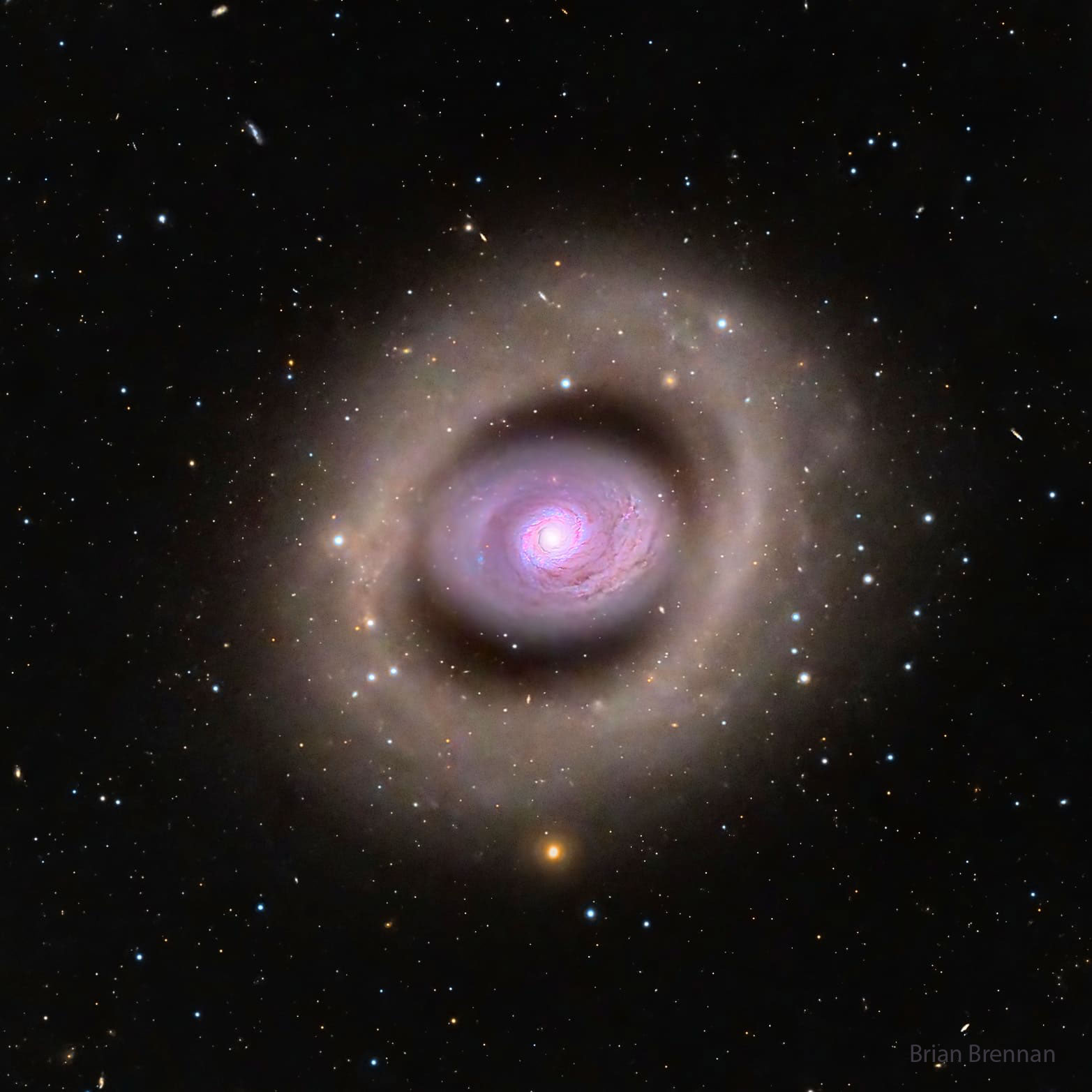
*Image Credit & Copyright: Brian Brennan*
Most galaxies don't have any rings of stars and gas -- why does M94 have two? First, spiral galaxy M94 has an inner ring of newly formed stars surrounding its nucleus, giving it not only an unusual appearance but also a strong interior glow. A leading origin hypothesis holds that an elongated knot of stars known as a bar rotates in M94 and has generated a burst of star formation in this inner ring. Observations have also revealed another ring, an outer ring, one that is more faint, different in color, not closed, and relatively complex. What caused this outer ring is currently unknown. M94, pictured here, spans about 45,000 light years in total, lies about 15 million light years away, and can be seen with a small telescope toward the constellation of the Hunting Dogs (Canes Venatici).
#APOD #galaxy #Universe #spaceRing #curiosity
Posted manually due to troubles at NASA APOD API (503)
**Astronomy Picture of the Day**
06 June 2023
**Star Eats Planet
Illustrative Video**
*Credit: K. Miller & R. Hurt (Caltech, IPAC)*
It’s the end of a world as we know it. Specifically, the Sun-like star ZTF SLRN-2020 was seen eating one of its own planets. Although many a planet eventually dies by spiraling into their central star, the 2020 event, involving a Jupiter-like planet, was the first time it was seen directly. The star ZTF SLRN-2020 lies about 12,000 light years from the Sun toward the constellation of the Eagle (Aquila). In the featured animated illustration of the incident, the gas planet's atmosphere is first pictured being stripped away as it skims along the outskirts of the attracting star. Some of the planet's gas is absorbed into the star's atmosphere, while other gas is expelled into space. By the video's end, the planet is completely engulfed and falls into the star's center, causing the star's outer atmosphere to briefly expand, heat up, and brighten. One day, about eight billion years from now, planet Earth may spiral into our Sun.
#APOD #star #Universe #planet #spacechaos
Posted manually due to troubles at NASA API (503)