
**Astronomy Picture of the Day**
31 March 2024
**Total Solar Eclipse Below the Bottom of the World**
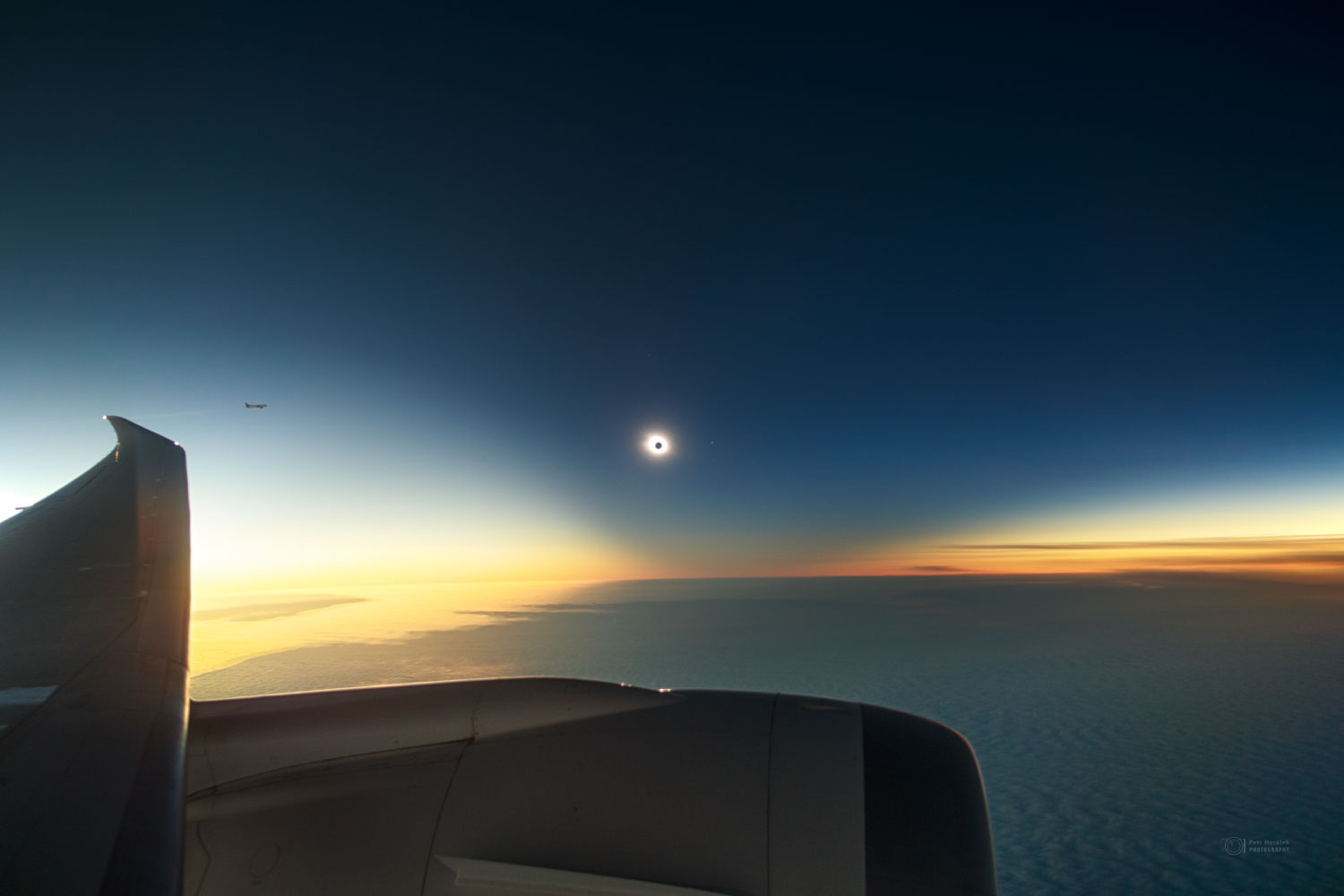
Image Credit & Copyright:
Petr Horálek
(ESO
Photo Ambassador,
Inst. of Physics in Opava) ;
Acknowledgement:
Xavier Jubier
In late 2021 there was a total solar eclipse visible only at the end of the Earth. To capture the unusual phenomenon, airplanes took flight below the clouded seascape of Southern Ocean. The featured image shows one relatively spectacular capture where the bright spot is the outer corona of the Sun and the eclipsing Moon is seen as the dark spot in the center. A wing and engine of the airplane are visible across the left and bottom of the image, while another airplane observing the eclipse is visible on the far left. The dark area of the sky surrounding the eclipsed Sun is called a shadow cone. It is dark because you are looking down a long corridor of air shadowed by the Moon. A careful inspection of the eclipsed Sun will reveal the planet Mercury just to the right. You won't have to travel to the end of the Earth to see the next total solar eclipse. The total eclipse path will cross North America on 2024 April 8, just over one week from today. NASA Coverage: Total Solar Eclipse of 2024 April 8
#APOD #Astrobiology #Meteorology #Astrozone #SpaceTravel
**Astronomy Picture of the Day**
30 March 2024
**Medieval Astronomy from Melk Abbey**
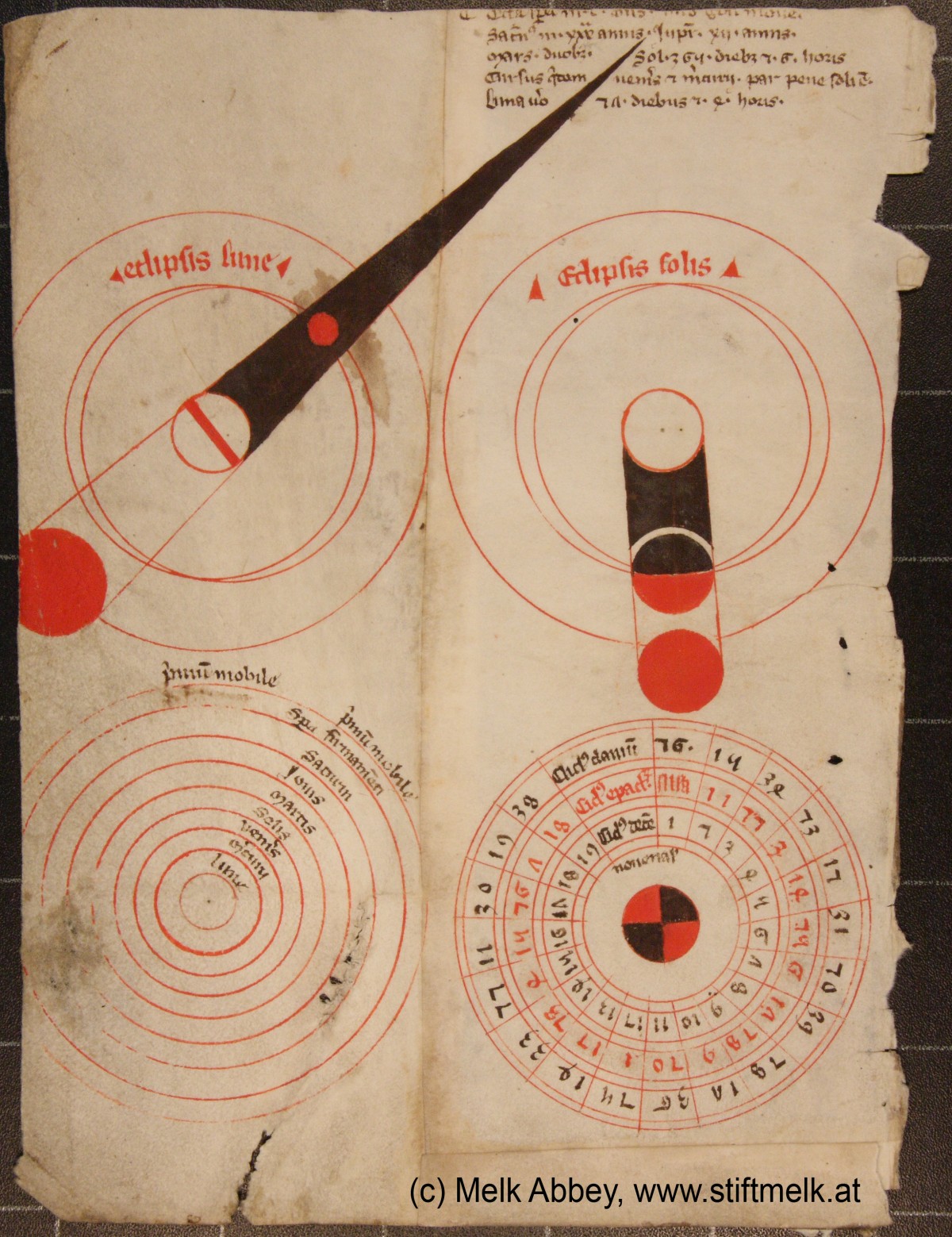
Image Credit & Copyright: Library of Melk Abbey, Frag. 229
Discovered by accident, this manuscript page provides graphical insight to astronomy in medieval times, before the Renaissance and the influence of Nicolaus Copernicus, Tycho de Brahe, Johannes Kepler, and Galileo. The intriguing page is from lecture notes on astronomy compiled by the monk Magister Wolfgang de Styria before the year 1490. The top panels clearly illustrate the necessary geometry for a lunar (left) and solar eclipse in the Earth-centered Ptolemaic system. At lower left is a diagram of the Ptolemaic view of the Solar System with text at the upper right to explain the movement of the planets according to Ptolemy's geocentric model. At the lower right is a chart to calculate the date of Easter Sunday in the Julian calendar. The illustrated manuscript page was found at historic Melk Abbey in Austria.
#APOD #Astroengineering #GalaxyExploration #Planetarium #Astrodata
**Astronomy Picture of the Day**
29 March 2024
**Galileo's Europa**
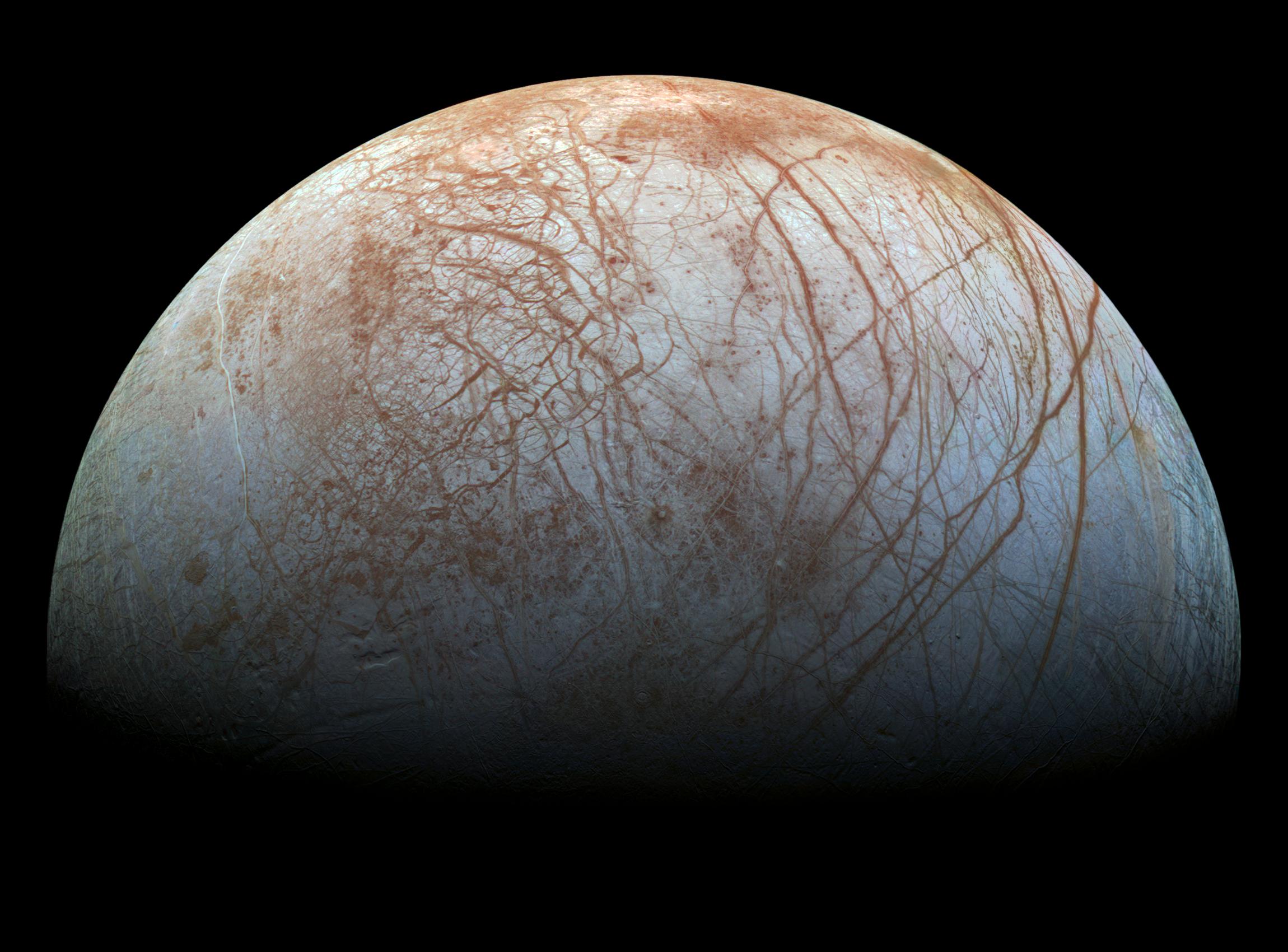
*Image creditor details unavailable via API. Visit linked page below for full info.*
Looping through the Jovian system in the late 1990s, the Galileo spacecraft recorded stunning views of Europa and uncovered evidence that the moon's icy surface likely hides a deep, global ocean. Galileo's Europa image data has been remastered here, with improved calibrations to produce a color image approximating what the human eye might see. Europa's long curving fractures hint at the subsurface liquid water. The tidal flexing the large moon experiences in its elliptical orbit around Jupiter supplies the energy to keep the ocean liquid. But more tantalizing is the possibility that even in the absence of sunlight that process could also supply the energy to support life, making Europa one of the best places to look for life beyond Earth. The Juno spacecraft currently in Jovian orbit has also made repeated flybys of the water world, returning images along with data exploring Europa's habitability. This October will see the launch of the NASA's Europa Clipper on a voyage of exploration. The spacecraft will make nearly 50 flybys, approaching to within 25 kilometers of Europa's icy surface.
#APOD #Astroinformatics #Astrobiology #Astrotheory #Astroeducation
**Astronomy Picture of the Day**
28 March 2024
**Millions of Stars in Omega Centauri**
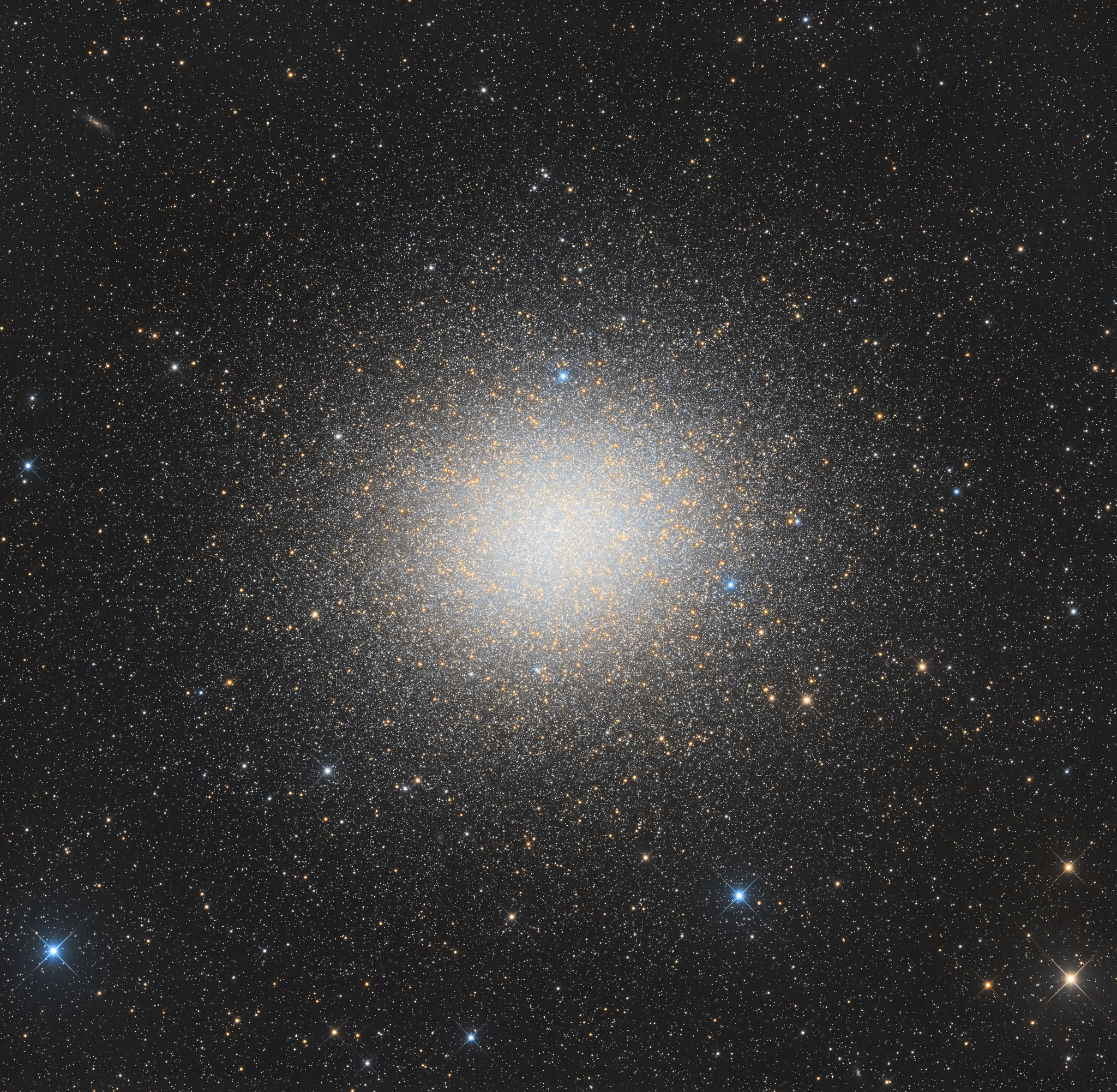
Image Credit & Copyright:
Massimo Di Fusco
Globular star cluster Omega Centauri, also known as NGC 5139, is 15,000 light-years away. The cluster is packed with about 10 million stars much older than the Sun within a volume about 150 light-years in diameter. It's the largest and brightest of 200 or so known globular clusters that roam the halo of our Milky Way galaxy. Though most star clusters consist of stars with the same age and composition, the enigmatic Omega Cen exhibits the presence of different stellar populations with a spread of ages and chemical abundances. In fact, Omega Cen may be the remnant core of a small galaxy merging with the Milky Way. With a yellowish hue, Omega Centauri's red giant stars are easy to pick out in this sharp, color telescopic view.
#APOD #Science #AstronomyPhotography #Universe #Planets
**Astronomy Picture of the Day**
27 March 2024
**The Coma Cluster of Galaxies**
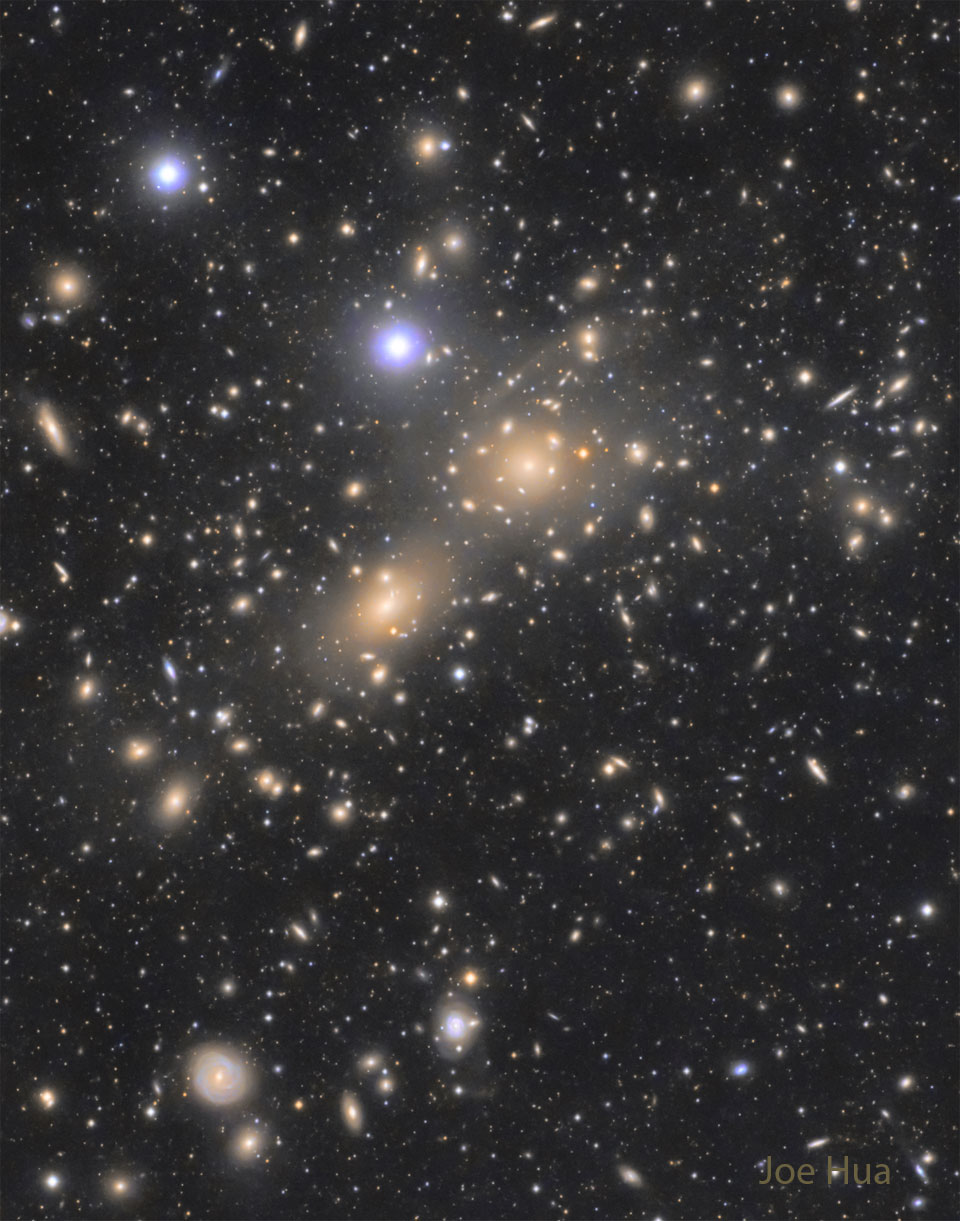
Image Credit & Copyright:
Joe Hua
Almost every object in the featured photograph is a galaxy. The Coma Cluster of Galaxies pictured here is one of the densest clusters known - it contains thousands of galaxies. Each of these galaxies houses billions of stars - just as our own Milky Way Galaxy does. Although nearby when compared to most other clusters, light from the Coma Cluster still takes hundreds of millions of years to reach us. In fact, the Coma Cluster is so big it takes light millions of years just to go from one side to the other. Most galaxies in Coma and other clusters are ellipticals, while most galaxies outside of clusters are spirals. The nature of Coma's X-ray emission is still being investigated.
#APOD #Astrogeology #Astrotheory #Astrofans #PlanetaryExploration
**Astronomy Picture of the Day**
26 March 2024
**Comet Pons-Brooks' Ion Tail**
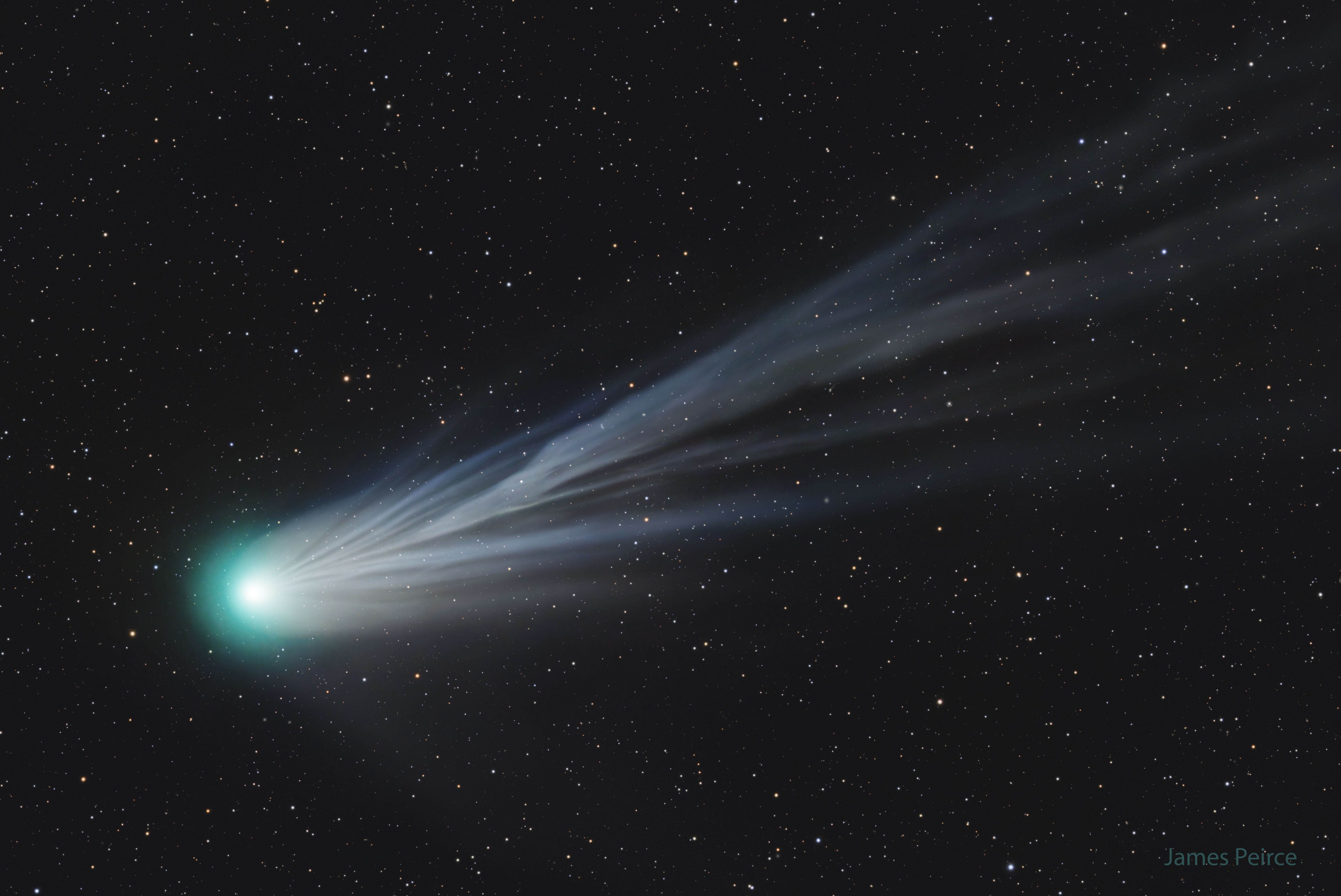
*Image creditor details unavailable via API. Visit linked page below for full info.*
Comet Pons-Brooks has quite a tail to tell. First discovered in 1385, this erupting dirty snowball loops back into our inner Solar System every 71 years and, this time, is starting to put on a show for deep camera exposures. In the featured picture, the light blue stream is the ion tail which consists of charged molecules pushed away from the comet's nucleus by the solar wind. The ion tail, shaped by the Sun's wind and the comet's core's rotation, always points away from the Sun. Comet 12P/Pons–Brooks is now visible with binoculars in the early evening sky toward the northwest, moving perceptibly from night to night. The frequently flaring comet is expected to continue to brighten, on the average, and may even become visible with the unaided eye -- during the day -- to those in the path of totality of the coming solar eclipse on April 8.
#APOD #Astrospace #SpaceTravel #SpaceMission #Planets
**Astronomy Picture of the Day**
25 March 2024
**Sonified: The Jellyfish Nebula Supernova Remnant**
https://youtube.com/embed/NqBfQeJqkfU?rel=0
*Image creditor details unavailable via API. Visit linked page below for full info.*
What does a supernova remnant sound like? Although sound is a compression wave in matter and does not carry into empty space, interpretive sound can help listeners appreciate and understand a visual image of a supernova remnant in a new way. Recently, the Jellyfish Nebula (IC 443) has been sonified quite creatively. In the featured sound-enhanced video, when an imaginary line passes over a star, the sound of a drop falling into water is played, a sound particularly relevant to the nebula's aquatic namesake. Additionally, when the descending line crosses gas that glows red, a low tone is played, while green sounds a middle tone, and blue produces a tone with a relatively high pitch. Light from the supernova that created the Jellyfish Nebula left approximately 35,000 years ago, when humanity was in the stone age. The nebula will slowly disperse over the next million years, although the explosion also created a dense neutron star which will remain indefinitely.
#APOD #Meteorology #SpaceTech #Cosmology #GalacticAdventures
**Astronomy Picture of the Day**
24 March 2024
**Looking Back at an Eclipsed Earth**
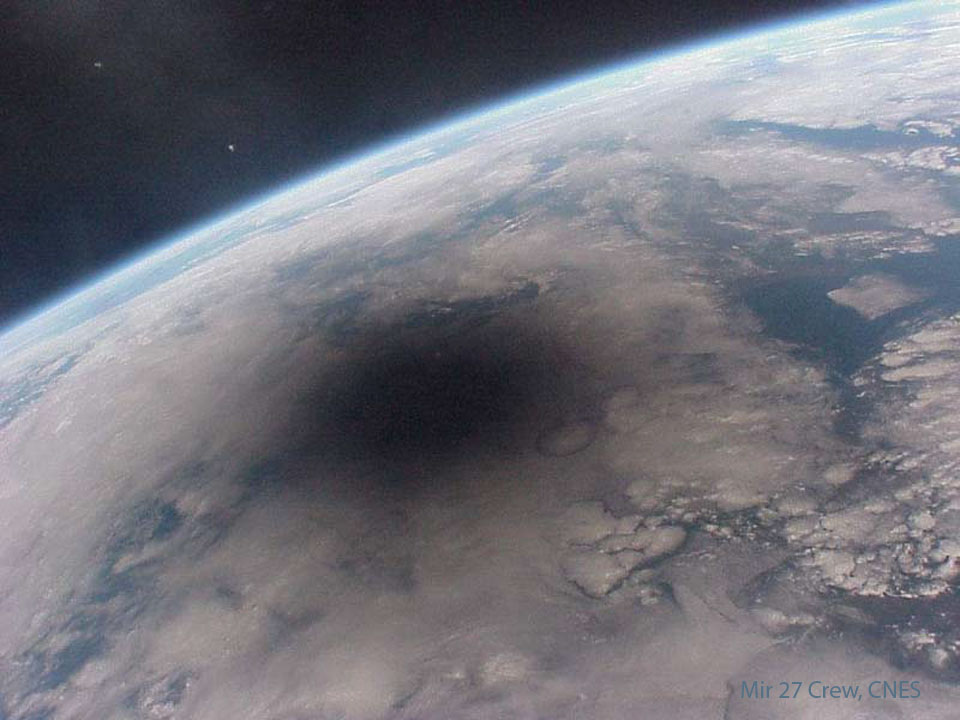
Image Credit & Copyright: CNES
Here is what the Earth looks like during a solar eclipse. The shadow of the Moon can be seen darkening part of Earth. This shadow moved across the Earth at nearly 2000 kilometers per hour. Only observers near the center of the dark circle see a total solar eclipse - others see a partial eclipse where only part of the Sun appears blocked by the Moon. This spectacular picture of the 1999 August 11 solar eclipse was one of the last ever taken from the Mir space station. The two bright spots that appear on the upper left are thought to be Jupiter and Saturn. Mir was deorbited in a controlled re-entry in 2001. A new solar eclipse will occur over North America in about two weeks.
#APOD #PlanetaryExploration #Space #AstronomyFacts #SpaceResearch
**Astronomy Picture of the Day**
23 March 2024
**Ares 3 Landing Site: The Martian Revisited**
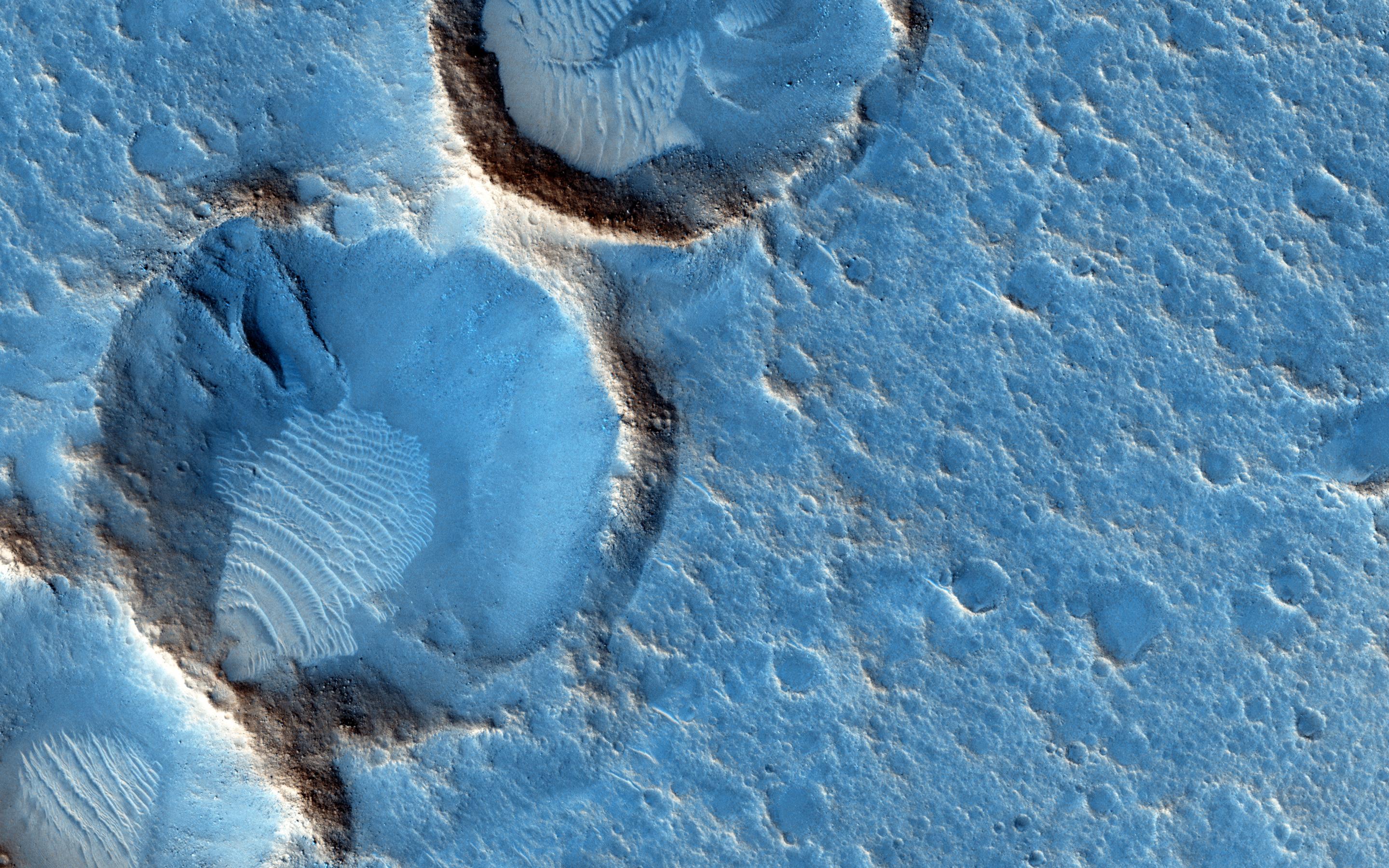
*Image creditor details unavailable via API. Visit linked page below for full info.*
This close-up from the Mars Reconnaissance Orbiter's HiRISE camera shows weathered craters and windblown deposits in southern Acidalia Planitia. A striking shade of blue in standard HiRISE image colors, to the human eye the area would probably look grey or a little reddish. But human eyes have not gazed across this terrain, unless you count the eyes of NASA astronauts in the scifi novel The Martian by Andy Weir. The novel chronicles the adventures of Mark Watney, an astronaut stranded at the fictional Mars mission Ares 3 landing site corresponding to the coordinates of this cropped HiRISE frame. For scale Watney's 6-meter-diameter habitat at the site would be about 1/10th the diameter of the large crater. Of course, the Ares 3 landing coordinates are only about 800 kilometers north of the (real life) Carl Sagan Memorial Station, the 1997 Pathfinder landing site.
#APOD #Astrospace #Meteorology #Astrogeology #PlanetaryScience
**Astronomy Picture of the Day**
22 March 2024
**Phobos: Moon over Mars**
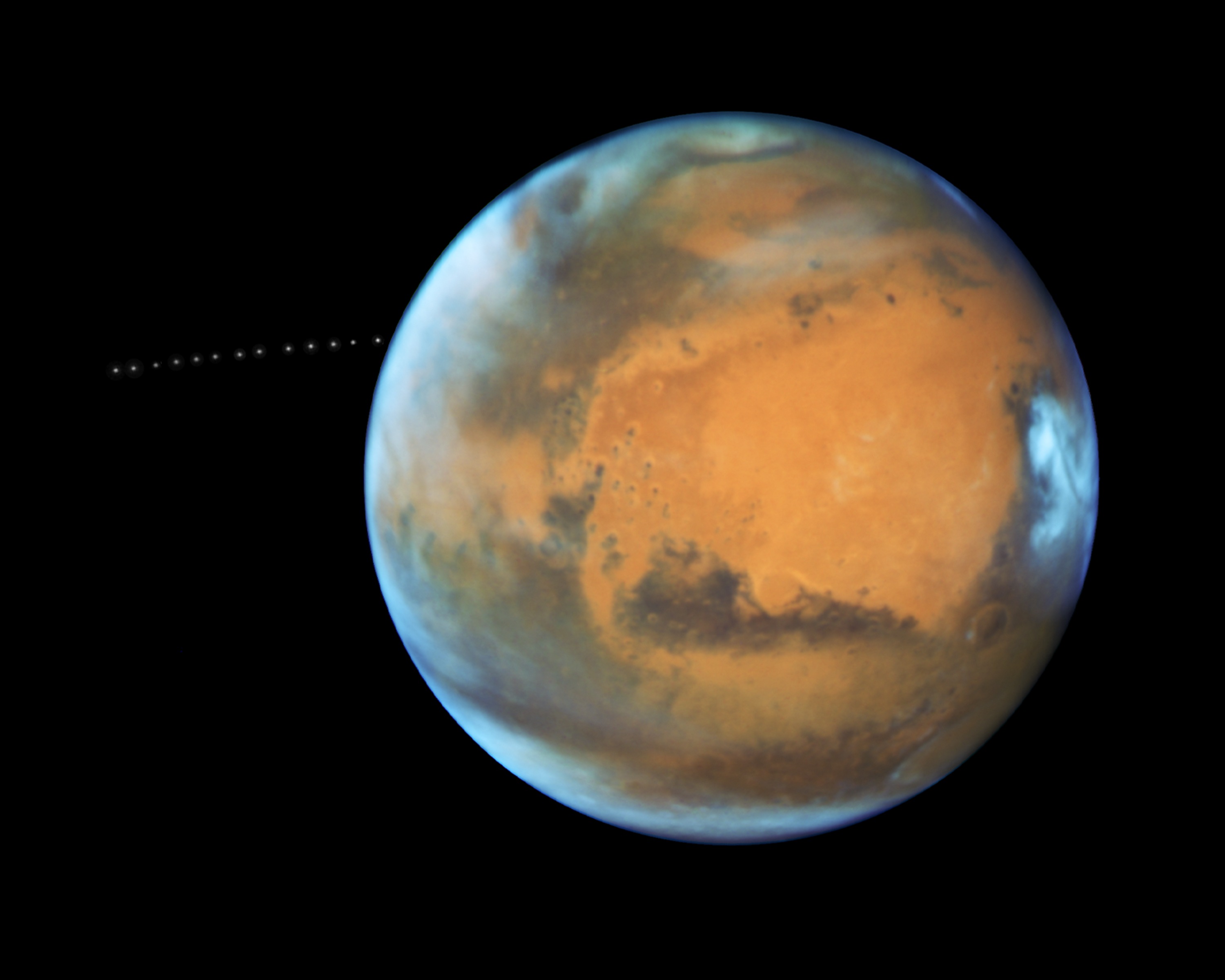
*Image creditor details unavailable via API. Visit linked page below for full info.*
A tiny moon with a scary name, Phobos emerges from behind the Red Planet in this timelapse sequence from the Earth-orbiting Hubble Space Telescope. Over 22 minutes the 13 separate exposures were captured near the 2016 closest approach of Mars to planet Earth. Martians have to look to the west to watch Phobos rise, though. The small moon is closer to its parent planet than any other moon in the Solar System, about 3,700 miles (6,000 kilometers) above the Martian surface. It completes one orbit in just 7 hours and 39 minutes. That's faster than a Mars rotation, which corresponds to about 24 hours and 40 minutes. So on Mars, Phobos can be seen to rise above the western horizon 3 times a day. Still, Phobos is doomed.
#APOD #Astrophotography #RocketScience #Stellar #SpaceFacts
**Astronomy Picture of the Day**
21 March 2024
**The Leo Trio**
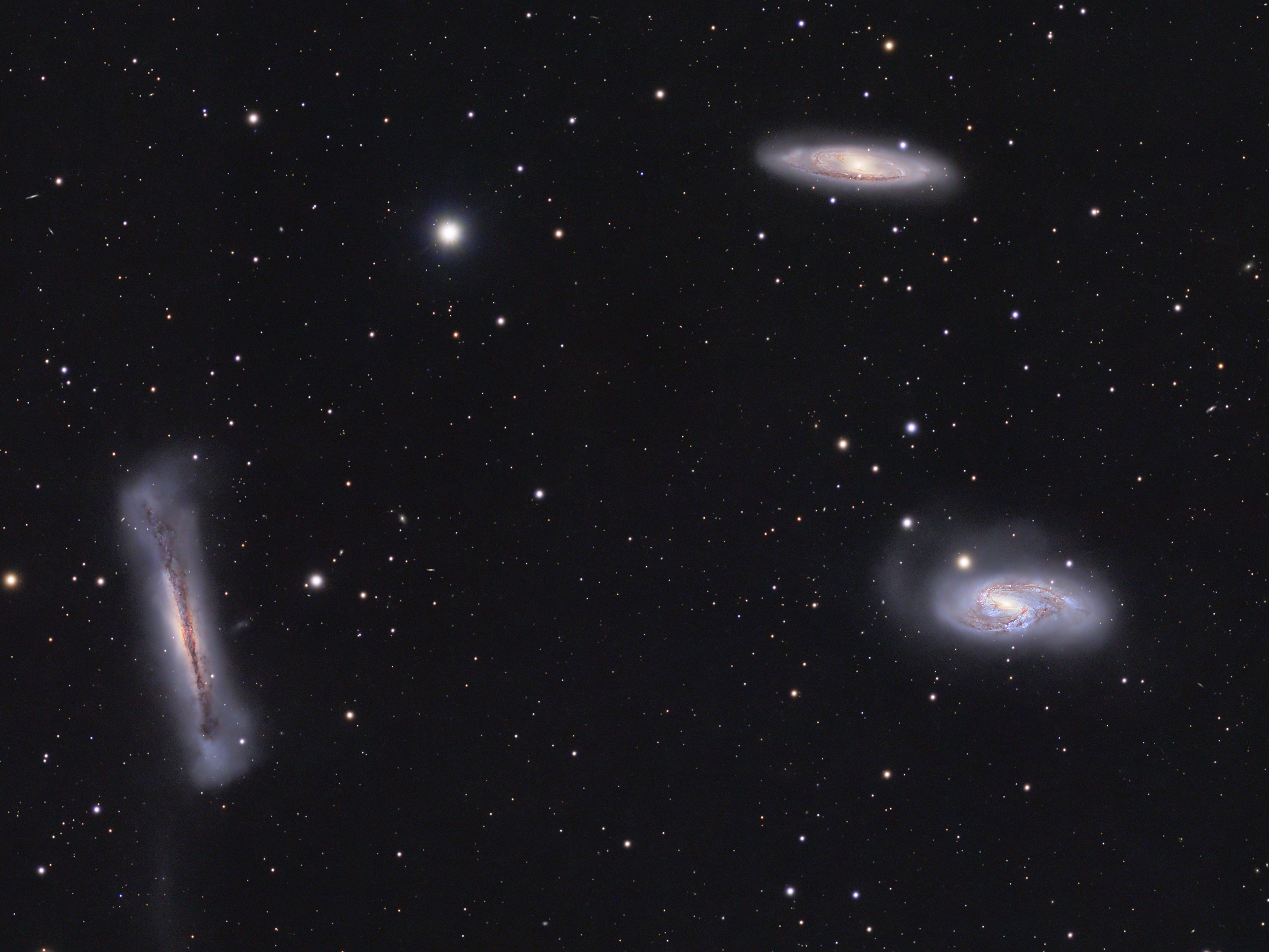
Image Credit & Copyright: Steve Cannistra
This popular group leaps into the early evening sky around the March equinox and the northern hemisphere spring. Famous as the Leo Triplet, the three magnificent galaxies found in the prominent constellation Leo gather here in one astronomical field of view. Crowd pleasers when imaged with even modest telescopes, they can be introduced individually as NGC 3628 (left), M66 (bottom right), and M65 (top). All three are large spiral galaxies but tend to look dissimilar, because their galactic disks are tilted at different angles to our line of sight. NGC 3628, also known as the Hamburger Galaxy, is temptingly seen edge-on, with obscuring dust lanes cutting across its puffy galactic plane. The disks of M66 and M65 are both inclined enough to show off their spiral structure. Gravitational interactions between galaxies in the group have left telltale signs, including the tidal tails and warped, inflated disk of NGC 3628 and the drawn out spiral arms of M66. This gorgeous view of the region spans over 1 degree (two full moons) on the sky in a frame that covers over half a million light-years at the trio's estimated distance of 30 million light-years.
#APOD #GalaxyExploration #Cosmos #NASA #SpaceTech
**Astronomy Picture of the Day**
20 March 2024
**The Eyes in Markarian's Galaxy Chain**
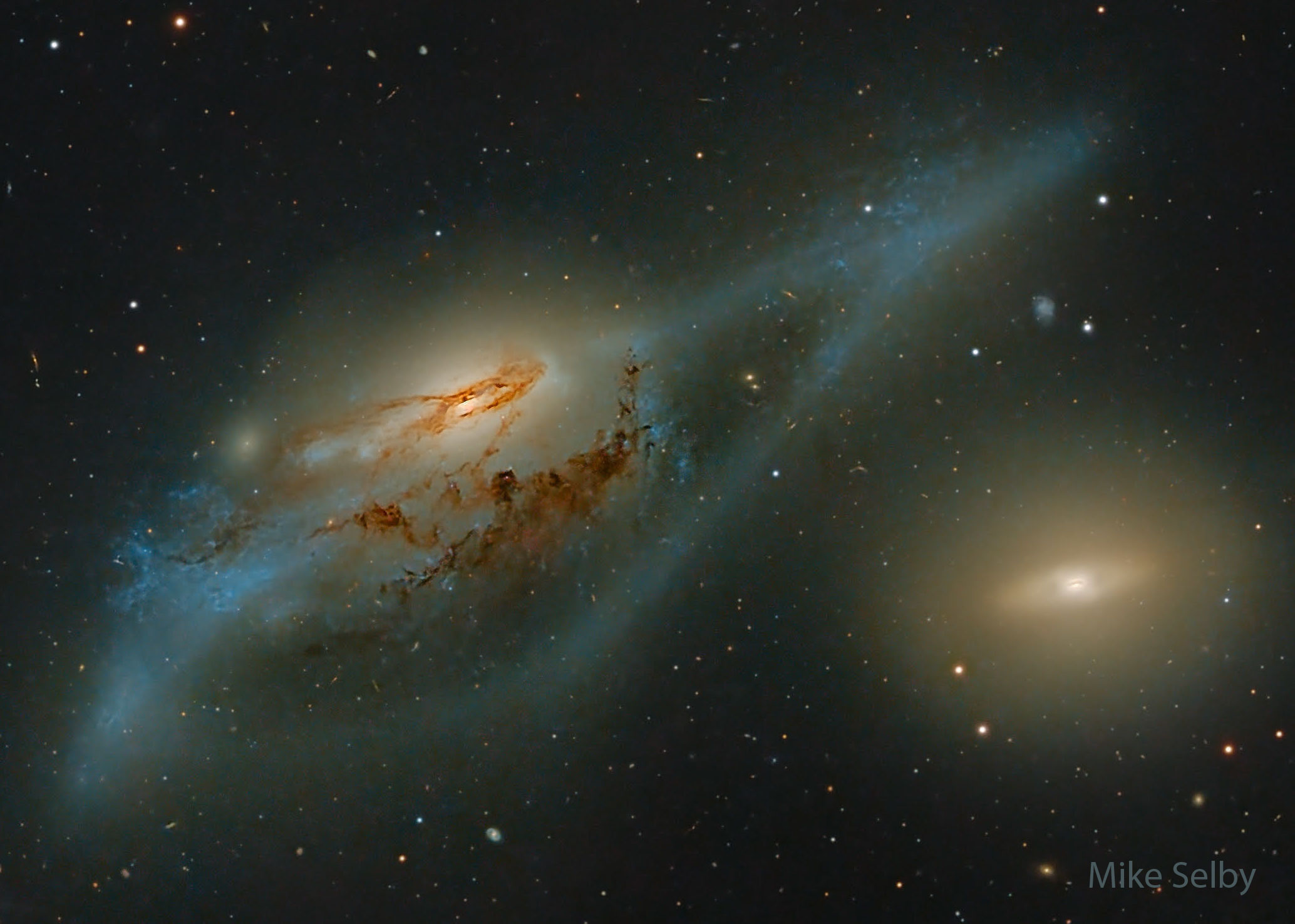
Image Credit & Copyright:
Mike Selby
Across the heart of the Virgo Galaxy Cluster lies a string of galaxies known as Markarian's Chain. Prominent in Markarian's Chain are these two interacting galaxies, NGC 4438 (left) and NGC 4435 - also known as The Eyes. About 50 million light-years away, the two galaxies appear to be about 100,000 light-years apart in this sharp close-up, but have likely approached to within an estimated 16,000 light-years of each other in their cosmic past. Gravitational tides from the close encounter have ripped away at their stars, gas, and dust. The more massive NGC 4438 managed to hold on to much of the material torn out in the collision, while material from the smaller NGC 4435 was more easily lost. The remarkably deep image of this crowded region of the universe also includes many more distant background galaxies.
#APOD #CosmosJourney #SpaceExploration #SpaceTechnology #Astrozone
**Astronomy Picture of the Day**
19 March 2024
**A Picturesque Equinox Sunset**

Image Credit & Copyright:
Alan Dyer, Amazingsky.com,
TWAN
What's that at the end of the road? The Sun. Many towns have roads that run east-west, and on two days each year, the Sun rises and sets right down the middle. Today, in some parts of the world (tomorrow in others), is one of those days: an equinox. Not only is this a day of equal night ("aequus"-"nox") and day time, but also a day when the sun rises precisely to the east and sets due west. Displayed here is a picturesque rural road in Alberta, Canada that runs approximately east-west. The featured image was taken during the September Equinox of 2021, but the geometry remains the same every year. In many cultures, this March equinox is taken to be the first day of a season, typically spring in Earth's northern hemisphere, and autumn in the south. Does your favorite street run east-west? Tonight, at sunset, you can find out with a quick glance.
#APOD #AstronomyPhotography #LunarMission #Galaxy #Astrozone
**Astronomy Picture of the Day**
18 March 2024
**Comet Pons-Brooks' Swirling Coma**
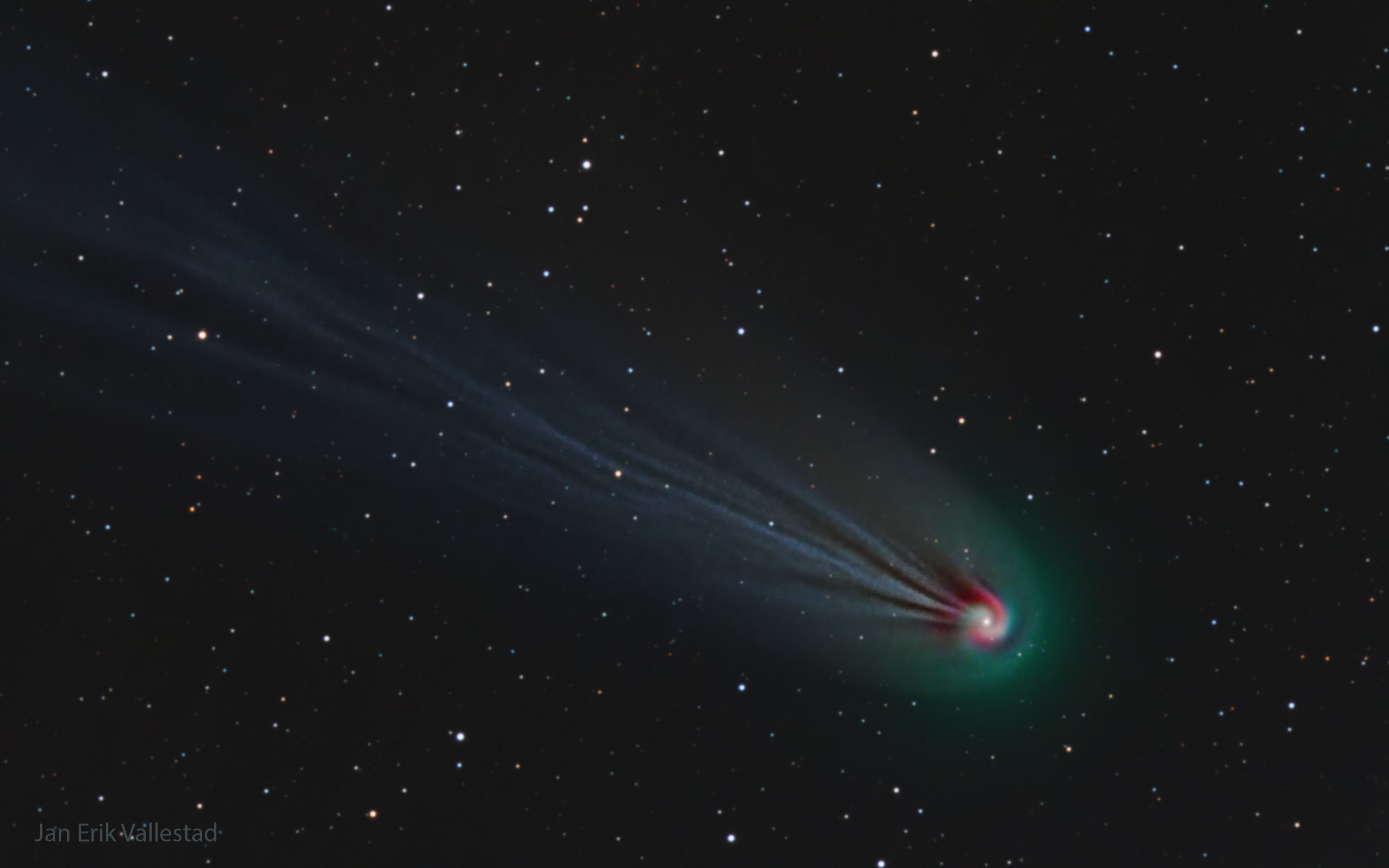
Image Credit & Copyright:
Jan Erik Vallestad
A bright comet will be visible during next month's total solar eclipse. This very unusual coincidence occurs because Comet 12P/Pons-Brooks's return to the inner Solar System places it by chance only 25 degrees away from the Sun during Earth's April 8 total solar eclipse. Currently the comet is just on the edge of visibility to the unaided eye, best visible with binoculars in the early evening sky toward the constellation of the Fish (Pisces). Comet Pons-Brooks, though, is putting on quite a show for deep camera images even now. The featured image is a composite of three very specific colors, showing the comet's ever-changing ion tail in light blue, its outer coma in green, and highlights some red-glowing gas around the coma in a spiral. The spiral is thought to be caused by gas being expelled by the slowly rotating nucleus of the giant iceberg comet. Although it is always difficult to predict the future brightness of comets, Comet Pons-Brook has been particularly prone to outbursts, making it even more difficult to predict how bright it will actually be as the Moon moves in front of the Sun on April 8. Total Eclipse Info: 2024 Total Solar Eclipse from NASA
#APOD #Universe #Planets #Astrocosmos #SpaceResearch
**Astronomy Picture of the Day**
17 March 2024
**NGC 7714: Starburst after Galaxy Collision**
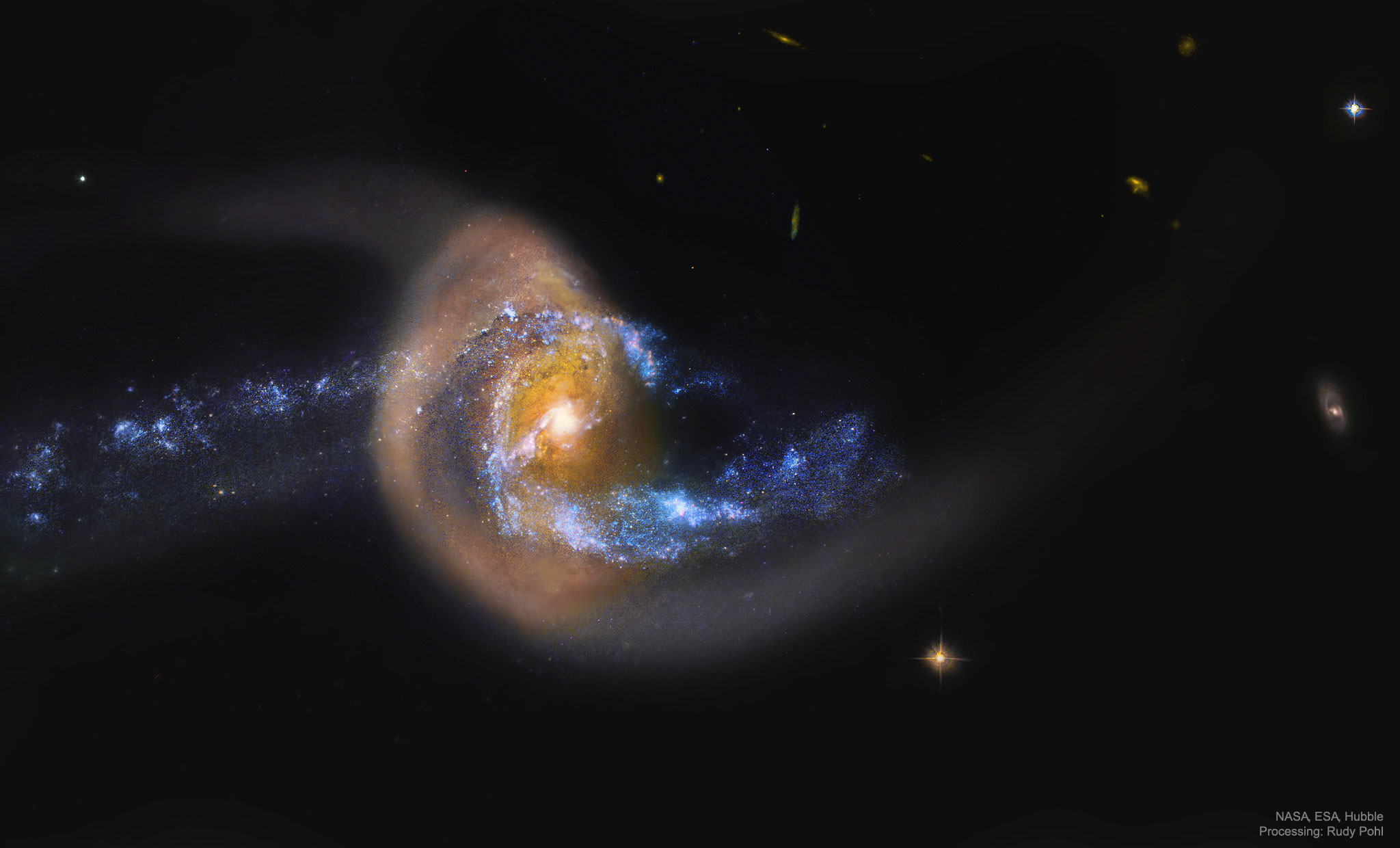
*Image creditor details unavailable via API. Visit linked page below for full info.*
Is this galaxy jumping through a giant ring of stars? Probably not. Although the precise dynamics behind the featured image is yet unclear, what is clear is that the pictured galaxy, NGC 7714, has been stretched and distorted by a recent collision with a neighboring galaxy. This smaller neighbor, NGC 7715, situated off to the left of the frame, is thought to have charged right through NGC 7714. Observations indicate that the golden ring pictured is composed of millions of older Sun-like stars that are likely co-moving with the interior bluer stars. In contrast, the bright center of NGC 7714 appears to be undergoing a burst of new star formation. The featured image was captured by the Hubble Space Telescope. NGC 7714 is located about 130 million light years away toward the constellation of the Two Fish (Pisces). The interactions between these galaxies likely started about 150 million years ago and should continue for several hundred million years more, after which a single central galaxy may result.
#APOD #RocketLaunch #Galaxy #Planets #GalacticAdventures
**Astronomy Picture of the Day**
16 March 2024
**ELT and the Milky Way**
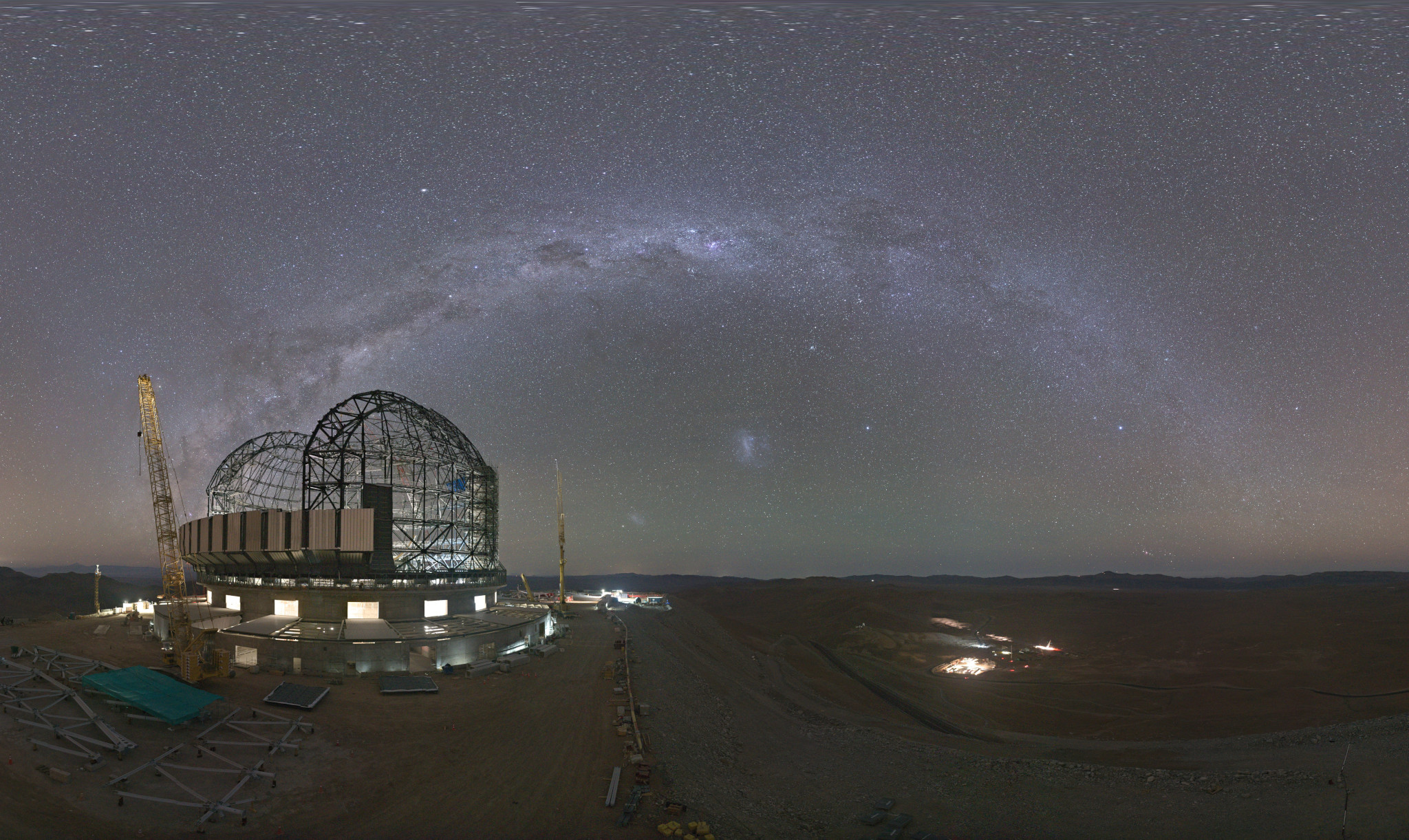
*Image creditor details unavailable via API. Visit linked page below for full info.*
The southern winter Milky Way sprawls across this night skyscape. Looking due south, the webcam view was recorded near local midnight on March 11 in dry, dark skies over the central Chilean Atacama desert. Seen below the graceful arc of diffuse starlight are satellite galaxies of the mighty Milky Way, also known as the Large and Small Magellanic clouds. In the foreground is the site of the European Southern Observatory's 40-metre-class Extremely Large Telescope (ELT). Under construction at the 3000 metre summit of Cerro Armazones, the ELT is on track to become planet Earth's biggest Eye on the Sky.
#APOD #Astrotheory #Exoplanets #Cosmological #Meteorology
**Astronomy Picture of the Day**
15 March 2024
**Portrait of NGC 1055**
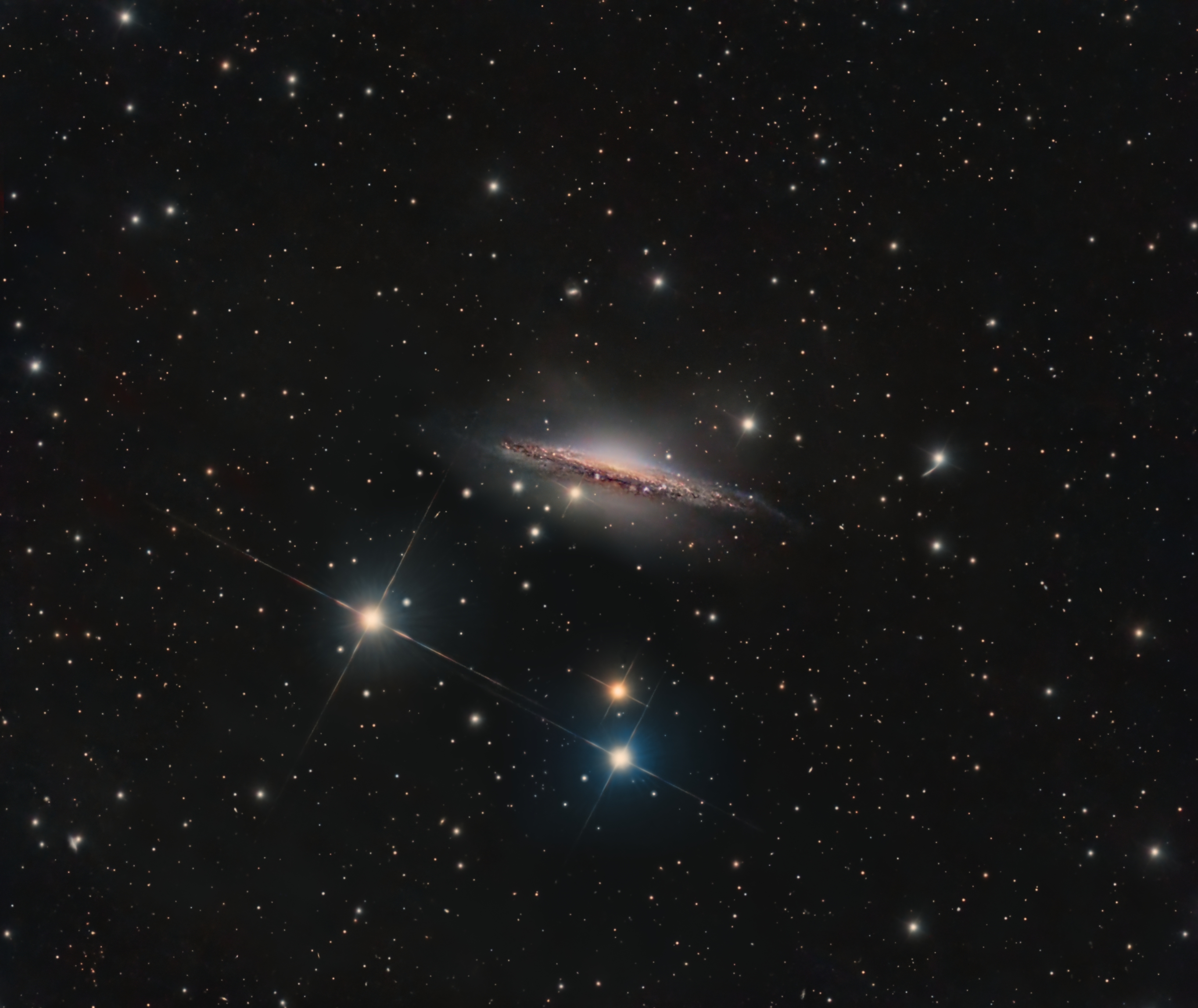
Image Credit & Copyright: Dave Doctor
Big, beautiful spiral galaxy NGC 1055 is a dominant member of a small galaxy group a mere 60 million light-years away toward the aquatically intimidating constellation Cetus. Seen edge-on, the island universe spans over 100,000 light-years, a little larger than our own Milky Way galaxy. The colorful, spiky stars decorating this cosmic portrait of NGC 1055 are in the foreground, well within the Milky Way. But the telltale pinkish star forming regions are scattered through winding dust lanes along the distant galaxy's thin disk. With a smattering of even more distant background galaxies, the deep image also reveals a boxy halo that extends far above and below the central bulge and disk of NGC 1055. The halo itself is laced with faint, narrow structures, and could represent the mixed and spread out debris from a satellite galaxy disrupted by the larger spiral some 10 billion years ago.
#APOD #Astrodata #Astroeducation #MilkyWay #RocketLaunch
**Astronomy Picture of the Day**
14 March 2024
**Moon Pi and Mountain Shadow**
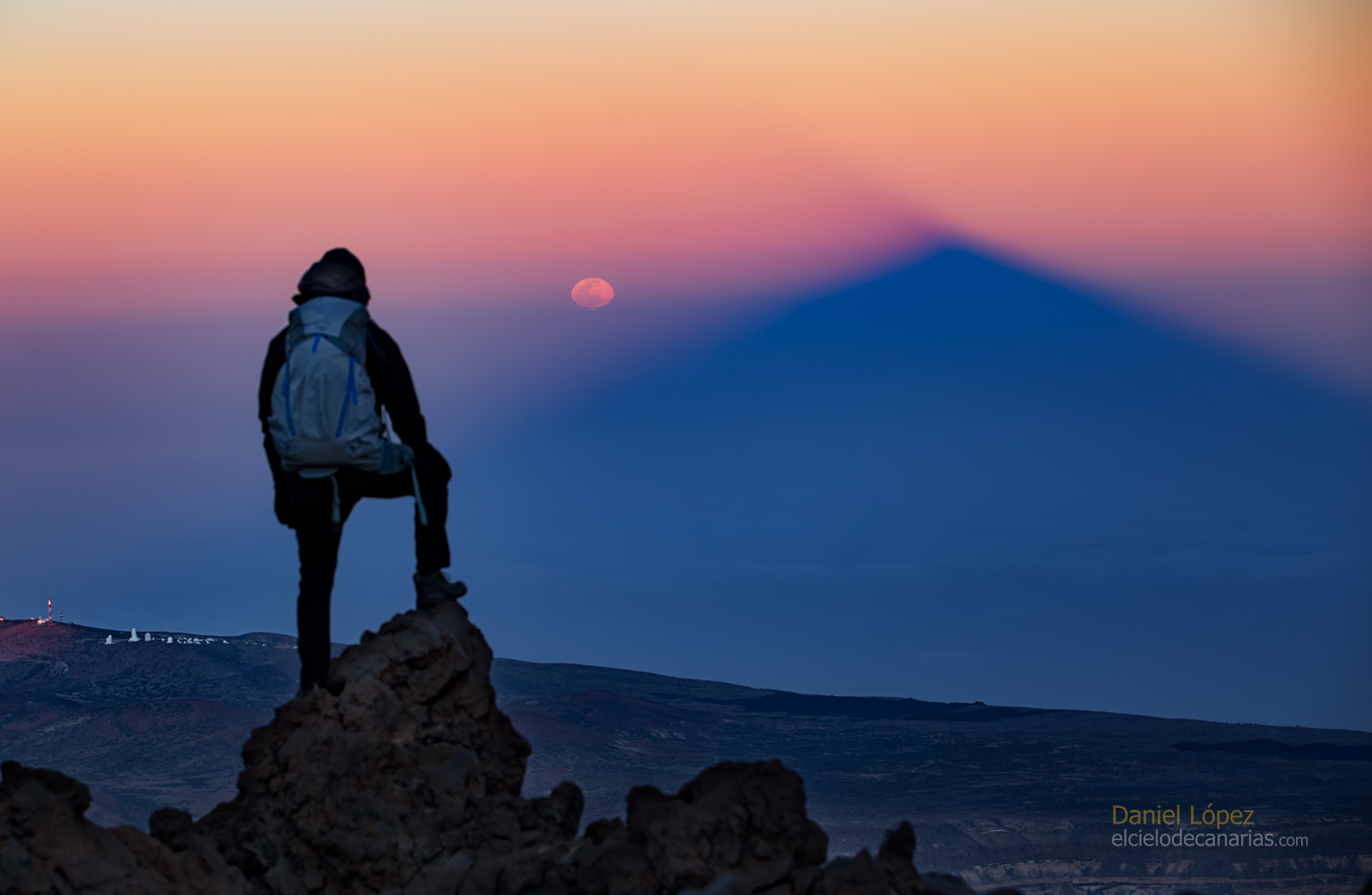
Image Credit & Copyright: El Cielo de Canarias
What phase of the Moon is 3.14 radians from the Sun? The Full Moon, of course. Even though the Moon might look full for several days, the Moon is truly at its full phase when it is Pi radians (aka 180 degrees) from the Sun in ecliptic longitude. That's opposite the Sun in planet Earth's sky. Rising as the Sun set on March 9, 2020, only an hour or so after the moment of its full phase, this orange tinted and slightly flattened Moon still looked full. It was photographed opposite the setting Sun from Teide National Park on the Canary Island of Tenerife. Also opposite the setting Sun, seen from near the Teide volcano peak about 3,500 meters above sea level, is the mountain's rising triangular shadow extending into Earth's dense atmosphere. Below the distant ridge line on the left are the white telescope domes of Teide Observatory. Again Pi radians from the Sun, on March 25 the Full Moon will dim slightly as it glides through Earth's outer shadow in a penumbral lunar eclipse.
#APOD #Astrophoto #GalacticAdventures #Astrophotography #SpaceMissions
**Astronomy Picture of the Day**
13 March 2024
**The Seagull Nebula**
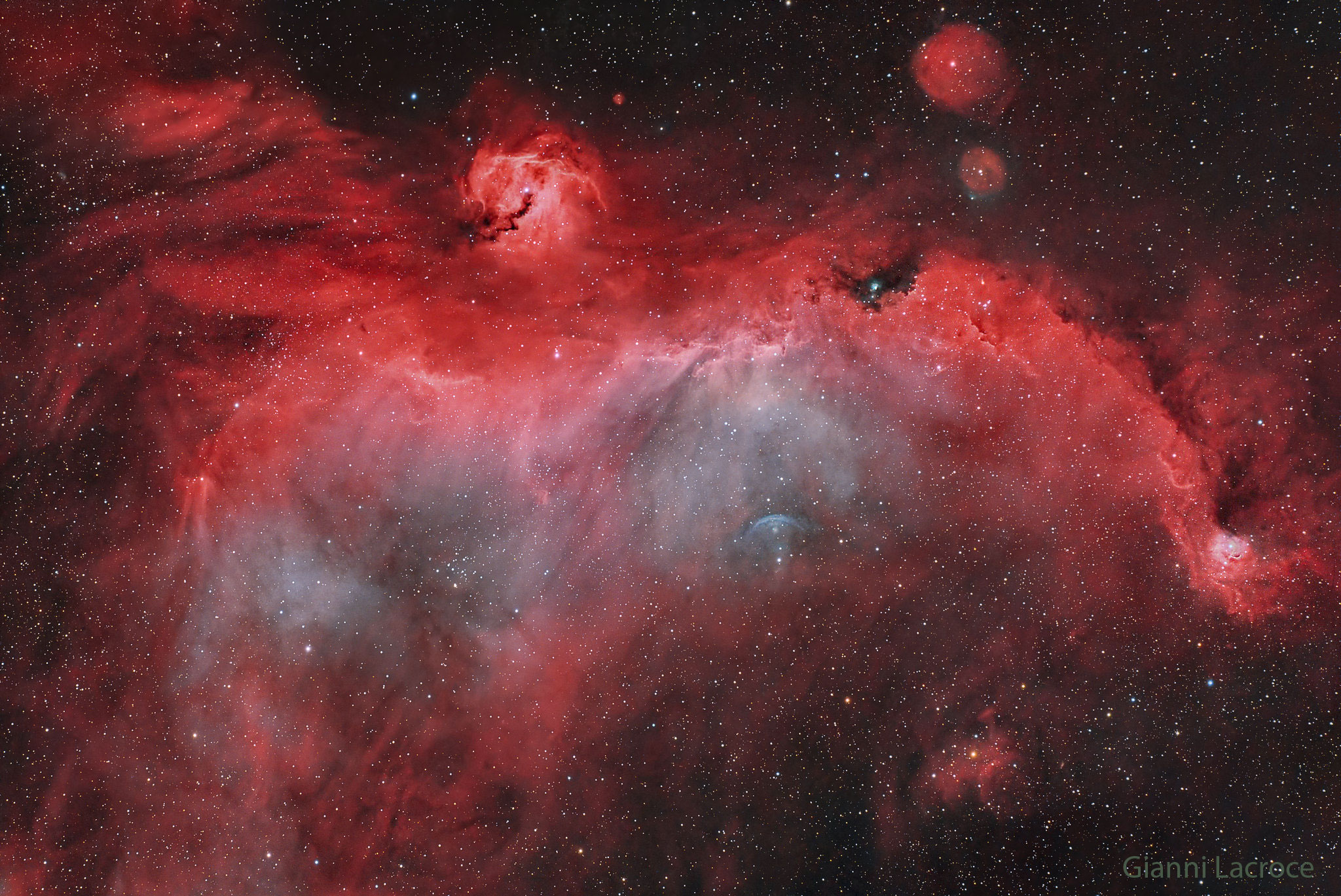
Image Credit & Copyright:
Gianni Lacroce
A broad expanse of glowing gas and dust presents a bird-like visage to astronomers from planet Earth, suggesting its popular moniker: the Seagull Nebula. This portrait of the cosmic bird covers a 1.6-degree wide swath across the plane of the Milky Way, near the direction of Sirius, the alpha star of the constellation of the Big Dog (Canis Major). Of course, the region includes objects with other catalog designations: notably NGC 2327, a compact, dusty emission and reflection nebula with an embedded massive star that forms the bird's head. Dominated by the reddish glow of atomic hydrogen, the complex of gas and dust clouds with bright young stars spans over 100 light-years at an estimated 3,800 light-year distance. Almost Hyperspace: Random APOD Generator
#APOD #SpaceExploration #Exploration #AstronomyClub #Astrochemistry
**Astronomy Picture of the Day**
12 March 2024
**A Galaxy-Shaped Rocket Exhaust Spiral**
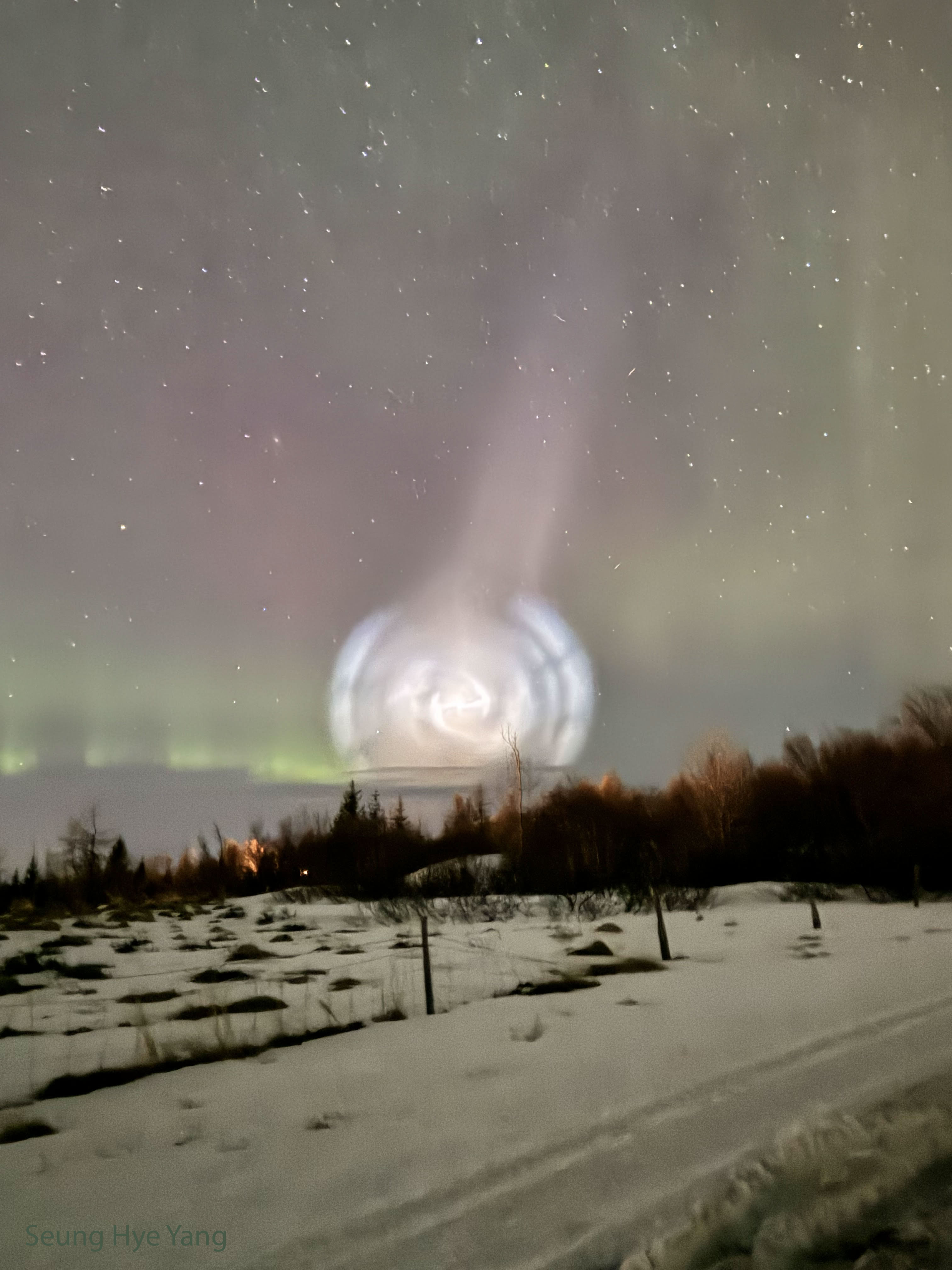
Image Credit & Copyright:
Seung Hye Yang
What's that over the horizon? What may look like a strangely nearby galaxy is actually a normal rocket's exhaust plume -- but unusually backlit. Although the SpaceX Falcon 9 rocket was launched from Cape Canaveral in Florida, USA, its burned propellant was visible over a much wider area, with the featured photograph being taken from Akureyri, Iceland. The huge spaceship was lifted off a week ago, and the resulting spectacle was captured soon afterward with a single 10-second smartphone exposure, before it quickly dissipated. Like noctilucent clouds, the plume's brightness is caused by the Twilight Effect, where an object is high enough to be illuminated by the twilight Sun, even when the observer on the ground experiences the darkness of night. The spiral shape is likely caused by high winds pushing the expelled gas into the shape of a corkscrew, which, when seen along the trajectory, looks like a spiral. Stars and faint green and red aurora appear in the background of this extraordinary image.
#APOD #Exoplanets #SpaceMission #SpaceResearch #Astrobiology