
**Astronomy Picture of the Day**
15 February 2025
**Parhelia at Abisko**
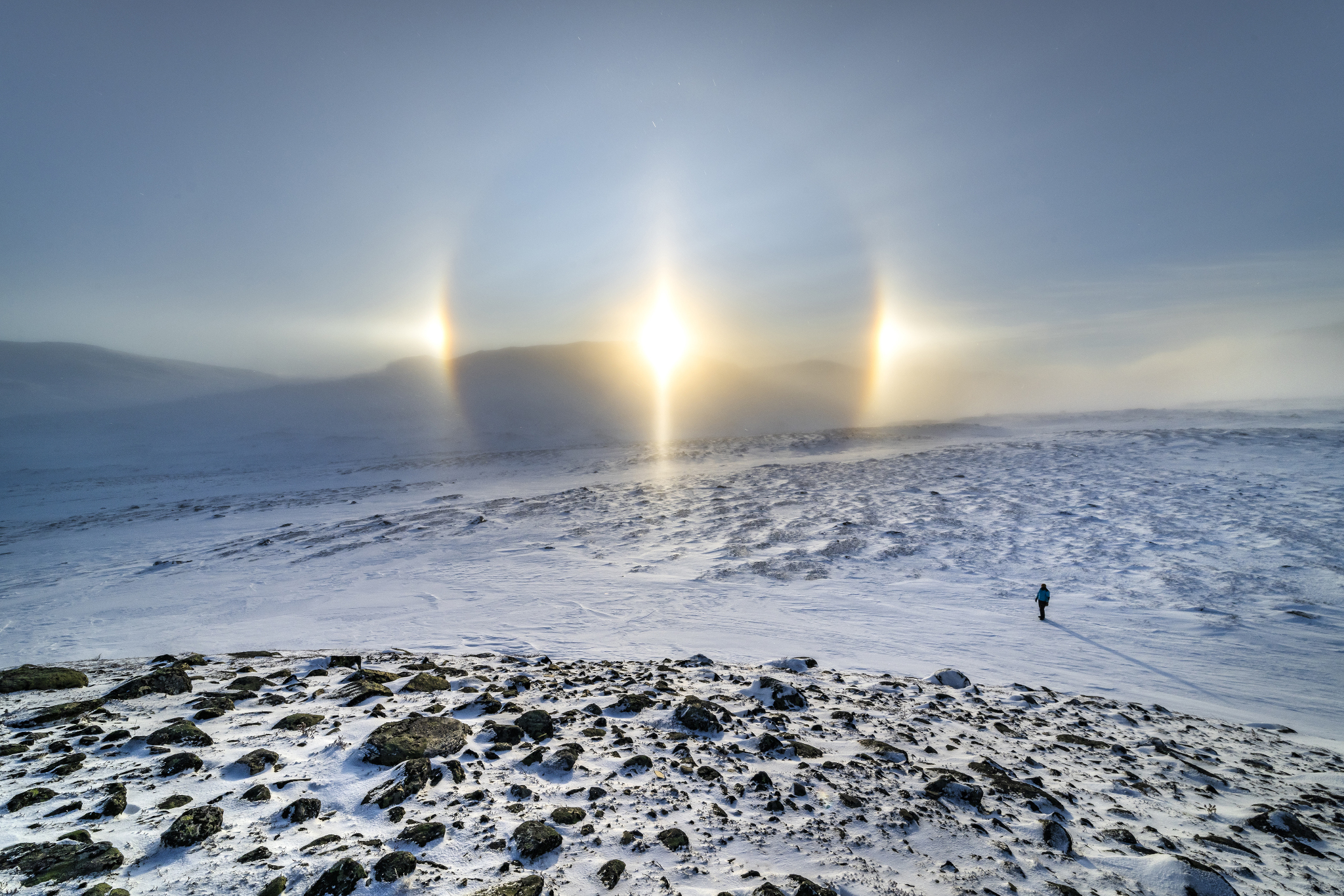
Image Credit & Copyright: planet Earth
Three suns seem to hug the horizon in this otherworldly winterscape. But the evocative scene was captured during a February 3rd snowmobile exploration of the mountainous region around Abisko National Park, northern Sweden, planet Earth. The two bright spots on either side of Earth's Sun are parhelia (singular parhelion), also known as mock suns or sun dogs. The parhelia are caused by hexagonal ice crystals suspended in the hazy atmosphere that reflect and refract sunlight. Commonly seen in winter and at high latitudes, the bright parhelia lie along the visible 22 degree ice halo of the Sun.
#APOD #Astrozone #BlackHoleDiscovery #CosmicWonders #Stargazing
**Astronomy Picture of the Day**
14 February 2025
**A Cosmic Rose: NGC 2237 in Monoceros**

Image Credit & Copyright: Harry Karamitsos
The Rosette Nebula, NGC 2237, is not the only cosmic cloud of gas and dust to evoke the imagery of flowers, but it is probably the most famous. At the edge of a large molecular cloud in Monoceros some 5,000 light years away, the petals of this cosmic rose are actually a stellar nursery. The lovely, symmetric shape is sculpted by the winds and radiation from its central cluster of hot young, O-type stars. Stars in the energetic cluster, cataloged as NGC 2244, are only a few million years young, while the central cavity in the Rosette Nebula, is about 50 light-years in diameter. The nebula can be seen with a small telescope toward the constellation of Monoceros, the Unicorn. This natural appearing telescopic portrait of the Rosette Nebula was made using broadband color filters, but sometimes roses aren't red.
#APOD #Cosmological #StarCluster #Astrochemistry #Cosmos
**Astronomy Picture of the Day**
13 February 2025
**Reflections on VdB 31**
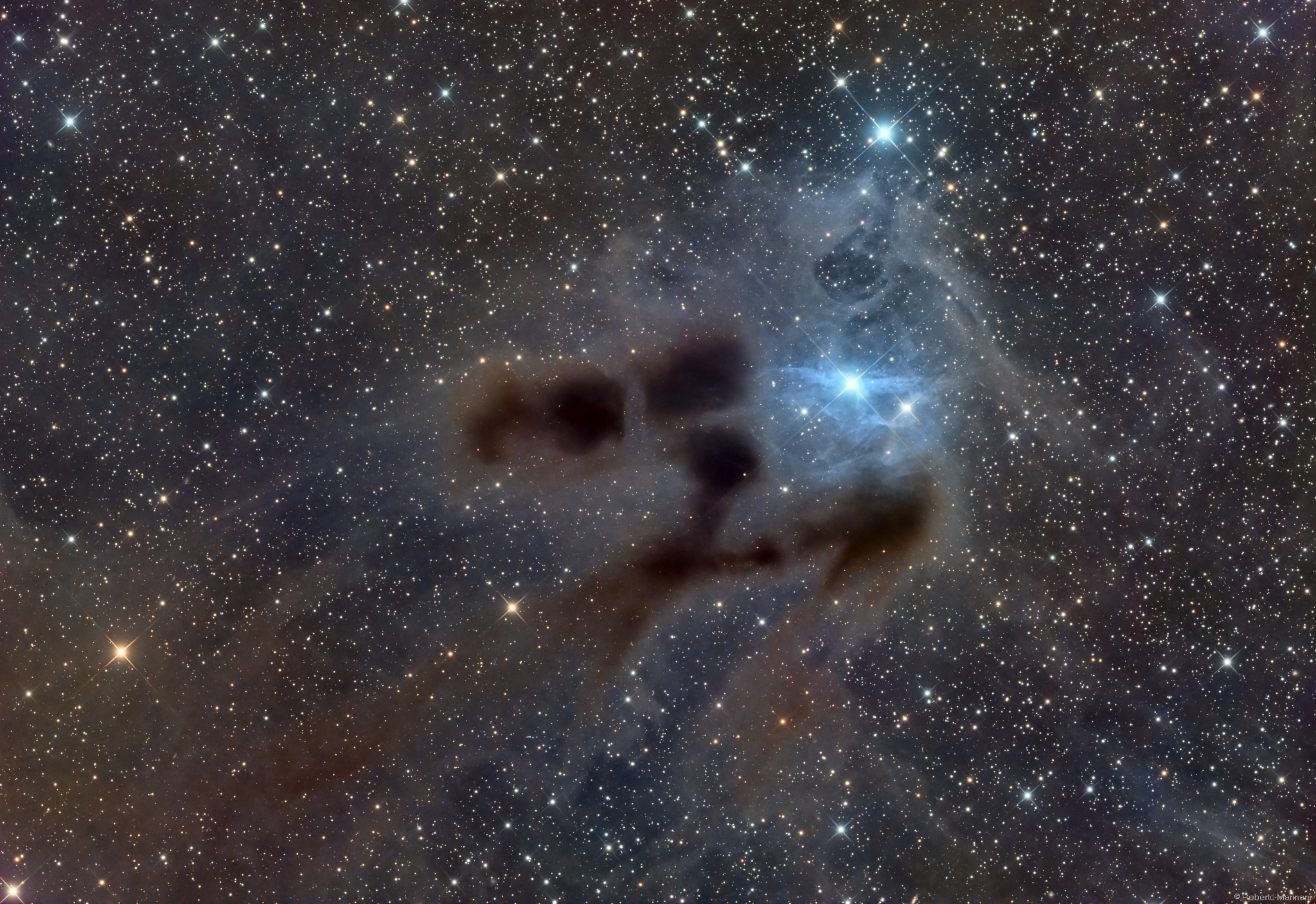
Image Credit & Copyright: Roberto Marinoni
Riding high in the constellation of Auriga, beautiful, blue VdB 31 is the 31st object in Sidney van den Bergh's 1966 catalog of reflection nebulae. It shares this well-composed celestial still life with dark, obscuring clouds B26, B27, and B28, recorded in Edward E. Barnard's 1919 catalog of dark markings in the sky. All are these nebulae are interstellar dust clouds. Barnard's dark nebulae block the light from background stars. For VdB 31 the dust preferentially reflects bluish starlight from embedded, hot, variable star AB Aurigae. Exploring the environs of AB Aurigae with the Hubble Space Telescope has revealed the several million year young star is itself surrounded by a flattened dusty disk with evidence for the ongoing formation of a planetary system. AB Aurigae is about 470 light-years away. At that distance this cosmic canvas would span about eight light-years.
#APOD #Astroinformatics #RocketScience #SpaceResearch #Astroeducation
**Astronomy Picture of the Day**
12 February 2025
**Asteroid Bennu Holds the Building Blocks of Life**
https://www.youtube.com/embed/ukCSRYcjSQw?rel=0
*Image creditor details unavailable via API. Visit linked page below for full info.*
What can a space rock tell us about life on Earth? NASA's OSIRIS-REx spacecraft made a careful approach to the near-Earth asteroid 101955 Bennu in October of 2020 to collect surface samples. In September 2023, the robotic spaceship returned these samples to Earth. A recent analysis has shown, surprisingly, that the samples contained 14 out of the 20 known amino acids that are the essential building blocks of life. The presence of the amino acids re-introduces a big question: Could life have originated in space? However, the protein building blocks themselves held another surprise -- they contained an even mixture of left-handed and right-handed amino acids -- in contrast to our Earth which only has left-handed ones. This raises another big question: Why does life on Earth have only left-handed amino acids? Research on this is sure to continue.
#APOD #LunarExploration #Astroengineer #PlanetExploration #SpaceResearch
**Astronomy Picture of the Day**
11 February 2025
**The Spider and the Fly**
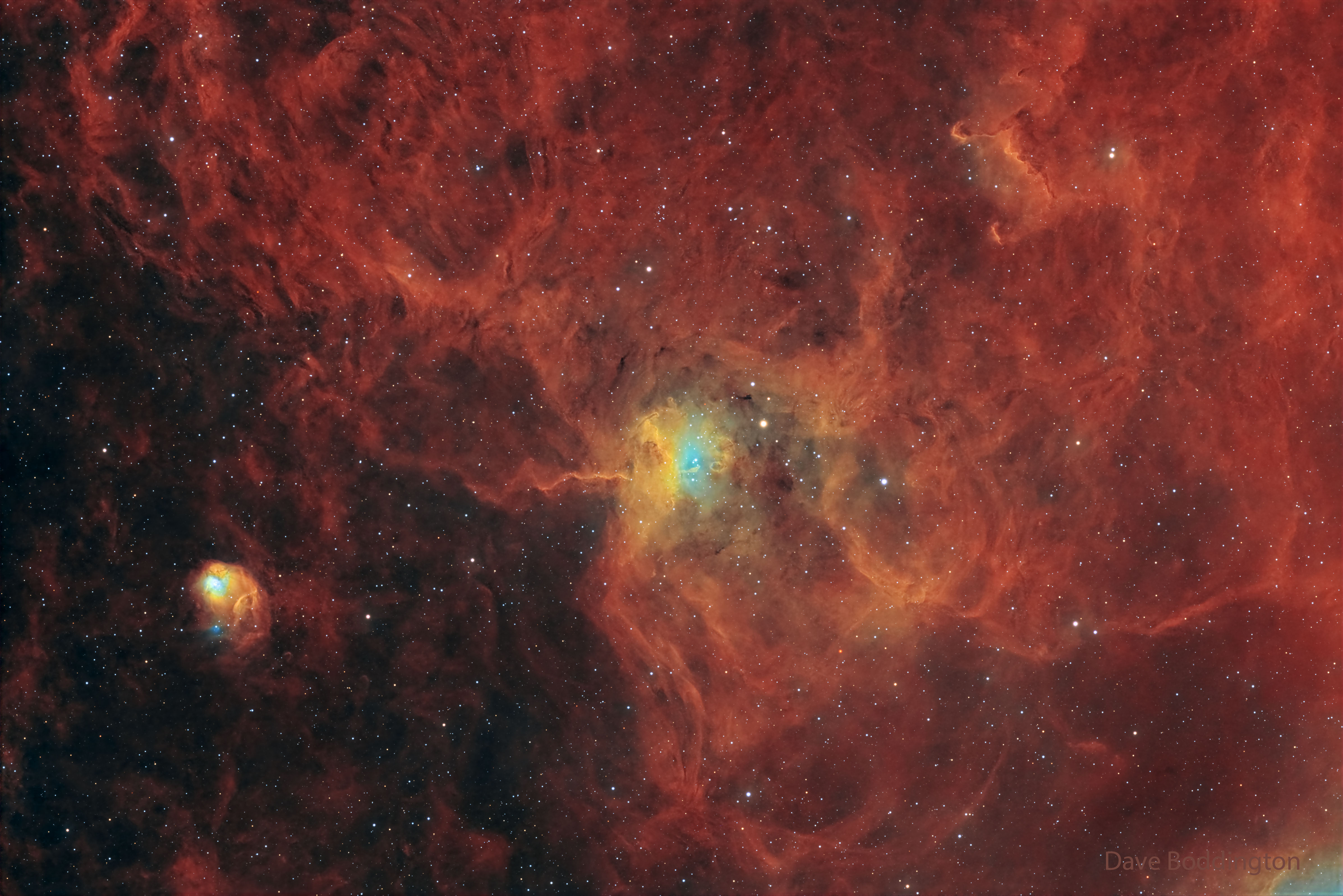
Image Credit & Copyright:
Dave Boddington
Will the spider ever catch the fly? Not if both are large emission nebulas toward the constellation of the Charioteer (Auriga). The spider-shaped gas cloud in the image center is actually an emission nebula labelled IC 417, while the smaller fly-shaped cloud on the left is dubbed NGC 1931 and is both an emission nebula and a reflection nebula. About 10,000 light-years distant, both nebulas harbor young star clusters. For scale, the more compact NGC 1931 (Fly) is about 10 light-years across. The featured deep image, captured over 20 hours during late January in Berkshire UK, also shows more diffuse and red-glowing interstellar gas and dust. Explore Your Universe: Random APOD Generator
#APOD #CosmicWonders #Galaxy #Astrobiology #NASA
**Astronomy Picture of the Day**
10 February 2025
**Auroral Hummingbird over Norway**

Image Credit & Copyright:
Mickael Coulon
Is this the largest hummingbird ever? Although it may look like a popular fluttering nectarivore, what is pictured is actually a beautifully detailed and colorful aurora, complete with rays reminiscent of feathers. This aurora was so bright that it was visible to the unaided eye during blue hour -- just after sunset when the sky appears a darkening blue. However, the aurora only looked like a hummingbird through a sensitive camera able to pick up faint glows. As reds typically occurring higher in the Earth's atmosphere than the greens, the real 3D shape of this aurora would likely appear unfamiliar. Auroras are created when an explosion on the Sun causes high energy particles to flow into the Earth's atmosphere and excite atoms and molecules of nitrogen and oxygen. The featured image was captured about two weeks ago above Lyngseidt, Norway.
#APOD #Space #RocketScience #SpaceObservatory #Astroeducation
**Astronomy Picture of the Day**
09 February 2025
**Milky Way over the Australian Pinnacles**

Image Credit & Copyright:
Michael Goh
What strange world is this? Earth. In the foreground of the featured image are the Pinnacles, unusual rock spires in Nambung National Park in Western Australia. Made of ancient sea shells (limestone), how these human-sized picturesque spires formed remains unknown. In the background, just past the end of the central Pinnacle, is a bright crescent Moon. The eerie glow around the Moon is mostly zodiacal light, sunlight reflected by dust grains orbiting between the planets in the Solar System. Arching across the top is the central band of our Milky Way Galaxy. Many famous stars and nebulas are also visible in the background night sky. The featured 29-panel panorama was taken and composed in 2015 September after detailed planning that involved the Moon, the rock spires, and their corresponding shadows. Even so, the strong zodiacal light was a pleasant surprise. Your Sky Surprise: What picture did APOD feature on your birthday? (post 1995)
#APOD #Meteorology #Astrozone #Cosmology #Astrogeek
**Astronomy Picture of the Day**
08 February 2025
**A Conjunction of Crescents**

Image Credit & Copyright: Aldo S. Kleiman
A waxing crescent Moon and a waning crescent Venus are found at opposite corners of this twilight telephoto field of view. The close conjunction of the two brightest celestial beacons in planet Earth's western evening sky was captured on February 1 from Rosario, Argentina. On that date, the slender crescent Moon was about 3 days old. But the Moon's visible sunlit crescent will grow to a bright Full Moon by February 14. Like the Moon, Venus cycles through phases as it orbits the Sun. And while its visible sunlit crescent narrows, the inner planet's apparent size increases as it gets closer to Earth. In a Valentine from the Solar System, Venus, named for the Roman goddess of Love, will also reach its peak brightness in planet Earth's evening skies around February 14.
#APOD #Research #Astrophysics #MeteorShowers #Astrophotography
**Astronomy Picture of the Day**
07 February 2025
**LEDA 1313424: The Bullseye Galaxy**

*Image creditor details unavailable via API. Visit linked page below for full info.*
The giant galaxy cataloged as LEDA 1313424 is about two and a half times the size of our own Milky Way. Its remarkable appearance in this recently released Hubble Space Telescope image strongly suggests its nickname "The Bullseye Galaxy". Known as a collisional ring galaxy it has nine rings confirmed by telescopic observations, rippling from its center like waves from a pebble dropped into a pond. Of course, the pebble dropped into the Bullseye galaxy was a galaxy itself. Telescopic observations identify the blue dwarf galaxy at center-left as the likely collider, passing through the giant galaxy's center and forming concentric rings in the wake of their gravitational interaction. The Bullseye Galaxy lies some 567 million light-years away toward the constellation Pisces. At that distance, this stunning Hubble image would span about 530,000 light-years.
#APOD #Cosmology #SpaceExploration #Astroeducation #SpaceObservatory
**Astronomy Picture of the Day**
06 February 2025
**IC 2574: Coddington's Nebula**
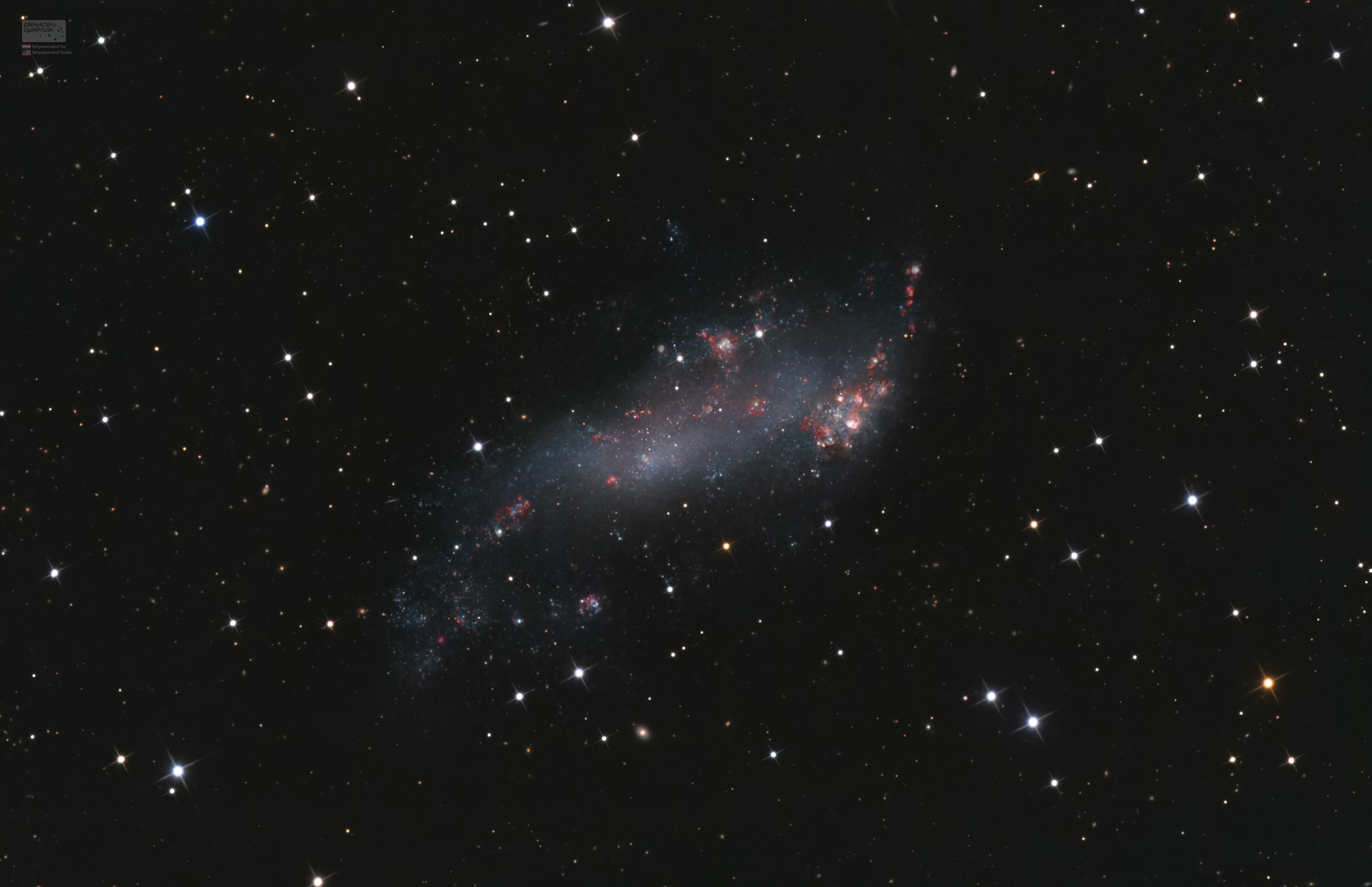
Image Credit & Copyright: Lorand Fenyes
Grand spiral galaxies often seem to get all the glory, flaunting their young, bright, blue star clusters in beautiful, symmetric spiral arms. But small, irregular galaxies form stars too. In fact dwarf galaxy IC 2574 shows clear evidence of intense star forming activity in its telltale reddish regions of glowing hydrogen gas. Just as in spiral galaxies, the turbulent star-forming regions in IC 2574 are churned by stellar winds and supernova explosions spewing material into the galaxy's interstellar medium and triggering further star formation. A mere 12 million light-years distant, IC 2574 is part of the M81 group of galaxies, seen toward the northern constellation Ursa Major. Also known as Coddington's Nebula, the lovely island universe is about 50,000 light-years across, discovered by American astronomer Edwin Coddington in 1898.
#APOD #BlackHoleDiscovery #Astrogeek #Astrophysics #SpaceDiscovery
**Astronomy Picture of the Day**
05 February 2025
**Comet G3 ATLAS Setting over a Chilean Hill
**
https://www.youtube.com/embed/nt5j0NiVesQ
Image Credit & Copyright:
Gabriel Muñoz
Where is Comet ATLAS going? In the featured time-lapse video, the comet is not itself moving very much, but the Earth's rotation makes it appear to be setting over a hill. The Comet C/2024 G3 (ATLAS) sequence was captured with an ordinary camera on January 22 from the Araucanía Region in central Chile. Comet ATLAS has been an impressive site in the evening skies of Earth's Southern Hemisphere over the past few weeks, so bright and awe-inspiring that it may eventually become known as the Great Comet of 2025. Unfortunately, Comet G3 ATLAS is not going anywhere anymore because its central nucleus broke up during its close pass to the Sun last month. Some of the comet's scattered remains of rocks and ice will continue to orbit the Sun, some in nearly the same outward section of the orbit that the comet's nucleus would have taken.
#APOD #Science #Meteorology #BlackHoles #Astrobiology
**Astronomy Picture of the Day**
04 February 2025
**Anticrepuscular Rays: A Rainbow Fan over Spain**

Image Credit & Copyright:
Julene Eiguren
Yes, but can your rainbow do this? Late in the day, the Sun set as usual toward the west. However, on this day, the more interesting display was 180 degrees around -- toward the east. There, not only was a rainbow visible, but an impressive display of anticrepuscular rays from the rainbow's center. In the featured image from Lekeitio in northern Spain, the Sun is behind the camera. The rainbow resulted from sunlight reflecting back from falling rain. Anticrepuscular rays result from sunlight, blocked by some clouds, going all the way around the sky, overhead, and appearing to converge on the opposite horizon -- an optical illusion. Rainbows by themselves can be exciting to see, and anticrepuscular rays a rare treat, but capturing them both together is even more unusual -- and can look both serene and surreal. Jigsaw Challenge: Astronomy Puzzle of the Day
#APOD #Research #Astronomy #Astroknowledge #Astronauts
**Astronomy Picture of the Day**
03 February 2025
**Wolf-Rayet Star 124: Stellar Wind Machine**
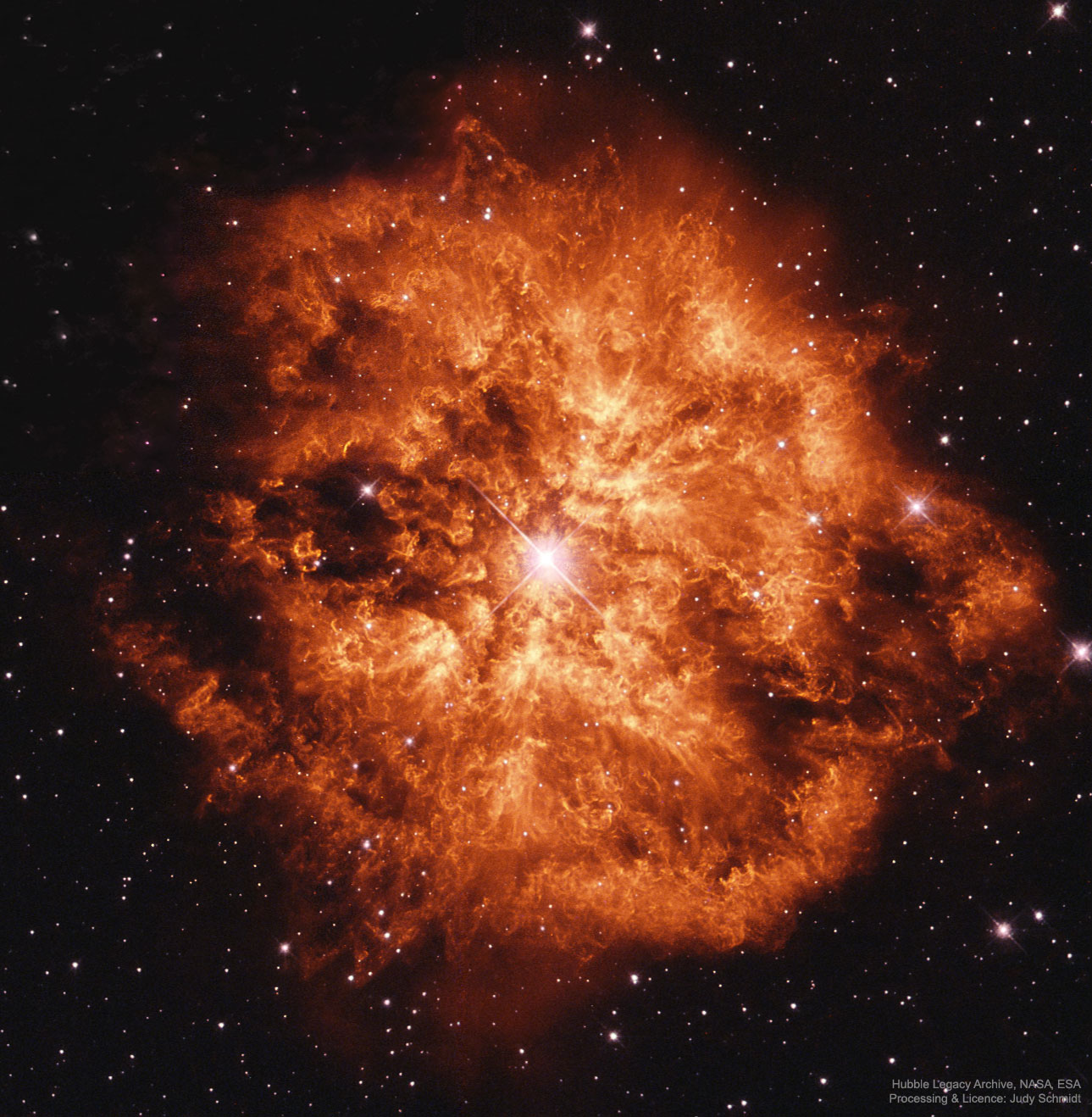
*Image creditor details unavailable via API. Visit linked page below for full info.*
Some stars explode in slow motion. Rare, massive Wolf-Rayet stars are so tumultuous and hot that they are slowly disintegrating right before our telescopes. Glowing gas globs each typically over 30 times more massive than the Earth are being expelled by violent stellar winds. Wolf-Rayet star WR 124, visible near the featured image center and spanning six light years across, is thus creating the surrounding nebula known as M1-67. Details of why this star has been slowly blowing itself apart over the past 20,000 years remains a topic of research. WR 124 lies 15,000 light-years away towards the constellation of the Arrow (Sagitta). The fate of any given Wolf-Rayet star likely depends on how massive it is, but many are thought to end their lives with spectacular explosions such as supernovas or gamma-ray bursts. Explore Your Universe: Random APOD Generator
#APOD #Celestial #LunarExploration #AstronomyClub #RocketScience
**Astronomy Picture of the Day**
02 February 2025
**Comet G3 ATLAS Disintegrates**
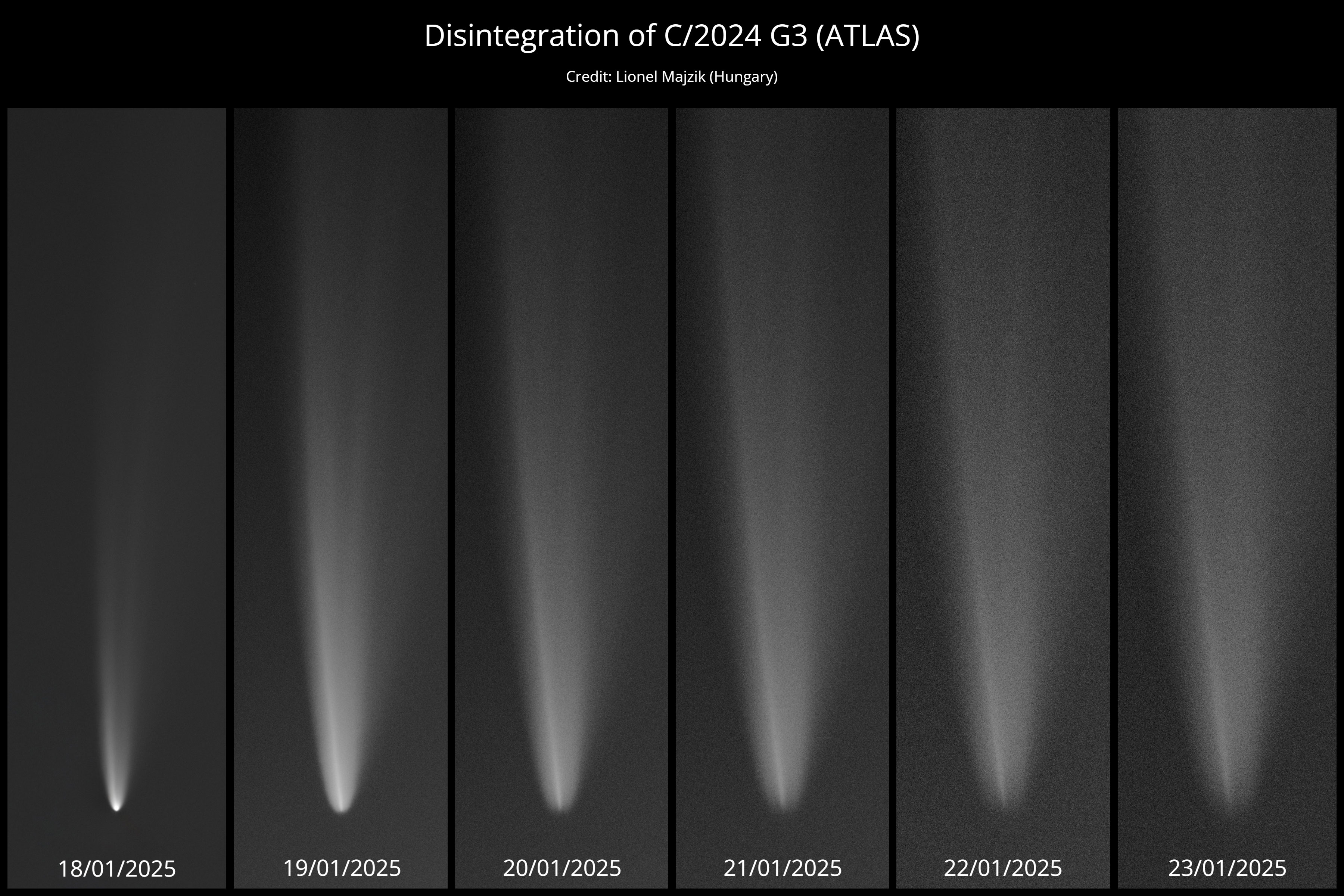
*Image creditor details unavailable via API. Visit linked page below for full info.*
What's happening to Comet G3 ATLAS? After passing near the Sun in mid-January, the head of the comet has become dimmer and dimmer. By late January, Comet C/2024 G3 (ATLAS) had become a headless wonder -- even though it continued to show impressive tails after sunset in the skies of Earth's Southern Hemisphere. Pictured are images of Comet G3 ATLAS on successive January nights taken from Río Hurtado, Chile. Clearly, the comet's head is brighter and more centrally condensed on the earlier days (left) than on later days (right). A key reason is likely that the comet's nucleus of ice and rock, at the head's center, has fragmented. Comet G3 ATLAS passed well inside the orbit of planet Mercury when at its solar closest, a distance that where heat destroys many comets. Some of comet G3 ATLAS' scattering remains will continue to orbit the Sun. Gallery: Comet G3 ATLAS
#APOD #Astrozone #Astroeducation #SpaceMission #Meteorology
**Astronomy Picture of the Day**
01 February 2025
**Nacreous Clouds over Sweden**

Image Credit & Copyright: Known as nacreous
clouds
Vivid and lustrous, wafting iridescent waves of color wash across this skyscape from northern Sweden. Known as nacreous clouds or mother-of-pearl clouds, they are rare. But their unforgettable appearance was captured in this snapshot on January 12 with the Sun just below the local horizon. A type of polar stratospheric cloud, they form when unusually cold temperatures in the usually cloudless lower stratosphere form ice crystals. Still sunlit at altitudes of around 15 to 25 kilometers, the clouds diffract the sunlight even when the Sun itself is hidden from direct view.
#APOD #Stellar #Astrogeek #Exploration #AstronomyPhotography
**Astronomy Picture of the Day**
31 January 2025
**The Variable Nebula NGC 2261**

Image Credit & Copyright: Tommy Lease
The interstellar cloud of dust and gas captured in this sharp telescopic snapshot is seen to change its appearance noticeably over periods as short as a few weeks. Discovered over 200 years ago and cataloged as NGC 2261, bright star R Monocerotis lies at the tip of the fan-shaped nebula. About one light-year across and 2500 light-years away, NGC 2261 was studied early last century by astronomer Edwin Hubble and the mysterious cosmic cloud is now more famous as Hubble's Variable Nebula. So what makes Hubble's nebula vary? NGC 2261 is composed of a dusty reflection nebula fanning out from the star R Monocerotis. The leading variability explanation holds that dense knots of obscuring dust pass close to R Mon and cast moving shadows across the dust clouds in the rest of Hubble's Variable Nebula.
#APOD #Galactic #CosmosJourney #Astrotheory #SpaceTech
**Astronomy Picture of the Day**
30 January 2025
**Hydrogen Clouds of M33**

Image Credit & Copyright: Pea Mauro
Gorgeous spiral galaxy Messier 33 seems to have more than its fair share of glowing hydrogen gas. A prominent member of the local group of galaxies, M33 is also known as the Triangulum Galaxy and lies a mere 3 million light-years away. The galaxy's central 60,000 light-years or so are shown in this sharp galaxy portrait. The portrait features M33's reddish ionized hydrogen clouds or HII regions. Sprawling along loose spiral arms that wind toward the core, M33's giant HII regions are some of the largest known stellar nurseries, sites of the formation of short-lived but very massive stars. Intense ultraviolet radiation from the luminous, massive stars ionizes the surrounding hydrogen gas and ultimately produces the characteristic red glow. In this image, broadband data were combined with narrowband data recorded through a filter that transmits the light of the strongest visible hydrogen and oxygen emission lines.
#APOD #SpaceWeather #Galaxy #Astrochemistry #Stargazing
**Astronomy Picture of the Day**
29 January 2025
**Dust Shells around WR 140 from Webb**

*Image creditor details unavailable via API. Visit linked page below for full info.*
What are those strange rings? Rich in dust, the rings are likely 3D shells -- but how they were created remains a topic of research. Where they were created is well known: in a binary star system that lies about 6,000 light years away toward the constellation of the Swan (Cygnus) -- a system dominated by the Wolf-Rayet star WR 140. Wolf-Rayet stars are massive, bright, and known for their tumultuous winds. They are also known for creating and dispersing heavy elements such as carbon, which is a building block of interstellar dust. The other star in the binary is also bright and massive -- but not as active. The two great stars joust in an oblong orbit as they approach each other about every eight years. When at closest approach, the X-ray emission from the system increases, as, apparently, does the dust expelled into space -- creating another shell. The featured infrared image by the Webb Space Telescope resolves greater details and more dust shells than ever before. Images taken over consecutive years show the shells moving outward.
#APOD #AstronomyPhotography #Astroknowledge #Astrodata #AstronomyFacts
**Astronomy Picture of the Day**
28 January 2025
**Comet G3 ATLAS over Uruguay**

Image Credit & Copyright:
Mauricio Salazar
Comets can be huge. When far from the Sun, a comet's size usually refers to its hard nucleus of ice and rock, which typically spans a few kilometers -- smaller than even a small moon. When nearing the Sun, however, this nucleus can eject dust and gas and leave a thin tail that can spread to an enormous length -- even greater than the distance between the Earth and the Sun. Pictured, C/2024 G3 (ATLAS) sports a tail of sunlight-reflecting dust and glowing gas that spans several times the apparent size of a full moon, appearing even larger on long duration camera images than to the unaided eye. The featured image shows impressive Comet ATLAS over trees and a grass field in Sierras de Mahoma, San Jose, Uruguay about a week ago. After being prominent in the sunset skies of Earth's southern hemisphere, Comet G3 ATLAS is now fading as it moves away from the Sun, making its impressive tails increasingly hard to see. Gallery: Comet ATLAS (G3)
#APOD #GalacticAdventures #Astrocosmos #Astroeducation #SpaceWeather
**Astronomy Picture of the Day**
27 January 2025
**Pleiades over Half Dome**
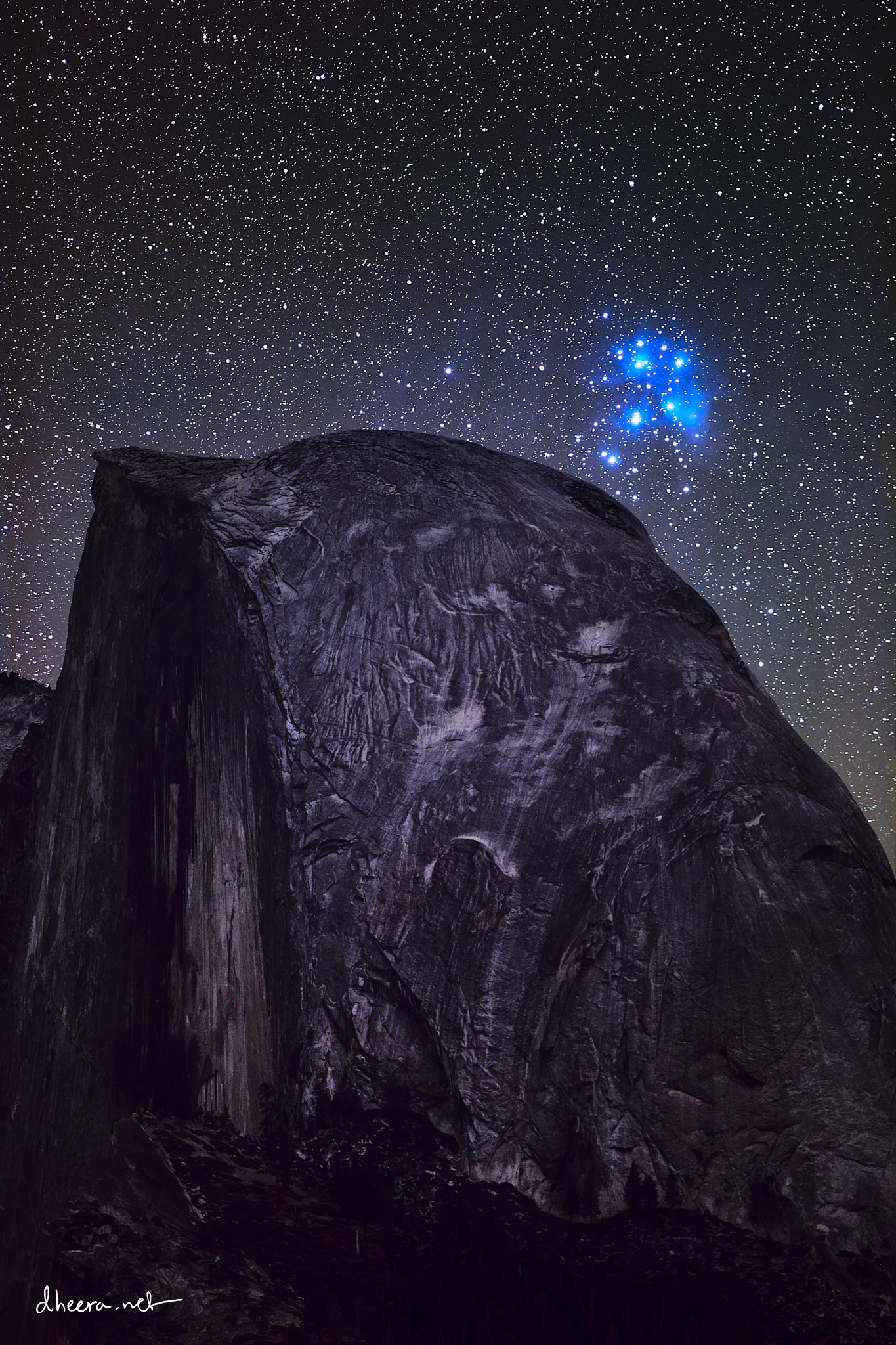
Image Credit & Copyright:
Dheera Venkatraman
Stars come in bunches. The most famous bunch of stars on the sky is the Pleiades, a bright cluster that can be easily seen with the unaided eye. The Pleiades lies only about 450 light years away, formed about 100 million years ago, and will likely last about another 250 million years. Our Sun was likely born in a star cluster, but now, being about 4.5 billion years old, its stellar birth companions have long since dispersed. The Pleiades star cluster is pictured over Half Dome, a famous rock structure in Yosemite National Park in California, USA. The featured image is a composite of 28 foreground exposures and 174 images of the stellar background, all taken from the same location and by the same camera on the same night in October 2019. After calculating the timing of a future juxtaposition of the Pleiades and Half Dome, the astrophotographer was unexpectedly rewarded by an electrical blackout, making the background sky unusually dark. Astrophysicists: Browse 3,500+ codes in the Astrophysics Source Code Library
#APOD #Cosmology #PlanetaryScience #Astroenthusiast #SpaceTechnology